
One of my favourite books on popular music is Carl Wilson’s contribution to the 33 1/3 series, a collection of deep dives into critically acclaimed albums published by Bloomsbury.
Except Wilson’s pick isn’t a critically acclaimed album at all: it’s Céline Dion’s Let’s Talk about Love, and his analysis leads to an extraordinary, and often quite personally challenging, reflection on the question of good (and bad) taste. It’s a question I think about a lot as a critic myself. We’re expected to interact with taste in all kinds of ways: not only to determine it through ratings and reviews, but to respond to it, to follow it, to question and challenge it, to unpick where it intersects with such issues as class and race.
As a child, my earliest musical tastes came from my dad, who was no stranger to the conflicting demands of taste. Born in the ‘60s, he loved prog rock as a teenager, then decided it was “uncool” and abandoned it in favour of punk, before returning to it around the time of my birth in the early ‘90s. Not many other people did the same, and while Pink Floyd’s Dark Side of the Moon still gets a high ranking on “best of” lists, the wankier, more egregiously public school music of bands like Yes and Genesis is largely seen as a historical footnote nowadays, a dead end whose influence can only be found today in obscure little corners of alt metal.
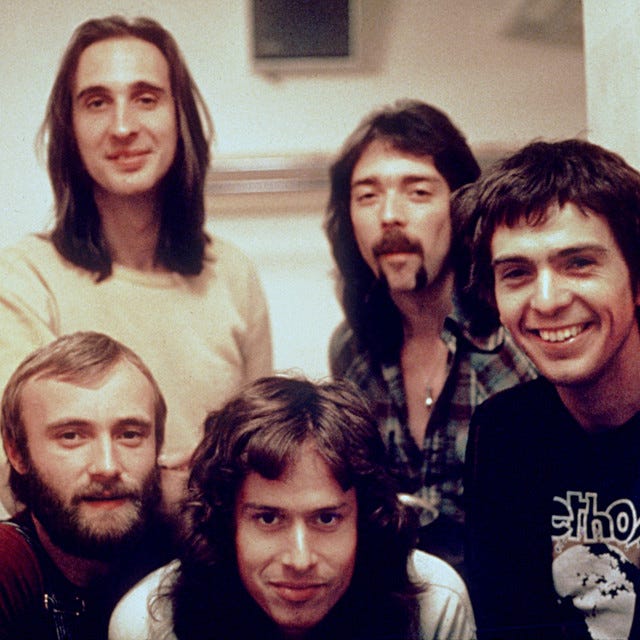
And that’s not even to mention latter-era Genesis. Led by Phil Collins, who took over frontman duties after Peter Gabriel left for a solo career in 1975, the band gradually transitioned from complex rock epics inspired by Greek mythology to synth-heavy pop tracks about TV addiction and migration controls. Songs like “Illegal Alien” aren’t just offensive to critics because of their condescending racism, to many they summed up the laziness and frivolity of the general public’s taste when it came to music, which kept Collins’ music in the charts despite (and indeed because of) its refusal to do anything interesting.
Genesis was the first band I saw live, with my dad, at their reunion tour in 2007. (The Wikipedia page for that tour still includes a picture I took when I was 13, which I’ve only just realised while researching this feature.) Even then, several of the songs had to be performed in lower keys to accommodate Collins’ declining vocal range; when my dad and I saw them again on their next tour 15 years later, the singer could barely stand, let alone play the drums.
Seeing the band that made you fall in love with music slowly fade away without much hope of a reappraisal... it’s a sad thing to witness. So, while everyone rediscovers the guilty pleasures of ‘00s nu metal and emo, I want to make a case for the band even your least cool uncle doesn’t listen to anymore.
THE LINE of BEST FIT is a completely independent and volunteer-run publication. To receive new posts and support our work, consider becoming a paid subscriber and help us create a future where music writing can thrive!
The entry point: Duke (1980)
Duke isn’t Genesis’ best album, but it’s the album that best encapsulates the band’s dual identity as the ‘70s sidled cautiously into the ‘80s. The proggy art rock of five years ago still lingers in the bombastic instrumentals and high-concept lyrics, but it’s a pop record really, buoyed by catchy melodies and Collins’ lightly soulful vocals.
That unlikely blend of genres might actually have been Genesis’ most lasting legacy: here was a band crafting synth-led art rock a year before Talk Talk formed or OMD released Architecture & Morality, and a full decade before Depeche Mode’s Violator.
Of course, it’s a sound that hadn’t fully crystallised yet, and much of Duke is a bit dated today: the weird reverb on Collins’ vocals makes it sound like he’s singing inside a hyperbaric chamber, while the fluty synth trills on “Man of Our Times” made it clear that Tony Banks had yet to update his keyboard’s custom presets. But that’s also what makes for a great deal of the album’s charm.
Duke opens with “Behind the Lines”, a track which more people now know from the solo version Collins released on Face Value a year later, and whilst that version is sparse and awkwardly funky, the full band’s recording is an in-your-face symphony of over-the-top musicianship, Mike Rutherford’s stadium guitar arcing over a furiously driving cascade of drums and Banks’ horn-like synths. It’s almost impossible to believe that there’s only three people playing on the track.
The album’s big hit was “Turn It On Again”, on one level a quirky little pop song about parasocial relationships, anchored in Collins’ well-worn technique of adopting (and ironising) the perspective of a cultural outsider. But how many top ten hits are in a 13/8 time signature? (The most obvious example that springs to mind, “Golden Brown”, is by another of my dad’s favourite bands from the ‘70s, the Stranglers. Funny how the proggers and the punks would converge on the exact same ideas.)
“Turn It On Again” lent its name to that reunion tour in 2007, and it’s little wonder why: the song, much like the album it comes from, encapsulates better than anything else the two incarnations of Genesis, and how - for a few brief years at the turn of the decade - they existed in harmony.
The high point: Selling England by the Pound (1973)
As a nerdy teenager with no friends, it was Genesis’ sprawling double LP The Lamb Lies Down on Broadway that most captured my imagination with its Wonderlandish concept and egregious mélange of styles. But it’s the album that preceded it, Selling England by the Pound, which I return to as an adult, and which stands as Genesis’ most consistently brilliant masterpiece.
Selling England lacks the uncanny darkness and sexual neuroses of The Lamb; instead, Peter Gabriel’s obsessions with kink, capitalism and mythology are tempered by the lighter humour of his bandmates, resulting in an album that’s endlessly creative and fun, even at its most musically challenging.
And musically challenging it often is. 13-year-old me sank many hours into mastering the piano intro to “Firth of Fifth”, a pastoral ten-minuter that’s all arpeggios and wacky time signatures - I’m sure that if I’d had access to a guitar at that point, I’d have learned how to play solely for the purpose of trying out Steve Hackett’s gorgeous solo in the mid-section.
“Dancing with the Moonlit Knight” is almost as long, but it’s a heavier, more ominous beast, building slowly from Gabriel’s a cappella opening the album, (“Can you tell me where my country lies?”) to an extraordinary climax in syncopated rhythm. Gabriel’s arcane lyrics about credit cards and dancing captains don’t make any more sense on the fifteenth listen, but they’re strangely evocative nonetheless - and Phil Collins’ drumming in the instrumental sections is a revelation. It’s easy to forget now just how brilliant a drummer Collins was in the ‘70s, expertly scaffolding the complex rhythmic changes that underpin so many of these songs.
Selling England also gave Genesis their first charting single with “I Know What I Like (In Your Wardrobe)” - a testament to what a weird landscape the ‘70s music charts were. A surreal, comical narrative about a gardener, it’s the high point of Genesis’ experiments with psychedelia, built around Mike Rutherford’s ambling bass line and a panoply of squelchy synths. The last minute is truly bonkers, Gabriel moving from spoken word in an unplaceable regional accent (Welsh? Somerset?) to a flute solo that’s eventually doused in ominous chords: that blend of quirky humour and darkness would define Gabriel’s last album with the band a year later, The Lamb Lies Down on Broadway.
It’s actually quite extraordinary how suffocating and nightmarish parts of The Lamb are in comparison with Selling England, and Genesis would return under Collins’ leadership to their trademark tone of off-beat whimsy. But they’d never again reach the heights of this masterpiece, which stands as Exhibit A in the case that cerebral, technically challenging rock music can also be incredibly fun.
The low point: Calling All Stations (1997)
In 1996, Phil Collins left Genesis. That really ought to have marked the end of the band; instead, remaining members Mike Rutherford and Tony Banks decided to team up with Ray Wilson from Stiltskin (you know, the band who did that song from the Levi’s advert) to make another album.
The result, Calling All Stations, is the worst album the band had made since their very uncertain debut From Genesis to Revelation, and of far less historical interest. While Revelation sounds like a bunch of teenagers trying, and usually failing, to make Piper at the Gates of Dawn, Calling All Stations sounds like a band that’s given up on trying to do much of anything at all. Wilson’s sincerity was a poor replacement for the goofiness of Collins, who had been oddly charismatic at his most embarrassing, and even the album’s best songs - the title track and “Shipwrecked”, which was a minor hit - are staid and languorous, devoid of heart.
Collins’ loss isn’t just felt in the vocals, the band ended up using a drum machine to write most of the tracks, which means not only that none of them end with any kind of purpose - the album’s entirely structured around fade-outs - but that the session drummers who recorded in the studio are essentially just imitating a computer, giving everything a by-the-numbers sound that’s a far cry from the organic dynamism of Genesis’ best work.
Gone, too, is the band’s adventurousness. While their previous album We Can’t Dance had been a pretty inconsistent affair, it had at least made a virtue of that inconsistency, interspersing upbeat pop songs (“I Can’t Dance”, “Jesus He Knows Me”) with schmaltzy ballads (“Hold On My Heart”, “Never a Time”) and proggy epics (“Fading Lights”, “Driving the Last Spike”). Calling All Stations essentially smushes these three styles together, resulting in a uniform sound that’s ponderous and unvaried, without any interesting instrumentals or changes of gear across the 70-minute runtime. A Genesis album in name only, it’s lacking everything that made the band fun and unique.
The trio called it quits three years later, and Calling All Stations now stands as a strange, awkward bookend for a band who’d gone from nerdy prog pioneers in the ‘70s, to art rock superstars in the ‘80s, to the butt of a joke about bad taste in Bret Easton Ellis’ 1991 novel American Psycho. If murderous stockbroker Patrick Bateman showed his lack of humanity by preferring Phil Collins to Peter Gabriel, what might he have made of Ray Wilson?
Tom Kingsley is a music journalist and life model from Manchester.
THE LINE of BEST FIT is a completely independent and volunteer-run publication. To receive new posts and support our work, consider becoming a paid subscriber and help us create a future where music writing can thrive!
Comments
Nothing yet. Say the first thing.
Sign in to join the conversation.