
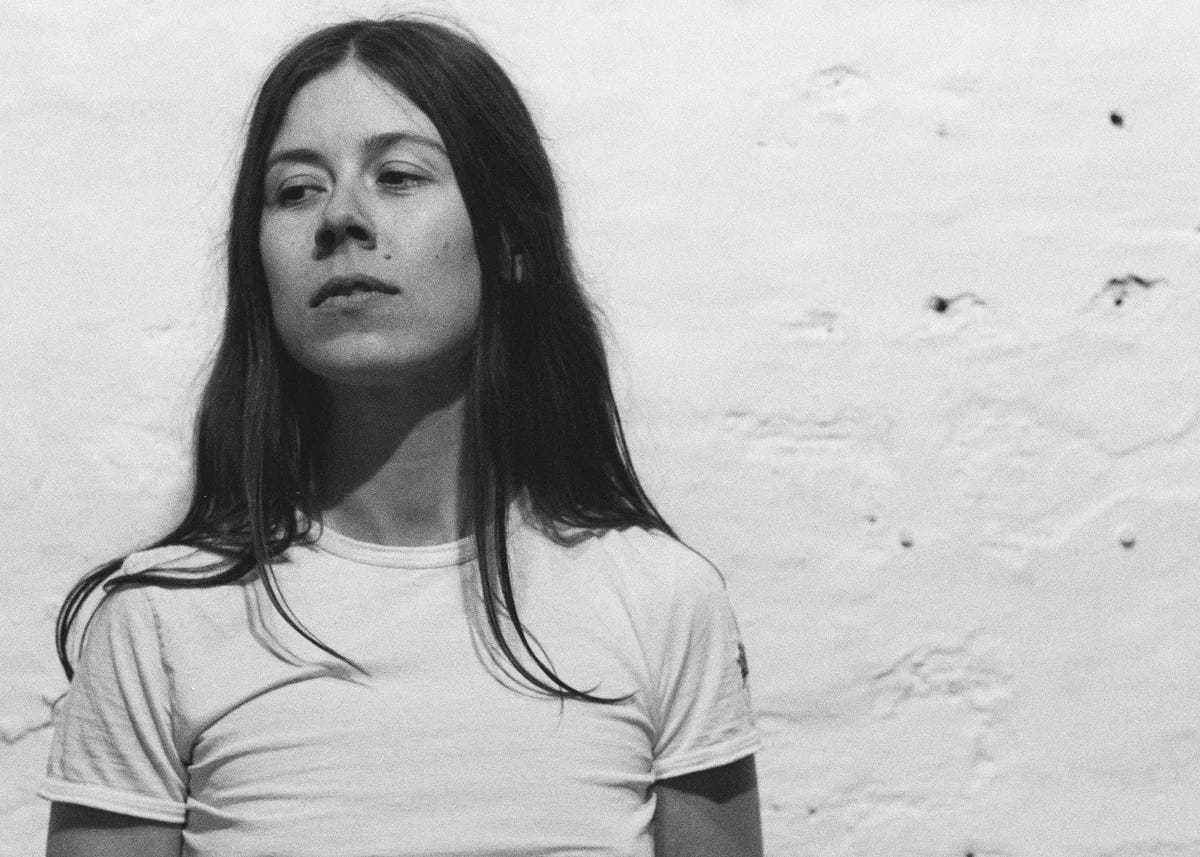
There’s so much that Brighton-based singer/songwriter and New Eves member Nina Winder-Line cannot say in words. “Street Hassle”, the jangly and expressive opener to her debut solo album Wild Love, knows this to be true. “Give me an electric guitar and I’ll play it / I can’t say it,” Winder-Lind’s trademark trembling and forceful vocal explains during the climax. It’s a manifesto for the album at large – dedicated to the idea that rock’n’roll and the electric guitar have always had a liberating force and innate ability to express our rawest feelings. Now it’s Winder-Lind’s turn to liberate those thoughts.
“Urgency is the word,” Winder-Lind explains from a remote-looking shed in the Swedish countryside where she’s currently visiting home in Sweden having now become a full-fledged Brighton resident with her husband Hugo. A neat coincidence considering how important these two locations are to Wild Love and the Nina Winder-Lind creative process.
Brighton started as a four-month plan to do a language course on the English coast in the aftermath of a “really toxic and horrible” classical musical college in Stockholm, but turned into a vortex of music and creativity. “I brought my cello and I found people. I got to improvise and jam for the first time. I’d never done that,” Winder-Lind says of those early Brighton memories, learning that it was okay to play things that no one had written down. Such was the whirlpool of the scene that Winder-Lind stayed: “I got sucked into the music scene and the people there.”
Those people include Winder-Lind’s bandmates in The New Eves, the ‘Hagstone rock’ four-piece whose breakout debut The New Eve Is Rising was released last year. It may seem odd to re-debut so soon with solo material but the process was natural and parallel to the band’s work. As Winder-Lind describes it: “a different channel to let things out into” – another “pot of songs” to The New Eves that acted as a creative necessity.
What started as Winder-Lind just wanting her solo music on Bandcamp quickly and frenetically changed during production. The EP, as it was conceived first, was a self-funded venture on a tight deadline of three days with Winder-Lind working with the “very Bristolian” producer Jack Ogborne beneath the iconic Bristol venue The Louisiana, which has a studio in its basement. Five songs made it. When The New Eves’ label Transgressive Records heard the result of this frenzy, Winder-Lind found the extra support and excitement needed to scale the project’s ambition and very suddenly Wild Love had snowballed into life in brilliant ways, almost without Winder-Lind’s knowing. “I didn’t think about it as something that would be successful,” she says. “It was more like, I just want to release the music because I’m exploding.” It’s this being on the edge of explosion, of urgency and necessity even at the point of recording, that best represents Winder-Lind’s solo artistic thesis.
“Urgency is the word – these songs, almost all of them, have come from a really intense place,” Winder-Lind explains. It’s from this place that you get the electric spiralling of “Headfirst”, its energy supercharged with the essence of classic rock, or the jaunty, folk-pop warmth of “This Is Our Life”, which bursts into a sprawling crescendo. For Winder-Lind, the sound of urgency is manifested with the intense and beautiful sounds of electric guitars, folk riffs, delicate flute melodies, and crashing drums – an album of cathartic, radiant, and alive music with all the energy of Winder-Lind’s emotions being exorcised at the core of each track. It makes for exciting and potent songwriting fuel. “I think I write best from very strong emotions… and that is very personal and very vulnerable,” she says.
Harry Edmundson
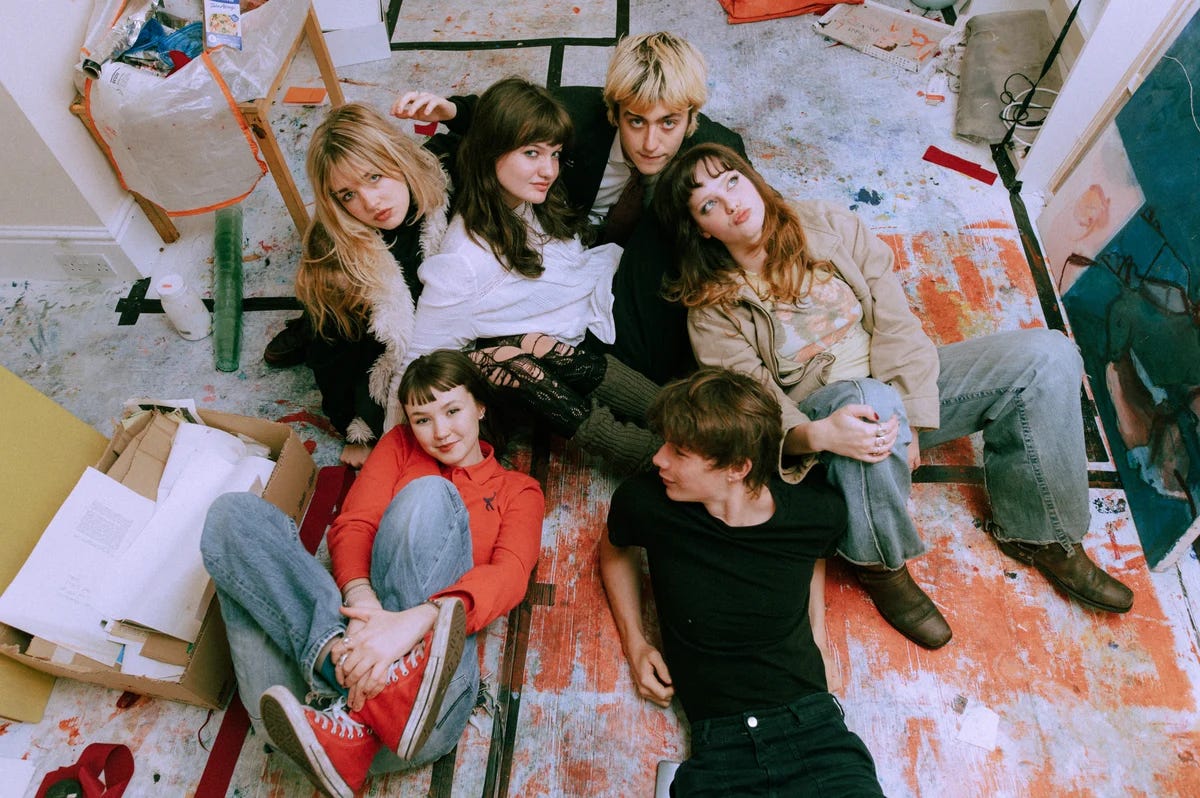
Leading the week’s best releases, Man/Woman/Chainsaw [above] turn in one of the year’s most exciting debuts as the Fiction-signed London six-piece deliver Cannonball. Colombian electronic musician Ela Minus and Brooklyn-based producer – longtime friends who have circled around each other with remixes and guest appearances up until now –finally deliver a proper collaboration with the pristine three track EP qué les pasó a mis amigos?. Effe’s solder EP recalls early BANKS and London Grammer and delivers a brilliant shot of heart-stopping throwback bedroom-pop throwback from the Aussie, while her fellow Antipodean Hanna Stretton’s second album tiarn is a perfect meshing of dream-folk collages within an expansive sonic universe. Japanese trio maya ongaku’s Nothing Space Music channels 1960s and 1970s experimental rock, folk and psychedelia into an immersive and fluid listen, and finally there’s the wonderful Nebular, a dreamy collab netween New Zealand-based guitarist Roy Montgomery and our very own Martha Skye Murphy.
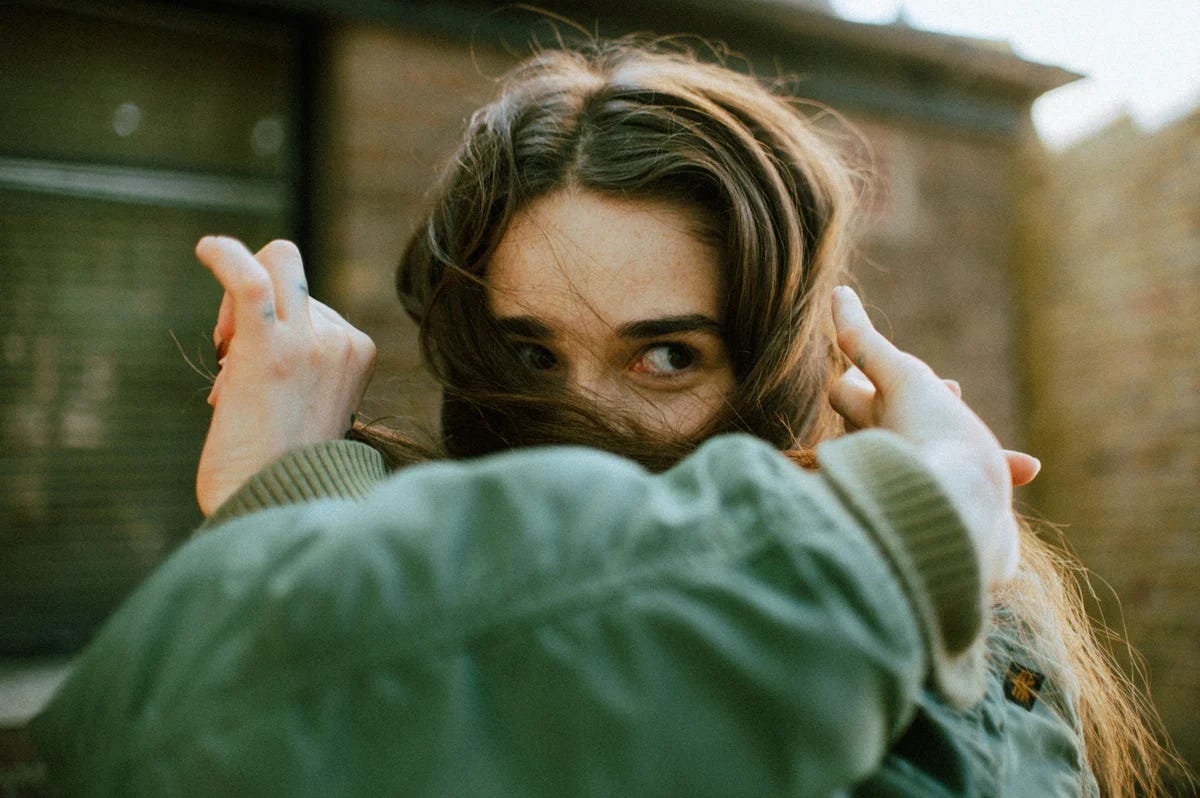
Yasmina Derradj’s second album as Zoumer – e.a.l. (euro arab lovergirl) – impelled her to walk people through her identities, as she does on its near-eponymous mission statement “euro trash girl”. Atop a confidently strutting beat, Derradj maps her whereabouts from Algiers to Copenhagen in a freestyle embracing her nuance: “I am a different girl, I got mixed up genes, I got Arab attitude.” The song was stylistically and attitudinally inspired by Chicks on Speed’s cover of Cracker’s 1994 song of the same name with Zoumer recasting the postmodern, self-aware, ironic character, reclaiming her through a diasporic perspective, approaching the character euro trash girl as a euro-arab, non-smoking, cat loving Gen Z.
The floaty, lustrous dream-pop of Copenhagen collides with hypnotic oud and qanun rhythms of Algeria as Derradj seamlessly embodies the album title from beginning to end, as if her paths converge: “Yeah she is walking around, in some real nice clothes,” later expressing, “I’m a lovergirl, I’m waiting for the right gem.” Derradj feels herself as all those things and more. “The ‘euro trash girl’ is a character I’ve heard about for such a long time,” she tells me, “but then I was thinking, ‘Who is she?’ I wanted to give her a scene.”
Derradj is based in Copenhagen, a fact gatherable from “euro trash girl”’s comical and hopefully fictitious explanation of her father, an Algerian prince, who was busted for drugs in Paris and settled in Denmark’s capital – but Derradj did in fact grow up on Amager, the largest island in the Øresund and also home to Christiana. Carrying a diasporic identity, naturally, that’s seeped into her music – e.a.l. (euro arab lovergirl) sits in the intersection of Copenhagen’s cool alt-pop and Middle Eastern and North African instrumentation, with accompanying field recordings across Copenhagen, London, Paris, and Algiers. It’s a record of contradictions existing between disparate places, cultures, and ways of viewing the world, but that combination gave strength to Derradj’s own identity.
A breakup spurred Derradj’s need to reconnect with her roots. “There can be many different reasons for why you have to connect with yourself,” she says, soon eagerly offering deeper reflection. “When I grew up, there were many times – which, when I look back at it, it’s super weird and I’m embarrassed by – where I wished I was completely Danish, or completely Algerian. Which is weird because you’re not just one of those things.” The “euro arab lovergirl” she repeatedly circles back to serves to name that in-between experience of living in diaspora. “The ‘lovergirl’ aspect was this idea of sides of myself that I wanted to embrace,” Derradj explains about the latter. “I feel we all have those sides – being open and curious about music, nature, and the people around us.”
To ascribe a tangible meaning to the phrase, it’s a guiding light for Derradj, used to banish the shadowy cloud of doubt of embracing her dual identity as one. It’s not in stasis, either: “That’s why I shortened it down to ‘e.a.l.’. People can be like, ‘I only relate to lovergirl, or arab lovergirl, or just lover,’ something like that where they can make their own character.”
The record’s existence catalysed multiple other changes – having more fun with music than on her 2024 debut Green World, and finally overcoming the separation of her identities. “I think it’s embarrassing in my mid-twenties to finally get there,” Derradj admits with a laugh, “But when I look in the mirror now, I’m like, ‘This is who I am. I’m this layered person.’ That’s awesome when you think about it – that you can make something that can help you get to somewhere else. It’s like, music did talk to me!” Her fans have corroborated this: “I had a half-Norwegian, half-Syrian girl who was texting me, writing an extended greeting sharing their background. It was so cute. Someone also said, ‘Greetings from a fellow Euro-Algerian.’ It was really cool.”
Dom Lepore

I grew up listening to rock music. I’ve always loved finding new music, I’ve loved listening to music, and it was very rock-focused. I saw electronic-based music as being this other world that I didn’t really understand.
Then I started a rock band, and sometimes people would mention these minimal electronic producers that were treading on similar grounds, arrangement-wise or composition-wise. And I understood what they were talking about, but it’s just been this really rock-oriented world.
When Aphex Twin’s Syro came out - I can’t remember what year it was, but it was when the band already existed - I listened to it constantly. But it was the first time I really saw that I had seen this false dichotomy of rock music as this warm and human thing, and electronic music as this cold techno, technological thing.
“minipops 67 [120.2][source field mix]”, the first track on Syro, is the most human music I’ve ever heard. It’s so playful and organic, and it deconstructs music at such a more granular level. I think that my attraction to this German psychedelic music, krautrock stuff, comes from having loved the idea of deconstructing music form, but this is at a level where he’s just ripping apart sound waves to create new sounds.
And there’s a human voice on it, and it’s so bizarre, but it’s so fun and playful. And, to me, it feels very irreverent of musical history, but it feels like it comes from such a deep love of music that it sometimes makes me really emotional to listen to it.
It’s somebody who just loves music and loves making music so much, and can have fun making it in such a nuanced way. Every measure of the drumbeat, there’s something new. And with every evolution of the way a sound is constructed, it’s constantly falling apart and then turning into something new.
It completely changed the way that I thought about what music was, really. I had a much more rigid idea of what music could be made from. I was so late to the party with electronic music in general, but this record was a gateway for me that led to this five-year-long journey that I’ve been on, trying to understand what electronic music is and what music can be.
To me, in rock music, production is the last step. You have the song, and it feels like the icing on the cake. I always thought of it as being something really boring and technical, which it is in a sense, but production is somebody else’s job. We just write songs, and then the producer comes in. It’s this really boomer idea. But hearing that production can be this completely organic, playful composition tool is really cool. And you can hear it happening constantly over the course of the song.
The song, in a sense, is simple, but the production decisions, the sophistication of the rhythms, the textures, and the melodies that evolve and come in and out, are production and composition going hand in hand, which was a new idea to me. I think when music is your job, you can forget it is supposed to be fun. And it’s really cool to listen to somebody having fun making music.
You hear [the lyrics] differently all the time, but to me, it feels like mumbling of some kind. It feels really casual and low-stakes. And when we’re talking about sampling, I feel some producers look for the perfect thing to sample, but there’s a sample of his voice, or, I don’t know what it is, that feels all fucked up. And there are samples on that record that feel as though he walked into a random public space, just hit record on a tape recorder for five seconds, and took random sounds of whatever it was. And he built a song around it.
It feels fun to not be precious about the sounds that you’re making music from. I was watching this session breakdown with Jane Remover, who’s a producer in the US that I love. There are all of these sounds, and someone asks, ‘Oh, why do you pick these sounds?’ And they’re like, ’I literally just searched my computer for sound files.’
They had a video game on the computer that came with sounds as part of the game, and they showed up in the search window as sounds on their computer. So then they just dragged them in and used them. And I think it’s really a fun idea to just use whatever’s in front of you.
DIIV’s new record ZIRP! produced by A.G. Cook is released on 30 October
34 years ago, a bored 17-year old thrash-metal fan from Loughborugh became an unlikely hero of the music world. Mulleted Midlands lad Chris Needham saw an advert in the TV Times appealing for teenagers to document their lives on video and the result was c, a 50-minute cross between High Fidelity, Spinal Tap, Wayne’s World and the lives of any pre-Internet age music fan who dreamed of forming a band (in this case the beautifully named Manslaugter) to cope with smalltown monotony.
Airing on BBC2, the film led to Needham’s cocky bedroom edgelording – riling against “old bastards”, Neighbours, vegetarians, religion and “chart music” – quickly became schoolyard legend among teenage music fans. The film is a wonderful reminder of how wonderful television was before reality content became a genre; watch the whole thing above.

Dropping at midnight every Thursday, follow our playlist for a taste of the best new music from the most exciting breaking artists. Leading the selection this week are new tracks from Lonnie Gunn, Helena Gao, Sesame Girl, legobygger123, Hockitay, and coverstar Blood Lotus.
“Your fannish obsession is your beard. If you know absolutely all the trivia about your cubbyhole of pop culture, it saves you fror having to know anything about anything else. That’s why it’s excruciatingly boring to talk to such people: They’re always asking you questions they know the answer to.” – Roger Ebert
No posts
Comments
Nothing yet. Say the first thing.
Sign in to join the conversation.