
We’re approaching the 250th birthday of the U.S., and it’s a good idea to thumb through the ideas that have seeded the ongoing oppression Americans live under today. For this piece, I asked what ideas have truly upheld our biggest policy obstacles as human flourishing advocates that are getting funded today. Turns out, all the droppings of disinformation we’re cleaning up as social good professionals came from mutants bred in wealth-hoarding idea labs of white supremacist patriarchs, nurtured with radioactive poison over time. (Stick around ‘til the end for the dollar signs.)
From the outposts I’ve occupied through both professional and lived experiences as a Black woman strategizing for liberation across the American South, here’s a list of the 5 division narratives that keep us scrambling in this fight, along with some antidotes to use in your conversations and campaigns.
Division Narrative #5: Public schools are failing, and families need to flee to private and charter schools.
I’ve written about public education as liberation over on The Expectations Project blog recently, but what needs to be stated here explicitly is that this is a narrative that can be easily debunked. This resource from Public Schools First NC does a great job of that. Attacking public education is critical to destabilizing a democracy trying to serve a diverse population.
Counter with this: It’s absolutely true that historic disinvestment and school funding inequities have perpetuated injustice in public education, but public schools are a cornerstone of a thriving society and a shared responsibility that strengthens entire communities. When we invest in public schools as public goods that should serve everyone equally, every child thrives, and everyone benefits.
Division Narrative #4: Average people are voting against their best interests.
There’s nuance with this one, so let’s unpack it all. First, it’s important to note that “average people” don’t really exist. There is a vast, diverse landscape of individuals and communities in this nation who are constantly being disinformed or completely cut off from information altogether. Second, this narrative is divisive fuel because it creates “others” who can be associated with deep poverty, are unworthy of their right to vote, and ultimately can be viewed as not worth helping in any way. This narrative is baked into the South with a wide array of stereotypes that are designed to make people want to side against the very concept of democracy. After all, who wants to share rights with “those” people?
Counter with this: People’s interests are complex and interconnected, and when we ask people directly (not through billionaire-owned media), they overwhelmingly agree on what matters: safety, dignity, opportunity for their families, and a livable world.
Division Narrative #3: People are apathetic, and that’s why there’s low voter turnout.
This narrative is crucial for people who want to be able to make decisions without seeking any form of consensus. After all, if people are “apathetic,” who cares what happens to them, anyway?
Again, there is data as medicine here. Aside from this concept being deeply biased against people in poverty, it’s also untrue. As I mentioned in my last post, there are 109 policy proposals for those building big tents, and to show that consensus can and does exist.
Counter with this: The system has been sabotaged to make us feel powerless, but when we organize around issues that people care about, voters feel heard and empowered to use their vote to make a difference.
“Sabotaged” is an important word here because of how true that is. A true expression of democracy has been sabotaged at every turn, and naming that returns power to the people who have put their lives on the line for the right to engage in it.
Division Narrative #2: Taxes are oppressive to rich people, and the government can’t be trusted with resources.
Even though it isn’t something the masses are contending with directly, we’re getting spoonfed these ideas to gin up support for those who’ve “made it,” which is something we all hope to do one day. This one is really hurting people of color who are trying to climb out of instability and into generational wealth. After all, who wants the earnings from their business “taken away” before it has the chance to benefit their family?
The underbelly here started out far more insidiously and is rooted in slave-holding. If a person’s taxes can go to help people they don’t think are people (because they’re poor, a person of color, etc.), to begin with, that’s a violation of individual expression. For the liberal side, this is the same concept that fuels the philanthropy industry: wealthy people should be able to choose which people and which causes get their resources. In taxing them and distributing wealth, they are the ones being oppressed (and so is everyone…because one day…we will have our massive fortunes ripped away from us).
Counter with this: Democratic taxation is how we collectively decide to care for each other, and it’s the antidote to a select few gatekeeping who gets to flourish. Public goods funded collectively create opportunities that benefit everyone. Yes, even including the wealthy. A thriving public sphere lifts all of us.
Division Narrative #1: A multi-racial society can’t exist without one group dominating another.
In the data-backed trainings from the Racial Equity Institute, which I highly recommend, the narrative through-lines around colonialism show the importance of ideas to the construction of race and the limitation of imagination. This one is the final boss because, from the foundation of race, all of the other narratives around class and gender are activated. Many are dealing with limited attention spans and aren’t provided enough time or word count to delve into the Reconstruction Era or Northern Ireland after 1998 for our audiences. We also do not have mass, convenient access to observing a working model (yet) to say, See? We can do it, too! But this narrative can still be dismantled.
When stated explicitly, it sounds anti-human. Even without case studies or other forms of data, if you just stop to think for just a moment, a person might ask, Well, how do we really know that’s true? Has anyone ever tried before? This is also where an opportunity-cost strategy can be effective in opening imaginations to what’s possible.
Counter with this: What we’re doing now right now isn’t working, but when we come together, it is possible to design systems that do. For ourselves, future generations, and the planet, we have to make our democracy work for everyone, with no one left behind.
You might be wondering how one could get to a Buzzfeed-style top 5 listicle of oppression narratives. Glad you asked! Required reading, Democracy in Chains, provides a helpful framework for identifying which ideas throughout the decades rose to prominence and have become fixtures today in subverting pluralistic democracy. That’s how I got to numbers 1–4, by pinpointing and summarizing Nancy MacLean’s findings based on my experience in narrative change work. From there, I added number 5, a centuries-old outright lie that has become fuel for gutting public education–a cornerstone of our democracy–and other public goods.
As a treat for those of you who stayed to the end, here is the proof that that division is expensive and that these narratives need serious cash to move:
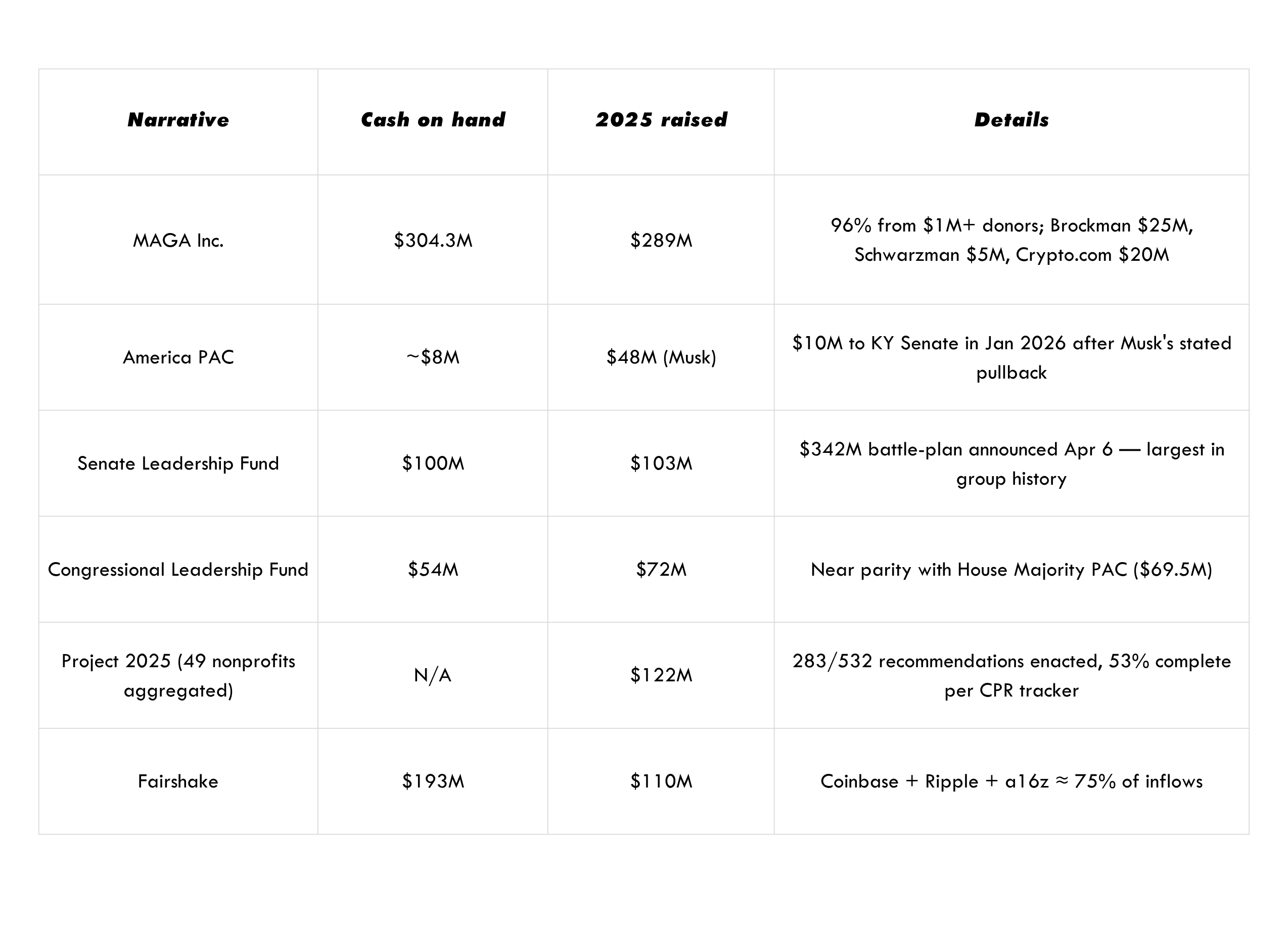
That’s a lot of money, and it would absolutely be better spent on collective thriving. But you know what? Division is expensive because liberation is powerful. Now you know what to say.
Which of these five shows up most in your work, and what counter have you actually tested? Drop it below; I'll compile the best ones. 👇🏾
How I Got The Numbers
I ran a prompt in Claude that pulls in all the public sources of campaign data. You can do it, too!
Here’s the prompt:
Create a live monitoring dashboard that tracks billionaire-backed narratives in real time, including Project 2025, MAGA Inc., America PAC, the Senate Leadership Fund, the Congressional Leadership Fund, and major philanthropy or crypto narratives. Pull in new donations, major announcements, and media spikes, show a trendline for each narrative, and add alerting when funding, mentions, or organizational activity crosses a threshold.
Sources:
FEC OpenFEC API — api.open.fec.gov. Committee totals (cash on hand, cycle receipts) and Schedule A itemized receipts (individual donations). Free, requires a key from api.data.gov.
GDELT 2.0 DOC API — api.gdeltproject.org. Worldwide news mention volume across broadcast, print, and online media. Free, no key.
Baseline figures used in the seeded demo dashboard (the first artifact, before we wired up the worker):
Brennan Center for Justice — MAGA Inc. megadonor analysis (96% from $1M+ donors, 62% from $5M+).
OpenSecrets — historical PAC totals, donor breakdowns, cycle summaries. URLs like opensecrets.org/political-action-committees-pacs/C00504530/...
Wikipedia / Wikidata — Make America Great Again Inc., Congressional Leadership Fund, MAGA Inc. committee ID confirmation.
CNN — SLF $342M battle-plan announcement (Apr 6 2026).
NPR — Republican vs Democratic super PAC cash-on-hand comparison.
NBC News — Musk / America PAC spending coverage.
The Hill — CLF fundraising and House race reporting.
Axios — MAGA Inc. donor activity.
CNBC — Schwarzman, Brockman, and other megadonor stories.
Forbes — Brockman $25M to MAGA PAC reporting.
Politico — pro-Trump super PAC ad spend.
The New York Times — pay-for-access reporting on MAGA Inc.; Timothy Mellon donations.
Notus — 2025 MAGA Inc. total ($289M raised).
Center for Progressive Reform (CPR) — Project 2025 implementation tracker (283 of 532 recommendations, 53% as of Feb 2026).
Campaign Legal Center — Coinbase/Fairshake federal contractor complaint, Herrera Velutini straw donor allegations.
Citizen.org — Coinbase FEC complaint PDF (Fairshake committee ID confirmation).
Influence Watch — MAGA Inc. organizational profile.
PBS NewsHour — MAGA Inc. founding coverage.
FactCheck.org — MAGA Inc. structure and operations.
19thnews.org — 2026 cycle Democratic candidate fundraising context.
FEC committee pages (for ID verification):
MAGA Inc. — fec.gov/data/committee/C00825851/
America PAC — fec.gov/data/committee/C00867083/ (verify before deploy)
Senate Leadership Fund — fec.gov/data/committee/C00571703/
Congressional Leadership Fund — fec.gov/data/committee/C00504530/
Fairshake — fec.gov/data/committee/C00835959/
Lauren is a liberation communications strategist and the founder of Bound for Good, a Research Triangle–rooted practice serving organizations in housing, education, and economic justice. Learn more.
No posts
Comments
Nothing yet. Say the first thing.
Sign in to join the conversation.