
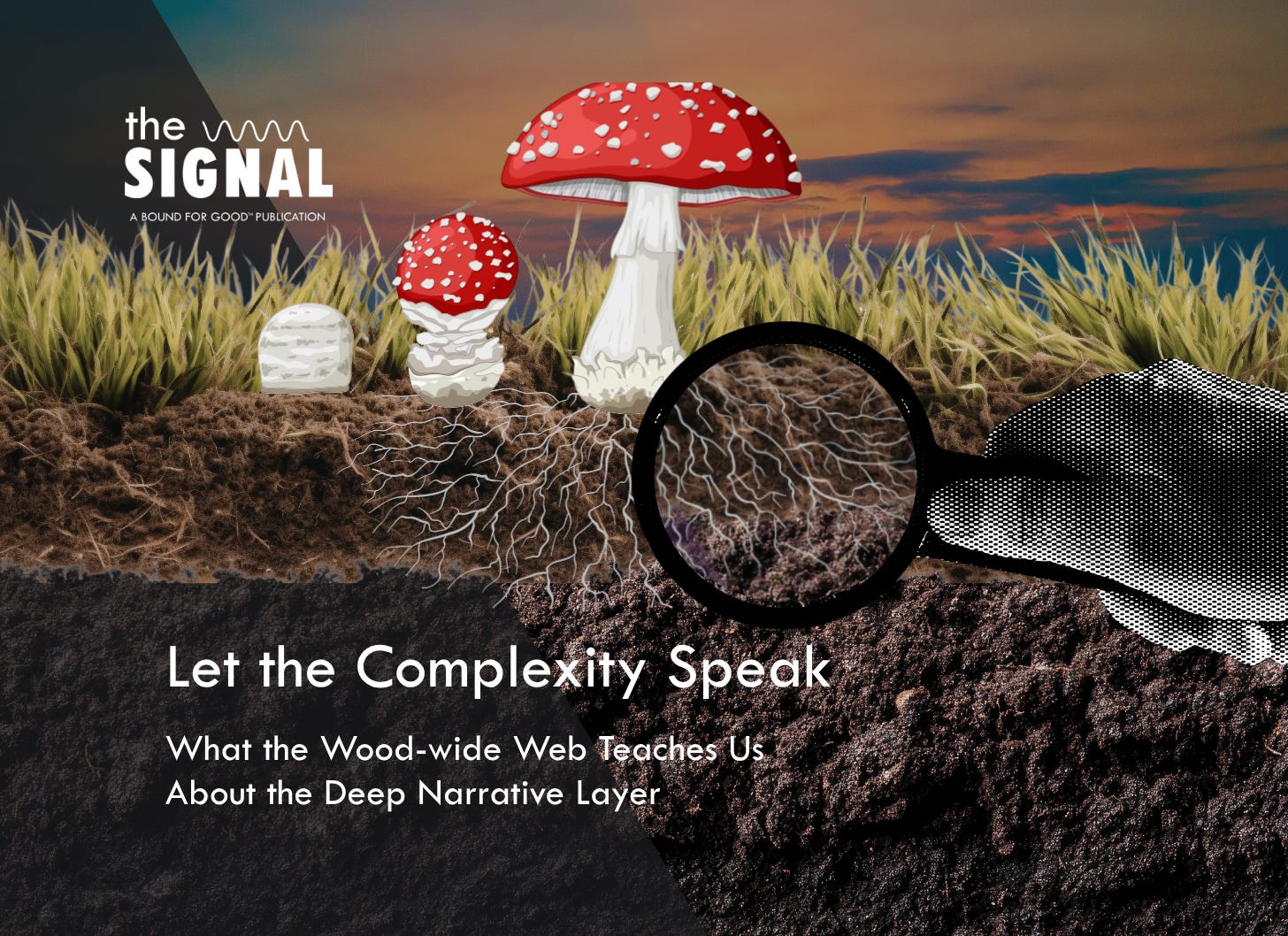
If you and I are meeting for the first time for coffee to talk about any single subject, it will take approximately 34 minutes to bring up the wonder that is mycelium. It’s usually because I’m talking about building narrative power for liberation, and conceptually, mycelium is a perfect metaphor for how that’s done. On the flip side, the current narrative about mycelium is a metaphor for what happens when people get too excited about an untested concept and run with it before science has had the chance to verify the claims fully.
Mycelium is the underground threadlike body of fungus that connects to the roots of plant life, and it is also known as the “Wood Wide Web” because plants may send each other communications (and nutrients) through the hairlike fibers. If you’ve never heard of this, it’s a rabbit hole 100% worth going down. People inside and outside of scientific circles have tried to institutionalize the natural phenomenon because it’s a really beautiful idea: nature has it figured out if only humans would evolve to listen. Everyone from corporations to the spiritual community has made this idea gospel over the past decade (and in some cases it’s become a religion). But there’s a real issue with flattening the science to metaphor.
The idea that plantlife has a comms network is great news for people who like building systems after models. In this metaphor, there’s an entire layer of strategy to build and activate, one where organizations can show there is real potential for powerful collaboration in the connectedness of causes to the overall well-being of society. I personally latched on to this hard because in my experience, nonprofits often do not acknowledge the base layer. (This free resource from Race Forward helps.)
Deep narratives → Narratives → Stories → Messages
Organizations are often too preoccupied with urgent matters like fundraising and the daily fire drills of rapid response to invest in something people may never see, like the deeply held beliefs of constituents or the ‘-isms that are driving decision-making. How one messaging issue impacts another gets pushed down in priority, and sharing between orgs gets risky in the perception of scarce resources. This glossing over the hard part produces a vicious cycle. Without going to the narrative level, campaigns fall flat. Feedback loops don’t get built, which is how we refine the message. And perhaps the most devastating of all, the powerful stories of individuals and communities never get told from their context, which is where the magic of transformation happens.
We've done what we do to things we like but don't fully understand: make a romance.
Back to the question of metaphor. The truth is mycelium dynamics are now a bitter fight between scientists, so we’ve done what we do to things we like but don’t fully understand: make a romance. Some scientists are arguing that the sharing isn’t actually sharing–it’s the fungi acting in its own best interest, and it just looks like it’s sharing. Others say that positive citation bias has overblown the whole idea. We want our work to outlive us, and we want a harmonious society where everyone has what they need. We want this to get easier. Enter: an enchanting concept of nature weaving magic beneath our feet. Boom! The TEDx talk writes itself. But in the haste to resolve the tension, the metaphor becomes even more apt. The strategic layer is not where we go to make everything tidy so the top layer is buttoned up better, and we look so much smarter. The strategic layer is where we wrestle with the complexity, including what’s been said in the past that people have run with that wasn’t true or understood yet. It’s also the container we build for honesty and accountability.
Practically, going to the deep narrative layer can be simple. Before your next campaign planning meeting, name the one belief your audience holds that your message quietly depends on. Write it down. Then ask whether your campaign strengthens that belief or contradicts it. That single question is the difference between messaging and narrative strategy.
What we want most from the mycelium metaphor is the recognition that our well-being is bound together and that we do, in fact, rely on one another. But nature does not make that an inevitable reality for humans. It’s only true if we decide it and commit to all of us thriving, with none of us left behind. Then, we put in the resources and navigate the complexity that making it true demands. That’s the muscle we have to build, and it’s how we stay the course toward liberation and collective thriving.
What's a metaphor you or your organization leans on that might be doing more romancing than teaching? I want to hear it in the comments. 👇🏾
Lauren is a liberation communications strategist and the founder of Bound for Good, a Research Triangle–rooted practice serving organizations in housing, education, and economic justice. Learn more.
No posts
Comments
Nothing yet. Say the first thing.
Sign in to join the conversation.