
On March 5, Jaime and I celebrated fourteen years together. Not just fourteen years—but six homes, two countries, a half dozen jobs, a string of beginnings and endings—and now, the quiet, almost disbelieving countdown toward becoming three.
So we decided to take one last trip that would belong only to us.
We pieced together airline miles collected over years and hotel points Jaime had saved from dozens of work trips, and booked a week in Argentina—a babymoon, as we had learned to call it.
“Let’s try and do something,” I said to Jaime the day we landed, the humid air of Buenos Aires clinging softly to our skin.
“What’s that?”
“We’ve spent the past two years thinking about nothing but parenthood. Let’s take these few days to not talk about Jaidan. Let’s just have this moment for us.”
“Deal,” Jaime said.
We spent our first days getting lost in Buenos Aires—wandering the uneven, pebbled streets of Palermo, ducking into narrow shops that smelled of leather and paper, eating steak sandwiches in Recoleta, the juices running down our wrists. We walked along Puerto Madero, the river a dull sheet of silver under low clouds, and searched for the perfect choripán in the crowded, restless streets of San Telmo.
We had coffee at El Ateneo, a grand theater turned bookstore where velvet balconies loomed above shelves of books, the air thick with espresso and old pages. At night, we found ourselves at Peuteo, a dimly lit queer bar, music vibrating through the floor, laughter spilling into the street.
For a few days, we felt like teenage boyfriends again—laughing too loudly, brushing against each other for no reason, delighted by things that would normally pass unnoticed. It rained constantly, a fine, stubborn drizzle that glossed the sidewalks and blurred the city lights. We didn’t mind. Nothing could have bothered us.
From there, we flew to Luján de Cuyo, in Mendoza’s wine country. We rented a small cabin on a vineyard and settled into a slower rhythm. Late March marked the beginning of fall—the vines stretched endlessly in rows of gold and amber, their leaves dry, whispering against one another in the breeze. Grapes hung heavy and dark, some vines already stripped bare from the harvest.
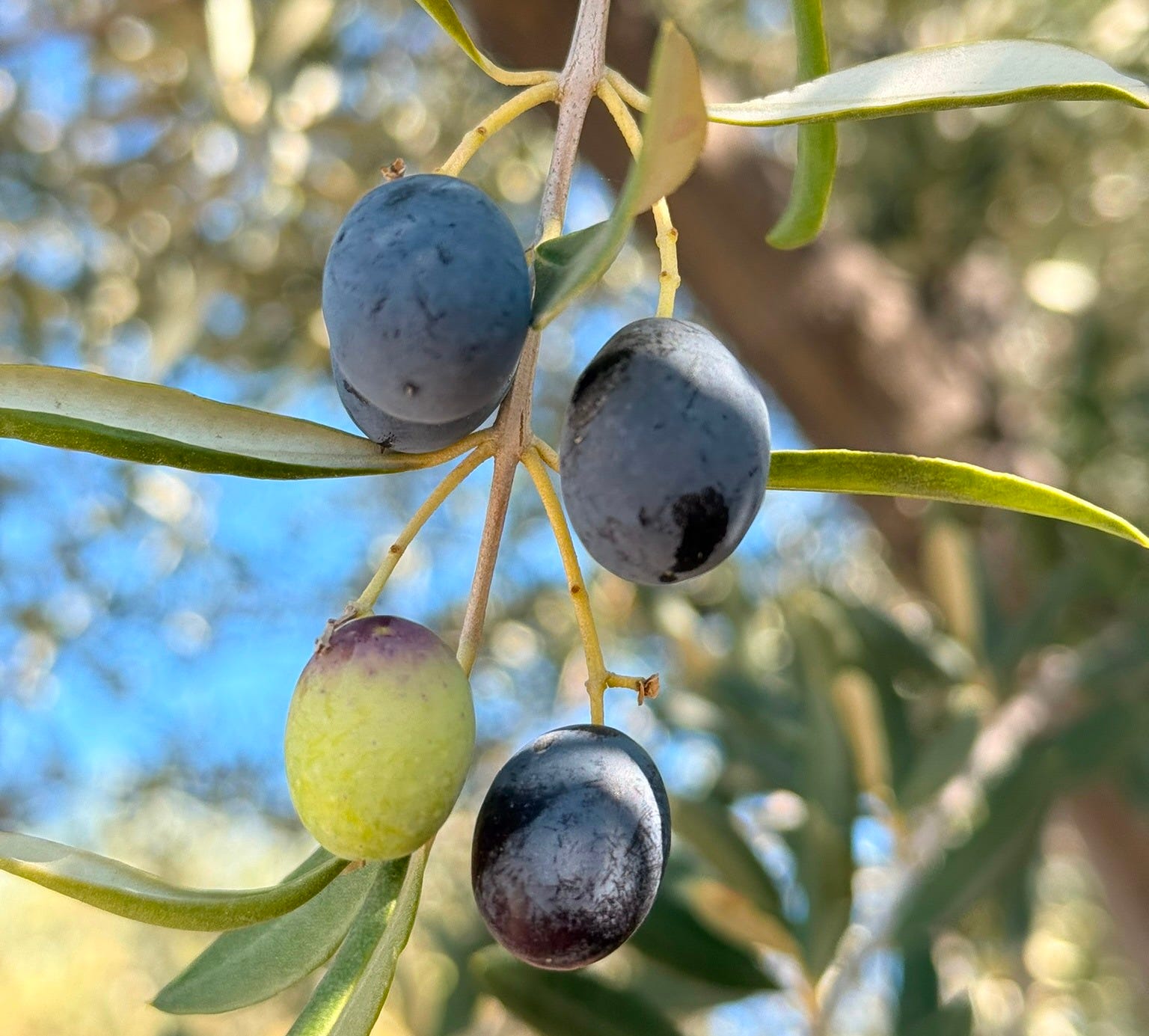
At the edge of the property, beyond the ordered rows of vines, a small stand of olive trees grew wild and slightly apart. Their trunks were twisted, thick with age, their leaves a muted green that flashed silver when the wind moved through them. They didn’t have the symmetry of the vineyard, or its careful tending. They looked like they had endured more—heat, storms, time—and simply kept going.
Every time we drove past them, one of us would glance over. Sometimes we’d point them out again, as if the other hadn’t already seen them. They kept catching our attention in a way neither of us tried to explain.
We lingered over long lunches at local wineries, the scent of earth and oak barrels hanging in the air. Bread arrived warm, with shallow dishes of olive oil—green and peppery, almost sharp—and we dipped absentmindedly, letting conversation stretch and wander. We drank entire bottles of Malbec, a slow warmth spreading through our chests, softening everything. We bought a few to bring home, as if we could bottle those days—something of that version of us—and return to it later.
On our last night, we sat down for dinner by the Río de la Plata, its surface barely moving in the fading light.
“I don’t think I want to have steak for the next six months,” I said, pushing my plate away with a smile.
“No kidding,” Jaime laughed. “If we had our physicals next week, our cholesterol would be off the charts.”
“It will have been worth it.”
“Oh, completely worth it,” he said. Then he paused, looking at me—really looking.
“We didn’t keep our promise,” he said.
“Yeah,” I admitted. “I know.”
“It’s hard not to think about who we’re about to become.”
He reached for my hand, his thumb tracing small, absent circles against my skin.
“But I noticed something,” he continued.
He took a slow sip of wine, the last deep red catching the light.
“We talked about our future differently. Not with anxiety. Not like a checklist of everything that could still go wrong. Just… with joy. About the family we’re about to have.”
I smiled. He was right.
“We’ve been through so much these past few years,” I said. “So many steps. So many what-ifs. So many moments where we didn’t know if things would go our way. Four years of holding our breath—living appointment to appointment, call to call—waiting for the next piece of news that could change everything.”
I paused.
“Four years of bracing. Never fully exhaling. Never quite letting ourselves believe we had made it through one stage before the next uncertainty arrived.”
Jaime squeezed my hand.
“I think we got used to that rhythm,” I went on. “Preparing for impact. Scanning for what could still go wrong. Instead of stopping to recognize what we’ve already done. What we’ve already built.”
I thought, briefly, of those trees at the edge of the vineyard—how they had grown without permission, without symmetry, shaped more by endurance than design. Olive trees—there’s just something to them.
I looked at him.
“To us” —I declared, raising my glass. “And everything we’ve gone through.”
Jaime raised his glass.
“To us” he said. “And everything we’re about to become.”
Our glasses met softly in the evening air.
The trip ended the way most good things do—too quickly, and with a jolt back into reality. After an eleven-hour red-eye, our connecting flight was diverted to Philadelphia because of bad weather. We sat on the tarmac for hours, the air thick and stale, passengers coughing and shifting in their seats. By the time we finally made it home, it had been nearly a full day since we left Buenos Aires.
But the feeling we carried back with us held.
At 32 weeks, we were officially in the third trimester. It was time.
We started by clearing the room that would become the nursery. We hung artwork that had sat for months against the walls, donated stacks of books we no longer needed, and moved the ones we couldn’t part with into our bedroom. We emptied shelves of knickknacks and souvenirs, making space for something we still couldn’t fully picture.
The room looked suddenly bare—almost unsettling in its emptiness.
But only for a moment.
A few days later, the furniture arrived.
That night, we stood in the middle of the room. The walls were still blank, the floor still uncarpeted, the space echoing in a way it never had before. And there, at the center, sat an olive-colored crib—small, impossibly small.
“It’s so tiny,” I said.
“I know,” Jaime replied. “Can you imagine him laying there in a few weeks?”
I smiled but didn’t answer. I didn’t need to.
Little by little, the room began to change.
Each evening after work, we added something new. A pale rug with soft polka dots that warmed the floor. Felt bins that would one day hold bibs and bottles and toys. A diaper pail from a friend. An arm to hang the safari mobile we had picked out together.
Instead of painting, we found wall decals—cartoon jungle animals that would stretch across the room like a storybook. We measured carefully, using Post-its to map out spacing, adjusting and readjusting until it felt right. Then, slowly, we began to place them—elephants, giraffes, tigers, lions—bringing the walls to life.
One night, standing on a stepladder, I reached up to press a small tree into place. Jaime was in the kitchen making dinner—the smell of roasted tomatoes drifting through the apartment. I paused and looked down.
The room had changed.
In just a few days, it wasn’t an empty room anymore. It was a nursery.
Every corner held something intentional. Something chosen. Something given.
There was love everywhere—ours, of course, but also the love of everyone who had helped us get here. Every gift, every gesture, every quiet vote of confidence in a future that, for so long, had felt uncertain.
I climbed down and stepped out of the room. Jaime was adding the final touches to a dish.
“We’re so damn lucky, you know?” I said.
Not just the two of us anymore.
Us three.
We—our new, not-yet-complete, already-fully-real family—were so damn lucky.
No posts
Comments
Nothing yet. Say the first thing.
Sign in to join the conversation.