
I learned how to drive when I was sixteen years old. I got my learner’s permit in high school and, from that moment on, spent almost fourteen straight years behind the wheel. In Mexico City, driving wasn’t really driving so much as inching forward inside a collective nervous breakdown. At 9 a.m., traffic locked into place. Then again at 3 p.m. Then somehow, impossibly, even worse at 6. Entire avenues became parking lots with aspirations. Vendors weaved between cars selling gum, phone chargers, and newspapers. Exhaust hung thick in the air. Somewhere, always, someone leaned on their horn as if rage alone could make all the other cars disappear.
I lost hours of my life like that —watching the minutes crawl across the dashboard clock while I sat trapped on Periférico, late to school, late to work, late to dinner, late to everything. I can still hear the symphony of honking: short angry blasts, long existential ones, the occasional desperate staccato from someone who had clearly already given up on happiness.
Which is precisely why I fell in love with New York City.
People can say whatever they want about the subway —that it’s filthy, chaotic, overcrowded, smells vaguely of hot garbage in July and mysterious fluids year-round. Fine. All true. But when I need to get somewhere, I tap my phone and go. No parking garages charging the equivalent of a small mortgage. No circling blocks for forty-five minutes looking for a spot the size of a shoebox. No insurance payments. No gas prices. No sitting motionless on a highway questioning every life decision that led me there.
For years, I wore my lack of a driver’s license like a badge of honor.
“I haven’t driven in ten years,” I’d proudly tell people.
The reactions were always the same: half horror, half envy.
“But… what if you need a car?”
“I don’t,” I’d say with the smug confidence of a man who lived a few blocks from the 7 train. One stop to Grand Central. Two stops to Bryant Park. Three stops to Times Square. Ferries to Brooklyn on the weekends.
But as Jaime and I prepared to become dads, a quiet sense of panic began creeping in around the edges of my subway evangelism.
I started noticing parents everywhere. A mother wrestling a stroller down a station staircase while balancing a diaper bag the size of a camping backpack. A father carrying a sleeping toddler over one shoulder, sweating through his T-shirt as he waited for an elevator that would never come. Tiny children melting down on crowded platforms while trains screeched into the station with the force and subtlety of an approaching tornado.
And suddenly, the city that had always felt so efficient started to feel… complicated.
The pediatrician’s office was a thirty- to forty-minute walk from our apartment. Fine for two adults with hot beverages in hand on a crisp fall morning. Less ideal with a feverish baby and a diaper blowout. Then came the bigger questions. What if we moved to the suburbs someday? What if Jaidan wanted to play soccer? Or had birthday parties in places inaccessible by train? What if we wanted to take family vacations —Disney World, the beach?
A U.S. driver’s license was no longer optional. It had quietly transformed into a requirement.
So as March turned into April, I finally stopped procrastinating and made my way to the D.M.V.
The office had all the warmth and ambience of a hospital basement. Fluorescent lights buzzed overhead. The air smelled faintly of printer ink, wet umbrellas, and human despair. A television mounted in the corner played an instructional video nobody was watching.
After checking in at a touchscreen kiosk sticky enough to raise concerns, I selected “Learner’s Permit” and was directed toward a waiting area.
“Sit right there,” a D.M.V. employee said with the emotional investment of someone announcing delayed baggage at an airport.
I followed her finger and froze.
The room was full of teenagers.
Actual teenagers.
Kids in hoodies nervously tapping their feet while clutching study guides. One boy couldn’t have been older than sixteen and somehow already had a mustache better than mine. A girl nearby was quizzing her friend on road signs while chewing aggressively on bubble gum.
And then there was me: a visibly exhausted almost-forty-year-old man preparing to retake a test I had technically passed during the George W. Bush administration.
I could practically hear their thoughts.
Who brought their dad?
Still, I sat down and waited my turn. One by one, the teenagers disappeared behind the testing stations and emerged minutes later either triumphant or devastated. You could immediately tell who had passed. Winners walked out puffed up with confidence, clutching papers like Ivy League acceptance letters. The others stared blankly into the middle distance, already rehearsing how they’d explain this to their parents when they got home.
When my name was finally called, I marched to the computer with the intensity of a man defending his honor.
A few minutes later, I walked out beaming.
Perfect score.
Honestly, after paying New York rent and surviving the subway system for a decade, questions like “Who has the right of way at a four-way stop?” felt manageable.
A few weeks later, my permit arrived in the mail.
“I’m officially allowed to drive,” I told Jaime, “so long as I have a responsible adult with a driver’s license in the car with me.”
“I’ll be your responsible adult,” he said.
He had gotten his license earlier that year.
“I should probably practice before the road test,” I admitted. “I haven’t stepped on a gas pedal in almost a decade.”
Jaime stared at me for a moment.
“Yikes,” he said. “You should probably get on that.”
“I’ll practice driving when you start reading the books I gave you.”
Jaime glanced toward his nightstand, where an increasingly unstable tower of parenting books had begun collecting dust. I had devoured all of them. The one about data-driven parenting. The one about the French way to raise babies. Three different sleep-training books written by people who all spoke with tremendous confidence while directly contradicting one another every fifteen pages.
One told us to wake the baby.
Another told us never to wake the baby.
A third implied the baby should be potty trained from day one.
“I’ll get to it,” Jaime said.
“It’s just so…”
“Urgent?” I finished. “We’re seven weeks away. Maybe six.”
“Fine,” he sighed. “I’ll get to it.”
Except I knew he wouldn’t.
Jaime could happily spend an entire day reading a forty-page analysis on judicial independence in Guatemala or the constitutional foundations of the rule of law in Chile. He loved footnotes. He respected policy briefs. He considered dense legal briefs “light reading.”
But swaddling techniques? Diaper-changing strategies? The emotional importance of tummy time?
Absolutely not.
For those things, Jaime required what he called “hands-on learning,” which was a very sophisticated way of saying he refused to read the instructions beforehand.
So a few weeks later, I decided to intervene.
“I signed us up for a class,” I announced one evening.
“A class?”
“Yes. One of those ‘how to keep your baby alive’ classes.”
“Ugh,” he groaned. “Do we have to?”
“You won’t read the books, and I need us to have at least one competent parent in this household. So yes. We have to.”
A few weeks later, I headed to meet him —not in my nonexistent car, but via my preferred method of transportation in New York City.
“I’m getting on the D train, first car,” I texted him.
I boarded at 34th Street. A few minutes later, the train pulled into Bryant Park and Jaime squeezed in through the doors just before they closed.
“Where is this place?” he asked.
“Fifty-Eighth and Ninth.”
The train lurched forward with its usual combination of violence and confidence.
We managed to secure a small patch of standing room by the doors, carefully balancing ourselves as the train rattled uptown. Every time it jerked sideways, the entire car swayed in unison like seaweed in a current.
“Here,” I said, pulling out my phone. “They sent us PDFs to review beforehand.”
Jaime opened one at random.
Immediately, seven photographs of dirty diapers appeared on the screen, lined up like paint swatches at Home Depot.
“What Different Poop Colors Can Tell You About Your Baby’s Health,” the title read.
Jaime physically recoiled.
“Nice,” he said, gagging slightly. “Can’t wait for the live demonstration.”
We got off at Columbus Circle and walked the rest of the way. The class was held inside an old apartment building on a quiet block —very Upper West Side, very New York. The instructions had told us to ring apartment 3B, which felt less like attending a parenting class and more like arriving for a vaguely illegal speakeasy.
The buzzer crackled.
“Hello?”
“Baby class,” I answered.
The door clicked open.
We climbed two narrow flights of stairs, passing framed watercolor paintings and the lingering smell of someone cooking onions. A printed paper sign taped crookedly to the wall read:
BABY CLASS THIS WAY →
It led directly into what was very clearly somebody’s apartment transformed into a miniature educational center for anxious future parents.
“Welcome!” a woman in her late fifties said brightly as we walked in. Reading glasses hung from a colorful beaded chain around her neck. “Take a baby and find a seat.”
She gestured toward the middle of the living room.
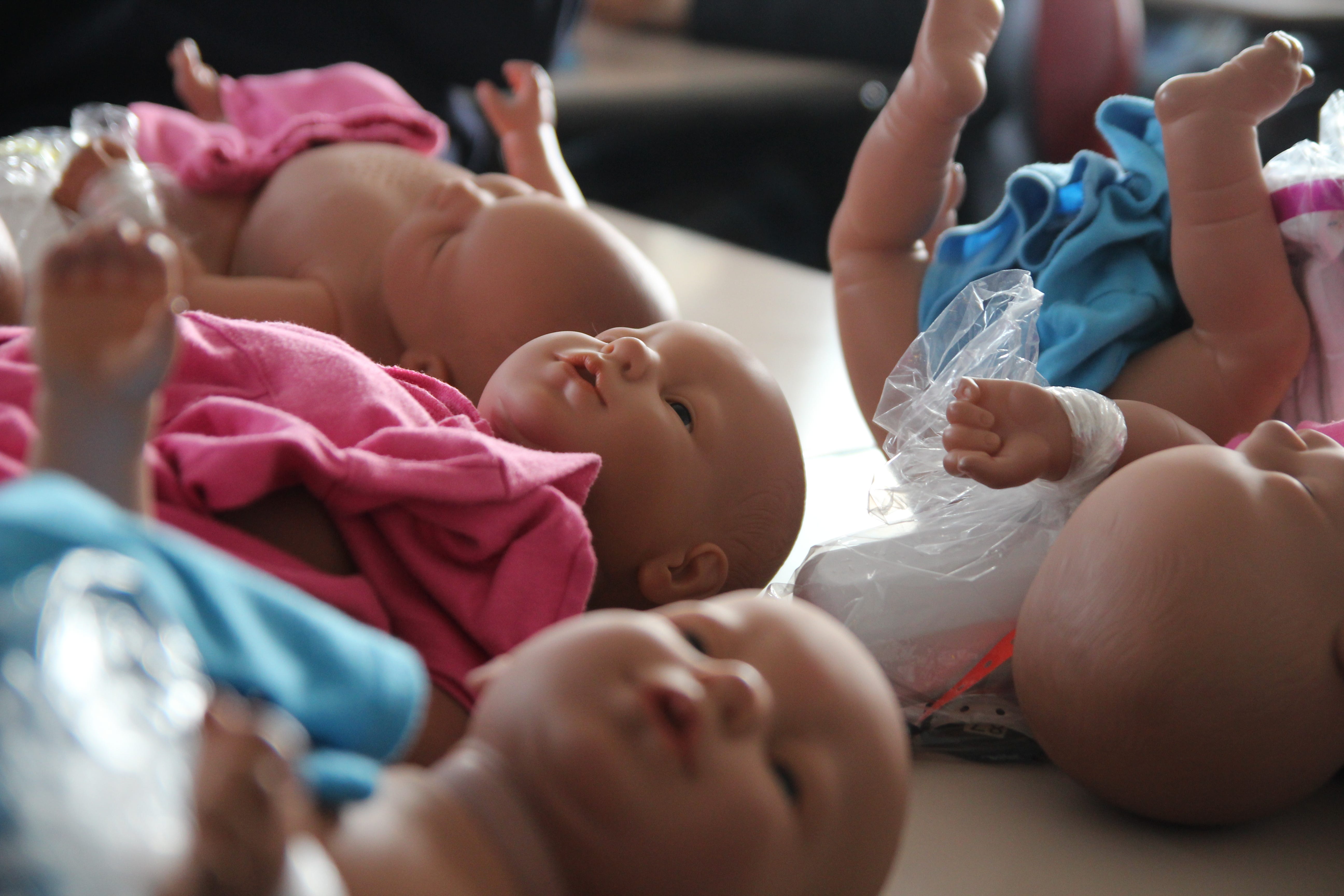
Scattered across the rug were a dozen naked baby dolls staring blankly at the ceiling.
I froze.
The dolls came in different skin tones —some Black, some white—and suddenly what should have been a simple task felt weirdly loaded. The room was full of straight white couples, only a couple of white dolls were left, and my brain immediately short-circuited.
Was it stranger to pick the white baby? Or stranger to deliberately not pick the white baby?
I glanced at Jaime. He looked equally panicked.
Before either of us could accidentally turn this into a full ethical debate, the instructor casually grabbed one herself and handed it to us.
“There you go,” she said. “Take a seat.”
I looked around the room. Five or six other couples had already arrived. Every single one of them was straight. Every woman was deep into her third trimester, carefully lowering herself into a folding chair with the concentration of someone docking a yacht. Beside each of them sat a husband or boyfriend wearing the exact same expression: the unmistakable face of a man who had been told, repeatedly, that attendance was “non-negotiable.”
We took our seats in a semicircle around the living room while the instructor introduced herself and explained that, over the next three hours, we would learn the fundamentals of newborn care. Around us, the other couples settled in with the exhausted seriousness of people preparing for a licensing exam.
And almost immediately, Jaime and I became acutely aware that we were the only gay couple in the room.
Not in a bad way. Nobody was rude. Nobody stared. But every example the instructor gave landed squarely in heterosexual territory.
“When mom is breastfeeding…”
“The mother’s body naturally…”
“Dad, this is where you come in and support mom…”
At one point, she handed out a worksheet titled SUPPORTING YOUR WIFE THROUGH DELIVERY.
Jaime quietly slid it toward me.
“I guess one of us has to become a wife,” he whispered.
Things escalated about thirty minutes later when the instructor disappeared briefly into another room and returned holding an enormous plastic breast.
Not a diagram. Not a drawing.
A full three-dimensional boob.
“Now,” she said enthusiastically, “proper latching is everything.”
For the next half hour, she demonstrated breastfeeding positions using the plastic breast and a baby doll with the focus and intensity of a NASA engineer walking us through a spacecraft docking procedure.
“You want the nipple angled upward…”
“The baby’s mouth should form a seal…”
“Notice the latch…”
I genuinely did not know where to look.
On one hand, I wanted to be respectful and attentive. On the other, maintaining unwavering eye contact with a stranger rhythmically positioning a fake nipple into a plastic infant’s mouth felt oddly intimate.
So Jaime and I developed a silent strategy: glance up for three seconds, nod thoughtfully, look down at our phones, repeat.
Around us, the straight couples took furious notes like this information would be included on the final exam.
Meanwhile, we sat there thinking: none of this applies to us, but it does feel important somehow.
Still, the class turned out to be surprisingly reassuring. Mostly because we quickly realized we had probably overprepared compared to many of the other parents there.
One couple asked whether newborns could drink chocolate milk.
Another asked if babies needed water “right away or eventually.”
A man in the back raised his hand and asked, with complete sincerity, “How long before they can sleep with a pillow?”
Each question made Jaime and me slowly turn toward each other with widening eyes.
Suddenly, my neurotic midnight reading sessions about sleep schedules and developmental milestones no longer felt excessive. If anything, we seemed alarmingly qualified.
By the end of the class, we hadn’t learned much we didn’t already know. But we did leave with one very valuable takeaway:
Our child would, at minimum, probably survive us.
We handed back our baby doll, thanked the instructor, and stepped back out into the cool evening air. Columbus Circle was buzzing with its usual chaos —cabs honking, buses hissing to a stop, tourists standing in the middle of the sidewalk for no apparent reason.
As we walked down into the subway station, I asked, “So… worth it?”
Jaime thought about it for a second.
“I mean,” he said, going through the turnstiles, “I did learn there are fifty shades of poop.”
“That’s true.”
“Yellow mustard? Green frothy? Seedy?” he continued, counting with his fingers.
“Stop it,” I said, laughing.
The downtown D train screeched into the station.
“And honestly,” he added as we stepped inside, “after tonight, I think I’m ready to breastfeed.”
We laughed as the train doors closed and the car rattled south beneath the city. At the time, everything still felt manageable —classes, checklists, subway rides home. We thought we were preparing for parenthood.
We had no idea what life was about to throw our way.
No posts
Comments
Nothing yet. Say the first thing.
Sign in to join the conversation.