
Zelman narrowed his eyes against the glare. At first it was only a shape—gray against gray, wavering in the morning haze—but then it resolved into something unmistakable. Across the water, she stood: a woman of copper and sky, her arm raised impossibly high, her torch held steady against the wind.
Lady Liberty.
He gripped the railing of the upper deck, the metal warm and damp beneath his palms. The river stretched wide before him, churning and restless, carrying with it the smells of salt, smoke, and something new he could not yet name. Around him, voices swelled in a dozen languages—laughter, prayers, the sharp cry of a child—but they seemed to reach him from far away, as though muffled by the pounding in his chest.
A tear slipped down his cheek before he could stop it. He did not wipe it away.
The river kept moving. It always had. It carried everything forward—ships, people, names—whether they were ready or not.
Two years. Two years since he had returned to Odessa in uniform, his boots still dusted with the remnants of war, his chest pinned with a medal he had not asked for. He had fought for the Czar in the Yellow Sea, had watched men sink beneath black water and vanish without a sound. He had come home expecting something—gratitude, perhaps, or at least familiarity.
But Odessa had not been waiting for him.
The city he found was tightened into itself, sour with suspicion. Hatred lingered in the streets like rot. It had been building for years, ever since the Tsar’s assassination, but now it moved openly, violently—faces twisted in rage, windows shattered, bodies left in the wake. By the time the pogroms reached their neighborhood, there was no longer a question of if, only when.
He and his sister did not speak of leaving at first. They did not need to. The decision settled between them in the quiet moments—in the way she packed bread too carefully, in the way he stopped unpacking his trunk.
When they finally fled, it was not heroic. It was hurried, frightened, incomplete. A place on a ship was not bought so much as seized—whispered arrangements, quick movements, the constant fear of being turned away. From the Black Sea to ports whose names blurred together, and then, finally, another vessel. This one.
This one that brought them here, to New York.
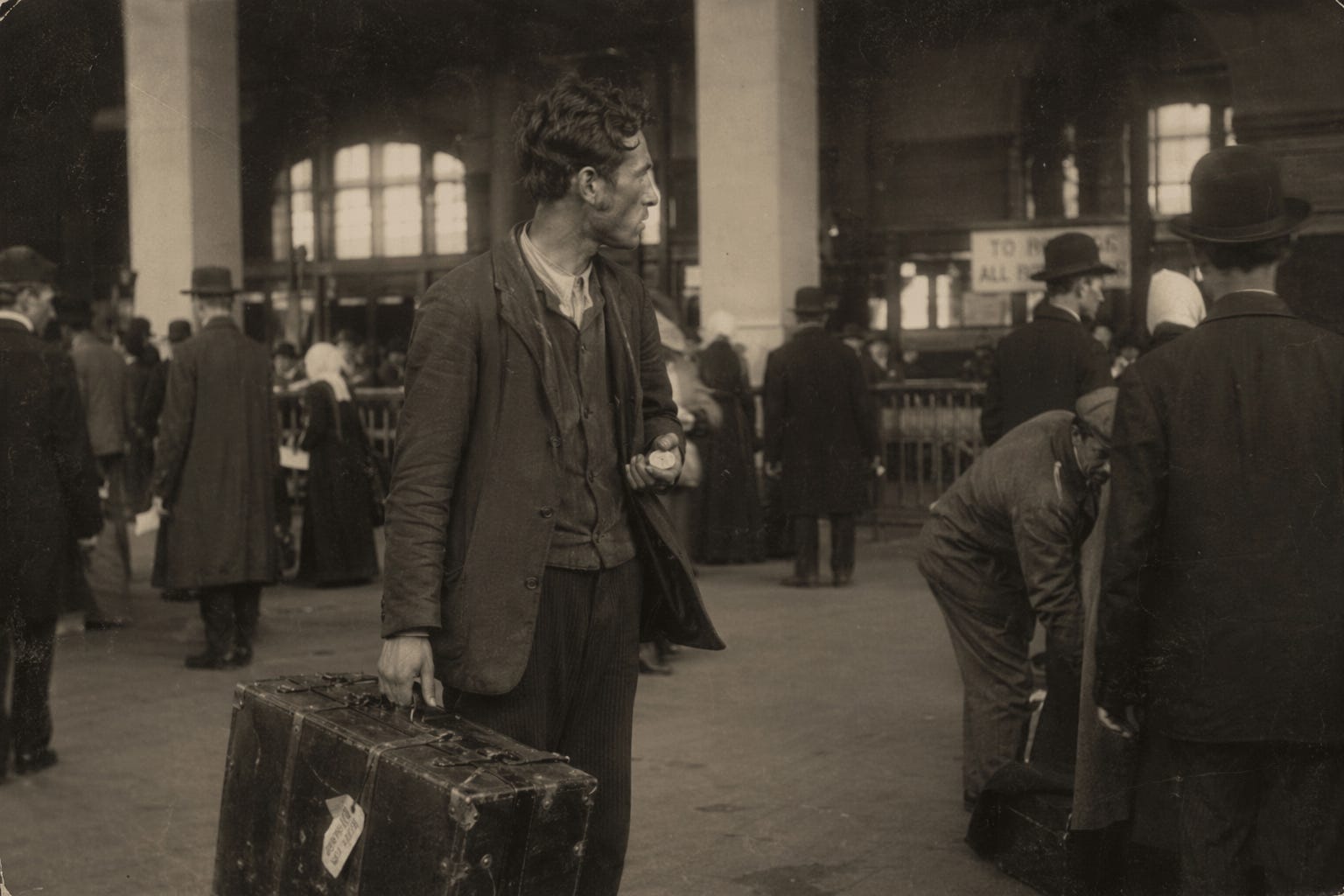
The line at Ellis Island moved slowly, inch by inch, as though the building itself were deciding who belonged. The summer heat pressed down on him, heavy and unrelenting. Sweat gathered at his temples, slid down the back of his neck, soaked into the collar of his shirt. The air inside the great hall was thick—dense with bodies, with hope, with exhaustion.
He shifted his weight and tightened his grip on the handle of his trunk. It held everything he had carried across continents: a few worn clothes, the bronze medal with its red and yellow ribbon, dulled now but still catching the light if turned just right, and a handful of coins that clinked softly with each step.
He did not speak the language. He did not know a single soul.
When his turn came, it arrived almost abruptly. One moment he was in the line, the next he stood before a desk, an officer waiting, pen already in hand.
Zelman placed his identification card on the table with care, as though its edges might crumble.
“This is not in English,” the officer said, barely looking up. “What’s your name?”
Zelman hesitated. The words meant nothing to him. He leaned forward slightly, pointing to the card, to the familiar Cyrillic letters that spelled out the only name he had ever known.
The officer shook his head. “I can’t read that, sir.” He tapped his own chest, then gestured toward Zelman. “Your name. What is your name?”
For a moment, Zelman simply stared at him. The noise of the hall surged back in—a wave of voices, footsteps, distant instructions shouted in clipped tones. He felt suddenly unmoored, as though the ground beneath him had shifted.
Then, slowly, he smiled.
“Be-re-zof-ski,” he said, shaping each syllable with care, offering it forward like something fragile.
The officer nodded, already writing. The pen scratched quickly across the paper, letters forming that Zelman could not read, could not follow, could not correct.
“Okay, Mr. Berezowski,” the officer said, stamping the card with a firm, final thud. He slid it back across the desk.
“Welcome to America.”
Zelman took the card in his hand. The ink was still fresh.
For a brief moment, he wondered—quietly, almost imperceptibly—who, exactly, had just been welcomed.
“Next!” the officer yelled.
Around him, the line moved forward, carrying names into a country that, for many of them, would be only a beginning.
Outside, the East River kept moving.
I have stood there too—looking out, trying to understand what, exactly, was being carried forward, and what might be left behind.
Like most who passed through Ellis Island, he would not stay. His sister would remain in New York, building her life among others who spoke her language, who could make the unfamiliar feel, if not safe, at least recognizable.
But Zelman would keep going.
South.
To a country he had never seen, and likely never imagined—a Mexico that, decades after its Reform War, now allowed Jews to become citizens. A place that would offer him something Russia no longer could: the possibility of staying.
He would arrive there alone.
In Mexico City, he would build a life out of fragments. Out of memory and adaptation. Out of what he chose to preserve and what he allowed to change.
He married a Christian woman there—not only across language and geography, but across inherited ideas of faith and belonging. It was not a rupture he named. It was a negotiation he lived. In that marriage, as in so much of his new life, he gave up certain certainties of who he had been in order to remain at all.
He never learned Spanish.
So, he spoke little to his daughters.
To his sons, he passed on what he could—words in Yiddish, expectations without translation, a sense of what it meant to be a man that did not need explaining because it was never meant to be questioned.
No one wrote those rules down.
They held anyway.
Just years before his arrival, police in Mexico City had raided a private gathering: forty-one men arrested, half dressed in women’s clothing, all publicly shamed. The event became something larger than itself, folding into national memory as a symbol of deviance made visible. The number—forty-one—stayed behind after the men disappeared from view. It became a warning embedded in language. A number avoided in apartments, in schools, even in censuses, as though naming it might invite its meaning back into the room.
By the time Zelman arrived, that number had already become part of the air.
No one in my family ever mentioned it.
But the rules it stood for—the ones about what a man could be—didn’t need explaining.
They moved forward anyway.
First with my grandfather, Alejandro.
Then with my father, Alejandro Raul.
My father inherited those expectations the way people inherit most things—not as choices, but as givens. What masculinity was supposed to look like. What it was supposed to reject.
In his house, growing up, some things were simply not spoken about. Homosexuality was one of them. It existed somewhere outside the boundaries of what could be named, let alone understood.
When it did surface later—in passing, in jokes—it came out the way it often does when it has never been examined. In locker room banter. In words that were meant lightly, tossed off without weight. Words like faggot, said with a laugh.
He did not know what those words carried.
I did.
And I learned, quietly, to hold parts of myself back.
But by then, he and my mother had already begun another kind of leaving.
In 2010, they left Mexico for Vancouver. Together, they stepped into a place where the language did not fully belong to them—where conversation required effort, where belonging was not immediate. They had no friends there, no built-in community, no map for how to move through that world.
They learned anyway.
They adapted in ways that were visible—new routines, new work, a different pace of life—and in ways that were harder to see. The quiet recognition that the rules you grew up with are not the only ones that exist.
Two years later, I came out to them.
And I watched something shift.
Not all at once. Not cleanly. But undeniably.
What it meant to be a man—what it allowed, what it rejected—began to change for my father. And the shape of our family changed with it.
He learned to love me for who I am. But more than that, he allowed that love to reshape the terms of our relationship. We became something different to each other.
We could talk about our emotions.
He could be vulnerable in ways I had never seen before.
He let me see him not just as the figure he believed he had to be, but as the person underneath it.
My mother, in her own way, held that space open too—steady, intuitive, helping make room for a version of our family that none of us had been taught how to build.
My parents did not erase what they had been taught.
But they chose, deliberately, not to carry all of it forward.
I never met Zelman. By the time I was born, he existed only in fragments—stories told in pieces, a name that had already shifted once before it reached me. But the things he carried, and the ones he left unsaid, did not disappear. They settled into the background, shaping the boundaries of what felt possible long before I had the language to question them.
And still—the path bent back.
Almost a century later, I left Mexico too. Not fleeing, not in the same way, but still leaving behind family, language, and the life that had made me. I came to the United States carrying my own set of certainties, and my own set of questions.
Like them, I chose what to bring with me.
Some things fit easily. Others did not.
Jaime and I arrived in a country that, like the one Zelman first stepped into, was not built with us in mind.
As immigrants.
As two men trying to build a family together.
And yet, we stayed.
Coincidentally, I ended up in New York, by the East River.
The same kind of water Zelman would have seen first—moving, indifferent, carrying everything forward.
He could not have imagined a life like mine. He could not have imagined that one day, his great-grandson would stand in this same city, married to another man, trying to bring a child into the world in a way that would have made no sense within the boundaries of his understanding.
And now I am at the edge of something else entirely.
I am about to become a father.
And I find myself thinking less about what I will pass down, and more about what I will choose to carry.
Not everything fits.
Not everything should.
Zelman carried what he could across an ocean, and let the rest fall away.
My parents did the same—across a border, across a language, across an idea of what it meant to belong.
And now it is my turn.
To decide what belongs in the suitcase. What we keep, and what we leave behind.
What will make it possible not just to continue—but to become.
I am beginning to understand that love, too, is a kind of parting.
Not just inheritance, but revision.
Not just carrying forward—but making room for what I cannot yet imagine.
Comments
Nothing yet. Say the first thing.
Sign in to join the conversation.