
At the 2021 virtual conference for the World Professional Association for Transgender Health’s (WPATH) U.S. branch, or USPATH, the plenary address was given by two leading figures in pediatric gender medicine Dr. Stephen Rosenthal and Dr. Johanna Olson-Kennedy. I obtained the full video of the session, which I’m publishing in full in this Substack.
This video is the latest in the series I’m publishing of 2021 to 2023 USPATH and WPATH conference videos. To see the full set, go to this master list:
Dr. Rosenthal is a professor of pediatrics at the University of California, San Francisco and the co-founder and medical director of the multidisciplinary UCSF Child and Adolescent Gender Center. Dr. Olson-Kennedy is a pediatrician and until the clinic was shuttered last year under pressure from the Trump administration, directed the pediatric gender clinic at Children’s Hospital Los Angeles. She now does similar work for a private clinic in Pasadena.
Dr. Olson-Kennedy is the lead investigator on the long-running study of medical interventions to treat gender dysphoria among youth, the Trans Youth Care Study, that has received some $10 million in National Institutes of Health funds to date. Dr. Rosenthal is one of the co-principal investigators on the study. The study is particularly controversial because of reporting by The New York Times in 2024 that Dr. Olson-Kennedy had refrained from publishing results of their research about puberty blockers for political reasons. (Dr. Olson-Kennedy has said her interview with the Times was mischaracterized.)
This 2021 USPATH video is particularly notable because it includes Dr. Olson-Kennedy going into the weeds about the first year of follow-up of 316 youth after they started cross-sex hormones. At the time, she was more optimistic about how publishing her data would sway the political debate about pediatric gender medicine. But as a 2023 conference video demonstrates, by then her perspective had darkened, and she came to the conclusion that it was more politically expedient to be very cautious about publishing. As I reported in Compact magazine:
In 2021, Olson-Kennedy reported that her team had amassed a trove of data from the federally backed study. Facing rising political scrutiny, she suggested sunlight was the best disinfectant. “We want to prioritize publishing this information because it needs to get out into the general public while there is this ongoing attack on transgender youth and transgender youth care,” she said. By the 2023 conference, she reported her team had up to seven years of follow-up data and were working on “several more manuscripts.” But now they were wary about publishing.
“I asked our person at the NIH if there was a prize for the grant that got the most FOIA requests, and she said, ‘No, but even if there was, you would still be behind Covid and fluoride,’” Olson-Kennedy said, to laughter. Describing her team’s painstaking efforts to avoid providing fodder for a backlash, Olson-Kennedy said, “Every single manuscript is absolutely impeccable with what it is, what it is stating, the results that are being reported. We’re thinking about how things can be taken out of context and misused and potentially come back and damage us.”
Following Dr. Rosenthal and Dr. Olson-Kennedy’s USPATH 2021 presentations, she engaged in a detailed dialogue with Dr. Joshua Safer. Dr. Safer is a professor of endocrinology at Mount Sinai in New York, where he is the executive director of the transgender program. He was a leader in the revision of WPATH’s transgender-care guidelines, the Standards of Care, Version 8, or SoC 8, which were published to much fanfare (and controversy) in September 2022.
Introducing the plenary, Dr. Safer said it would address how “we navigate our evidence-based approaches in an environment where sometimes the conversations we have are distorted for political gain.”
The first to present, Dr. Rosenthal reported that the prevalence of trans identification in adolescents and young adults was about 0.7 percent. (This figure would only soar in the subsequent couple of years—to about 3 percent. Although data recently analyzed by psychologist Jean M. Twenge has suggested this figure has since retreated again.)
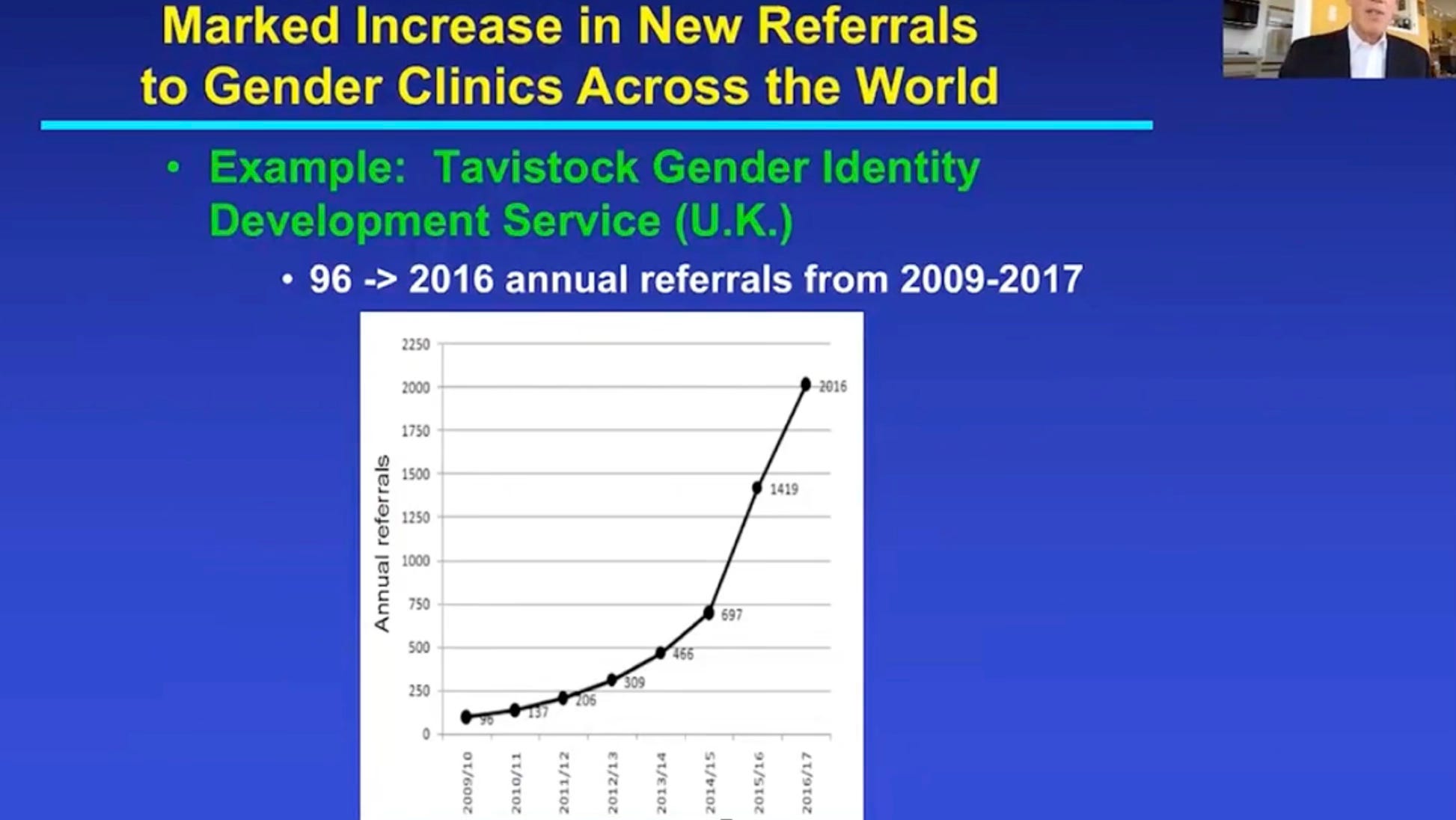
Dr. Rosenthal posed the question of what drove the “marked increase” in referrals to youth gender clinics in recent years. He pointed to Dutch research concluding it was driven by reduced stigma towards trans identities. He did not explicitly suggest that there was a cultural component to this increase. He further noted the recent inversion of the sex ratio—youth presenting at clinics used to be largely natal boys and now they are largely natal females—but did not offer a reason for this dramatic shift.
Instead, he spoke more generally about the notion that “gender identity is not simply a psychosocial construct, but very likely reflects a complex interplay of biological factors as well as environmental and cultural factors.” He did not broach this subject, he said, to “develop a litmus test of being transgender, and certainly not to identify something to be fixed to prevent gender diversity.” Rather, he said, he hoped “this can lead to destigmatization, which can then lead to increased acceptance and decrease health disparities for people of diverse gender identities.”
The SoC 8, which greatly loosened guardrails around pediatric gender-transition treatment, was not out yet. So Dr. Rosenthal referred instead to the most recent Endocrine Society guidelines, which he noted, said that cross-sex hormones could be prescribed to youth who have “sufficient mental capacity to give informed consent, which most adolescents have by age 16 years.” But the guidelines, he said, did allow for commencing hormones at younger ages in select cases.
The authors of the SoC 8, acting under pressure from a Biden administration health official, the American Academy of Pediatrics, and the Trevor Project, would remove the age limits on pediatric gender-transition interventions in the guidelines. They kept secret that they did not make this change based on scientific research, but under duress. Child psychiatrist Dr. Scott Leibowitz, the lead author of the adolescent chapter in the SoC 8, then got up in WPATH’s 2022 conference and made a number of false claims about the reason for the removal of the age limits, as I reported in a previous Substack.
Dr. Rosenthal then went into specifics about the Trans Youth Study.
Comments
Nothing yet. Say the first thing.
Sign in to join the conversation.