
This is the latest installment in the ongoing series in which I’m publishing the trove of World Professional Association for Transgender Health conference videos I obtained and covered in a recent article for Compact magazine. This particular video concerns the panel at the 2022 WPATH conference that introduced a long-awaited new chapter in the organization’s transgender-care guidelines, concerning caring for patients identifying as nonbinary.
For an eloquent and eyebrow-raising account of this and several other nonbinary-focused conference videos included in the videos I obtained, I also direct you to Leor Sapir’s December article in The Free Press. He wrote:
One of the biggest revelations from the recordings is how these clinicians acknowledge performing unproven, seemingly experimental treatments—only it appears there is often no protocol being followed, no formal research being conducted, and no ethics-board approval being sought. These practitioners say their goal is to fulfill the “embodiment” desires of their patients, whatever these may be, and doing this may require “deviat[ing] from guidelines.”
The conference video I’m documenting in this Substack includes a particularly astonishing admission by one care provider that made it into Dr. Sapir’s headline. The provider said, “We’re all just winging it” where medical interventions for nonbinary patients are concerned.
To see all the previous WPATH conference videos I’ve published, see:
Despite a paucity of research to guide gender interventions for nonbinary patients, the WPATH presenters in the 2022 nonbinary session insisted that this fast-growing population had a genuine medical need for all manner of experimental hormonal treatments and body-modification surgeries, sometimes effecting bodies that do not appear in nature. And the audience members who came up to the mic made it clear that they generally wanted guardrails stripped down to facilitate access to meet the swelling patient demand.
(Psychologist , note, has recently presented data in her Substack suggesting that nonbinary identification has sharply declined in adolescents and young adults in the years since this conference. This has added fodder to the argument that such an identity is largely shaped by shifts in culture and not by fixed biological forces.)
As Dr. Sapir wrote, there was a heavy emphasis on treatment “goals” in this and other conference presentations about nonbinary-related treatment. Such a service-minded orientation took over this field because, as the presenters acknowledged, there is sometimes no established precedent for the medical interventions this population seeks. This is all a part of a larger postmodern, deconstructionist project to “move away from the binary” in the gender-care field. Such an academic project has merged with a departure from traditional medical paternalism, in which the doctor was seen as an infallible demigod, and toward more patient-led care with minimal guardrails around what any individual person might seek from a white-coated professional bearing a medical license and a prescription pad or a scalpel.
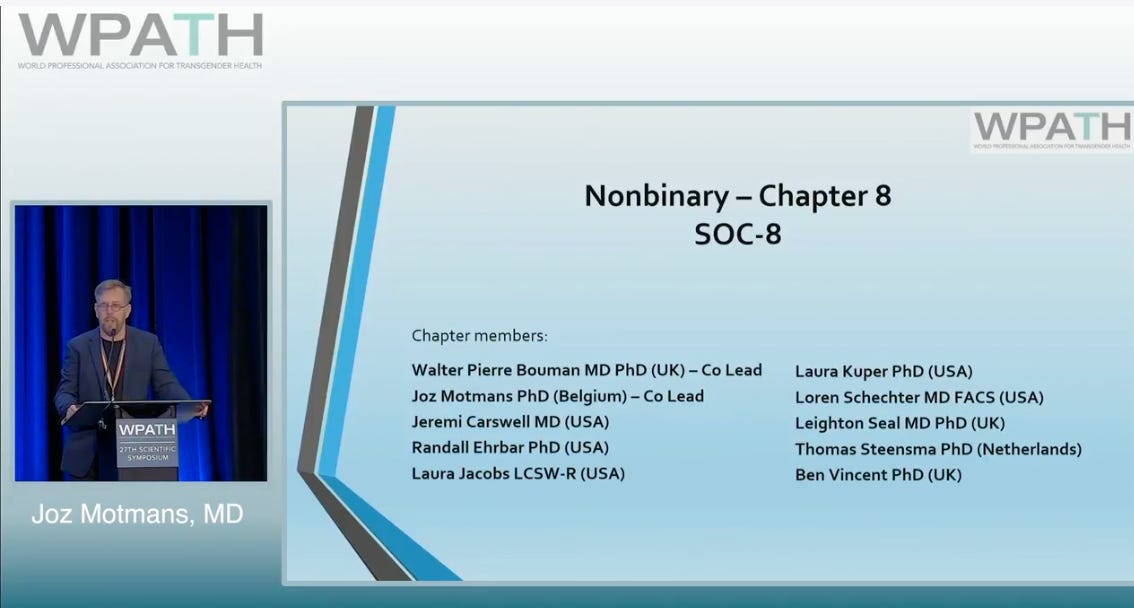
The 2022 presentation opened with words from Dr. Joz Motmans, who is the director of the Centre for Sexology and Gender at Ghent University Hospital in Belgium. Dr. Motmans was one of a slew of coauthors of the new nonbinary chapter in WPATH’s Standards of Care, Version 8. The SoC 8, as it’s known, is the trans-care guideline update that was published to much fanfare in September 2022, days before this particular conference.
As was often the case in the WPATH conference videos I reviewed, Dr. Motmans apologized for a lack of racial diversity in the leadership. (I made particular note of this brand of self-flagellation in a recent essay I published in UnHerd.) He alluded to the fact that the coauthors of the SoC 8 nonbinary chapter were all white. “We do miss some diversity in the authorships,” he said. “But I think that’s the case in most of the chapters.”
Dr. Motmans said that doctors should observe a particularly open mind when caring for nonbinary patients, saying: “It’s very important that health care professionals recognize a need of an individual to access gender-affirming medical procedures and that you cannot predict that need based on someone’s gender role, expression, or identity,” He continued: “So it’s important that health professionals provide information about existing medical procedures and options that might help alleviate gender dysphoria or incongruence and increase body satisfaction without making assumptions about which treatment options may best fit.”
Next, Dr. Walter Bouman, a transgender care specialist at the Nottingham Centre for Transgender Health in the United Kingdom, took to the lectern. Along with Dr. Motmans, he led the WPATH working group on nonbinary genders.
“An individualized assessment for a nonbinary person starts with understanding how they experience their own gender and how this impacts on the goals for care that they are seeking,” Dr. Bouman said. “Let your patient tell you what they want and who they are, rather than us imposing upon them what we think that fits into our matrix of our idea of what gender constructs are.”
Dr. Bouman did, however, acknowledge that there are limits to what doctors might provide this population. He said: “People may find challenges in reconciling their personal identities with the limits of the medical treatments. There may be things that people wish to have—physical expressions of gender that they wish to have—which may not be physically possible. We need to support people into understanding that, because that’s the blunt tools that we’re using and how we can reconcile that inability for us to deliver what they want.”
In an ironic admission given he was introducing a SoC 8 chapter that was ostensibly a care guideline, Dr. Bouman said of nonbinary care, “We don’t have guidelines to guide us. We don’t have outcome measures to try to reassure us of what’s going to happen in the future. And the conceptualization of assessment and people’s expression of gender in this field is constantly moving.”
Dr. Bouman emphasized that unlike with binary trans care, with nonbinary care, hormonal treatment is not necessarily recommended prior to gender-transition surgery. However, this introduced various uncertainties about medical outcomes, he acknowledged. For example, it was an open question as to what would happen with vaginoplasties among people not taking estrogen. How would the lack of hormonal treatment impact the healing post-surgery and the function of the new genitals? This might, for example, raise the risk of hair growth in the vagina, he said.
Such risks notwithstanding, Dr. Bouman advocated an informed-consent model for providing such experimental medical interventions. “Altering the pathway for the individual is the right thing to do,” he said of changing the traditions of trans medical care. “But that individual then needs to be aware of the positives, the negatives and the limitations that could happen from the altered pathway.”
Another example of the new frontier of nonbinary medical interventions was the penis-preserving vaginoplasty, Dr. Bouman noted. This involves creating a neovagina in a natal male but preserving the penis, so that the patient winds up with both a penis and a vagina. He raised questions about the potential complications of such a surgery and the ultimate psychological impacts. It was important, he said, to advise the patient in advance of the operation of the limitations of the care providers’ knowledge about the expected outcomes.
Beyond asserting that a certain body modification was simply not possible, there was no mention during the panel of any ethical red lines that a doctor would not or should not cross in catering to the goals of nonbinary patients for body modifications.
“We should generally recommend that fertility preservation, if at all possible, should be done before hormonal interventions because we still don’t know what hormonal interventions do to the gametes,” said Dr. Bouman. “However, a decision by a nonbinary, gender diverse person for fertility preservation or counseling should not be used as a basis for denying or delaying access to hormonal treatments.”
After this, the session shifted to a lively question-and-answer period.
A Swedish plastic surgeon intimated that the language in the SoC 8 nonbinary chapter was too strong and questioned whether the authors might have considered providing “suggestions” rather than “recommendations,” Dr. Bouman seemed to contradict himself when he replied: “The purpose of a guideline is to use the best available evidence to guide practice. And we simply don’t have the evidence.” He said that the coauthors relied heavily on their own clinical experience to guide them. “But we were all very conscious in the room that we all had very divergent practice, and there wasn’t sufficient consensus for us to make suggestions,” he said.
One member of the audience expressed gratitude that in general in the SoC 8, “the recommendations seem to have been a lot less restrictive” for trans care. But she said the exception was in the nonbinary chapter, including the recommendation to consult with a multidisciplinary team prior to a gender surgery.
Dr. Bouman replied with a suggestion of how tricky it was to balance patients’ desires with doctors’ concerns about liability. He noted the recent backlash against trans care in the UK for minors and suggested this was a potential harbinger for the availability of nonbinary care.
“When you’re working at the edge of a field,” Dr. Bouman said, “the problem is, is that it can be closed off very quickly.”
Dr. Bouman suggested it was important for care providers to diffuse their individual liability by spreading out the responsibility for caring for patients across a wider care team.
“To allow people to move the field forward, you need to have a support network around you as a clinician so that if that decision is made and that decision is regretted, how did you make that decision process?” he said.
“So as an individual practitioner, if you make that in isolation, you could be vulnerable to being criticized for doing something that is outside of the norm,” he continued. “Whereas if you have a network around you, where a clinical team, in concert with the individual has made a decision, you then have a framework to say, ‘Well, the ethics of this were explored.’” He acknowledged: “ Because we are doing procedures here where we don’t have outcome data.”
He said that “there isn’t a long term outcome data of what the pros, the cons, the psychological impact, the sexual functioning impact is for these newer procedures. We don’t have that outcome. So unless you want to go to individual ethics boards in each hospital to get ethics permission to do those surgeries because they’re on the edge of the field of medicine, you need to have a mechanism around you to support you.” Apparently referring to legal liability, he said, “Otherwise you could be vulnerable.”
Addressing concerns about health outcomes for nonbinary-related medical interventions, Dr. Bouman referred to “partial androgenization with lower testosterone levels.” He said, “I can’t put my hand on my heart and say, ‘Your bones are going to be okay,’ because there are studies suggesting your bones may thin.”
A psychiatrist named Jane from the audience was one of the only people in the conference videos I’ve seen to explicitly state that for some patients seeking gender-transition interventions, their mental health might not be stable enough for them to receive such treatment at a given time.
Lastly, a care provider named Erica from Utah got up and put into plain language how much these medical providers are operating in the dark. She said that when she was treating within a binary framework, she felt confident. But there was a lack of data and expertise, she said, to guide her when treating nonbinary patients—a population she noted had surged in number in recent years.
Erica made a plea for guidance from the people in the room on how to care for these patients properly. “I will fully just take your ideas,” she said. Such guidance, she said, could come from a forum as informal as a social media platform. She advised providers to “like make a Pinterest board or something.” She pled for others to “throw a tweet out there or something, saying, ‘This is kind of what I do, and it might be different for you, but this is a regimen that you might use.’”
“I feel like we’re all just winging it,” she said. “But maybe we can just, like, wing it together—publicly in a space where we can share the ideas of how we’re winging it.” Until then, she said, “I still don’t know what to do.” She continued: “because I want to help these folks, and I haven’t yet been given the tools.”
She closed with a final plea for social-media-driven directives from this treatment field: “You know, Pinterest tweet, whatever.”
I am an independent journalist, specializing in science and health care coverage. I contribute to The New York Times, The Guardian, NBC News, The Free Press and The New York Sun. I have also written for the Washington Post, The Atlantic and The Nation, among many others. Follow me on X: @benryanwriter. Visit my website: benryan.net
The full AI transcript of the nonbinary panel:
Speaker1: [00:00:05] Welcome to this, um, session on the eighth chapter in the SoC eight on non-binary people. My name is Josh Mothman’s. My pronouns are he, him, and I’m together here with my colleague Leighton Seale from UK and myself. I’m from Belgium, and we’re going to walk you through the chapter on non-binary. And we also expect Laura Cooper. I’m not sure if they are already in the room to join us for the discussion. There they are. Great. So, um, the non-binary chapter is, as you might have known, one of the few new chapters. There hasn’t been any non-binary chapter in previous standards of Care, so it was a challenge to start drafting from scratch, uh, as well as trying to make sure that non-binary aspects were also mainstreamed in the other chapters. So there might be a lot of overlap with other chapters sometimes. So these are the chapter members that were included. So together with Walter Bowman, um, I was a co-lead. And then we had Jeremy Carswell, who is following online. Hi, Jeremy. Uh, Randall Arbor, Laura Jacobs, Laura Cooper was here. Lauren Schecter latency. Who is here? Thomas Steensma and Ben Vincent. Um, as you can see, quite a big group, but it worked out really well. I think, uh, although we do have to acknowledge we do miss, um, some diversity in the authorships, but that’s, I think, the case in most of the chapters. So my role today is to walk you through the introduction.
Speaker1: [00:01:39] It’s one of the eight chapters with a quite lengthy introduction, as you might have noticed in comparison with others, and with only a few statements. Um, and the statements will be explained by my colleague Clayton Seale. Um, so, yeah. So in short, in the introduction, you might find these subtitles and I will walk you through it. I’m sorry that it puts a lot of words on the slide. I’m just very tired. And I did it also for myself so that I can explain it to my best abilities. So first of all, we felt it might be necessary to explain the terminology and the use of non binary as a concept that we described in the chapter as an umbrella terms. I’m referring to those individuals who experience their gender as outside of the gender binary. And we did have a few, um, concepts that we elaborated on, such as uh, by gender, age, gender, uh, dim boy, dim girl, gender fluid, etc. but also acknowledging that gender non binary in itself is a concept that might be used among the spectrum of gender non-binary individuals. Um, and that these words, these concepts are of course, very much in the English language. And we have to acknowledge that there are many more, um, concepts and terms available in different cultures and settings that, um, are sometimes not acknowledged. We know that in the English language, non-binary people might use the pronouns they, them, theirs, or other new pronouns.
Speaker1: [00:03:17] More creative pronouns sometimes, but they might just as well use he she. Uh. Pronouns. So, um, this is something to be aware of. And when it comes to, um, proportion or size of non-binary individuals, there are different studies out there suggesting that roughly between 25% to over 50% of the larger transgender population. Um, would be falling under that broader spectrum of non-binary people. But especially samples of young people, which is also noticeable in the latest Canadian census. Um, reporting the highest percentage of non-binary people. We thought it was important to underline that healthcare professionals should understand gender identities and gender expressions as a nonlinear spectrum, because sometimes in the understanding of of healthcare professionals, they put like females on one hand, males on the other, and non-binary people in between, which is not correct. Um, so many gender identity categories are very specific and cannot be easily translated, uh, especially not in our known paradigm of gender in the western part of the world. And we also thought it would be very important to underline and stress. And there are many more important points that just picked a few, um, that aspects of gender expression that might traditionally be understood culturally as masculine or feminine or androgynous, um, may also be expressed by people of, of uh, non-binary, uh, experience. So it might be expressed by actually everyone, regardless of gender identity.
Speaker1: [00:04:58] So the idea behind that message was, don’t expect non-binary folks to have a non-binary expression, or don’t assume that they will have a non-binary expression. So for healthcare professionals, it’s very essential that they view non-binary genders as not as partial articulations of trans manhood or trans womanhood, um, as somewhere in the spectrum. But um also understand that a lot of non-binary individuals consider themselves outside male and female victimization altogether. Another part of the introduction underlines the need for access to gender affirming care, um, in some regions of the world. Uh, health care professionals seem to assume that non-binary people do not need care, which is of course not true. Some non-binary people may feel that certain treatment is necessary for them, while others do not, just as is the case in binary trans people. Uh, we have up to today, not real hard numbers to say. What is the proportion of non-binary people who seek gender affirming care, and what are their specific goals of that care? But in any case, it’s very important that health care professionals, um, recognize a need of an individual to access gender affirming medical procedures and that you cannot predict that need based on someone’s gender role, expression, or identity. So it’s important that health professionals provide information about existing medical procedures and options that might help alleviate gender dysphoria or incongruence and increase body satisfaction without making assumptions about which treatment options may best fit.
Speaker1: [00:06:46] So don’t assume that a non-binary person will only have interest in hormones and not surgery, etc.. We also know from lots of studies that there are a lot of barriers, especially for non-binary people, to access care, um, and that they are, well, it’s widespread, um, and that especially the non-binary people, um, show high rates of difficulty in accessing mental health and gender affirming medical care. Um, concrete advice could be to make very clear in your communication that it’s not only for trans men, trans women, but also non-binary people are welcome. Another um topic in the introduction underlines the need for appropriate level of support. Um, we know that a lot of non-binary people are lacking, um, non-binary identity narratives. Um, that they are not so much available as narratives that are more binary, that they might have less resources available to explore and to articulate their gender related sense of self. At the same time, we see that when we look at minority stress research that non-binary people appear to experience minority stresses. Um, sometimes similar, but also sometimes in a unique form when compared to trans men and trans women. And there are, um, is definitely a need for. And these are also in development clinical guidance in how to assist providers in adopting gender affirming therapeutic care to meet these unique experiences of non-binary people.
Speaker1: [00:08:26] So I think that’s one of the last point. Yes. Before we go to the statements. Um, I will not go into that because I think it comes also back to the statements, but there are some gender affirming medical interventions for non-binary people that are like quite specific that we have to think through. Um, there are sometimes no established precedents for certain particular medical interventions. And when that’s the case, it’s very important that before this intervention is considered, the individual is provided with an overview of available information, including recognition of what we might not know yet. It’s also important to undertake and document a comprehensive discussion of the desired physical changes and the potential limitations in achieving those attributes, as well as the implication that any given intervention may or may not enhance an individual’s ability to express their gender. So exploration of medical and or social transition independently of each other, and option to explore hormones and or surgery independently of each other should be available to everyone. So not only non-binary people, but of course, especially in this group, it’s very important, but it doesn’t actually really matter if you’re dealing with a trans man, trans woman or a non-binary person. This is just like basic good care. So that’s all about introduction. I invite you to read it in the SoC eight chapter itself. And then I invite my colleague Leon to go into the specific statements.
Speaker2: [00:10:04] Thank you. Joseph. So, um, we had four specific statements from the chapter, uh, statement 8.1 we recommend healthcare professionals provide non-binary people with individualized assessment and treatment that affirms their non-binary gender experience. We recommend that health care professionals consider medical interventions, such as hormonal treatments and surgeries for non-binary people, in the absence of traditional social gender role change. We recommend that health care professionals consider gender affirming surgical interventions in the absence of hormonal treatment, unless hormone therapy is required to achieve the desired surgical result. I’ll explore these a little bit later on, and we recommend that health care professionals provide information to non-binary people about the effects of hormonal therapies and surgery on future fertility, and discuss the options for fertility preservation prior to starting hormonal treatment are undergoing surgery. To be honest, this is part of the general assessment as well. We should be doing this for all people who are gender non-conforming. So exploring statement number one a little bit more. An individualized assessment for a non binary person starts with understanding how they experience their own gender and how this impacts on the goals for care that they are seeking. There is, as Joseph said, a traditional binary that may be coming to the assessment room and we need to successfully move away from that and trying to understand an individual’s concept of their own personal gender identity in the context of them as an individual, rather than imposing our traditional matrices on there to try and deliver care.
Speaker2: [00:11:37] And we should stop making a priori assumptions about a client’s gender identity. Expression of desires for care. Let your patient tell you what they want and who they are, rather than us imposing upon them what we think that fits into our matrix of our idea of what gender constructs are. We should be mindful that non binary experience of a gender may or may not be relevant in assessment and treatment goals, so a person’s expression of their gender may require medical interventions, surgical interventions, but it may not. And therefore the individual should guide you about where you how far you take that assessment. So if somebody doesn’t want to have surgical intervention, for example, there’s no point in asking them about certain aspects of their identity where surgery could affect things such as sexuality, for example, that it is valid to explore that with individual. It should be a very tailored assessment, and the extent to which a client’s gender is relevant to their treatment goal should determine the detail at which you approach the assessment. As we’ve already said, non-binary people find it particularly difficult to access health care, and a lot of that is about non-binary invisibility in the environment. Non-binary people, when they come to an environment, often will not see themselves there. They will not see themselves mentioned in any of the literature. They will not see themselves represented in the people working at the clinic, or the other people sitting in the waiting room there. So it’s beholden on us as people delivering care in this field to try and be more non-binary, inclusive.
Speaker2: [00:13:06] Clinical settings should aim to be welcoming and reflect and reflect the diversity of genders of the people coming to visit our services. This is part of the cultural competence. A non-binary cultural competence should be thought of consciously until it is embedded in our routine practices. Certain things are obvious. Things like ensuring privacy at a reception desk, setting up alternatives to league, and to listing under legal name. So the preferred name choices may be very important for non-binary people. Haven’t changed their name, gender neutral toilets I don’t know why toilets always come up, but they always do. Toileting it’s important, and setting out alternatives to calling up the legal name in the waiting room. That can be very triggering for a lot of people. Think about how that can be done more effectively. Always think about preferred pronouns. Don’t assume that the pronouns are going to be they them. It could be a neutral one, a new pronoun. Please find out what that is. Respect your patient’s gender identity by respecting their pronouns. We recommend that you encourage a an approach that focuses on strengths and resilience. Often in assessment, there is a focus on dysphoria and alleviating dysphoria. But equally you will see in the text there is gender euphoria. So you don’t necessarily have to focus on the negative aspects of gender identity and how that impacts upon you as a person functioning in society.
Speaker2: [00:14:31] Think about the positive as well, and trying to have a more balanced and nuanced, um, assessment. Some of the assessment many non-binary people may not want to have physical intervention, but equally, they may need support in their social transition into the gender role that they want or to be able to adopt that because, um, because of non-binary invisibility. In addition to utilizing diagnoses to access care, work collaboratively with your patient to get a broader range of gender expression experiences and how they fit with the treatment options. Don’t limit yourself again to the binary of masculine and feminine or the alternative non binary. Think about how that person’s gender expression fits into what is available in the treatment sphere. For all people. Having a good, supportive network around you is the most successful way to improve psychological functioning. So again, exploring the social constructs around the person, the degree of support they have, whether they’re embedding communities or not, and advocating facilitating contact with people that can support their gender identity is important as part of the assessment process. When advising people about interventions, it’s important to realize the and making assessments. It’s important to realize the limitations of the tools that are being used in many centers. Diagnostic tools. Diagnostic scales are being used for gender diagnoses and gender assessments. These are blunt instruments at the best of times, but in the sphere of non binary people, they haven’t been validated. So consciously. Think about if you’re using tools such as that in this sphere, what is their purpose? What is their reliability? Similarly, the diagnostic criteria, which have tried to be become more inclusive of non-binary people by specifically stating that as part of the diagnostic criteria and the applicability, may also not capture the breadth of experience of non-binary people, a lot of the diagnostic criteria are focused on dysphoria and physical intervention and transition there, whereas it may not capture adequately the social stresses of somebody in the non-binary position having to constantly identify a place for themselves in society which is not open and visible to them.
Speaker2: [00:16:50] Open ended discussion is more likely to get you to a deeper and more accurate understanding of the individual’s gender identity. In this context, rather than using closed assessment scales or diagnostic criteria. We recommend a person centered approach, which I think everybody would agree with. Um, in the field. We also need to recognize as part of the assessment process, a non binary. People may find challenges in reconciling their personal identities with the limits of the medical treatments. They may be things that people wish to have physical expression of gender that they wish to have, which may not be physically possible. We need to support people into understanding that, because that’s the blunt tools that we’re using and how we can reconcile that inability for us to deliver what they want. Also, it’s important to conceptualize assessment as being ongoing. This is the part of our field which is right at the cutting edge.
Speaker2: [00:17:46] We don’t have guidelines to guide us. We don’t have outcome measures to try to reassure us of what’s going to happen in the future. And the conceptualization of assessment and people’s expression of gender in this field is constantly moving. So considering the evolution of this field, it’s beholden on people working with non binary people to keep themselves up to date and maintain your competencies in a rapidly shifting and moving field. So coming to statement two, we recommend that medical interventions can be considered in the absence of social gender role change. Previous assessments have had an emphasis on occupying a social gender role, consistent with the person’s internalized sense of gender. Non-binary people have an explicit problem in that the non binary identities often invisible within society. How do you occupy something that isn’t generally seen to exist in Western culture? Now, in other cultures, yes, you can occupy that space, but in the Western culture, that is very difficult. Um people use often use various techniques. You may use a mixture of visual cues to signal that you don’t occupy either a masculine or feminine space. That may work for some people, that may not. For other people, that’s not possible, and they have an internal sense of their non-binary identity that does not invalidate it as an identity. And. Therefore, insisting on somebody occupying a social gender role which doesn’t exist can be extremely problematic. For example, non-binary people may not have access to their gender label that they would put on themselves with informal documentation.
Speaker2: [00:19:38] It may not exist there, and where it does exist, people may need support and advocacy for them to be able to do that. Uh, requiring somebody to occupy a social gender role can sometimes put them at risk. In certain cultures, being seen as non male or non female can result in risk. So again we have to question the ethics of insisting on that before as a as a as that as a gate to accessing medical care. So framing access to medical care in the terms of experience of social dental transition is problematic. Living in a social in a gender role that is congruent with the gender identity may involve external changes to your physical appearance and your gender role, but it may not. It may be an internal sense of gender. Statement three recommend healthcare professionals consider gender affirming surgical interventions in the absence of hormonal treatment, unless the hormonal therapy is required to achieve desired surgical result. Again, here we are dealing with new outcomes. There has been a traditional model where hormone therapy is generally started before surgical intervention. And the basis for that, and the rationale for that was we can monitor how somebody responds to an intervention to see whether psychological functioning improves before going to a more invasive intervention. But for non-binary people, they may not desire hormonal changes. I think a very good and easily model example is somebody who was assigned a female gender at birth, who was a strong dysphoria to their chest area.
Speaker2: [00:21:19] They do not want to have facial hair. They do not want to have body hair that is not part of their gender identity, but the absence of their chest is, and that is now recognized in many centers as something that is done, whereas if you go back 5 or 10 years ago, it would not have been done. So in that situation where actually the hormonal therapy is unlikely or has a minimal impact on the final surgical outcome, then it’s entirely reasonable to go ahead with the surgical intervention in the absence of hormonal therapies. For other surgical interventions, however, surgical hormone therapy is necessary before the surgical intervention. And a good example of this is metallurgy. Oplasty. If somebody decides to have metallurgy plasty to enhance their genital appearance, to make that more congruent with their gender identity, if you do that, in the absence of testosterone, the surgical result is likely to be compromised. So in this situation, you need to have an understanding of the hormonal therapies, what they will achieve, how that interacts with the surgical therapies and what can be achieved with the surgery. And when you have that constellation of information, you can then pass it on to the client, who can then make an informed decision. So it’s about understanding the limits of our interventions and how that fits with the individual’s idea of gender and how the physical interventions they desire will achieve their personalized goal.
Speaker3: [00:22:53] The.
Speaker2: [00:22:58] The other important thing is that surgeries in the absence of hormonal therapies may result in changes in surgical outcomes, which may occur or may not. And again, we need to counsel individuals about this. The example we’ve had here supplied by the surgeons was that vaginoplasty. We do not know what happens in the absence of estrogen, how that will affect the surgical healing or the function of the genitals following surgery. For example, if somebody has hair follicles still remaining in the penile inversion tube or the scrotal flap, if testosterone is not suppressed, hair could form there, which could result in hair ball, um, formation, which again is a surgical complication. So again, altering the pathway for the individual is the right thing to do. But that individual then needs to be aware of the positives, the negatives and the limitations that could happen from the altered, um pathway. As with all medical interventions, it’s important to go through the risk and benefit ratios with the individuals who are considering surgical, um, treatments. There are surgical treatments that are possible that haven’t been used traditionally so far. A prime example of this would be penis conserving vaginoplasty. There are surgical interventions are now feasible that individuals may ask for. However, we have to be upfront and honest with our clients. We do not know what the outcome of those surgeries are going to be. The complications that those surgeries could have, and the lack a likely functioning of of the surgery and the likely psychological impact of that surgery. So in that situation, there has to be a collaboration between the surgeon who would perform the surgery, the team assessing the individual from the hormonal point of view, the psychological point of view and the individual themselves.
Speaker2: [00:24:58] So the person before they go into that surgical intervention understands the limitation of the knowledge and the possible complications of that, so that person can have an informed consent or decide against the surgery in an informed way. Statement 8.4. We recommend the health care professionals provide information on to non-binary people about the effects of hormone therapies and surgeries on future fertility, and discuss the options with them. They should be offered to all people undergoing surgical, sorry hormonal therapies and surgeries that can result in reduced fertility. This is part of our general care anyway, but a lot of the literature is non-binary, exclusive or certainly not non-binary inclusive as well. So we need to consciously think about that as part of our guidance for individuals. I’ll personally, just as an anecdote, I’ve looked at that in our personal clinic, and it is interesting that non-binary people, less non-binary people in our clinical cohort, wish to preserve fertility compared to binary people. So again, don’t make the same assumptions that you would for the binary cohort, that the same interest in fertility preservation is present or not. Um, it’s important to discuss the impact on of hormone therapy, on family planning as well. You cannot assume that the hormonal therapies are going to be using are going to be contraceptive. So equally as you may want to discuss, fertility preservation, contraception and sexual health is also an important set of conversations to have. Non-binary people are less likely to access fertility care. That may be personal choice, but it may not. As I said, it may be, um, systemic exclusion.
Speaker3: [00:26:50] So.
Speaker2: [00:26:52] All information should try. You should try make your information inclusive to non-binary people, and we should generally recommend that fertility preservation, if at all possible, should be done before hormonal interventions because we still don’t know what hormonal interventions do to the gametes. However, a decision by a non-binary, gender diverse person for fertility preservation or counseling is not a desired should not be used as a basis for denying or delaying access to hormonal treatments. Thank you for your attention and we’re happy to take questions and comments.
Speaker4: [00:27:41] Uh, General Selvaggio, plastic surgeon from Sweden. I was attending the previous, uh, session as well, and I put a question about, uh, the difference between recommendation and suggestion. Uh, so my question is, in the non-binary chapter, did you ever consider to give some suggestion rather than recommendation? If not, why not?
Speaker1: [00:28:06] You can take it. Yeah.
Speaker2: [00:28:08] The purpose of a guideline is to use the best available evidence to guide practice. And we simply don’t have the evidence. So we were very conscious when we were developing this chapter that we’ve all got our own personal practices. The people selected to be on the chapter either have an extensive practice in non-binary, um, hormonal therapy or surgical therapy, or were people from the community themselves so that we were trying to get people with experience. But we were all very conscious in the room that we all had very divergent practice, and there wasn’t sufficient consensus for us to make suggestions.
Speaker5: [00:28:48] That person was before.
Speaker6: [00:28:49] I was in the previous session as well, and I really appreciate the expanse of coverage to come close to.
Speaker2: [00:28:58] The mic. We can’t hear you. Sorry.
Speaker6: [00:29:01] Yeah, um, I really appreciate how expansive the non-binary section is in this version. Um, I work in a surgical practice, and the recommendations seem to have been a lot less restrictive in this version, um, than in previous versions. The one exception seems to be with non-binary. Non-standard, I think is what they call it surgeries, where they recommend patients seeking these actually have and it is a recommendation their consult consulting with a multidisciplinary team. And it just seems I guess I’m trying to reconcile that we’re covering this group a little more, but at the same time. Is it more restrictive? Like are we. I guess I’m trying to reconcile that internally, just seeing how we’re releasing some of these previous recommendations, yet kind of holding on to that one.
[00:30:11] Yeah I think.
Speaker2: [00:30:13] The when you’re working at the edge of a field. The problem is, is that it can be closed off very quickly. So for example, in UK practice we’ve had that backlash for for children. So technically now our um service protocols stop us treating children under the age of 16. If you’ve actually read what the NHS has done in response to that, and therefore when you’re doing operations that we have to accept, at some point somebody will regret the surgery that they’ve done. So to allow people to move the field forward, you need to have a support network around you as a clinician so that if that decision is made and that decision is regretted, how did you make that decision process? So as an individual practitioner, if you make that in isolation, you could be vulnerable to being criticised for doing something that is outside of the norm. Whereas if you have a network around you where a clinical team, in concert with the individual has made a decision, you then have a framework to say, well, the ethics of this were explored because because we you have you have a situation where you can explore the ethics of that, because this is we are doing procedures here where we don’t have outcome data. So for the for a vaginoplasty, for a phalloplasty, there is a long terme outcome data of what the pros, the cons, the psychological impact, the sexual functioning impact is for these newer procedures. We don’t have that outcome. So unless you want to go to individual ethics boards in each hospital to get ethics permission to do those surgeries because they’re on the edge of of the field of medicine, you need to have a mechanism around you to support you. Otherwise you could be vulnerable. That’s our feeling.
Speaker7: [00:31:57] And this might be somewhat tangential. And, you know, I’m from the mental health perspective, so I know less about surgery and hormones. But I think when we’re thinking about assessment or helping prepare someone for medical treatment, um, trying to focus less on this idea of we need more assessment to interrogate their gender, their sense of self. So shifting from that more towards that informed consent piece. So wanting to make sure they’re fully informed and there might be more nuance there in terms of what’s available or risks and side effects. So I think we try not to focus more on like assessment of their identity and interrogating that and more on the informed consent piece.
Speaker5: [00:32:40] I’ll actually jump right on that. Because while while we do say that, um, lung assessment is not necessarily necessary. Um, when when we’re actually reading the statement of recommendation, we do see there is a very big tangent of leaning towards the assessment model rather than the informed consent model. I’ve heard you mentioned that informed consent is essential, but that is really not what we’re seeing in the statement of recommendation. We’re really seeing a physician approach, a physician centered approach instead of a patient centered approach. When we’re still say thank you because we’re still saying, you know, that non-binary people are all different and may want different type of care or different treatment, but we’re not treating them as such. In the statement of recommendation, we’re still saying we recommend health care professionals consider gender affirming medical intervention for their patient and consider, uh, gender affirming surgical intervention for their patient. Instead of saying that the medical professionals should really be listening to the needs of the patient and building a track with them rather than for them. So can you explain this incoherence between the, uh, informed consent model that you’re presenting and the assessment model that we’re seeing in the recommendations?
Speaker1: [00:33:58] I think that, um, that the first part that you mentioned about listening to the patient and make them central is definitely also in the recommendations, or at least that’s how I feel it. So I don’t think it’s so black and white. Um, at the same time, I think it’s necessary to, especially with non, uh, how do you say it like practices that are like not usual for the physician. It’s definitely important to have at length in depth discussions or talks with with with clients about options, because I think the question is oftentimes also new for the medical practitioner. And they might also need more information from the client about desired outcomes of the specific question. If I explain that, well.
Speaker2: [00:34:51] I mean, when you when you’re working with somebody, the. I’m an endocrinologist, so the hormone, my hormonal practice is very nuanced with the individual. I need to spend more time with them to understand exactly what the physical goals are in a way that for somebody undergoing a binary transition, I can say this is, this is. The protocol. The changes are likely to happen over this kind of of time period, and we will end up here that I can do that for somebody who is under binary and transition, for somebody who has a non binary identity, who may want partial physical changes in certain areas, but not in other areas, I need to explore that against the physiology of what the hormones will actually do. So I need to have a longer and more in-depth assessment with the individual, because what they want may actually not be physically possible. So it’s a it is more in depth discussion with somebody because you you may not they may not end up at the point of their physical goals. Um, if you don’t, they may have physical goals that they were expecting and not and not actually be able to achieve them. So it’s much more collaborative. And um, again, with, with a follow up as well, hormonal values may be measured, for example. But we in my practice, I ask people to send in a email telling me how are they happy they are with the changes? Are the changes good for them? Are they bad for them because the individual’s response and how they feel about the response is as important as any number I’m going to measure. So the the collaboration is much stronger, not assessment, but the the collaborative conversation with the individual has to be.
Speaker5: [00:36:28] While I hear what you’re saying and I completely understand it, I actually agree with you’re saying because you’re really describing the informed consent model here. This is really not what we’re saying, seeing in the statement of recommendation it what you’re saying does appear in the core of the chapter, but it is not coherent with what is in the recommendations. And this is very sad, but not all doctors are going to read the entire chapter. Most are only going to read the statement of recommendation, and the way it is phrased really does lean towards the assessment model and towards the physician centered approach, when it really should be at the core of the recommendation that it is an individual, patient based approach and not a physician’s approach. So why was it not more clear in the recommendation that what you want is informed consent, that what you want is a patient based approach?
Speaker1: [00:37:21] This is a statement that you’re referring to, I guess.
Speaker5: [00:37:24] Yes. The statement.
Speaker1: [00:37:26] Yeah. I don’t I mean.
Speaker5: [00:37:27] Mostly 8.12 and three. I’m not talking about four right now. Yeah okay.
Speaker7: [00:37:34] Well, I do, you know, appreciate that feedback and, you know, don’t um, and just taking us taking ownership that we might have gotten some things wrong and, um, we’ll look through that in more detail and reflect on that. So we don’t want to dismiss that comment and appreciate your feedback.
Speaker8: [00:37:55] Thank you.
Speaker1: [00:37:55] I think it might stem from our concern that we want health care professionals to consider. Yeah, we want them to be open for these kind of requests. So that’s why we might have focused on them and not on trying.
Speaker7: [00:38:07] To speak to these other providers and really encourage the providers to be open to this. So that’s maybe where some of the language.
Speaker3: [00:38:16] Needs have been.
Speaker2: [00:38:16] Five years in the making. And if you think back to the world five years ago, it’s an entirely different place to where it is now from that point of view. And the aim of this is to push people forward, to make them think about it and do it, whereas there’s a lot of resistance in a lot of areas about doing things that are not on protocol that you don’t have a guidance for. So the aim here is to to try and force is a strong word, but to get people to go beyond that.
Speaker5: [00:38:44] I completely understand. Sorry, I don’t want to hug the mic for too long. This is going to be my last comment, I promise. But um, from a policy, just from a policy point of view, this I get where you’re going, but this is not what it’s going to achieve. The way it is sent, the way it is phrased really puts it all on the doctor, which gives more power to the doctor when really what you want is to give more options to the patient. So, um, well, thank you for hearing me, and I really do hope that there will be a revision of, of this chapter, if not in the next year. Of course, in SoC nine at least. I think there really needs to be a reconsideration of the approach that we have when we treat non-binary people. Thank you.
[00:39:29] Hello. Hi. My name is Robert. Um.
Speaker9: [00:39:32] I just wanted to ground myself in that question, of which I presently live on the stolen lands of the Algonquin Anishinaabe people, also known as the City of Ottawa. We’re also here meeting in the stolen land of the Mohawk nation, also known as the City of Montreal. Um, I just wanted I really appreciated the opening, um, sentence around the recognition of the limitations of the recommendations and that they were based in English. Um, with the, you know, obviously, Western context. So I was just curious about what, um, indigenous scholars, certainly here living on Turtle Island, there’s been much work around Two-spirit identity as it involves, um, you know, the inhabitants of this land, the true inhabitants of this land. Um, and or what plan is there for, um, how to inculcate that into future recommendations? Just in, I guess in just a little bit more context in terms of, um, you know, talking about, um, also in a non-binary identity in which there’s obviously various cultures that have various names, different fluctuations and how they present in different language. So, you know, there was this brief acknowledgement, but was there any work done or work? Will it be done, um, to make sure that those voices are part of this? As we look at this and thinking about decolonizing ourselves, looking at this from a anti-oppressive platform.
Speaker1: [00:40:57] Yeah. Thank you so much. Um, I think what we did at the moment when we drafted the chapter is we looked at what was available in the English literature. Again, I think that’s, of course, already a highly selected, uh, part of what we have access to, what we can read. Um, and I would definitely encourage scholars to, to work more on these topics. We try to recognize that we are drafting a text in English. Therefore, again, um, yeah. Using a paradigm which might not be applicable in different cultures or contexts. Um, yeah. So thank you so much. It’s a very valuable remark. And I think what we did is we tried to work with what was out there, what we could have access to in our language. Um, but it’s definitely not comprehensive or. Yeah.
Speaker2: [00:41:45] And in the introduction, we do acknowledge that this is the Western culture and that there are other cultures where, um, there are third genders and there are dispirited people. So that is acknowledged in the text of the actual chapter itself. There was a there’s a chapter on terminologies as well. I think there’s some work on that in, in the terminologies chapter, if I’m correct as well. So that was outside of the remit of, of this, this, this was about the interventions that we can offer people in the context of the medicalized model, to be quite honest.
Speaker9: [00:42:24] Great. Thank you.
Speaker2: [00:42:25] Please be advised.
Speaker9: [00:42:25] Yeah. And then, you know, also, you know, how we apply that and particularly as regards to assessment and clinicians and how we’re working, I.
Speaker2: [00:42:33] Suppose it’s not it’s not explicitly stated, but but as part of the assessment process, it’s about getting that individual’s context. We do emphasize understanding the person in the context of their culture. So if person’s culture is in a third gendered space. So you have to understand that individual in that context. And we do say that as part of the assessment process, but not explicitly I agree.
Speaker10: [00:42:53] Yeah. Thanks.
Speaker11: [00:42:58] Hi, I’m Nicholas Chadi, pediatrician and adolescent medicine provider here in Montreal. My question is about identifying documents. So here in Canada, individuals can choose gender X on their passport. And I was wondering if, um, a reflection or discussion around the topic of identifying documents had been held in the process of writing this, this chapter, especially with non-binary individuals, I have often a lot of questions from parents and youth trying to decide if they want an X on their passport for fear of not being able to travel to certain countries, and then the other way around, having to choose, you know, a gender marker or sex marker that doesn’t represent them. I was just curious to see if you have if not, you know, as part of this chapter, any recommendations for providers engaging in these these discussions or how to navigate this rather difficult topic?
Speaker7: [00:43:53] Um, yeah. And I think when we were drafting it, there wasn’t much in terms of like research about that, in terms of non-binary people’s experience of gender markers. I think we maybe touched on it and just how it is diverse in terms of how people feel about wanting that or not wanting that. And I think, you know, our general theme is not making assumptions. So not assuming a non-binary person does want that marker. Um, so it kind of falls under that general theme.
Speaker8: [00:44:26] Right? I don’t think that we came across any.
Speaker1: [00:44:29] Research, um, about the impact of having a certain gender marker on mental wellbeing or anything like that. We could have taken on in the chapter or in the literature. So but yeah, I hope that there is more coming out on that aspect. Thank you.
Speaker2: [00:44:44] But we did recommend advocacy and specifically support in individuals. So this is up to the individual clinician to understand the process in their area and then advocate and help the individuals or at least signpost them to places where that can be done. So I think exploring that and part of this as well, we have to start somewhere in the absence of anything, to be quite frank, the literature is very limited. So this is a kind of starter for ten to get the ball rolling. Let’s get the research done. Let’s let’s let the next one be better with informed studies and data. So we can actually make strong recommendations, actually make recommendations about clinical care for people with non-binary identity.
Speaker4: [00:45:28] Thank you. Hi, my name.
Speaker12: [00:45:31] Is Kai Jacobson. I use they them pronouns. I’m non-binary myself, so I very much appreciate that this chapter exists for the first time and theemphasis on flexibility and individualized care. Um, I do wonder about some of the the language used in terms of contrasting non-binary versus binary experiences of gender. Um, I see this used outside the standards of care too, but I think we’re creating a false binary between binary and non-binary. Um, when? Uh, you know, I also know folks who identify as, like, a non-binary trans man, for example. Um, and I just wonder about if there is any consideration about, um, I worry that clinicians without a lot of other contexts might read this document and go, ah, okay. If I have a binary person, I give them this. If I have a non-binary person, then I ask them what I want. Um, so just was there any consideration about encouraging providers to take a more flexible, flexible, individualized approach for for all patients, regardless of their specific identity? Yeah.
Speaker7: [00:46:28] Thank you. Yeah. And I know just in general and we had some of this tension about like just there even being a separate non-binary chapter versus this is something that should be incorporated throughout, you know, the whole standards of care. I think there it felt like overall there was a need for a specific chapter to specifically name these things and highlight it. Um, with that flexibility. And I think there was too, a lot of back and forth, like Ben Vincent especially. That’s something they’ve talked about, like this binary of binary binary versus non-binary. So I think we we tried our best there. It does look like some of the language was tweaked after we wrote it to make it more consistent. So I think unfortunately there were some tweaks that were out of our hands afterwards. We talked a little bit about more binary oriented maybe being a firm versus just binary. Um, yeah. So there are some limitations with the language that.
Speaker8: [00:47:32] Yeah, definitely.
Speaker1: [00:47:33] I do think when we started off the process, we were all very much in favor of having this chapter as in, finally, some attention for this group and we need some specific information. And during the time, as you said, more of us felt like actually this should just be like mainstreamed in every chapter, but also recognizing, as you said, it’s it’s true that in many countries and I have the impression especially maybe not so much us, but also much more different parts of the world where like when I look at Europe, especially, um, more Eastern European countries, when I come there, the having a non-binary chapter is a signal is like important to have so that they know that they also have the right to care. So yeah, I think in the end the decision was made to keep it. But of course, I think with everything, especially when going through it once more, we often felt but this is true for everybody. This is true for all gender diverse folks. Yeah.
Speaker2: [00:48:31] The other thing we need to need to address as well is the fact that the health outcomes are may be different. We don’t know. We haven’t got the data here. So if somebody has the same hormonal for me as an endocrinologist, as somebody having the hormones that I would give in a binary transition, I can say with confidence, I know what your long tum outcomes are. I know what your risks are going to be. I know your bones are going to be healthy for somebody, for example, who’s having partial androgenization with lower testosterone levels. I can’t put my hand on my heart and say, your bones are going to be okay, because there are studies suggesting your bones may thin. So that person I have to treat differently and I have to have a different protocol. So at the moment, until we’ve got the the breadth and the thresholds of of where those hormones for me, for where those hormonal differences exist. So I can say, all right, if you want a testosterone above x, I don’t have to worry about your bones. If it’s less than x, I have to worry about your bones. We don’t have that data. So at the moment, having a category that is not binary transition hormones is important. So we can cohort that and and get the data to know what we’re doing with people.
Speaker12: [00:49:33] Thanks I appreciate that. And I think even when we do have sort of binary versus non binary um data, we should still that that’s still collapsing people into two categories. And so we should think um, more individualized even when we have more data.
Speaker2: [00:49:46] Yeah. Yeah, yeah. It’s the threshold physical intervention for me. It’s a threshold of value for sure. What am I doing with somebody? Thank you.
Speaker13: [00:49:55] Yeah. Hi. I’m Jane from Edmonton. I’m a psychiatrist there, and I do pre hormone and pre-surgical assessments. And there’s one thing I’m concerned that hasn’t been I don’t think talked enough about is individuals mental health and their ability to make, um, to make good decisions. Um, so sometimes when I’m seeing patients I need, I need to say to them, uh, your, your mental health isn’t stable enough right now and for you to have hormone treatment or surgery, surgical treatment. Um, and I think it’s a tough thing to say, but I think health care providers need to know that. And I think non-binary individuals need to know that, that this may happen. And most of the time it’s not a problem. But sometimes I’ve had to say that to patients. And then sometimes six months down the road, I see them again and they say, I wasn’t ready then to have this surgery or hormones, but I am now. That’s my comment. That’s my comment.
Speaker7: [00:51:00] And I think that’s definitely like a broader conversation that’s maybe outside the specific scope of our chapter. Um, one thing I would say is when we look at the literature, it’s complex. So at least we don’t necessarily see non-binary people are at more increased risk of mental health concerns than more binary oriented people. So we didn’t want to necessarily say, you know, there’s more mental health problems in this community or that we need to think about that more. Um, for a non-binary person. So, yeah, that would that was one thing we did notice. It wasn’t, you know, clear that there was more mental health concerns in the population or that we need to take a different approach for that reason.
Speaker2: [00:51:50] And mental health assessment is there is the mental health chapter in the SoC nine. So it’s about our remit to be specific to the specific issues of non-binary people rather than the general. So, you know, for for a lot of what we’ve written, you, we can put binary or non binary transition or whatever, you know, gender non-conforming people as a broader category rather than just specifically non binary. So it was about finding that threshold of where we’re looking at specific issues that could be present in the non binary population compared to other populations that we look after. Whereas mental health is and that’s across the board.
[00:52:29] Hello, I’m Pierre Paul.
Speaker14: [00:52:31] I’m from Montreal and I’m a family physician. First of all, I very much appreciate your use of patient centered care, which is a terme that we as family physicians accepted early. Um, I would encourage you to maybe try to use patient, um, combined decision making, since that’s what you’re really talking about in a lot of your, um, statements. Um, yesterday and the day before, there was a few speakers and a few people who did interventions through much maligned the Terme combined decision making. But I think this is very appropriate word to be used in this portion of the document. Thank you.
Speaker15: [00:53:21] Uh, very quickly, and then I’ll defer to the middle there. Just wanted to I really appreciated what the person said about, uh, the needed extra consultation. And one thing that we might consider for the next, uh, SoC nine is to put more emphasis on the need for the providers to break down the barriers of that extra consultation that I think that if that was something that didn’t wasn’t a barrier, it was just we we have you meet with this other person tomorrow and then we get going. We need to break down those barriers. Yeah.
Speaker7: [00:53:55] Um, hi.
Speaker16: [00:53:57] Um, I first wanted to say that I do appreciate. Oh, yeah, I do appreciate the inclusion of a separate non-binary chapter, despite some of the complexities of that, because as I think is clear throughout the statements of care, despite, um, sort of best intentions, it is not evenly applied. And so non-binary people are not evenly represented throughout the chapters. And so having a separate chapter at least allows for that representation at this point in time, even if in the future perhaps we can hope for non-binary representation equally in all of the standards of care. Um, one of the things that I was curious about, and this is not just a question for you all and is true of all of the chapters. So it might be unfair of me to ask you, but this is sort of the last day of the conference, and it’s something I’ve been thinking about the whole time is, um, you know, a lot of the responses to people’s questions and especially in the non-binary realm because of the lack. And, you know, the other area that I’m interested in is adolescence. And so, you know, together, right, areas where there is a huge lack of research and a lack of literature. And the response is usually, let’s do more research, please. More research. We can’t provide recommendations without, you know, the evidence base. And I guess I’m curious what. And I know and I’ve read the methodology section. Um, but what kinds of research and what kinds of evidence do you consider in your literature reviews? And do you move beyond the disciplines of like clinical medicine, for example, like there was the question about, you know, indigenous knowledge. And I think that if you’re talking about complex cultural situations, there are other disciplines that have a lot of research and evidence to offer. And I’m curious if there’s a way to, in the future, incorporate a more interdisciplinary lens, not like multidisciplinary in terms of like endocrinology and mental health, but multidisciplinary in terms of like clinical care and anthropology and sociology and like disciplines that have a lot to offer in these spaces but aren’t usually included in the conversation.
Speaker8: [00:56:10] Yeah, definitely.
Speaker1: [00:56:11] Good remark. Um, I think that the composition of the the group of authors for this chapter definitely included people from sociology, gender studies and the like. So there was definitely some expertise on board besides the clinical expertise, uh, such as Ben Vincent and myself, we have, I missed I don’t have a clinical practice. I’m a gender studies scholar. Um, you also might might know that actually the the whole introduction part was, I think, three times as long because there’s so much to say, especially from these disciplines. But we had to cut down a lot to make it more condensed and, and. Yeah, so a lot of it had to go. But we tried to keep the yeah, the most important, uh, tones and topics in the introduction. But it’s definitely true that, um, I think future chapters and that is true for every author group of the SoC aids could benefit from more diverse authors, uh, composition from different areas. Also, if you look at where we all come from, yeah, we don’t have it’s not a global representation at all. So that’s definitely something to work on I think. Yeah.
Speaker8: [00:57:26] Thanks. Thank you.
Speaker17: [00:57:30] Hi. Um, I’m Jamie, I’m a psychiatrist at the Trans Health Clinic in San Francisco, VA, and I use they them pronouns. I really appreciate this chapter. I just wanted to say that, uh, there is some evidence that non-binary youth, especially those who are amab, um, have higher rates of mental health issues, higher rates of suicide. So I just wanted everyone to be aware of that and the importance of serving this population, because I do think it has unique risk factors. And, you know, providing care to them is very important. Thank you.
Speaker8: [00:58:17] Absolutely. Yeah. Thank you. I think we try to contextualize.
Speaker1: [00:58:22] That a little bit in the chapter. Um, also pointing out aspects such as visibility, um, recognition. Um, yeah.
Speaker7: [00:58:31] Yeah. And I think intersectionality plays a big role there in the diversity of the population. There’s some research that some non-binary people feel invisible and not valid, and then some non-binary people feel hyper visible and very, um, at a lot higher risk of like, victimization. So there’s quite a spectrum, I think.
Speaker2: [00:58:54] And it’s interesting as well in our group, because I’ve looked at at a non-binary population in my group, it’s actually people who are assigned female at birth, had a higher suicide rate than people assigned male at birth in our cohort. So it’s not a universal cohort have been a particular birth gender, although mental health issues can be higher in some studies. But other studies, they didn’t show that, which is why we didn’t comment on it.
Speaker8: [00:59:19] I think we have one last question.
Speaker1: [00:59:21] That we have to.
Speaker18: [00:59:22] Close. Erica, Utah family. She her um, I want to thank you all and all of the comments from everyone in the room because I think everyone has brought up really great points. Um, when I think about what I was hoping to get, not just necessarily from this session, but from the conference in general, I feel like the rate at which people who are non-binary are coming to me and seeking hormone therapy has dramatically increased over the last three years. And when I’m in a more binary space, I feel fairly confident managing hormones. But in this newer space, I don’t feel like as a clinician, I have, you know, um, a lot of, of expertise in this area to offer them. And so I’m really I know that when, you know, as, as, as medical providers and as scientists, we, we really cling to this data, data, data. But I will fully just take your ideas like make a Pinterest board or something, because I can’t wait for SoC nine to come out to, you know, to start helping these folks. And, you know, so I would love it if the if the groups who who, you know, are having, you know, lots and lots of patients, if you can just, you know, throw a tweet out there or something saying, this is kind of what I do and it might be different for you, but, you know, this is a regimen that you might use.
Speaker18: [01:00:42] Or if you wanted to achieve this, you could try this because I feel like we’re all just winging it, you know? And which is okay, you’re winging it too. But maybe we can just, like, wing it together, you know, like publicly in a space where we can share the ideas of how we’re winging it. Because I think all of us are now going to go home and thinking like, it’s super important. I still don’t know what to do. You know what I mean? So I’m not that that’s something that this because I know we weren’t really focusing necessarily on the protocols, but just something to think about for the people in the room who are doing this, like, you know, write an opinion piece or something so that we can all just see what other people are doing. Um, because I, I want to help these folks, and I haven’t yet been given the tools. Uh, you know, with my drugs to, to do that in, in this conference yet. So but thank you for everything everyone said and did, but, you know, Pinterest tweet, whatever.
Comments
Nothing yet. Say the first thing.
Sign in to join the conversation.