
In a panel discussion at the 2022 World Professional Association for Transgender Health, or WPATH, conference, a quartet of women lamented what they characterized as the misuse of science in the law where pediatric gender medicine was concerned.
As an antidote, they frequently offered misinformation of their own, or at the very least made non-evidence-based claims.
This video of the conference session in question is the latest in an ongoing series I’m publishing of conference videos from WPATH and its US offshoot, USPATH, spanning 2021 to 2023. I covered the full scope of these videos as they applied to pediatric gender medicine in a recent article for Compact magazine. You can find the full roster of the videos I’ve published thus far here:
The title of the panel I’m focusing on in this Substack was: “When Science is Misused in law: How to Address the Biased Science that Underlies Legal Bans on Gender-Affirming Care for Youth.”
The panel was moderated by Anne L. Alstott, a professor at Yale Law School and included:
Jennifer Levi, the director of the transgender rights program at GLAD, the LGBTQ legal advocacy group
Dr. Christy Olezeski, an associate professor of psychiatry and the director of the Yale Pediatric Gender Program (she was on the program but wasn’t in attendance)
Dr. Meredithe McNamara, an assistant professor of pediatrics at Yale (who presented Dr. Olezeski’s slides and her own presentation)
Dr. Nathalie Szilagyi, an instructor at the Yale Child Study Center
Dr. McNamara in particular has established herself as one of the leading voices straddling medicine and policy in the effort to protect minors’ access to gender-transition treatments. In recent years, she has often served as a paid expert witness in legal settings defending the medical field—a practice that is highly lucrative for witnesses on either side of this dispute.
Ms. Alstott and Dr. McNamara are the cofounders of The Integrity Project, which acts as a kind of rapid-response hub in the face of legal and scientific threats to pediatric gender medicine. The project is most known for putting out a white paper criticizing Britain’s Cass Review of this field.
Jesse Singal has subjected that particular white paper to a withering three-part critique in which he said that it was guilty of spreading reams of misinformation.
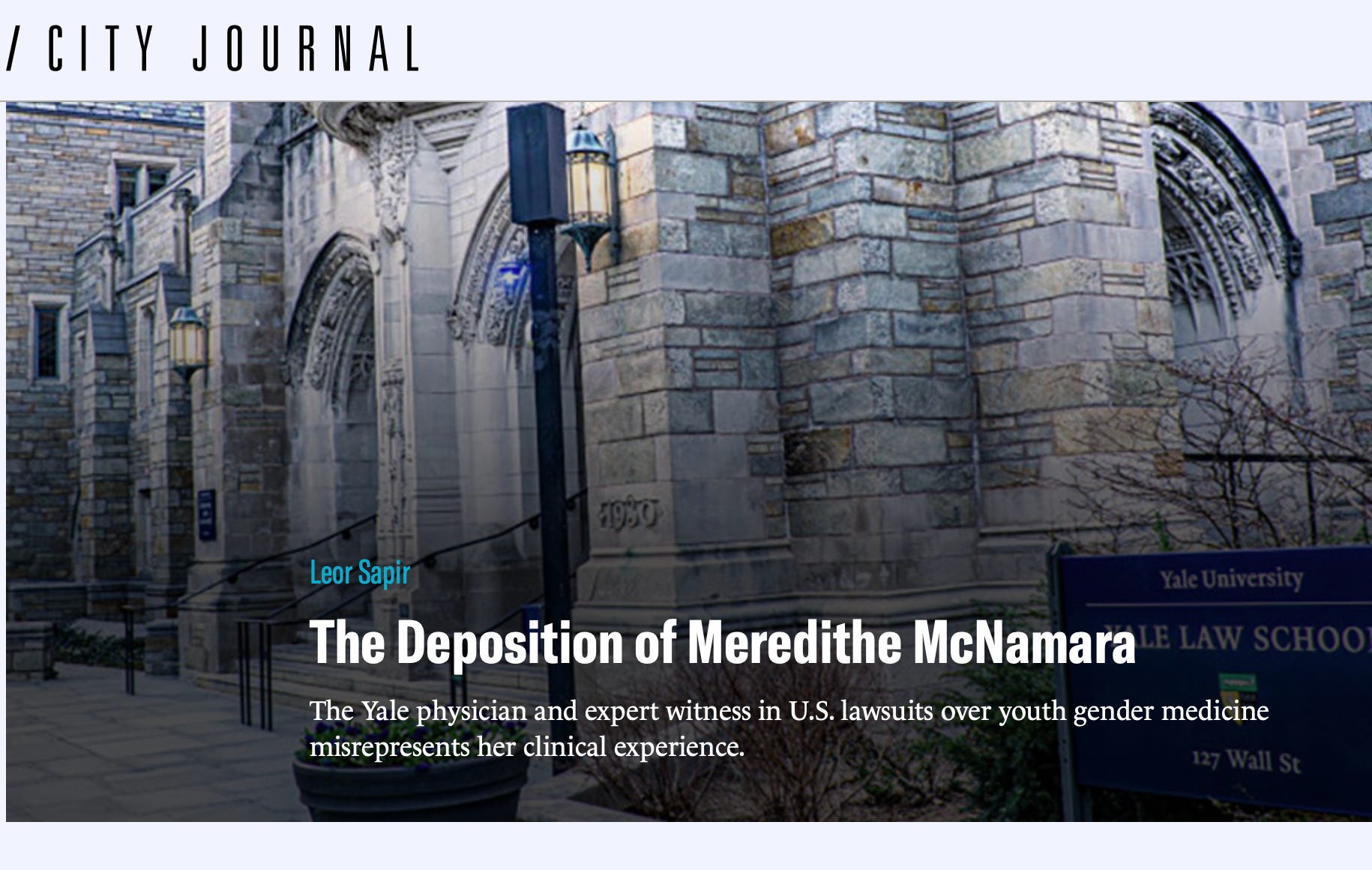
The Manhattan Institute’s Leor Sapir published a scathing account of what he characterized as Dr. McNamara’s misrepresentation of her clinical experience. In an August 2024 article in City Journal, Dr. Sapir analyzed a deposition that Dr. McNamara gave in the federal lawsuit over Alabama’s ban of gender-transition interventions for minors. Most notably, Dr. Sapir focused on Dr. McNamara’s admission that she did not provide gender-affirming care herself; and since 2021, she had only ever referred two minors to a pediatric gender clinic.
This admission is remarkable, given that Dr. McNamara has often suggested she is a hands-on expert in pediatric gender medicine. And indeed, in the 2022 WPATH panel, she suggested she was one.
What amazed me about this conference panel was how seldom the speakers rebutted misinformation with substantive information of their own. Oftentimes they simply sweepingly declared something untrue and expected the audience to take it on faith that this was an accurate assertion. This was not an unreasonable presumption, given how WPATH conference-goers almost never challenged the ideas of presenters—at least in the well over 100 videos that I watched during my reporting for Compact.
The 2022 legal panel was based on a certain bedrock of confidence among the speakers that their methods of combatting what they asserted was misinformation would help their movement prevail in the face of major, mounting political attacks on pediatric gender medicine. And while hindsight is 20/20, it is now clear that they were being wholly naive about just how aggressive—and ultimately successful—their opponents would be in this fight.
Little did they know that they were waging a fast-losing battle.
Ms. Levi expressed her dismay over what she characterized as “a coordinated, nationwide strategy to roll back protections” for the transgender community. This included attacks on pediatric gender medicine; school-related legislation that governed, for example, what could be addressed regarding LGBTQ issues in the classroom; and restrictions on cross-sex sports participation.
Regarding sports-related laws, Ms. Levi said, “The only tiny sliver of light here is that where these laws are challenged, courts have seen the bans for the bias that they reflect.”
In the coming weeks, the nation will see the culmination of that fight when the Supreme Court issues its ruling about the constitutionality of sex-based restrictions on sports participation and whether such restrictions square with Title IX. Legal experts expect the transgender plaintiffs will likely lose.
Speaking to laws banning pediatric gender-transition interventions, Ms. Levi said, “Proponents of these discriminatory laws and defenders of these discriminatory laws are actually abusing and misusing research to distort the truth and the underlying facts about transgender young people and the well-established medical care that many young people need.”
It is safe to say that Ms. Levi’s next assertion is contradicted by multiple systematic literature reviews of this medical field, which have found the evidence backing gender-transition interventions for minors wanting and uncertain. Journalist Jennifer Block reported in BMJ in 2023, for one, that gender-transition treatment cannot be considered evidence based.
Ms. Levi said that “there’s a course of care and treatment” for gender dysphoria “that is well established and evidence based.” She added that “there is voluminous research to show that the treatment, including the use of puberty suppressants and hormone therapy, when appropriate, is highly effective in resolving the clinical distress transgender people, including young people, can experience if they are not allowed to live consistent with their identity.”
Ms. Levi said that “there’s now extensive data that shows both the safety and efficacy of care and treatment of gender dysphoria and minors” and asserted that “that research is being twisted and distorted by legislatures, government agencies and individuals.”
The laws in question, Ms. Alstott said, are “clearly biased” and are “cloaked” in “the language of science. And that’s extremely dangerous. It threatens the integrity of the law, right? When lies are enacted in law. That’s bad, right?” She added: “They also threaten the integrity of science.”
Proponents of these laws, she said, put forth “false experts” and allowed “misinformation” to run “rampant.” This misinformation, she said “is being spread by…a relatively small but intense group of advocates, and it’s being then picked up by these legislators and used for craven political purposes to persecute people.”
She provided a content warning prior to the following slide about Alabama’s law banning pediatric gender medicine, warning that its language was “offensive,” “outdated” and “harmful”:
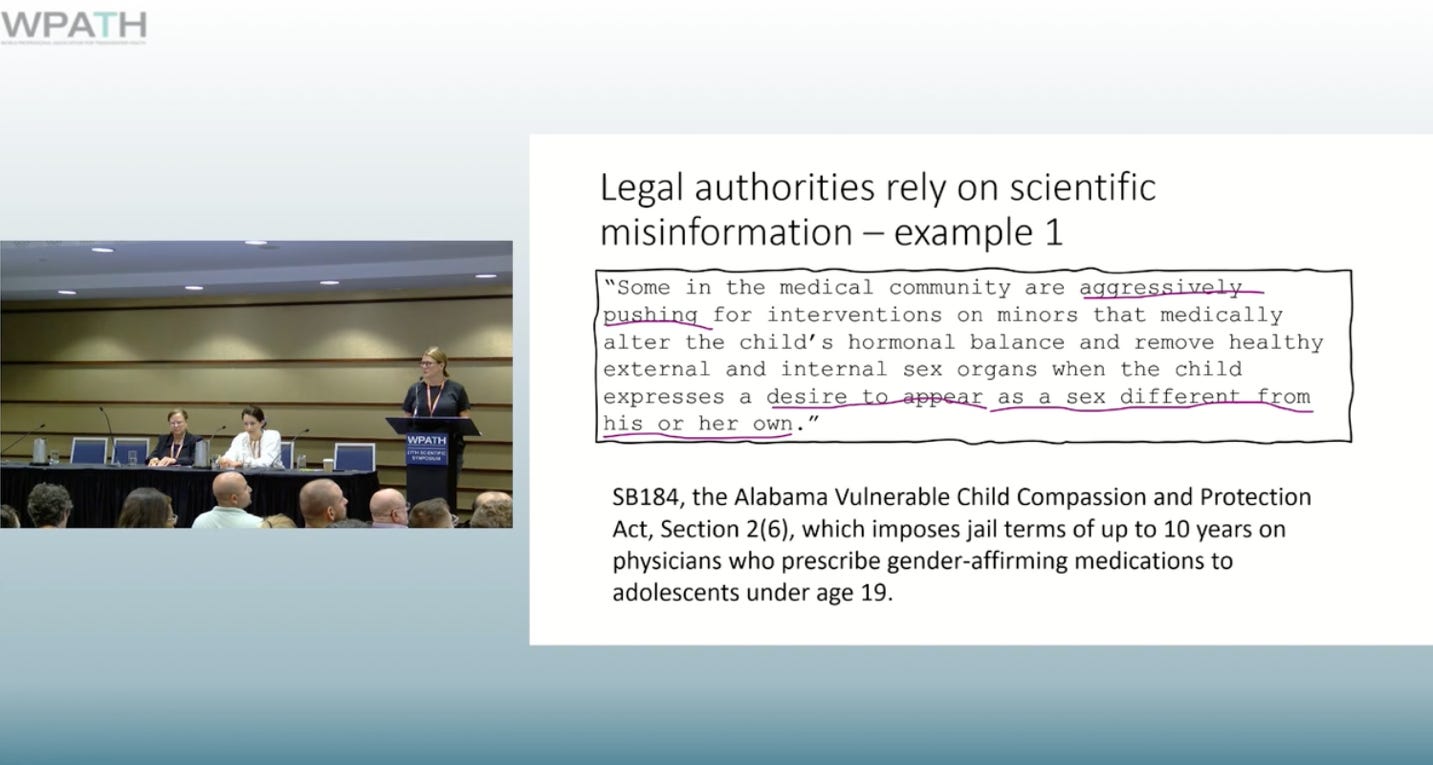
“The law itself states that the medical community is aggressively pushing to alter the child’s hormonal balance and remove healthy organs,” she said. “This is the language in the statute itself: ‘when the child expresses a desire to appear as a sex different from his or her own.’” She then reflected, “It is so nice to be in front of this audience. I do not have to go through why this is a wrong, offensive, inaccurate and so on.”
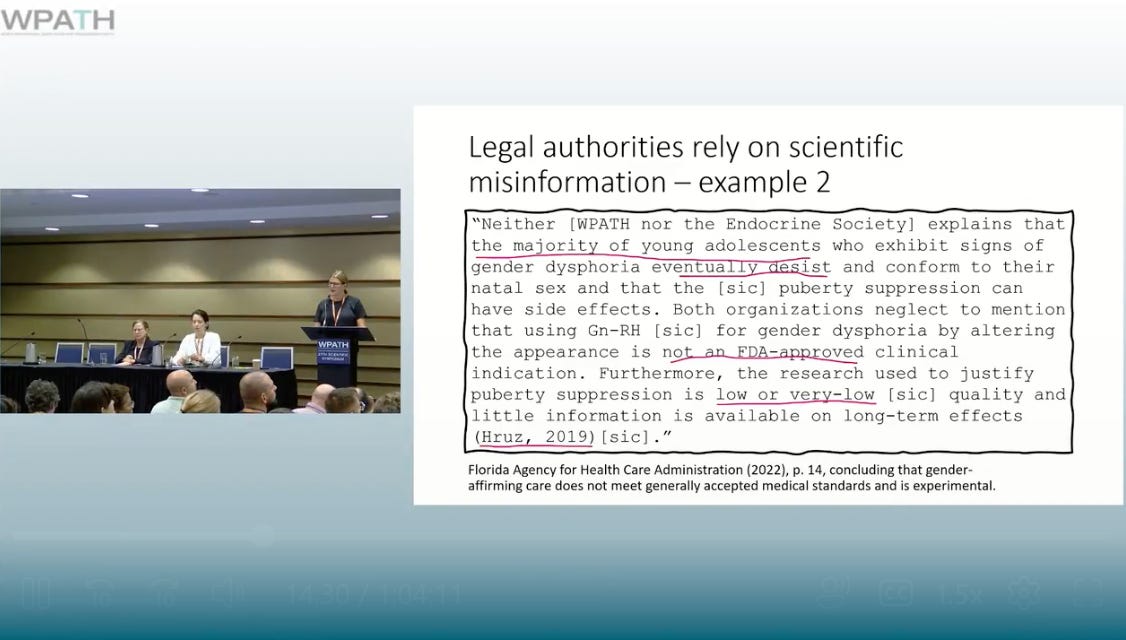
Ms. Alstott said that the claim, made by the Floria Health Care Administration in 2022, that “the majority of young adolescents” with gender dysphoria will “eventually desist” was false. But she did not provide any citation for this claim, which is, in fact, a matter of rigorous and ongoing debate among researchers. Part of the problem, as I see it, is that the older studies that found this high rate of desistance were conducted in a totally different social context, one in which socially transitioning prepubescent children was extremely rare. If we are to believe that socially transitioning a child at least in theory might lead to a snowball effect that in and of itself would make desistance less likely, then it only stands to reason that desistance would be less common in the current era than in the past.
Ms. Alstott said: “Texas attorney general states, falsely, that there is no evidence that long-term mental health outcomes are improved, or that rates of suicide are reduced by gender affirming medical care.”
It is remarkable that Ms. Alstott would have made such a sweeping claim about suicide rates in particular, since at that time there were no studies that directly assessed gender-transition treatment’s association with the suicide death rate among youths attending gender clinics. In 2024, the first and only such study was published out of Finland; it found no such association.
Ms. Alstott lambasted journalists for so-called both sidesism in their reporting on this issue and for characterizing WPATH as an advocacy organization and, she said, as “just a closed clique of advocates.”
In my recent reporting for Compact magazine, I found that these WPATH conferences betrayed a culture of strict ideological conformity. This very session is a prime example of that, as evidenced by the fact that the speakers presume, likely quite correctly, that the audience will have no objections to their claims. I also found that as the years progressed, WPATH’s conferences only became more ideological and more geared toward training doctors and researchers to function as activists in their professional lives.
Additionally, in subpoenaed internal records obtained by Alabama’s attorney general as a part of the aforementioned lawsuit in that state, it was revealed that a baseline requirement to serve as a coauthor of WPATH’s 2022 revision to its trans-care guidelines, people had to be an advocate for trans care.
Journalists, Ms. Alstott said, “create this appearance of scientific debate.” She made no mention of the very real debate that has transpired about this topic in the United Kingdom and the Nordic nations that, as the 2020s progressed, ultimately pulled back on their support of pediatric gender medicine.
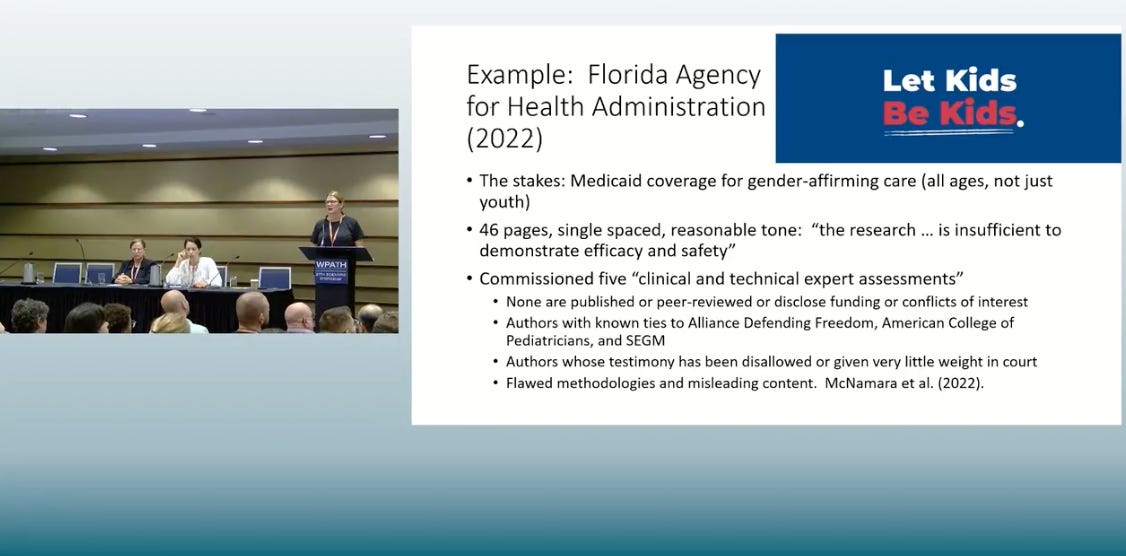
She criticized the state of Florida for putting a banner “on a report saying claiming incorrectly, falsely, that gender affirming care is experimental, that it’s investigational, that it fails to meet generally accepted professional standards.” This after Sweden, earlier in 2022, declared that gender-transition treatment for minors is experimental.
Presenting Dr. Olezeski’s slides, Dr. McNamara opened by going over the myriad psychosocial struggles that youths identifying as transgender disproportionately face—a product, she said, of minority stress, or the stress derived from stigma toward transgender people.
Suggesting she had much more experience with transgender patients than her deposition in the Alabama case would reveal, she said, “When I meet with a patient who is trans, gender expansive, non-binary, and I sense that they’re going through a hard time and they do volunteer with me, that they feel very threatened, unsafe.”
Laws that target transgender youth, Dr. McNamara said, and “the media attention that surrounds it, the propagation of misinformation on large public platforms, it provides cover for increased violence and harassment towards members of the community, which in turn leads to worsening mental health outcomes and in internalized transphobia.”
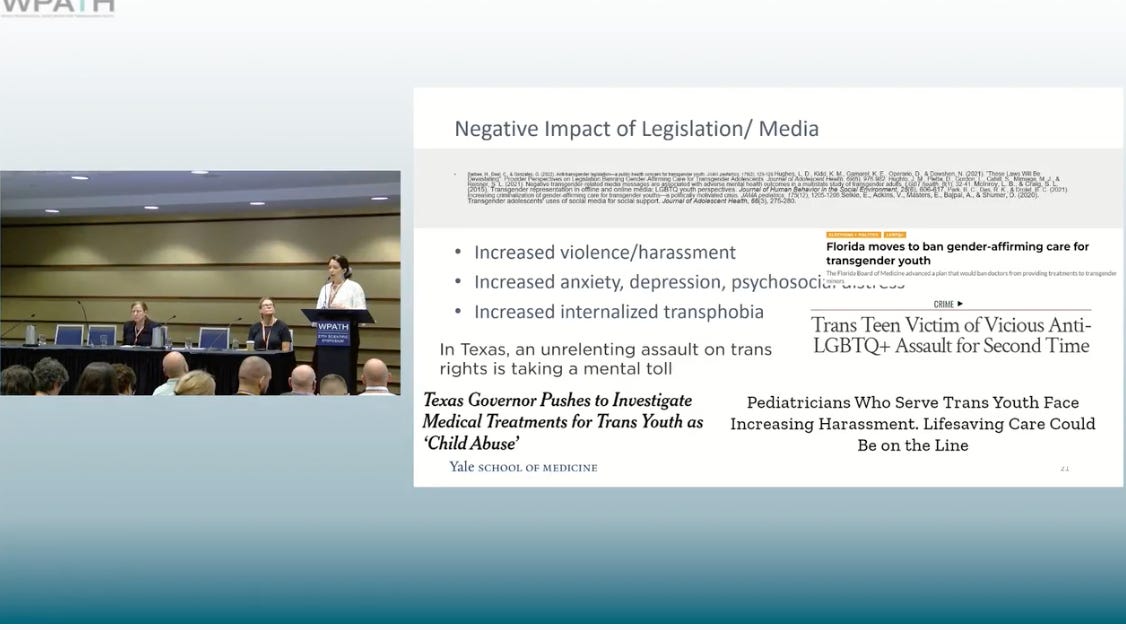
In another suggestion that she saw a substantial transgender patient population in her clinical practice, she said, “We’re very conscious of the imminent harms that this legislation poses to our patients, that we’re conscious of the fact that it occurs at a really important time in one’s life.”
Dr. Szilagyi said she would talk about “what the scientific evidence actually is” pertaining to social contagion of transgender identity and regret following gender-transition treatment. These, she said, are “two of the main claims” that “anti-trans legislators and opponents” leverage in their efforts to ban such treatment. “And,” she said, “I’m biting my tongue and not saying mean names to describe them.”
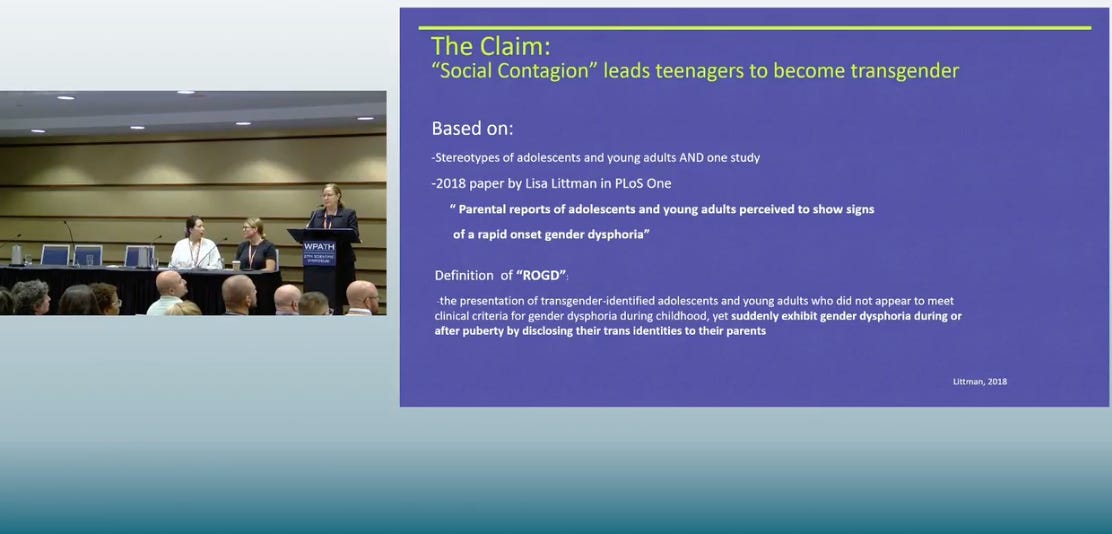
Dr. Szilagyi was among the multiple presenters at the WPATH conferences who lavished scorn on Dr. Lisa Littman’s 2018 paper on the hypothetical phenomenon of rapid-onset gender dysphoria, or ROGD. Part of Dr. Littman’s thesis in that highly controversial paper was that social contagion drove transgender identification among adolescent natal girls in particular.
The social-contagion theory, Dr. Szilagyi said, was based “really predominantly” on “stereotypes around adolescents and young adults: ‘You know how kids are. It’s because they were hanging out with the wrong crowd. It’s just a phase.’”
This raises the question, unaddressed by Dr. Szilagyi, who is ostensibly an expert in child and adolescent development, if young people do indeed often take identity cues from their peer groups, whether online or in person.
Psychologist Jonathan Haidt, author of The Anxious Generation, addressed this question in a 2024 interview with PBS:

Ryan Saavedra@RyanSaavedra
Psychologist Jonathan Haidt on why he says social contagion is behind the surge in the number of cases of people claiming to be transgender: "Because it happens in clusters of girls, it happens in clusters of girls who had no previous gender dysphoria when they were young."
12:18 AM · Mar 31, 2024 · 3.16M Views
349 Replies · 3.52K Reposts · 12.6K Likes
As for the notion of ROGD, Dr. Szilagyi was harshly dismissive. “It’s not really a thing, right?” Dr. Littman, she said, “invented it.” (A researcher would have to invent a hypothesis, but Dr. Szilagyi did not acknowledge this.) She lambasted Dr. Littman’s framework to define ROGD as “a mess.” Dr. Szilagyi was especially horrified by what she characterized as the pathologizing language and concepts Dr. Littman used to characterize the spread of trans identity, such as by comparing it to anorexia or suicide clusters.
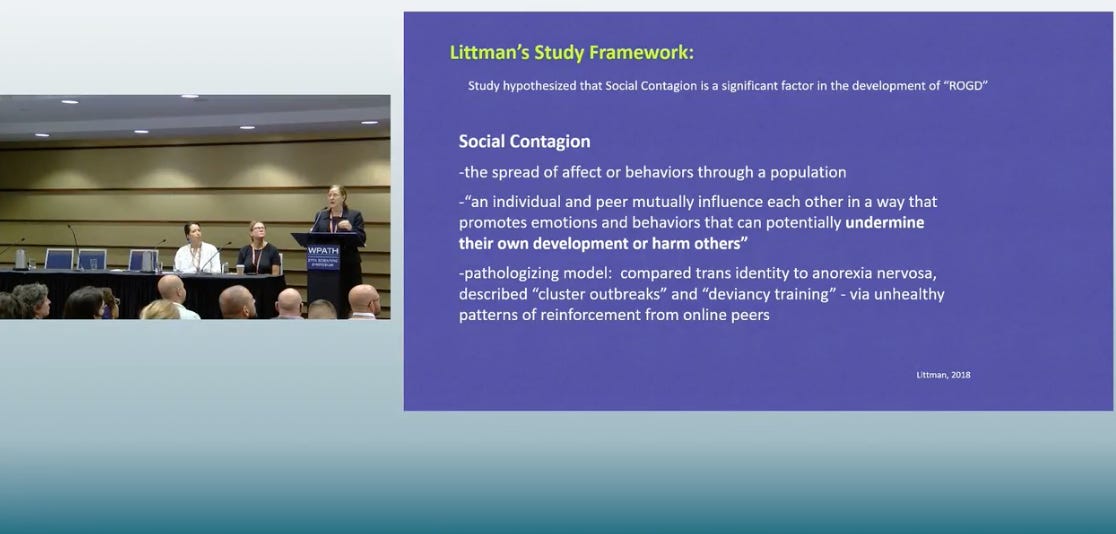
Dr. Szilagyi was especially disdainful that the study was a survey of parents, not of transgender youth.
ROGD, she said, is “not a clinical condition. It’s not a diagnosis, but it’s still out there.” She then cited a 2022 Canadian study that found, she said, “there’s no association between more recent onset of gender knowledge and increased involvement with online gender supportive peers or engagement in their gender identity.”
“So not only no evidence to support Littman,” Dr. Szilagyi said, “but evidence to argue against her hypothesis. But we all we all knew it was wrong.” The social-contagion theory, she said, “shows an essential misunderstanding of the development of gender identity. It’s not because your best friend told you to be trans. It also suggests that other external influences can change your gender identity, anybody’s gender identity. And obviously, there’s this clear underlying assumption that that trans identity is not desirable or pathological.”
Dr. Szilagyi referenced the 2015 U.S. Transgender Survey, which was a survey of adults currently identifying as transgender. Despite the fact that, by definition, such a survey would likely have excluded most people who had detransitioned and never retransitioned, she used the survey data to draw conclusions about the overall detransitioning rate of just 8 percent, 62 percent of whom said the shift was only temporary.
As I have written before, one should treat with skepticism anyone who expresses confidence about what the detransitioning rate for people who transitioned medically as minors is. The fact is we simply do not know what the rate is.
Dr. McNamara returned to the podium to present her own talk. Science denialism, she said, followed an age-old playbook that over the generations has targeted and distorted the public’s understanding of HIV, climate change and tobacco, for example. These misinformation campaigns, she said, were driven by corporate interests and religious extremism, and ultimately hurt LGBTQ people, children and adolescents and “Black, indigenous and Latinx people.” She said that “the tools of science denialism are racism, homophobia, ableism, economic discrimination.”
Dr. Szilagyi, she said, “gave us a really good breakdown of some of the misinformation. Why social contagion isn’t real, why rapid onset gender dysphoria, regret, desistance—all these things aren’t real. But then what we’ve also seen are just these like outright falsehoods. ‘People are experimenting on children. People are castrating children.’”
The castration claim depends on one’s definition of “children,” since a physician at Oregon Health & Science University said at the 2021 USPATH conference that they performed vaginoplasties on minors—specifically 17 year olds. That operation includes a bilateral orchiectomy—i.e. castration.

Benjamin Ryan@benryanwriter
OHSU Performed Vaginoplasties On 17 Year Olds Oregon Health & Science University urologist Dr. Geolani Dy said that for “a lot” of the hospital’s young patients, the timing of a vaginoplasty (a surgery that includes castration) “will fall around the seventeen-, eighteen-year-old
4:30 PM · Apr 1, 2026 · 47.5K Views
16 Replies · 60 Reposts · 224 Likes
One person in the audience argued that it might not be worthwhile to argue about social-contagion theory if it is based on the principle that it is not good to be transgender. “Similarly,” the audience member said, “viewing regret as this thing that does not or should not happen is steeped in cisnormativity, rather than allowing regret to be a normal part of people making decisions and changes in their life.”
Nowhere in this question was there a consideration of the potential harms of medical interventions given to minors that can impact fertility, sexual functioning and the removal of healthy body parts.
Nevertheless, Dr. Szilagyi responded to the questioner: “Totally agree, 100 percent.” Gender exploration, she said, is “normal and healthy.”
Dr. McNamara added: “we also have to consider, like, the IQ of the people that need to hear the very, very, very basic messages.”
Speaker1: [00:00:02] Um, let’s go ahead and get started if we can. Welcome. Hello, this is the panel on the Misuse of Scientific Information in Law. Um, and let me introduce our panel. So, uh, the slide is up there. You can see it. Uh, Jennifer Levi is the director of the transgender rights program, uh, project at Glad, which is a major us, uh, LGBTQ rights, uh, legal organization. Uh, the second speaker is me. Uh, I’m a lawyer. I’m a law professor. Uh, and I’m a public policy person. I’ll talk a little bit about that. Kristy Oleszewski, uh, who is, among other things, the director of the Yale Pediatric Gender Program. Kristy could not be with us today. Uh, but Meredith will go through her slides. Um, Natalie Szilagyi, um, is at the Yale Child Study Center and the director of the Greenwich Center for, um. Uh, it’s on the slide there. I’m trying to read it. Greenwich Child and Adolescent Psychiatry, Greenwich Center for Gender and Sexuality. And Meredith McNamara, who is an assistant professor of pediatrics and a specialist in adolescent medicine. So we’re going to talk about the United States today. And as our title suggests, we’re going to talk about the misuse of scientific information, not just out there in the ether, not just on social media.
Speaker1: [00:01:36] We are all wearily familiar of that. Uh, but now our focus is actually when this scientific misinformation, false statements about the scientific evidence are enacted into law. We’re seeing this pervasively in the United States. We’re from the US, so we’re going to focus on the US. Um, but we’re very interested in the international experience. We’re not the only country that is experiencing this and would love to connect with any of you from elsewhere, from the United States as well, but also from elsewhere. I also wanted to acknowledge, before we start, we will be talking about some specific interventions that some of us in this group have made in legal debates in the United States. We have filed amicus briefs, we have filed regulatory comments. We in an effort to correct this scientific misinformation. It’s an important project. We’ll talk to you about how we’ve been doing it. But before we started, I wanted to acknowledge some of our co-authors who are not on this panel but have contributed to the work, and I want to acknowledge them. So Laura Cooper Hussain, Abdul Latif, Susan Boulware, and Rebecca Carmody. So Jennifer is not here, but we are going to play her recorded, uh, presentation.
Speaker2: [00:02:54] I’m Jennifer Levi. I’m an attorney with Glbtq Legal Advocates and Defenders, and I direct the Transgender Rights Project there. I’m also a law professor and I teach at Western New England University. I’ve been doing work with the transgender community, uh, for now, about 25 years. And it has been remarkable to see so much progress made over that time, as well as to see really, the growth of a tremendously vibrant community and the development of the World Professional Association for Transgender Health path as a professional association. It’s also remarkable to see the alignment of so many other professional associations with W path, uh, and their focus on transgender health. I’m thinking here about groups like the APA’s, The Endocrine Society and many more. Unfortunately, uh, we are also seeing recently some significant political backlash against the community, which at the moment is targeting transgender young people, their families, and their medical and mental health providers. These efforts seem to be clearly part of a coordinated, nationwide strategy to roll back protections for the community. The the fact of that coordination is obvious by what we are seeing in terms of similarities across different state legislatures, as well as in specifically the experts that defendants, state agencies and states are relying on in cases in which these reactionary laws are being challenged. The. The backlash largely breaks down into three subject areas, which I will discuss today. Uh, and I do want to say, though, that, uh, I’d like to say this as a comprehensive description of the kind of backlash that the community is facing, but it’s really not.
Speaker2: [00:04:56] So first, I want to focus on, um, a number of states that have proposed and to many have actually passed laws that prohibit transgender young people from getting the medical care that they need. This has happened in Arkansas, Alabama and Arizona. In Arkansas, the legislature passed a law prohibiting physicians and other health care professionals from providing gender transition procedures to anyone under the age of 18. This includes prohibitions against young people getting puberty suppression medication, as well as hormone therapy in cases where those treatments are needed. A law passed just this spring in Alabama goes arguably even further by subjecting anyone who provides gender transition procedures to anyone under the age of 19 to serious criminal criminal penalties, including up to ten years prison sentence. It’s really quite astounding. Um, it’s important to note that in both Arkansas and Alabama, the laws were challenged before they went into effect, and federal district judges in each of those states issued orders preventing those laws from going into effect. Those cases are ongoing, with the states of Arkansas and Alabama appealing those early, very positive rulings. But in terms of the state of the law, providers can and are continuing to provide medical care for young people in those states, though obviously they are in jeopardy depending on how those cases go forward. The second area I want to address is what we are seeing in terms of youth being targeted in schools. Florida received a lot of attention recently for passing what has been referred to as the don’t say gay or trans law.
Speaker2: [00:06:39] That law prohibits any classroom instruction on sexual orientation or gender identity in grades K through three. And what we are seeing and hearing is that the law means that kids, for example, with LGBTQ parents, may not be able to talk about their families. Kids with LGBTQ people in their lives may be restricted in how they can report about what they did on their weekends. And we’re hearing already that teachers are changing curriculum to avoid talking about anything that touches on the lives of the LGBTQ families in their communities. This is, uh, to say the least, devastating for young people. You know, imagine being an eight year old, disciplined for talking about your transgender mom or dad, or a ten year old told not to talk about their trip to a museum with a gay uncle. It’s really devastating, not just for the kids with LGBTQ families, but for all kids who are getting a hostile message about what it’s like to be LGBTQ in their communities. The Florida law also creates a punitive enforcement mechanism where if a person complains about, for example, a child talking about what they did on the weekend with their two moms, that person can complain to the school. And if they don’t like how the school responds, the complaining parent can actually bring a civil lawsuit against the school and potentially receive a damage award against the school if the individual’s lawsuit is successful.
Speaker2: [00:08:04] In other words, in addition to prohibiting discussion about LGBTQ topics in school, the law creates a financial incentive for community members to be vigilant and monitor the school’s compliance. Alabama passed a similar law extending the prohibition against talking about LGBTQ issues in schools up to the fifth grade. And these, these, these, these laws are creating models for other states to consider as well. You can really just imagine how devastating these school based conversation bans will be for LGBTQ young people and and their peers going forward. The third and last area I want to highlight relates to sports. We have seen a dramatic increase in the number of statewide school based sports bans on transgender youth. We already know that transgender young people participate in school sports in dramatically lower numbers than their peers, and these laws make it impossible for for those even lower numbers of young people to join sports teams and clubs. And it also sends a statewide message that transgender young people are less than or inferior than their peers. The impact of young people is really devastating. There are growing numbers of of these laws and the it’s close to to 20 state bans at this point. The only tiny sliver of light here is that where these laws are challenged? Courts have seen the bans for the bias that they reflect in Idaho, Indiana and West Virginia. Courts have stopped these laws from going into effect. There’s a current case in Utah as well going forward to hopefully the same outcome.
Speaker2: [00:09:44] So I wanted to tee up the discussion of these three areas for my colleagues on this panel to talk about the ways in which proponents of these discriminatory laws and defenders of these discriminatory laws are actually abusing and misusing research to distort the truth and the underlying facts about transgender young people and the well-established medical care that many young people need. For example, what we know is that gender dysphoria is a real and serious medical condition, that it can impact youth and adults, that there’s a course of care and treatment that is well established and evidence based, and that there is voluminous research to show that the treatment, including the use of puberty suppressants and hormone therapy, when appropriate, is highly effective in resolving the clinical distress transgender people, including young people, can experience if they are not allowed to live consistent with their identity. I probably don’t have to tell you all listening, that the standards of care have been developed by W path and reflect decades of research, and of course, there’s now extensive data that shows both the safety and efficacy of care and treatment of gender dysphoria and minors. But as others on this panel will talk about, that research is being twisted and distorted by legislatures, government agencies and individuals to try to support the kind of backlash laws that I’ve been speaking about. So with that, I will turn it over to others on the panel to discuss in more detail the way that is happening.
Speaker1: [00:11:24] Great. I’m just waiting for the slides to come up. You guys are so efficient. Thank you. Perfect. Seamless. Seamless AV here. Um, so, uh, uh, in these anti-transgender, they’re clearly biased laws. Okay. There’s clear bias. You know, let us just be clear, okay? These are discriminatory laws. They’re cloaked, however, in the language of science. And that’s extremely dangerous. It threatens the integrity of the law, right. When lies are enacted in law. That’s bad. Right? You may have a low opinion of law and lawyers, but we do actually try. We do. You know, there is actually a higher ideal in which the law should be have some integrity. And these efforts threaten that. They also threaten the integrity of science. And as we’ll see, the proponents of these bans that Jennifer was talking about are deliberately trying not only to misstate the facts, but they’re putting forth false experts. They are, uh, as well. They are, um, uh, spreading their message of hate across US states. So I’m going to give some examples. I won’t read every example that I have for time reasons, but I wanted to show you. And by the way, I’m going to my slides have three examples. I could have given you hundreds. The kind of misinformation we’re about to see is rampant. Um, it is being spread by I will talk about a relatively small but intense group of advocates, and it’s being then picked up by these legislators and used for craven political purposes to persecute people. Um, I have a warning at the bottom of this slide because the language is offensive, outdated, uh, it’s at best outdated.
Speaker1: [00:13:16] It is offensive. It is harmful. Uh, but I wanted you to see the law as it’s being used. So the first one here, this is a claim. This is the Alabama so-called Vulnerable Child Compassion and Protection Act. That’s the law that Jennifer talked about that will send physicians or other health care providers who prescribe gender affirming medical care to their patients under age 19 to 10 years in jail. Uh, and the law itself states that the medical community is aggressively pushing, uh, to alter the child’s hormonal balance and remove healthy organs. This is the language in the statute itself, uh, when the child expresses a desire to appear as a sex different from his or her own, this is a it is so nice to be in front of this audience. I do not have to go through why this is a wrong, offensive, inaccurate and so on. But this is what the legislators say. Here is a slam. This is very, very common at warpath and the Endocrine Society in particular, uh, making the false claim that, quote, the majority of young adolescents who are transgender will ultimately no longer be transgender. That is a false statement. Uh, it’s extremely common. And then here is this is so that last statement was from the Florida Agency for Health Care Administration. The the state of Florida in August of this year banned Medicaid coverage.
Speaker1: [00:15:01] That’s public health insurance, band public health insurance coverage for gender affirming health care for people of all ages. All ages. Um, here is the Texas Attorney General stating falsely that there is and my my highlighter. It looks like I highlighted, uh, while impaired there, but it’s just a, uh uh, it’s just an artifact. I will claim it’s just an artifact of the, uh, the slide. Uh, the Texas attorney general states, falsely, that there is no evidence that long terme mental health outcomes are improved, or that rates of suicide are reduced by gender affirming medical care. Um, uh, all of these in official legal sources. So these are not just people bloviating on Twitter. These are legal officials using the coercive power of the state to mischaracterize transgender people, to mischaracterize and deny gender dysphoria, and to discriminate against transgender people in health care. So I’m focused on health care. Jennifer talked about some other laws. We’re focusing on health care in particular. These same groups are repeat players. They often oppose LGBTQ equality. More generally, they oppose reproductive rights. So it’s all a stew, a very toxic stew. But these people have been extremely effective in persuading. I mean, it’s it’s terrible, but in persuading politicians cynically that this is a winning issue for them, in some states, these are often explicitly religious groups. Couple of quotes there about assisting the Catholic Church and about God’s design for marriage and family. But the kind of scientific misinformation we’re talking about, you know, I’m pointing out to you that these are religious groups that their their animus against LGBTQ people and against women.
Speaker1: [00:17:00] Let’s be frank, uh, is, um, is religiously motivated, but they typically hide this. They typically have two faces, right? So to their faithful right, they are talking about the Catholic Church and God’s design for the family. But when they file legal briefs and when they enact regulations, they pull back from that. They disguise their religious motivation and instead they claim that the science is on their side. They target the media. They’re extremely effective in targeting the media and in selling a narrative to journalists. Right. So a lot of journalists don’t know anything about this. Journalists tend to want to see, quote unquote, both sides of the story. These people are right there. Oh, w path, they say, is an advocacy group. That’s their slam, right. The W path is just a closed clique of advocates. They say we are on the other side. That’s their narrative. And it’s been quite effective in the US media. They attack medical authority, they attack w path. Most recently they have attacked the American Academy of Pediatrics, which supports gender affirming care. They attack the Endocrine Society and of course they attack providers. Um, one of our colleagues was recently the subject of a just an absolutely nasty, uh, attack on social media, uh, full of false claims. They also how did they create this appearance of scientific debate? They’re very sophisticated. Um, they put they put forth experts, so-called.
Speaker1: [00:18:31] I have to I have to do the scare quotes here. Right. They put forth experts, these people often, I have to say typically. Right. I’m going to say typically as a waffle word, but I want to say always have few or no relevant clinical or research qualifications. But again, to, uh, to someone who doesn’t necessarily know this field, an MD is an MD, a PhD is a PhD, right. One side, the other side. Um, they also have websites that purport to be scientific societies, but are actually anti-trans fringe groups, and they file legal briefs, opinions and so on. So I’m short on time. I won’t go through this. The, uh, the, uh, this let Kids Be kids is not my banner. This is the State of Florida’s banner that they slapped on a report saying claiming incorrectly, falsely, that gender affirming care is, uh, experimental, that it’s investigational, that it fails to meet generally accepted professional standards. And their slogan is let kids be kids. Uh, right. And so how how do we counter misinformation? Meredith will talk more about this. Um, so I’ll just talk about it briefly. I’ll talk about it briefly. The first strategy which Jennifer mentioned is litigation. Right. So when these health care bans have gone into effect or when they’ve been enacted, we have the ability to challenge them in litigation. And as Jennifer mentioned, the one bright spot in all of this is that so far, the great majority of US courts have held the line and have invalidated these laws or have, I shouldn’t say, invalidated.
Speaker1: [00:20:22] The procedurally, the trials are still ongoing, but they have enjoined these laws. They have blocked them from going into effect so that gender affirming care can still be provided in Arizona and Alabama. Um, Arkansas litigation in Florida is uh, has just commenced. So at the moment the Florida ban is in effect, but there is literally a hearing on this movement to block the law coming up very soon. How can we help? And by we, I mean the expansive we, I mean law professors, lawyers that care about this, activists, scientists in particular. How can you help? Well, you know, there are all kinds of ways that experts can intervene and be useful in litigation. And I would really encourage people to do this because, you know, I come at it from the law side, right? We don’t know any science. We don’t know any math. That’s why we went to law school. Okay. Um, uh, and so, you know, it, it, it means that we are, among other things, naive readers of the literature. Right? We are not seasoned readers able to distinguish, you know, I mean, we we we have those of us who do work in this area have developed a feel for what is correct, but we’re not able to bring to bear the expertise that you can bring to bear to, um, identify the best studies and to address the attacks that are made on these studies.
Speaker1: [00:21:48] Because one of the key strategies is that that proponents of these discriminatory laws use is that they will cherry pick the science, they will mischaracterize studies. I would bet there are people in this room who have either been attacked or who have had their work mischaracterized, misused. They will say that studies, I mean, they’ll just lie, right? They put lies out there and then it is up to the other side to refute those lies. Lawyers try. We need your help. Um, the medical societies have started to become quite active. The AAP, the Endocrine Society, w path have all filed amicus briefs, which have been crucially helpful. You can if you read the court decisions that block these laws, you can see the influence of the medical societies. Um, what else can you do? You can also do scientific writing that is oriented to a legal audience. And that is what the group that I mentioned at the beginning. And those of us sitting here and Christie have been doing, um, there is, of course, traditional medical journal publication, which is helpful and useful, but that’s of course, cutting edge research. Right? That is precisely the stuff that the lawyers have. You know, we cite it, we try and use it. That’s a little bit harder for us. There’s a kind of exercise of translation that is extremely helpful to the legal community. Um, uh, in rebutting this information. And so I’ve given you some examples there in my slides. I’ve given you full citation.
Speaker1: [00:23:19] We did our group did two really lengthy. These are like 50 pages, single spaced point by point rebuttals. We went through these legal documents and we said, they say X, this is not true. Here are ten citations. They say why this is also not true and it’s a mischaracterization, mischaracterization of this study and so on. So this kind of detailed work that can then be used by litigators, it can be read by journalists so that they have some foundation for addressing. Um, and, and one of the things we’ve also done is that we have called out the purported experts that are being put forward and saying, look, person X does not have relevant qualifications, and person X seems to have indicators of bias given their presence in hate groups like the American College of Pediatricians. For those of you who say it seems like a lot of people know what the American College of Pediatricians is, it’s this misleading group that purports to be an international pediatric medical society. It is a hate group that opposes LGBTQ rights and has been a key source for misinformation dissemination. So I’m going to stop with that. I’ve got, um, uh, sources there. Uh, if anybody wants to read any of these things and Christy, as I mentioned, is not able to be with us, but Meredith is going to go through her talk, uh, talking about really important, uh. Impact of this legislation on, uh, stress that is being experienced by people.
Speaker3: [00:25:10] All right. So so it is my pleasure to present in Doctor Stead. She’s currently New Haven and really wishes she could be here. She does extraordinary work with the Yale Gender Program. She’s a clinical psychologist, and every day she sees the impact that hateful legislation has on young people everywhere, not just in the jurisdictions where these laws directly affect them. So, um. This is just kind of a breakdown of some of the professionals affiliated with the Yale Gender Program. Um, Doctor Olszewski is the director. Our medical director is Susan Boulware. We have a multidisciplinary team of endocrinologists, a psychiatrist who gets involved, legal supports. A lot of these, uh, individuals kind of represent similar structures and other gender programs. Um, we’re going to talk about the mental health concerns associated with minority stress. Kind of define what that means. Um, the impacts of these associated stressors and then talk about positive impacts of support. So we know that the trans and gender expansive community, um, particularly youth, face a very high, um, burden of mental health issues. Um, I think one thing that I really took away from our first session today was just not trying to parse out the directionality, just kind of accepting that these are co-occurring issues and that all of them need to be addressed. Right. Um, young people are facing a high incidence of depression and anxieties, eating disorders, victimization, um, either self-harm or suicidal ideation and attempts.
Speaker3: [00:26:48] They face high rates of inpatient hospitalization during a profound mental health crisis in which these resources are barely even available. Um, substance use issues and then HIV as well. Um, these statistics, I think, are things that we are all very familiar with as professionals in this field. Um, what I would like to kind of break down a little bit more is just what the gender minority stress model actually is. So distal stress factors, meaning just kind of knowing that they’re out there, that there is hate directed directly. Uh, um, basically, targeting your own personhood creates a very toxic environment to grow up in. Um, it creates a very, uh, untoward set of challenges during the most developmentally dynamic period of one’s life. Um, so gender related discrimination, rejection, victimization, non affirmation of one’s identity. Um, these feed into worse mental and physical health outcomes. Um, proximal stress factors will lead to kind of like what’s internal. So transphobia kind of self directed hate having very negative expectations of the people around you support systems your life in general, feeling rather futureless and then concealing your true self for purposes of safety or to avoid hate. Um, there are protective factors or things that can be considered resilience factors like community, connectedness, pride, that sort of thing.
Speaker3: [00:28:21] Just to kind of let you know what this looks like on the ground. When I meet with a patient who is trans, gender expansive, non-binary, and I sense that they’re going through a hard time and they do volunteer with me, that they feel very. Threatened, unsafe, no future orientation. One of the things that I try to do is to foster a little bit of resilience by telling them about the work that we do, and I just try to say, look like there are people out here who see you, who believe in your right to exist and who are protecting it every day. This is just a little tidbit of something I’m just trying to present, uh, to foster resilience in a clinical encounter for whatever, whatever benefit that has even being small. Um, so over the past year or so, we’ve seen crisis calls escalating, like I said, in centers that are not within the jurisdiction in blue states, in places where youth are. Not facing an imminent loss in their health care. And then paralleling that, I. Some of you may be familiar with the research after Marriage Equality, which shows that youth mental health outcomes, suicide rates plummeted because youth felt like they were more excited about coming of age in this world.
Speaker3: [00:29:33] So the converse is also true, and we’ll talk about that in a sec. So these laws, the media attention that surrounds it, the propagation of misinformation on large public platforms, it provides cover for increased violence and harassment towards members of the community, which in turn leads to worsening mental health outcomes and in internalized transphobia. Um, a lot of the personal family accounts coming out of Texas now, kind of in the aftermath of this child abuse allegations, are absolutely horrifying. Certain parents have been very brave in sharing these stories just to kind of draw attention to it. Um, these are just some very upsetting headlines that, um, can capture the current crisis that we are all practicing within and that our patients face daily. I just want to say, like, we think it’s bad when, well, we understand, but when health care providers are being targeted for the work they do, just imagine how bad it has to be for the people whose daily lives this actually is. And it’s really I personally feel like it’s frustrating when that’s what gets media attention and not the the daily realities of safety and, and those types of things for our patients. Um, however, representation matters access to information, appropriate supports, community connection, fostering pride.
Speaker3: [00:30:58] Um, these there are legislation that foster these things. There are media efforts that kind of are pushing back and also growing in voice and power. So we do know that these are positive resilience factors, that they do promote the well-being of these, um, of young people. Among the interventions that have had a direct impact on the mental well-being of trans youth. So psychotherapy, medical care, medical affirmation, community supports, legal supports and then legal supports, I think for our group is taking on new meaning. What that also means is being proactive in fighting back, not just being defensive, um, and trying to hold ground, school supports and then environmental safety. Um, we bring this up mostly because we want this audience to know that we’re very conscious of the imminent harms that this legislation poses to our patients, that we’re conscious of the fact that it occurs at a really important time in one’s life. I’m an adolescent provider, so I care about adolescent development more than anything in the world. And that that we recognize that we have kind of two directions to go in. It can either get worse or it can get a whole lot better. Um, I will pass it on to my colleague. Doctor Natalie Wasilewski. This is all you do you need. Oh, they’re going to do it.
Speaker4: [00:32:32] Thanks. Hello. Hi, I’m Natalie Szilagyi, a really hard to pronounce last name. And that’s okay. My kids call me my kids. My my patients call me doctor S. Mostly, I’m a child and adolescent psychiatrist in Connecticut, and I’m so thrilled to be speaking with you all. Um, as you could probably guess, we’ve been having problems with my slides, so apologies in advance. Hopefully this will work. Um, I’m going to be talking about what the scientific evidence actually is around social contagion and regret, which are two of the main claims that sort of anti-trans legislators and opponents, and I’m biting my tongue and not saying mean names to describe them, but you know what I mean? Um. Um, I have no disclosures. Um, Acap has trained me. Well, I always throw in that slide. Um, so the claim, right. Claim number one, social contagion leads teenagers to become transgender. Um, what’s it based on? Um, mainly. Really predominantly stereotypes. Stereotypes around adolescents and young adults. You know how kids are. It’s because they were hanging out with the wrong crowd. It’s just a phase. Um, but there’s one study, right? There’s one study that they all come back to. It’s Lisa Littman’s study from 2018. Um, and I put the actual official title in there because that’s important and it often gets skipped. The title is Parental reports of adolescents and young adults perceived to show signs of a rapid onset gender dysphoria.
Speaker4: [00:34:09] Um, so very quickly it caught on. You’ve probably all heard it right. Rogde rapid onset gender dysphoria. It’s this thing and what people are commenting on it throughout different media sources. Okay, it’s not really a thing, right? She invented it. Here’s how she defined it. She defined it as the presentation of trans gender identified adolescents and young adults who did not appear to meet clinical criteria for gender dysphoria during childhood. And this is her language again, yet suddenly exhibit gender dysphoria during or after puberty by disclosing their trans identities to their parents. I mean, here you all can see like five things wrong with that, right? Um, um, study more than five. Yeah. Sudden. Suddenly. Yes. Yes, exactly. Her framework was a mess, right? Her framework, she hypothesized, among other things, that social contagion is a significant factor in the in the development of again, she she claimed it immediately rogde um social contagion in general, as you probably know, we talk about it as the spread of affect or behaviors through a population. That’s a legitimate thing, social contagion. But she immediately applied. She applied it to trans gender identity. Right. She said, described it as an individual and pure, mutually influence each other in a way that promotes emotions and behaviors that can potentially, and again, her language, undermine their own development or harm others. Pathologizing right. Clearly, from the outset, Pathologizing she really dove into the Pathologizing model? Um, she compared trans identity to anorexia nervosa.
Speaker4: [00:35:56] She used language that we in psychiatry use around suicide outbreaks, you know, cluster outbreaks. She even used the terms deviancy training like outrageous. Right. Like how how did she get published? Um. Um, the answer is there were so many flaws. Eventually, her publisher demanded and published a correction the following year. But in the meantime, it got out there. Um, you can tell I get fired up, right? I sometimes like, say, like, oh, I feel like a Pentecostal preacher. Right. Um, um, but I’m going to go ahead and do my do my Pentecostal preacher thing. There’s so much wrong with this. I could I could preach on this one for an hour alone. I won’t these this is a summary of like, I don’t know, like the eight most egregious flaws with this study. There’s so much she didn’t ask the youth, right. It was only parents. It was such a biased sample. It was ridiculous. Um, very narrow demographic. And there’s this big assumption that she didn’t come out and say that when a kid comes, when a kid realizes they’re trans, they immediately come out and tell their parents, like, has she never met a kid? Right. So, um, important, given how widespread and how kind of publicized this got, is that no clinical studies have been found to show that it actually even exists, and no professional organizations recognize it.
Speaker4: [00:37:32] It’s not a clinical condition. It’s not a diagnosis, but it’s still out there. Um, a Canadian study, we have one study. And if this person is here, God bless you. Um, it, um, they they looked at whether there was an association between the timing of knowledge of gender identity and other outcomes. Right. Was there an association like Littman would have predicted? Um, so if Lipman’s hypothesis is correct, then you would expect to see teens who started identifying as trans more recently, they’d be more likely to have big influence by social online influence, right? They’d be more affected, more involved in and more affected by online trans sites, online trans peers, online identity groups. Um, she also said, by the way, and I’ll throw this out there, sort of. Oh, well, we think those kids were probably more vulnerable because they were mentally ill too. Right? That was kind of an aside. Um, the Canadian study by Bauer et al. And when I said she, I meant Littman. You guys probably got that right. But the Canadian study said no, there’s no association between more recent onset of gender knowledge and and increased involvement with online gender supportive peers or engagement in their gender identity. No association between more recent gender knowledge and current or historical mental health issues. So that’s not true either. Um, and in fact, there was lower there were lower anxiety severity and impairment scores among the more recent gender, those with more recent gender knowledge.
Speaker4: [00:39:06] So not only no evidence to support Littman, but evidence to argue against her hypothesis, but we all we all knew it was wrong. Anyway. Um, more problems with social contagion as a theory. Well, it shows an essential misunderstanding of the development of gender identity. It’s, you know, it’s not because your best friend told you to be trans. Um, it also suggests that other external influences can change your gender identity, anybody’s gender identity. And obviously, there’s this clear underlying assumption that that trans identity is not desirable or pathological. Um, boy, I literally just gave a talk on this on Friday, and it was 50 minutes and I rushed and didn’t finish. Right. I gave a talk on the development of gender identity, so I can’t do it in a line. But again, you all know because you’re here. The bottom line is it’s multifactorial and complex. Um, it’s not a single thing. Um, also, trans identity commonly emerges in adolescence commonly. Right. Anybody who works with trans kids and adolescents, we’ve experienced that. We live that every day. Um, and in the US trans survey. Oh, boy. I got two minutes. Sorry. Um, and the US trans survey in 2015, among among trans adults, um, 57% said they first realized they were trans in adolescence. That’s not some rare weird fluke like Littman’s study would suggest, right? That’s really common.
Speaker4: [00:40:37] And of those, 47% started to disclose their identity in adolescence. So yeah, not everybody tells their parents right away. Who would have thought, um, more quickly, one of her arguments was it’s because young people are online more right. And, and there’s such a strong influence of social media, it’s swaying our youth. Um, everybody’s online more. Right. Um, and yeah, social media use is common among children and adolescents. And a study from 2018 showed 90% of 13 to 17 year olds have used social media. It’s probably higher. That was 2018, but only 11. 4% of 13 to 17 year olds identify as trans. Right. Um, can it be changed? Can gender identity be changed through internal influence? No, no, we know that. We know that conversion therapy probably has its own presentation at this conference. No, um. The regret, I quickly I’ll tell you the regret argument. The argument is, oh, these kids will regret it. They don’t let them make this bad decision. They will regret it. Um, the answer the evidence shows that actually the vast majority of trans youth who transition socially remain stable in their gender identity. Um, adolescents with gender dysphoria rarely find that their dysphoria resolves without treatment. Right? Um, different stats for three year olds. But when we’re talking adolescents, right. Um, rarely resolves without treatment. Most adolescents who receive gender affirming hormones for gender dysphoria continue to receive those hormones in adulthood.
Speaker4: [00:42:26] Um, that doesn’t align with these big arguments. They’ll regret it. They’ll regret it. Right? Um, rates of regret, even for adults after gender affirming surgery. Surgery. Major intervention. Right. Still low. Still less than 1%. Um, but I hear this all the time. This stat 8%. And it isn’t even in some of the legislative pieces, right? 8% of trans people regret it. They’re misusing data, right? Really intentionally misusing it. Um, boy, that slide got messed up. Wow. We did so well. Almost right. Made it to the near the last slide. Um, they’re really talking about Detransitioning. And this is based on again on the US Transgender Survey from 2015. The question was and you can’t see it there, I’m sorry. It was. Have you ever gone back to living for any period of time in the gender assigned at birth? And this was a poll of tens of thousands of trans adults in the US, right? Among those 62%, um, among those 8% said they did right. So 8% at any time, for any reason ever went back, right? Um, that’s 8%. Remember who was being told it was trans adults, so they were still trans adults. They were still transgender people. So that 8% regret that’s that’s not what they were answering. That’s not what they were saying. Um. So Detransitioning does not equal regret. They’re misusing that one. Um, but I will stop. Thank you.
Speaker3: [00:44:19] So, um, I am going to focus now on the science denialism aspect of what we’re seeing here. Um, let me just skip through these guys. So early on when our group assembled and created the beginnings of these rebuttal reports. I remember texting Anne and saying, but wait, how can they do this? Because it’s all false. The problem is this really hasn’t happened before. So it is perhaps not fair that this should fall on this community to to be kind of like ground zero for combating science denialism in health care in general. But this is the challenge that was handed to us and how we recognize it. And what we do about it is really the inflection point that we’re all at right now. So, um, what I would like to pose to you is that a joint collaboration between medical and legal experts can kind of come together and create something more powerful than what they could create, alone or separately, to effectively bring integrity and combat science denialism and health policy. I’m going to be speaking a little bit more generally. Um, what I would like to focus on is two specific graphics for the time that I have with you all. So science denialism is actually an old strategy in this pink circle right here, you’ll see a couple of areas where science denialism has been rampant. The president of South Africa for ten years denied the existence of HIV and Aids. There was no law saying you couldn’t talk about it or it didn’t exist.
Speaker3: [00:45:57] But he denied it. So it did. Ronald Reagan Ronald Reagan said, this is a gay disease. And that’s that false. Absolutely, patently false, but not legislated. Climate change has been outright denied. It’s been denied by people in industry, by politicians who have vested efforts in continuing to pretend like it doesn’t exist. The health harms of nicotine and tobacco have been dramatically underemphasized so that we can sell those products. Studies have been more misrepresented, presented in Congress. And then there you go, science denialism. But it’s still not legislated. The reasons why science denialism is propagated in these areas are in the purple circle here. So you’ve got religious extremists who have their own point of views, their own agendas, corporate interests. It’s a little bit different with what we’re dealing with now. But as you’ll see, the tools of science denialism are racism, homophobia, ableism, economic discrimination. These are all things that spiral outward from the black hole of science denialism, and the harms directly fall upon LGBTQ people children and adolescents, black, indigenous and Latinx people. That stays constant. So. Now legislation is starting to experience a little bit of decay from the inside out because of science denialism. It’s a new threat in the legislative process. Specifically, we’ve seen this happen with Covid 19. A federal judge ended a school based mask mandate and said, we don’t need it anymore, completely denying the scientific realities of infection in children and the ability of masks to prevent severe Covid 19. This was before kids could even get vaccinated.
Speaker3: [00:47:42] Um, with regards to reproductive health care, state based abortion bans in the Post-roe era, again completely denying the scientific realities of human reproduction. There are people who are making laws about reproductive health care that really don’t even understand it. I’m not talking about agreeing. I’m not talking about ideology. I’m talking about a complete disregard for what a miscarriage is, what plan B is. How is that happening? Right? It’s happening because it can within the realm of transgender rights. So Natalie gave us a really good breakdown of some of the misinformation. Why social contagion isn’t real, why rapid onset gender dysphoria regret desistance all these things aren’t real. But then what we’ve also seen are just these like outright falsehoods. People are experimenting on children. People are castrating children. Putting this stuff in law, actually putting them in legal documents that put forth harmful legislation. We’ve never, ever seen this before, to my knowledge. If somebody knows of another example, that’d be great because I’d love to read about it. But this is a really weird landscape for us to practice in. And then within the past, I don’t know, year or so we’ve seen criminal, um, punishments levied against clinicians, parents, teachers, private citizens. That’s never, ever happened before. So I’m not trying to scare us all. I’m trying to pump you up so that you feel like you like you have a you have a role to play in every single one of these areas. Okay? And that’s what I think is so powerful, the type of so we I won’t actually go through each one of these because we’ve already kind of gone through these laws.
Speaker3: [00:49:26] Um, what I do want us to pay attention to, though, is how some of these laws have actually been challenged. And are this these challenges are going on right now. So in Bell versus Tavistock in the UK, NHS physicians provided accurate information on puberty blockers. Inaccurate information was in the first decision. They said hey, wait a second, that’s a little bit of playing catch up, right? Because it’s crazy that that was even allowed to pass, that the decision was even allowed to be, um, passed down by the High Court in Alabama, for instance, a multi-institutional, over 20 to 30 medical organizations put together an amicus brief that explained the medical benefits of gender affirming care, the realities of gender dysphoria, dysphoria, and debunked expert witnesses. So, um, Florida is kind of this new place where we’re going to see what happens. A lot of our work in both Alabama and Florida was putting together these extensive, detailed rebuttal reports that are online. You can read them any time you can borrow the language, but what we really wanted to do was to put. Correct information into the public record, so our public comments have to be responded to. The state has to respond to them, and you can’t respond to fact and say that it’s false. Like, like good luck doing that. It actually doesn’t hold up in court. There are other things at play.
Speaker3: [00:50:51] There are ideological arguments. There’s a lot of extensive lobbying on both sides. But what we really want to do is to put integrity into how laws that govern health policy function. So it’s not just gender affirming health care. It’s not just reproductive health care. It’s not just public health strategies to mitigate the spread of infectious diseases. It’s kind of everything. And what I really want you all to feel today is that you have a role to play in how this stuff unfolds, that you have expertise that needs to be heard not just by your patients and their families, and not just by the media, but by actual lawmakers. And like I said, I’ve said it before, like we have not really been in a position where we’ve needed to do this before. So we’re a little underequipped to understand legal procedures. But that’s why I think that these interdisciplinary collaborations can be really powerful. I’m excited to see where we take our next steps with this work. I can imagine a lot of, um, really cool implications, like scientific advisory councils. That’s like a dream. Of course, that’s kind of complicated in and of itself, but, um, I wanted to leave us on somewhat of an optimistic note. Um, because we all do do really important work, and we have to have good, positive energy to keep doing it. So I just want to thank you all so much for your attention. It’s been a pleasure talking to you all. And.
Speaker1: [00:52:25] I think officially we have to let you go. Yeah. Um. Uh, we’re happy to take questions. Uh, if anybody wants to stay, so, I don’t know. Do they need the room, like, right after this, or is there a lunch break or something? Anyway, we’ll stay and talk. Um, but if you need to go, we’re not offended.
Speaker5: [00:52:43] I have a question. Yeah. Um. Can you hear me? My name is Tracy Kurtzman. I’m a pediatrician at El Rio Health, which is the third largest federally qualified health center in the country. We’re based in Tucson, Arizona. Um, and I’m one of four, uh, people doing youth trans care with all that encompasses, including DNA analogs, etc. in southern Arizona. I have a colleague in Phoenix, and right now the other three people who are working with me are kind of training and learning it the way I did about where I started eight years ago. So the reason I’m bringing this up is because, um, of course, you know about the laws in Arizona from March. And, uh, I was asked by the parent support group who I love, and I know so many of these families so well to come and speak to the legislature or write a letter. And I started writing that letter with the intention to go up to Phoenix and to speak to the legislature. When these bills were in committee. Um, and then I had a moment of pause and. It’s no secret that colleagues around the country are being targeted, threatened with death threats. Yesterday, Steve Rosenthal told me there was a bomb threat at UCSF. Um, and the truth is, my kids are out of the house.
Speaker5: [00:54:07] I’ve checked off most of the things on my bucket list. Seen the Rolling Stones in concert. So I’m not I’m not really afraid for me, but I started thinking about it and I thought, you know, these unhinged people, number one, are the people who have a bunch of guns, and number two are the people who came in dozens and protested the day after my health center publicly said, we’re going to require all of our. Employees at this health center to be immunized against Covid. So these people showed up, protested, etc.. My concern is if I go and speak out, is my health center going to be targeted? And if it is, how is that going to impact the care of my young trans patients? I don’t want these idiots to interfere with my ability to give care. And so I am disincentivized to do exactly what you’re saying, which is go to my legislature and say, look, no, this isn’t an expert. You know, I don’t call myself an expert, but I’ve been doing this for a long time, and I know a lot, and I have a lot of experience because I’m worried that it’s going to impact patient care. So any ideas on that? So.
Speaker3: [00:55:25] So you’re. You do incredible work. Thank you so much for everything that you do. And I hope this is a place where you feel like the full love around that. Okay. Solid. So, um, I think you’ve got a call on colleagues who can who are a little bit safer, a little bit further removed, and ask them to do this work with you or even do it for you. And that’s kind of why, like up we’re in Connecticut, right? Like we’re okay and we’re. We are kind of like shields. I view myself as like trying to shield vulnerable people. Like if you can’t speak up in Arizona, then like ask me, you know that, like, we can talk offline. But that’s kind of what I would say is like, like thing number one, um, rely on your colleagues in safer areas for help. Thank you.
Speaker1: [00:56:11] Can I suggest? I mean, we want to hear from as many people as possible. Can I suggest that we just take, you know, kind of alternate microphones and let people speak and we will not, you know, you don’t need to hear more from us. So unless somebody has like a specific question, please, let’s just hear people and just alternate the sides of the room. So please go ahead.
Speaker6: [00:56:30] Hi. Oh. Can you hear me? Okay, great. Um. At noon.
Speaker1: [00:56:36] Okay. Okay, okay.
Speaker6: [00:56:39] Yeah. Um, thank you for your presentation. Um, I have sort of a question, sort of a comment, but I was thinking as you were talking, um, that isn’t like just framing transness as not desirable, like the core of the issue. Um, in terms of, like, you know, for example, social contagion theory is like only a problem if the perspective is that we want to limit the number of trans people or just have trans people and trans adolescents not exist. So is it like worthwhile to spend time arguing against social contagion theory, rather than arguing actually, that it is just like good to be trans and like, you know, similarly, with regret and detransitioning viewing regret as this thing that like, does not or should not happen is steeped in cis normativity, rather than like allowing regret to be a normal part of people making decisions and changes in their life. So, you know, just from my perspective, the argument is just that, like being trans is a good thing that should happen. Um, I know.
Speaker4: [00:57:41] Totally agree 100%. Yes, absolutely. You know, and the whole detransitioning thing, like we talk about exploration of gender identities as being normal and healthy and diverse gender identities being a normal part of human experience. And yet we don’t say, oh, well, you thought you might not be cis, therefore it’s not real. That’s ridiculous. Yes. So I totally agree. Those underlying assumptions need to be challenged and and overturned and rejected. Yeah.
Speaker3: [00:58:11] It’s just we also have to consider like the IQ of the people that need to hear the very, very, very basic messages. And that’s that’s a tough thing to sit with for sure.
Speaker7: [00:58:23] Uh, thank you for an amazing talk. And, uh, really, uh, I am a pediatric endocrinology fellow in Atlanta, Georgia. I’m a person of color. I identify as a gay man, so I feel vulnerable in a lot of different ways in practicing this. But this was really recharging. Thank you. So my first question was going to be around like how to seek support when you are in such a vulnerable position. But you do want to continue the work and you answer that question. Reach out to the colleagues who are in a more safer spaces. So yeah, my second question was, um, uh, in the first, uh, talk, it was mentioned, uh, the scientific publishing, um, to kind of focus on the legislation. So once you publish, like, what are the next steps? Like, who do we email somebody or we just like, I mean, I’m very early in my career, so kind of want to get there.
Speaker1: [00:59:17] Um, I am happy to connect anybody, anybody that wants to do legal facing work, anybody that wants to have their work, you know, just email me. My email is out there. I’m happy to connect people with legally connected folks, and I’m happy to talk procedures and all the stuff that lawyers know. I’m so sorry. I’m Anne Alstott Alstott and if you just Google me, you’ll get my Yale email address. Okay. So I thank you. Thank you so.
Speaker7: [00:59:43] Much for that.
Speaker8: [00:59:44] All right. Hi. I’m an MSK family medicine student here at McGill and a sex educator. My last job was at a as a health teacher. Um, and one particular concern of mine through all of this has been being an advocate while being transgender yourself, while working with youth, um, and the zeitgeist of with all the discourse about grooming and social contagion and how to deal with that. When you are one of the people who stands to be targeted by that discourse. If you have any suggestions for effective arguments back or social coping mechanisms. Just the light stuff. Just.
Speaker4: [01:00:39] I think safety in numbers. I do, I think I think about like like we’re buffered by having lots of names on our, our pieces that we, you know, our rebuttals. Um, maybe you can be buffered with allies and community organizations and, um, I am I’m also a big advocate for finding allies and places where you wouldn’t necessarily expect to, whether it’s like the PTA, right? Or maybe deans at your school. Maybe maybe that’s better here, you know, and you can assume that you’ll find allies there. It may be churches, right? Like find allies, find supports so that you’re not alone.
Speaker3: [01:01:24] I also think every organization now has a vested interest in coming up with a plan for exactly this problem. So it really shouldn’t be on you to think it through. It should be the people that pay your paycheck. And if they’re not doing it, I would say, why aren’t you doing this? Because having you do all that emotional labor is tremendously unfair. It’s not cool. No one’s doing it anymore. So I would actually hold people with more power responsible for these things and ask them to come up with, like a task force for how to protect you at work.
Speaker8: [01:01:57] All right. Thank you.
Speaker1: [01:01:59] It looks like we’re about to be evicted, but can we get one more?
Speaker9: [01:02:02] Hi, I’m Anne Grooms. I’m from Florida, the University of Florida in Gainesville, and I’ve been treating transgender patients for many years. Um, thanks to w past education efforts. Um, two things. One, we had very good University of Florida professors arguing against, um, what the governor put in. Yep. You know, I even talked to a legislator that I know personally. And his response to the don’t ask, don’t say gay was we just have different beliefs. So that was, you know, just distressing. But the other thing I’m thinking is I personally know a lot of our school board members, uh, and I’m wondering, how do we help the teachers and the school board people? Um. Get through this because, you know, they understand. I mean, I’m happy to. The only thing I can think is to go to the school board and say, is there a way we can help you? Can we answer something? Can we talk to somebody? Because the law is the law right now in terms of setting up discrimination and threats for parents and all that kind of stuff? Any suggestion?
Speaker1: [01:03:18] Yeah. I mean, my suggestion would be the one just to endorse what you’ve said. I mean, absolutely go to the school board, go to the school principals, school boards. You know, this the the don’t say gay law in Florida is very, very ambiguous. A lot of school boards don’t know what it means. A lot of organizations, right? Institutions are conflict averse. So the danger is that they will massively overreact. And you know, so yeah, indicating support, indicating expertise, saying, you know, this is off the top of my head, but maybe, maybe a committee or a body that, you know, if a teacher has a question or if a teacher gets in trouble, you know, if the teachers are being intimidated in some way, offer to the school board. Well, we have expertise, we can help and we’re willing to help. Here’s our contact information. Yeah.
Speaker9: [01:04:06] Good. Yeah. Thank you.
Speaker1: [01:04:07] Yeah. I’m sorry we can’t get to other folks. Um, but thank you all.
Comments
Nothing yet. Say the first thing.
Sign in to join the conversation.