
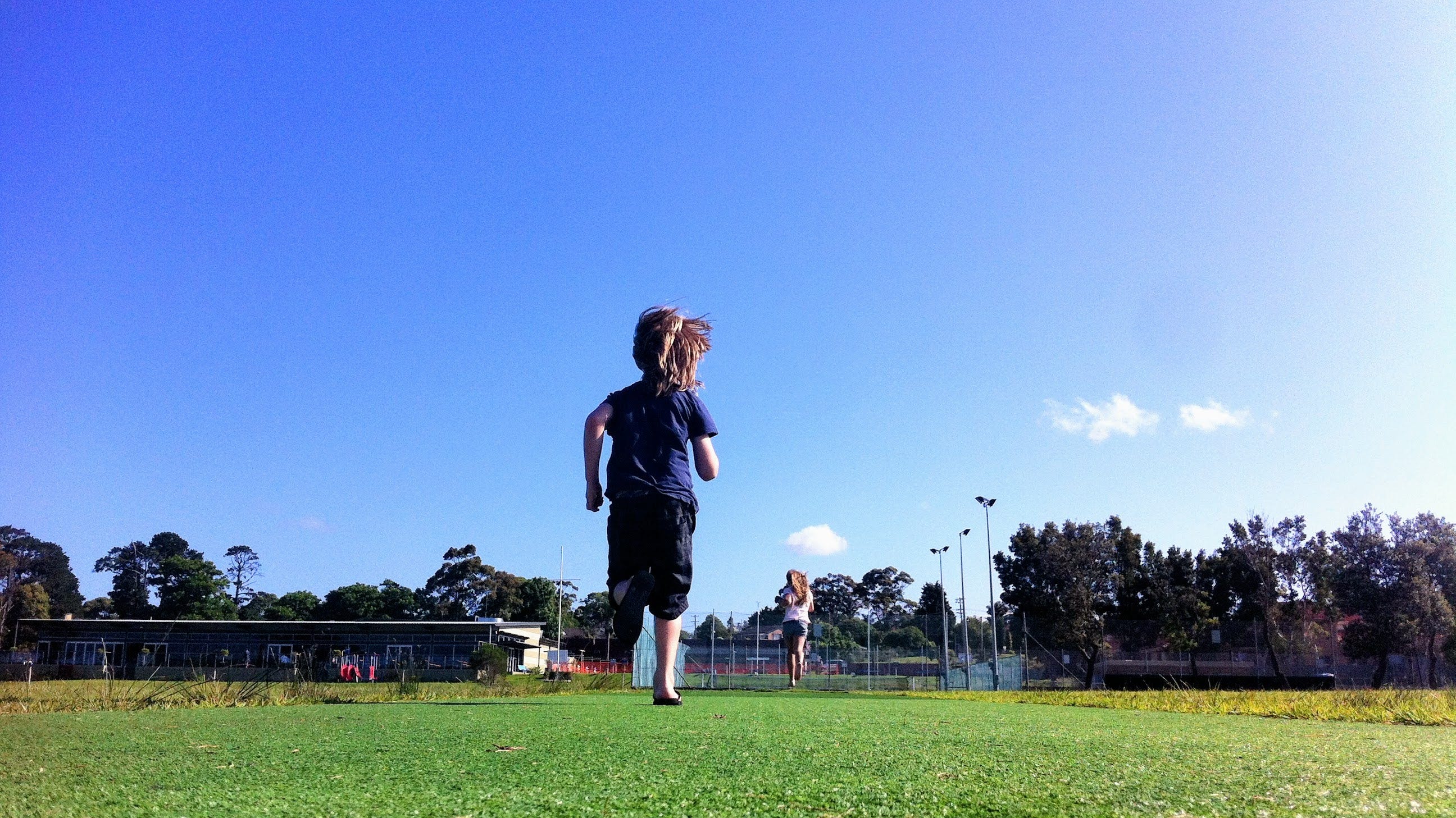
I don’t talk about cricket anymore. My American friends can’t really understand it, and my British friends turn it into an Ashes argument nobody needs. So I pretend it never mattered, even though it stole most of my childhood. Long weekends in cheap polyester, odd white pants, waiting six hours to bat for eight minutes with a bout of heat stroke in an odd wool hat. I’ve done my time.
When Kai was eleven, he came home from school and said he’d played cricket in PE. He asked if we could hit some balls at the nets on the weekend. I felt genuine dread. Not metaphorical dread. Real dread. The kind where your brain shows you a montage of everything you thought you’d escaped. But I said yes, because that’s what you do when your kid is excited about something.
We went to the nets and I did what every washed-up ex-junior cricketer does. I overprepared him. Full kit. Pads, gloves, Hector protector, the lot. I even explained, with way too much enthusiasm, that the red ball I’d brought was new and challenging and could really hurt. He smiled politely the way eleven-year-olds do when their dad is reliving something.
Then I walked all the way back to my bowling mark, shining my ball furiously. For my American friends, this is the cricket equivalent of winding up the trebuchet. The longer the run-up, the more serious the bowler thinks he is. My knees were already asking questions, but I ignored them and charged in like it was 1998. I bowled faster than I had in years, which isn’t saying much, but to an eleven-year-old it may as well have been test-match pace.
(And before my American friends panic, “shining my balls” is not what it sounds like. It is simply what grown cricketers do in public while pretending it is a legitimate athletic requirement. You take the red cricket ball, rub it aggressively on your white trousers with the confidence of someone who once peaked in Year 9, and insist it makes the ball swing. Every cricketer pretends they understand how to swing a ball. But they don't and they don’t (Swing it). It is half physics, half superstition, and half middle-aged adults trying to feel useful between overs to stop the boredom.)
Three balls in, Kai put the bat down and said, very calmly, “I don’t like cricket anymore, Dad. Can we go home now?”! “That’s fine, Kai”, I said. We packed up, went surfing instead, and just like that, I completed life’s greatest act of cricket sabotage (and stolen dreams).
But there was a time when cricket wasn’t something I accidentally ruined for my son. It was the thing I used to measure whether I was any good at anything.
When I think about competition now, I realise how much of my younger life was shaped by the belief that progress meant beating someone else. I didn’t question it, and adults reinforced it. The system reinforced it. Every sport, every schoolyard, every male conversation seemed to orbit around the same idea that improvement was a race and that someone else’s success came with an implied message about your own ability.
The moment I first felt the weight of that belief was in Adelaide when I was a teenager. I’d been invited to a development program, and the whole thing felt too big for this irresponsible, ego manic 19 year old kid (me!). I was batting (that’s cricket talk from my American friends) in the nets with Rod Marsh (Australian Royalty), which felt surreal in itself. He had a way of cutting through any illusion you had about your talent. You knew exactly where you stood by the time you stepped out of the net. I walked out buzzing and unsettled, still replaying every ball, trying to decide whether I’d shown promise or exposed my limitations (I still do that after every meeting or a night on the cans).
Then Ricky Ponting walked in.
He was young, too (well, my age in fact), but he carried himself differently. There was something centred about him that I couldn’t articulate then. I sat off to the back of the nets (batting lane for my American friends) with my gear, watching him take the first few dozen deliveries. The sound of the ball off his bat was cleaner than mine. His reactions were faster than mine. He seemed to be seeing the world two seconds earlier than everyone else in the building. It wasn’t flashy or loud. It was just accurate and composed in a way that made my chest tighten.
The envy hit quick and sharp enough that I knew it was there. I remember convincing myself that I could match him or that I deserved to be that good too. It was teenage arrogance mixed with insecurity, and I didn’t understand how those things fed each other. I walked away that day thinking that if I pushed hard enough or trained long enough, I could catch him. That mindset never helped me. It wasn’t fuel. It was friction. It made me irritated at myself and, if I’m honest, slightly resentful of him, even though he had done nothing except be exceptional.
He went on to become one of the greatest cricketers of all time. I, on the other hand, didn’t become great at anything; in fact, I decided to carry that as a private loss, as if his success had anything to do with my path. It’s strange how we attach ourselves to these imagined rivalries. They can shape the way we see our own lives far more than they should.
Decades later, I watched a similar moment unfold, only this time it wasn’t me in the middle of it. My basketball-playing, country-music-singing 18-year-old son, Kai, spent a season in Utah playing and training alongside A. J. Dybantsa, who, at 18, was already projected as the top pick in the 2026 NBA draft. Kai didn’t talk much about it. He just showed up every day. I’d get texts about training blocks, school, recovery, films they watched, meals they ate, nothing dramatic. Just the regular rhythm of a teenager trying to make sense of a big year in a foreign environment.
We visited him and sat in a gym one morning while Dybantsa trained with the group. Of course, by the time the others turned up, A. J was already pouring with sweat from the extra work he had done on his own before training. Talent is a choice, too. The room felt charged in a way I recognised from Adelaide. Everyone knew they were in the presence of someone rare. He moved differently. He saw the game the way Ponting had seen the ball, with a clarity that didn’t need to announce itself. It was the same language I had heard all those years ago, translated into a different sport.
I didn’t know what Kai thought of it. He’s quiet when he’s processing something, and I’ve learned not to fill the silence (Sorry, I am “learning” not to fill the silence). All I knew was that he was living through a moment I had lived at his age, but from a very different internal position. He wasn’t trying to match Dybantsa. He wasn’t threatened by the gap. He was just there, watching, absorbing, learning in his own way. If he ever felt envy, he never said so, and maybe that’s the difference between generations, or it’s just the difference between him and me.
That year taught me something I had missed when I was his age. Not all environments are arenas you need to dominate. They are classrooms where your job is to pay attention. If you walk into those places with a competitive mindset, you miss the actual value of being there. You mistake reference points for rivals. You miss the chance to evolve.
It took me years to understand how many areas of life work the same way. Creativity, for example, gets boxed into art, design, or talent. Still, the more people I meet, the more I see it in places we rarely acknowledge. I hear from single parents who have been out of the workforce for years and have to rebuild an entire part of their identity. I’ve spoken with women who raised children on their own and now feel the pull to create something new with the time that has opened up. None of them describes competition. They describe creation. Quiet, brave creation that requires more courage than any business pitch I’ve ever seen.
Raising a child is creative work. Running a household is creative work. Getting through a season of life where everything feels stacked against you is creative work. Yet we reserve the word for painters and architects and forget that most creativity is survival turned into movement.
The fear that holds people back is rarely the fear of the work. It’s the fear of judgment or exposure. In sport, there is a behaviour where a player deliberately underperforms so they can tell themselves the opponent didn’t really beat them. It’s easier on the ego to lose because you didn’t try than to give everything and realise it still wasn’t enough. Adults do a version of this in life. They avoid creating because creation exposes the truth about where they are and where they want to be.
I lost years to that mindset without realising it. It wasn’t laziness. It was self-protection disguised as ambition. Once I understood that, I started to see how often competition gets in the way of the actual work we want to do. It narrows our focus to other people rather than the one person we actually have the power to develop.
When I look back at that day in Adelaide now, the envy is gone. What’s left is gratitude. Watching Ponting showed me what excellence looked like long before I had any real understanding of my own direction. I just wasn’t mature enough to take it as a lesson instead of a comparison. I didn’t know how to let someone else’s brilliance expand me rather than shrink me.
If I’m being honest, I catch myself falling into old patterns. But I recover faster now. I recognise the feeling quicker. I know when I’m slipping into comparison instead of creation. I know when I’m treating life like a ranking system instead of a long, messy, creative process where you try many things, fail often, and occasionally stumble into something meaningful.
The real competition was never the person standing across from me. It wasn’t Ponting. It wasn’t anyone else. The only person I have ever needed to outgrow, outsmart, or outlearn is the version of myself who was too afraid to try.
Comments
Nothing yet. Say the first thing.
Sign in to join the conversation.