

In 1993, I was sporting a hairstyle reminiscent of Jason Donovan from Neighbours, a spiked blonde mullet that I was convinced was the source of my power. My form on the dating scene was solid (I’d had two dates in a month), so naturally I took my chiselled jawline and bad streaked hair to a modelling agency. I walked in expecting to be the next face of Calvin Klein.

Instead, they took one look at me and cast me as a generic criminal on Australia’s Most Wanted. Weekly. If you needed a guy who looked like he’d steal a car radio, I was your man.
But then came the big break. I was hired to be the Balmain Tiger for the NRL.
I was 19 and was sharing a changeroom with rugby league icons at Leichhardt Oval. I had made it. But there are rules to being a mascot. Rule #1: Don’t shake hands with kids. Why? Because kids are sociopaths. They will steal your paws. There is nothing more traumatising for a toddler than seeing a playful tiger suddenly have a naked, sweaty human hand. It’s like watching Mickey Mouse smoke a dart. It ruins the magic. Actually, that was the only rule.
One afternoon, a kid successfully looted my right paw. I marched into the changeroom to grab a spare. As I walked in, Wayne Pearce, an absolute legend of the game, gave me a nod as I whipped off the tiger head, shook out the Jason Donovan mullet in slow motion, and gave him a “sup.”
Wayne stared at me with pure confusion. “Ah fuck. No way. You’re a bloke? I thought only chicks did that job.” (Classic 90’s! - He said it not me)
My masculinity evaporated on the spot as I watched twenty grown men taping their ears and snorting Vicks VapoRub as I sadly re-attached my velcro paw.
Then, before I had even got started as the Tiger, disaster struck.
I got a memo that the world’s best Elvis impersonator was performing to film a promo reel as the game’s halftime entertainment. My instructions were simple: “Dance near Elvis. Create atmosphere. Make it fun.”
I thought, No worries. I’ve got rhythm. (Narrator voice: I did not, in fact, have rhythm.)
Elvis comes out. He’s belting out “A Hunk o’ Burning Love.” The crowd is vibing. I waddle out in the suit. I figure, whatever the King does, the Cat should do. Elvis starts swinging his hips. So, I start swinging my hips.
But you have to understand I’m in a heavy, synthetic fur suit. I have zero peripheral vision. I can’t see what I look like. In my head, I’m Justin Timberlake. To the crowd, I look like a furry having a seizure.
Elvis bends over to belt out a high note. I decide to back him up. I move directly behind him and start thrusting. Left to right. Back and forth. I am fully committed. The crowd begins roaring. I’m thinking, they love me! I’m stealing the show!
Encouraged by the applause, I grab Elvis by the shoulders to stabilise myself and really start thrusting, hips left and right, hips forward and back (I am standing behind him). With zero intention of what I was clearly and obviously doing to the King, I am now effectively humping, air rooting, lap-dancing (call it what you will), the King of Rock and Roll. Then I drop to the floor to do a pushup, fail immediately because of the suit head, and resort to just aggressively bucking my hips at the sky, up and down, I thrust, humping the floor. I am pure Rock n Roll!
The song ends. I am panting, sweating, triumphant and waving. I go for a high-five with the stage manager, a terrifying woman with a headset who is coming in hot!
She doesn’t high-five me. She leans into my ear and whispers, loud enough to shatter my soul:
“Please stop dry humping my Elvis and get the fuck off the stage.”
Rest assured, that was the last day I ever played the Balmain Tiger.
I tell you this story not just to relive the shame of my short-lived mascot career, but because it is the perfect metaphor for the technological moment we are currently living through.
In that moment on stage, I was operating with absolute confidence. I was enthusiastic and eager to please. I was moving fast and breaking things. But I also had absolutely no idea what I was doing. I lacked the necessary context (how to dance) and the situational awareness (that this was a family show) to discern the truth from... well, from dry humping an impersonator (or, more to the point, dry humping the King)!
I was, in the parlance of Artificial Intelligence, “hallucinating.”
We are currently being sold a future built on tools that behave exactly like 19-year-old me in that tiger suit. They are incredibly confident, fast, and can mimic the shape of an answer. But often, when you strip away the “green checkmark” emoji and the confident prose, they are just jamming unrelated things together and hoping no one notices.
Ryan Holiday recently wrote about this phenomenon, calling it the “Age of AI Slop.”
He shared a perfect example. He asked ChatGPT to estimate how many U.S. Naval Academy graduates died in World War II. The AI didn’t hesitate. It didn’t say “I don’t know.” Instead, it showed its work. It calculated the total number of graduates and applied a generic death-rate percentage to it.
The math was correct. The logic looked sound. The tone was authoritative.
The only problem? The numbers had nothing to do with each other. It applied a death rate for serving soldiers to the total number of graduates (many of whom didn’t serve). It was a logical hallucination.
Holiday also recounted trying to source a quote about Abraham Lincoln. ChatGPT told him it was from Tolstoy. Then it changed its mind and said it was from Lincoln’s secretaries. Then it claimed the quote didn’t exist.
Holiday only found the truth that it was a 19th-century journalist by doing the one thing the AI couldn’t do: he sat down and read an 800-page biography.
And this brings us to the core problem. The irony of AI is that as machines get better at sounding smart, humans have to get better at actually being smart.
We need a “finely tuned bullshit detector.” We need the domain expertise to know when the dancer is out of rhythm. We need to have read enough Tolstoy to know when a quote doesn’t sound like Tolstoy.
Because if we don’t know the material, if we haven’t done the work ourselves, we are just the audience clapping along while the Tiger humps the King.
There is a story about Robert Greene, the author of The 48 Laws of Power. When he was a student, he spent ten agonising hours translating a single paragraph of ancient Greek from Thucydides.
Ten hours for one paragraph.
If he had ChatGPT, he could have done it in three seconds. He would have gotten the “right” answer immediately. But as Greene points out, the “thinking process would have been annihilated.”
He wouldn’t have wrestled with the nuance. He wouldn’t have hit a wall, felt stupid, looked it up, realised he was wrong, and tried again. He would have bypassed the struggle entirely.
There is a difference between looking like you know what you’re doing and actually understanding it.
In the tiger suit, I had audacity but not confidence.
The word “confidence” comes from the Latin confidere, meaning “to have full trust.” It’s a deep, earned reliance on your own ability. It’s knowing you’ve done the work so that you can trust the result.
AI mimics the audacity and the tone. But it cannot mimic the confidere. It hasn’t earned our trust because it hasn’t endured the struggle of learning. And as I learned on that stage, without the struggle, you’re just dry-humping the truth.
We trust the work because we trust the struggle.
We trust a writer because we assume they sat in a room and stared at a blank wall until their forehead bled. We trust an expert because we assume they read the 800-page biography, not just the summary. We trust that their conclusions are earned, not synthesised.
AI cannot struggle. It cannot feel the frustration of a blank page or the sting of a wrong turn. It is terrified of silence. It is not prepared to be wrong; therefore, it can never be truly original. It can only give us the average of everything that has ever been written, smoothed out into a confident, hallucinating paste.
So, where does that leave us?
In a world drowning in “AI slop” and emails written by bots, articles summarised by algorithms, and answers hallucinated by predictive models, the most valuable thing you can do is take the hard way.
Do the research. Read the actual book. Write the draft by hand and use a pen. Scribble out the bad ideas on a napkin if you have to (I once designed a McDonald’s app on a napkin and had it approved). Be willing to sound stupid in the first draft so you can sound smart (sorry, be smarter) in the final one.
Reclaim your right to be wrong. As one of my heroes, Ken Robinson, famously said, “if you aren’t prepared to be wrong, you will never come up with anything original”. We need to get comfortable with looking foolish while you figure it out. Otherwise, we are just mimicking the past patterns.
Don’t outsource your thinking to a machine that doesn’t know the difference between a historical fact and a dry hump.
Trust your own hips. Even if you don’t have rhythm, at least you’re actually dancing.
I use Grammarly to edit my posts and Claude to coach my ideas, structure, and content. All writing and ideas are original.
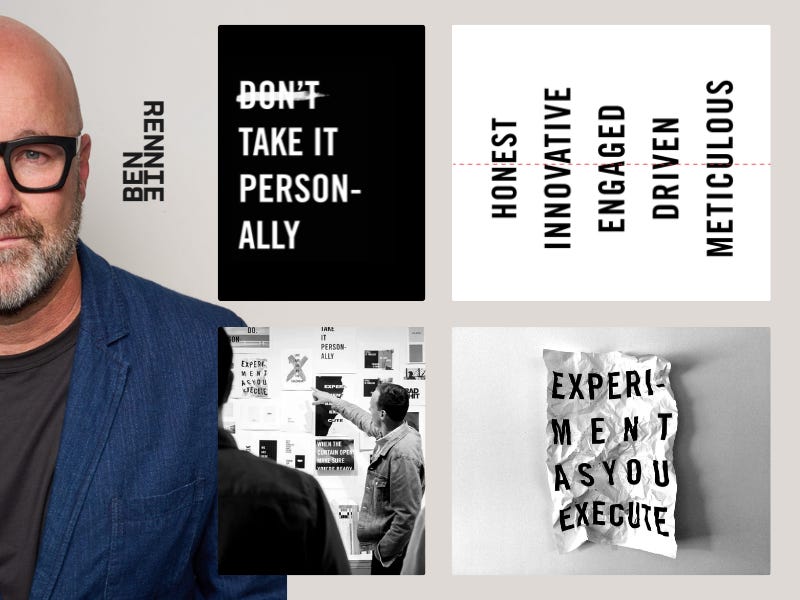
In 2020, a few business owners asked if I’d help them with brand, strategy, and what comes next as an advisor.
I said yes as it was Covid and felt like a challenge. Over the next few years, two become 5.
I didn’t plan to keep working with the same five people for 5 years. But those relationships or partnerships became about building something that lasts. It was and remains the most rewarding work I do.
Last month, two of those businesses exited. One went public. Another sold, and the founder retired at 52.
Which means I have two spots for my advisory services opening for 2026.
Here’s why I’m telling you this:
Most advisory work is transactional. Someone hires you to solve a problem, you solve it, and you leave. That works. But it’s not what this is.
What I do is work with business owners and founders to build creative capacity for growth, strategy and work that matters. Weekly check-ins, fortnightly deep sessions, monthly planning and quarterly face-to-face meetings to make sure we’re building toward the right thing.
I keep it to 5 people because that’s the number I can actually show up for. More than that, and I’m just another advisor who’s half-present. The 3 clients staying with me have been with me since 2020. That matters to me. A lot.
I’ve spent 20 years now working with Nike, Patagonia, NBA teams, Chanel, Ray-Ban, Oakley, Stone Island, D&G, and 200 other brands that set the standard for what excellence looks like. I get to see what works at the highest level.
I’ve also spent 19 years making mistakes in my own businesses. Failed launches, blown cash flow, wrong hires, wrong partners. That knowledge - the stuff that almost killed me - is often more valuable than the wins. I’ve been where you are. I know what it takes to get out.
Who this is for:
Business owners and founders working toward something specific: an exit, growth, rebrand, or launch or people who are stuck between where they thought they’d be and where they need to be.
Individual creatives (designers, artists, directors, entrepreneurs) who are ready to build something real and sustainable.
People who want a long-term partnership and are interested in serious work with serious results. If you’re ready for that level of commitment, apply.
What happens next:
Fill out this application here: https://tally.so/r/2Ejz5M
I’ll review every application and reply to everyone within a week.
If we seem like a good fit, we’ll schedule a conversation to see if we should work together. If we’re not the right fit, I’ll still reach out. We’ll spend 15 minutes talking about where you are and who might be able to help. You took the time to apply; I’ll take the time to respond.
I have 1 paid advisory spot available for 2026, and I am donating 1 spot reserved for a climate-related charity that will receive this work for free.
This is my favourite work. If we’re going to spend time together, I need to know we’re building something that matters.
Comments
Nothing yet. Say the first thing.
Sign in to join the conversation.