
A few years back, I found myself sitting at a pub in Byron Bay watching my mate Dave Fraser chase a football (Soccer) around a field. Dave founded Mr Simple, and I had dropped by to watch him play in a local match. That’s when Jimoin (the famous comedian) joined me.
Jimoin had just landed from Europe via the Gold Coast, and he decided to drive down to Byron to watch his own mate play on Dave’s team. We ended up sitting together, talking about soccer, comedy, and life.
During our chat, I reminded him about something that had happened years earlier. My mum and I had bought tickets for the family to see him perform live, but not long after, Mum was diagnosed with cancer. The chemo meant we couldn’t go. So, I emailed his team, and a few days later, four complimentary tickets arrived for a future show.
“Jimoin, you sent a signed book too, which was awesome, Mum loved that book” I said.
Jimoin looked at me. “Ah, no, no, I didn’t send a book.”
“Mate, yes, you did.”
“Nope, didn’t.”
“Yes, did.”
“Nope, didn’t, I can guarantee I didn’t send you a book.”
He paused, grinned and said, “I’ve never written a book. But I did send her a DVD. How is Maree doing anyway?”
He remembered her name; it was such a beautiful moment following such a lovely gesture.
I suggested we take a photo together to send her. We snapped one, and I looked at it. Something felt off about how I appeared in the frame. “Mate, that’s a shocker. Can we retake it?”
He looked at me, then at the photo, looked at me again, and then, with a look of curiosity, back at the photo, he said, “Ben, I don’t know how you think you look, but that’s exactly how you look.”
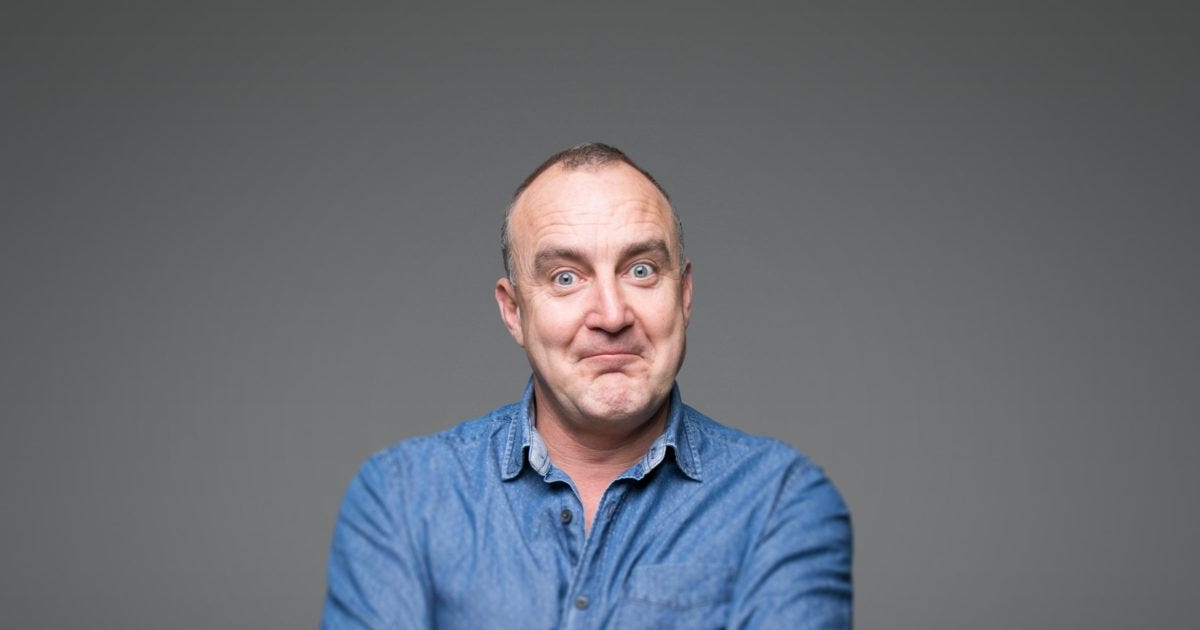
I think about that moment constantly. What did I think I looked like?
Here’s what I’ve come to understand: we spend so much time holding an image of ourselves in our heads that we stop seeing what’s actually there. We have this idea of who we should be, what we should look like, and how we should sound. And when reality doesn’t match that image, we assume reality is wrong.
Creativity works the same way. We have a picture in our minds of what creativity looks like, what it requires, and how it should feel. And because our work doesn’t match that picture, we decide we’re not creative. We’re asking the wrong question. We’re not asking “what am I actually creating?” We’re asking, “Why doesn’t this look like what I thought it would?”
Somewhere along the way, most of us learned what creativity is supposed to look like. Maybe it was school. Perhaps it was simply absorbing enough movies and artist biographies to form a picture of what a creative person should be. Tortured, talented, touched by something the rest of us can’t access.
Either way, we learned, and what we learned was often wrong.
History shows us that generational creative explosions have happened before. Florence in the 1400s, Harlem in the 1920s, the counterculture of the 1960s. Each time, people made things not because they had the right credentials, but because they couldn’t stay quiet. However, those were collective movements and cultural shifts that required the right conditions.
What I’m wrestling with is smaller than that. More personal and honest.
Because here’s what I’ve realised: I’ve spent a lot of my career chasing an image of what I thought my work should look like. What a studio should be. What “good” creative work looks like when you’re trying to build something meaningful.
A few years ago, we took on a project that I thought would define us. Big brand, big opportunity, the kind of work that would prove we belonged at a certain table. I had this picture in my head of what the outcome would be. How would it feel when we delivered it? How proud I’d be.
We delivered it. The client was happy. We got paid. It was good work by most measures. However, nothing changed for us as a result of it. I kept looking at what we’d made and feeling like it didn’t match what I thought we were creating. We were creating something that would change how people thought about their relationships with nature, the climate, and with one another. What we actually created was a well-executed campaign that presented impressively in a presentation.
The gap was the questions I’d been asking. I’d been asking “How do we make this look impressive?” when I should have been asking “Who is this actually for and what change are we trying to create?”
I’d been chasing an image of what good work should look like instead of asking what good work should do.
My good friend owns an abattoir in Western Sydney. When a chain breaks or a kink appears in the process, the meat goes bad. Everything has to work perfectly for the sake of the product and to ensure the work is as humane as possible.
Building technology follows the same logic. One broken link can cause the entire system to collapse, impacting outcomes, costs, jobs, families, and climate impact. Every decision we make (or choose not to make) has ripple effects.
So, we push forward, but need to understand who we are and what we actually contribute to our work. In that process, I realised my questions had changed.
I used to ask, “How do I make this look better? How do I make this more impressive? How do I prove my skills?” Now, I ask, “What am I actually trying to create? Who does this serve? What happens if it fails? What would I make if nobody were watching?”
Those are different questions. And they lead to different work.
In 2020, I wrote 99 rules for creative living. I called it a manifesto, though that word feels too grand for what it was. It was me trying to name what I valued, trying to figure out how to live with bravery when fear felt easier.
The thing about manifestos is that they change, but writing them down mattered. Naming what I cared about made it harder to ignore when I was tempted to compromise it for convenience, approval, or money.
A few of those rules still guide my thinking about creative work. Here is a few;
You can be shaped by what came before, or you can shape what comes next.
When work is only about money, people feel the hollowness in it.
The people who dismiss your ambitions are usually the ones who fear their own.
Every project should connect to something bigger than the project itself, or why bother?
When you feel fear about the work, that might be the signal to go faster rather than stop.
What you do for yourself dies with you, but what you do for others might outlive you.
Every choice comes down to feeding grievance or creating hope. Choose hope when you can.
Writing that manifesto shifted something. It gave me a sense that writing about creativity could make a difference to me, my family or someone, somewhere; it was where my obsession with systemic design began.
The thing that connects Jimoin’s comment to the work I do now: we don’t need a global creative revolution. We might not even need a movement. But we do need our own personal revolution. A place where we give ourselves permission to be creatively free without waiting for the world to validate it first.
Those historical moments, such as Florence, Harlem, and the '60s, were collective movements that needed the right conditions to catch fire. However, they all began with individuals creating, writing, and painting, as well as playing music and making choices about what mattered enough to risk failing at it.
The more I write, the more I realise that creative confidence doesn’t come from being good. It comes from asking better questions. Not “am I creative enough?” but “what am I trying to make and why does it matter?
I still think about that photo with Jimoin. “That’s exactly how you look.”
What did I think I looked like? What do any of us think we look like when we imagine ourselves as creative people?
Maybe the revolution happens when we stop trying to match that imagined version and start working with what’s actually there. When we stop waiting for permission, the perfect conditions, or the feeling of being ready, we can move forward. When we pick up the pen, the paintbrush, the camera, the keyboard, our voice or whatever tool is closest, and we make something because making it feels more important than not making it.
The next creative revolution might not be happening in galleries, studios, or on stages. It might be happening in living rooms and notebooks, in quiet moments when someone decides to try something (even if they have no idea if they’re doing it right).
It might be happening right now, in your hands, with whatever tools you have. Not because you’ve figured it all out, but because you’re finally done waiting to figure it all out before you start.
That’s where I am, anyway. Still learning. Still asking the wrong questions sometimes. Still making things that don’t match the picture in my head.
But I’m making them. That may be enough.
***Author’s Note: I use Grammarly and Claude for light editing and feedback. Every story and idea here is my own.
Comments
Nothing yet. Say the first thing.
Sign in to join the conversation.