
Hey,
If you’ve got equity sitting in a rental property and you need cash, your first instinct is probably to refinance.
Pull it out. Put it to work. Move on.
I get it. That’s what most investors do.
But here’s the problem nobody says out loud: if you locked in a rate in the 3s or 4s over the last few years, doing a cash-out refi right now means you’re handing that rate back. You’re trading something in the 3s for something in the 6s or 7s. Your payment goes up. Your cash flow goes down. And suddenly, the deal you funded with that cash has to work a lot harder just to break even on the back end.
The math gets ugly fast.
I’m Ben Stef. I’m a mortgage advisor. I work with real estate investors every single day to find the right financing for their deals so they can keep building without blowing up what they already have. My team and I have funded over $50 million in investor deals, and I can tell you confidently that most investors don’t even know the options I’m about to walk you through exist.
Here’s what we’re covering:
• Two loan products that let you pull equity from a rental without touching your first mortgage at all
• How each one works and who qualifies
• When a cash-out refi actually does make sense (because it’s not always the wrong call)
If you’ve been sitting on equity and not sure what to do with it, keep reading.
Most investors, when I explain this one, look at me like I just told them there’s a door in the wall they’ve been staring at for years.
Here’s the play:
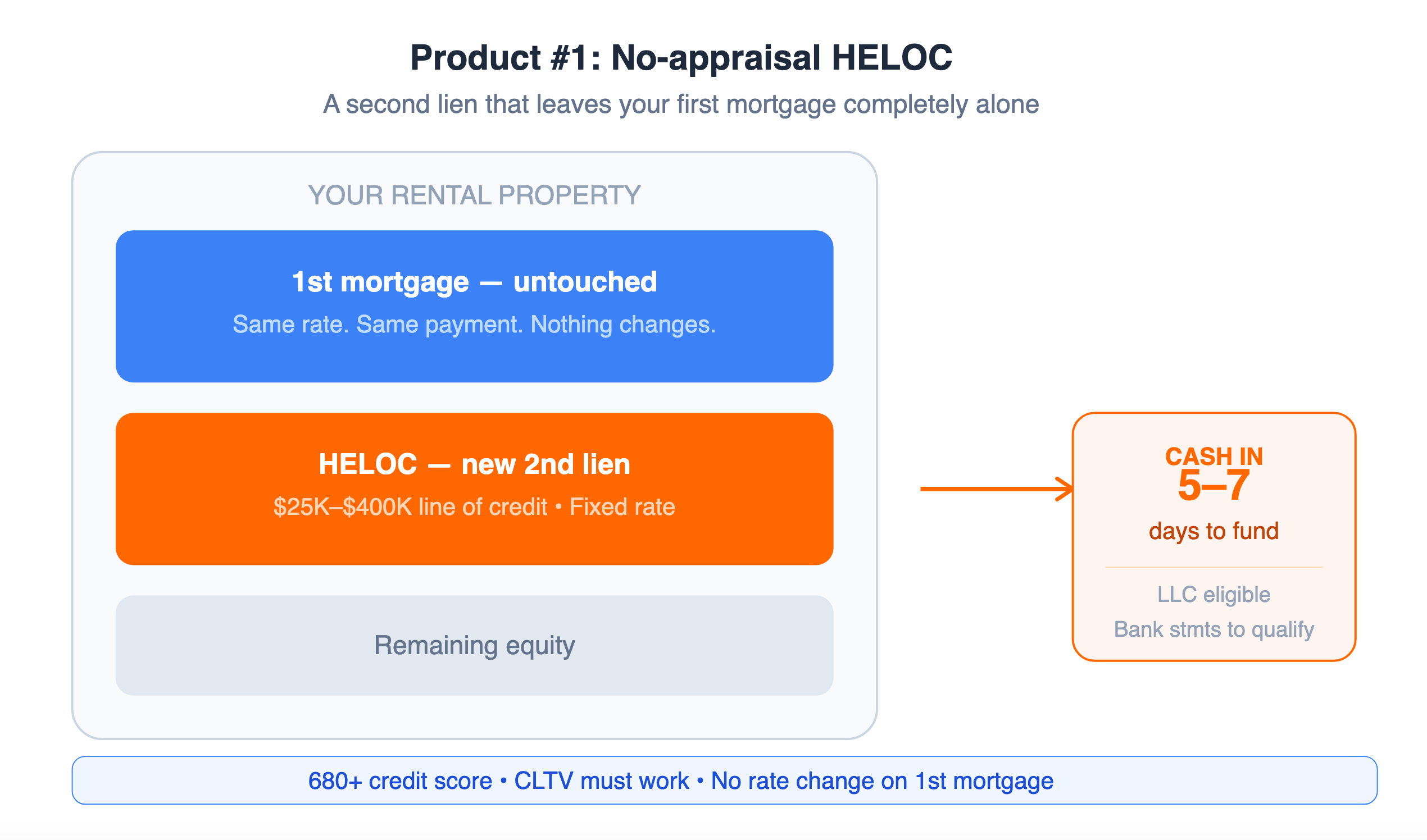
A no-appraisal HELOC sits behind your first mortgage as a second lien. Your existing loan stays exactly where it is. Same rate. Same payment. Nothing changes on that loan. You’re just opening a line of credit behind it and drawing from it when you need to.
And it can fund in 5 to 7 days.
That last part is where people’s ears perk up. If you’re trying to move on a deal, you can’t sit around waiting 30 to 45 days for a full refi to close. You can’t wait on an appraiser’s schedule and underwriting going back and forth. With this product, you can have capital in about a week.
Your rate stays. Your payment stays. You get cash in roughly a week.
Here’s what you need to know about the requirements:
680+ credit score on the investment side
Equity in the property (CLTV has to work)
Line of credit from $25,000 up to $400,000
Fixed rate -- does NOT adjust with the market
Can close in an LLC
Qualifies using bank statements
And because it’s a line of credit and not a lump sum, you draw what you need and you pay interest on what you’ve drawn. If you’re not using it, you’re not paying on it.
A lot of investors actually prefer that setup. You’re not sitting on capital you haven’t deployed yet. You draw, you deploy, you pay it back, you draw again.
I’ve had investors come to me ready to do a full refi. We talk through this, and they walk away with equity access in about a week without ever touching the rate they’ve been protecting. That’s a completely different outcome than what they walked in expecting.
Same basic idea as the no-appraisal HELOC. It sits behind your first mortgage. Your existing loan stays put.
The difference is how you qualify.
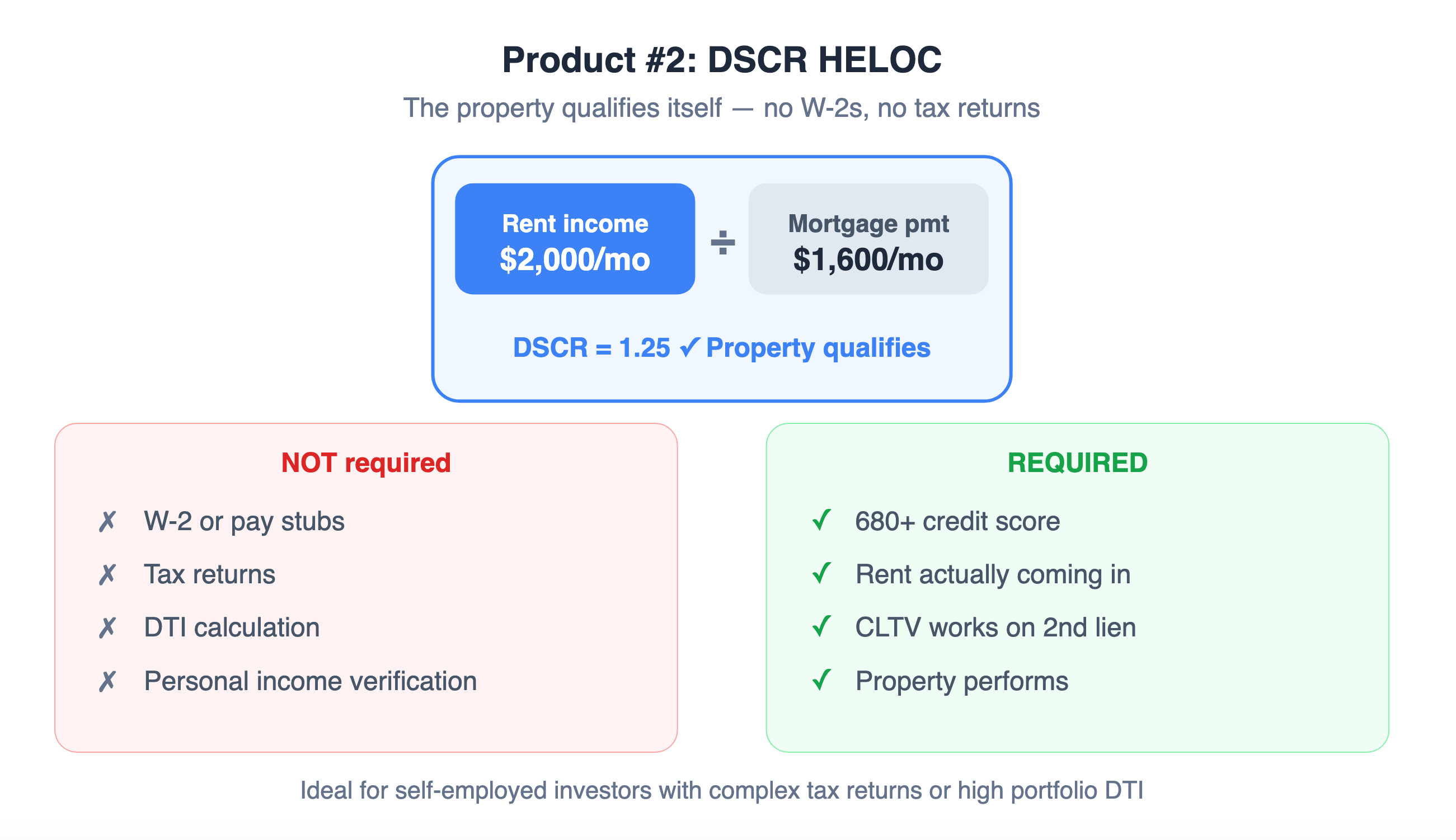
With a DSCR HELOC, the lender isn’t looking at your personal income. No W-2s. No tax returns. None of that. They’re looking at the property.
Specifically, they want to know whether the rent the property generates covers the cost of carrying it. That ratio is the DSCR -- Debt Service Coverage Ratio. If the rent covers the mortgage, you can qualify.
Here’s why that matters:
A lot of investors are self-employed. Or their tax returns make it look like they make less than they actually do. Or they own enough properties that their debt-to-income ratio looks messy on paper, even though the portfolio is cash flowing just fine.
With a standard loan, that’s a problem. With a DSCR HELOC, it basically isn’t.
The property does the qualifying for you. You just need it to be actually performing.
Here’s what you need to know:
680+ credit score
Property has to be performing -- meaning rent is coming in
CLTV needs to work on a second lien
No W-2s or tax returns required
Great for self-employed investors with complex income
Both of these products exist because there’s a real gap between what banks offer and what investors actually need. Conventional lenders aren’t set up for this. These are investor-specific products. And most investors have never heard of them.
I don’t want to leave you thinking a refi is always the wrong call. Because it’s not.
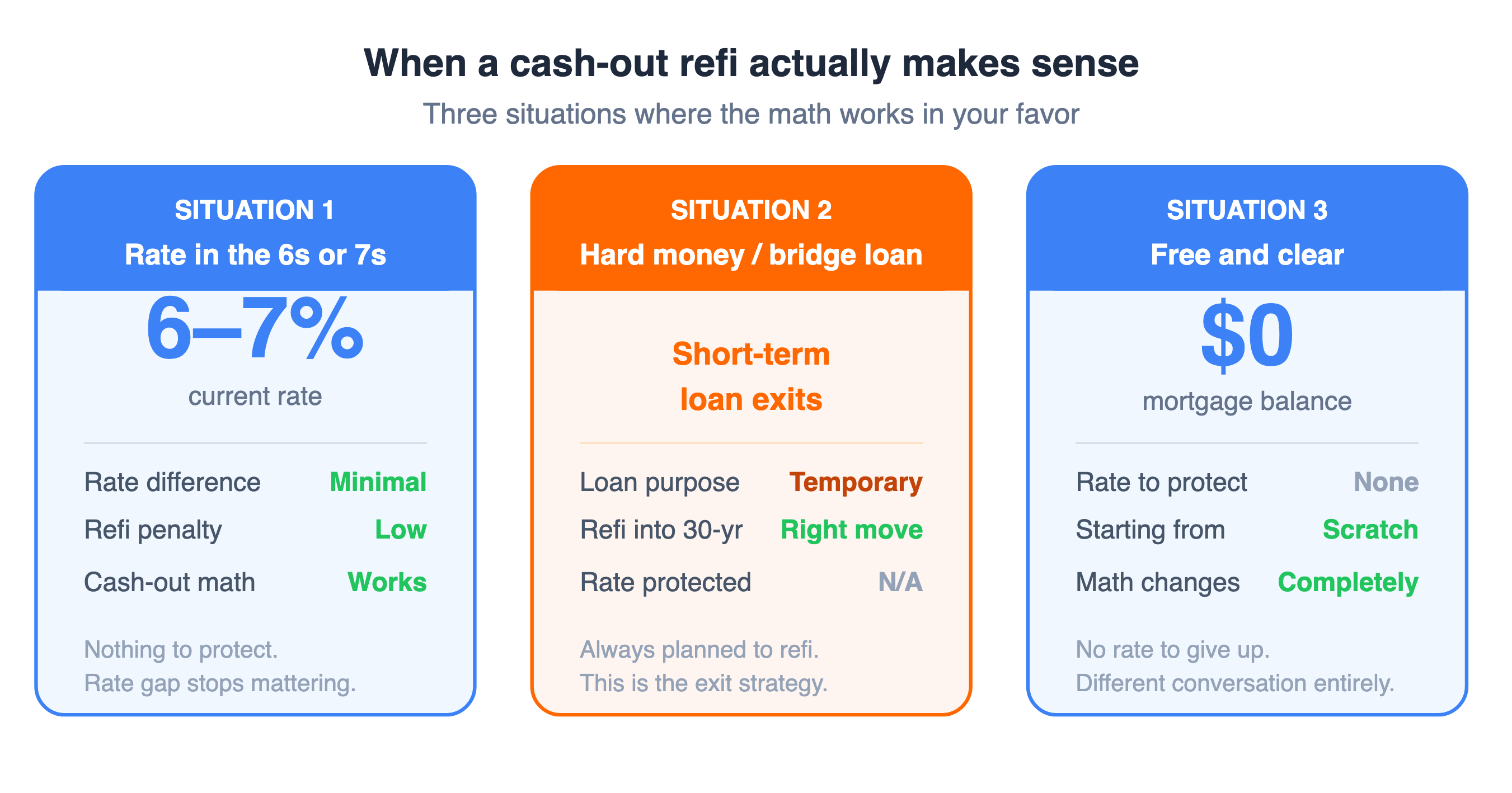
Here’s where the math actually works in your favor:
Your current rate is already in the 6s or 7s:
You’re not giving up much. The rate difference stops being the deciding factor.
You bought with hard money or a bridge loan:
That was always meant to be short-term. A cash-out refi into a 30-year product might be exactly the right call.
You own the property free and clear:
Totally different conversation. You’re not protecting a rate. You’re starting from scratch, so the math changes.
The mistake most investors make is assuming a refi is the only option without ever asking what else is out there.
Honestly, the math isn’t always obvious just from looking at the rate. You have to factor in what happens to your monthly cash flow, what it costs you to access that capital versus what that capital earns on the other end, and what the picture looks like a year from now.
Most investors see the equity and the cash-out amount and stop there. That’s where they get it wrong.
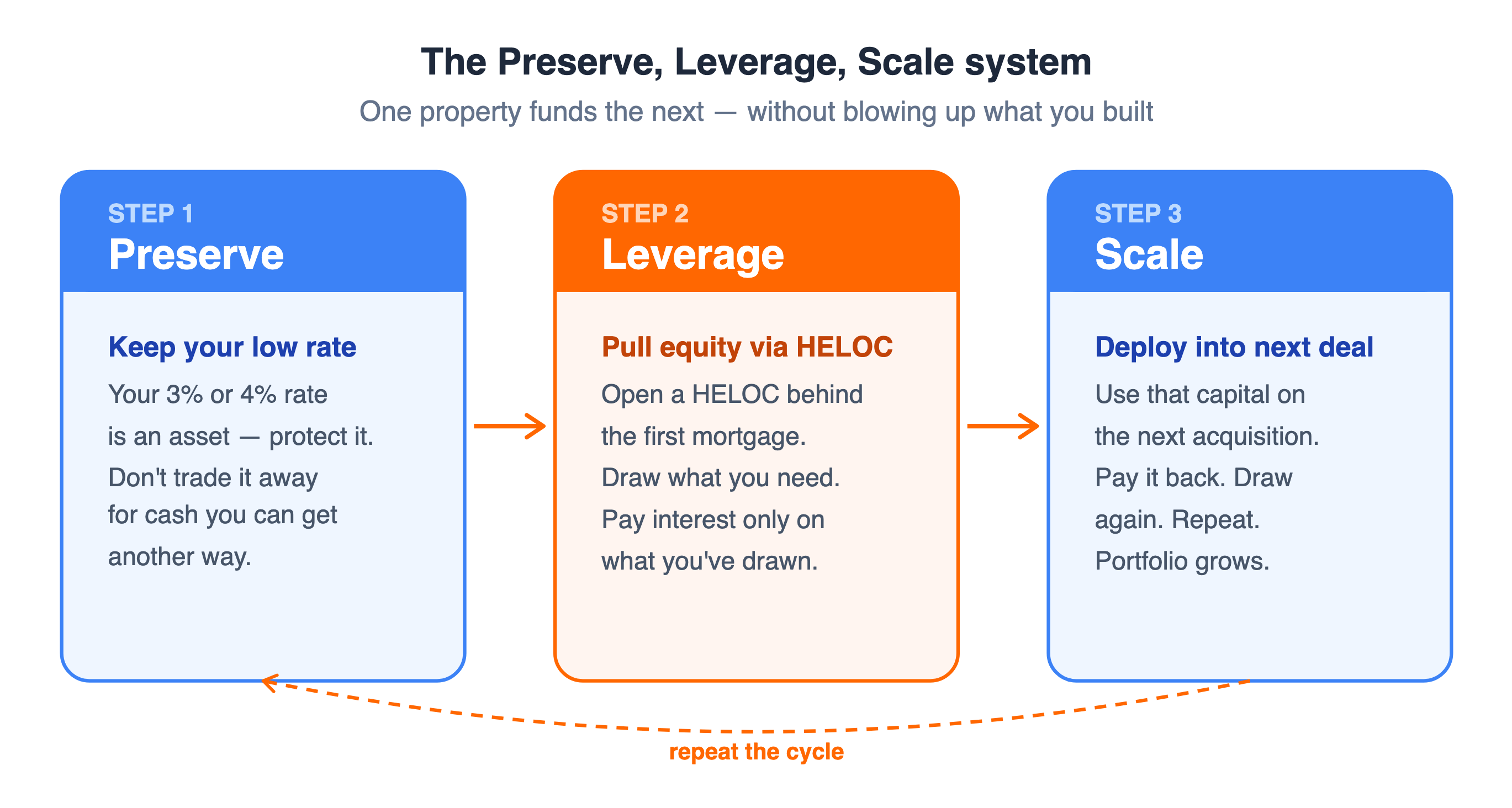
I call it the Preserve, Leverage, Scale system.
It’s basically a three-step way of thinking about equity:
Preserve - Keep the rate you already have. That low rate is an asset. Protect it.
Leverage - Pull equity out through a HELOC behind the first. Your rate stays. Your capital gets freed up.
Scale - Deploy that capital into the next deal. Pay it back. Do it again.
One property basically funds the next. And you never have to blow up what you already built to do it.
This is the part most investors figure out way too late. Your existing portfolio is probably sitting on more usable capital than you think. The question is just how to get to it without creating new problems on the back end.
If you’ve got equity in a rental and you’re trying to figure out whether a refi makes sense or whether one of these HELOC options is a better fit, that’s exactly the conversation I have with investors every single day.
Book a quick call with me using the link below. I’ll look at your actual situation and tell you what the numbers say. No pitch. Just the math.
Ben Stef
Mortgage Advisor | NMLS# 2018674
No posts
Comments
Nothing yet. Say the first thing.
Sign in to join the conversation.