
Most investors think DSCR loans are simple. Property cash flows, you get approved, done.
That’s partly true. But the details inside these DSCR guidelines are where deals either get done or fall apart….and most investors (and honestly, a lot of loan officers) have no idea what’s options are available, especially if your deal has issues….
I work with real estate investors full time. Every week I talk to people who got denied and they just didn’t know what options were available.
For example, say your property is vacant right now and you’re trying to pull cash out. A lot of lenders will penalize you for not having a tenant sometimes. Some won’t even touch it. But on our program, we use the market rent appraisal directly, and we use full gross income
Or say your DSCR is coming in just below 1.0. Most people hear that and think the deal is dead. But structure it as an interest-only loan, and suddenly we’re calculating on interest only, not the full P&I and THAT saves the deal.
There are strategies inside DSCR guidelines that most investors have never heard of. Blanket loans, gift fund rules, LLC vesting, short-term rental income calculations — all of it affects what you qualify for and how much you can scale.
I break it all down in simple sections so you can understand and I also made a video explaining each in detail. Hope it helps.
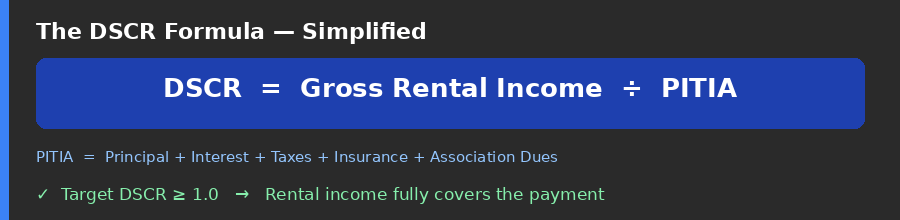
DSCR is math.
Gross Rental Income divided by PITIA. You need to land at 1.0 or higher.
Simple formula. But the income side of that equation? That’s where most people miss it.
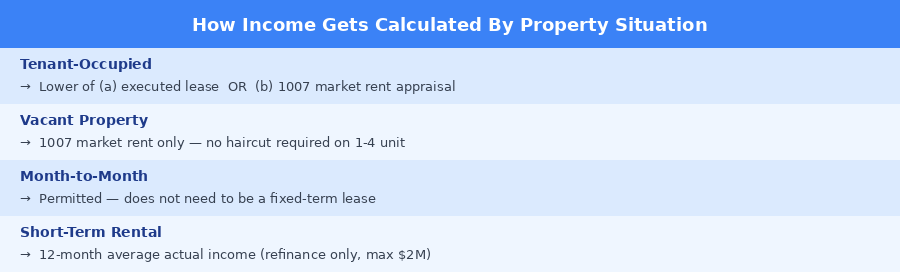
How income gets calculated depends on what’s happening with the property:
Tenant in place ➞ Use the lower of the executed lease or the 1007 market rent appraisal
Property is vacant ➞ Use the 1007 market rent only (no penalty on 1-4 unit)
Month-to-month lease ➞ Totally fine. Doesn’t have to be a fixed-term lease
Short-term rental (Airbnb/VRBO) ➞ Use the 12-month average actual income
That last one is important. If your Airbnb is generating $5K a month but market rent would only be $2,500, the STR program lets us use the actual income — not the capped market rate. That’s a different DSCR formula
Strategy: If a property is vacant, push for the strongest possible appraisal. The 1007 rental estimate is what we use, so comparable rents in that market directly affect your approval.
If a deal is borderline — say the DSCR is coming in at 0.92 — this is often the move. Structure it as a IO loan, recalculate, and we can get the deal done!!
The loan terms you structure directly change whether you qualify. This is why knowing the guidelines matters — not just knowing the rate.
Obviously most plans are principal and interest and there’s other options besides going interest-only but it is a viable option.
Let’s talk about the three moves that serious portfolio builders use.
Gift Funds
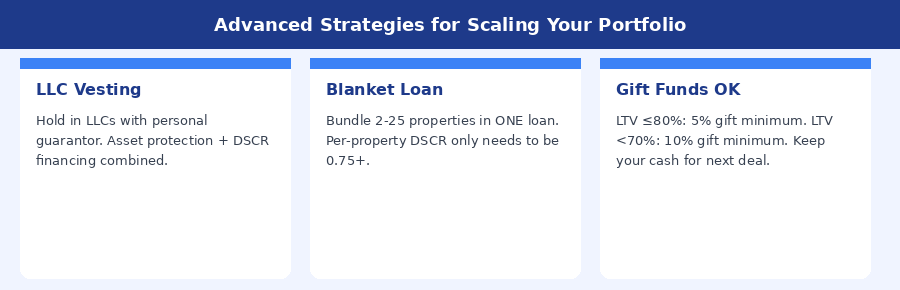
If your LTV is at or below 80%, you can use gift funds for as little as 5% of the down payment. Below 70% LTV, that minimum goes up to 10%.
Why does this matter? Because it lets you keep your own cash liquid and go after the next deal faster. Acquiring more properties at the same time becomes possible when you’re not draining your reserves on every single closing.
LLC Vesting
You can hold properties in an LLC and still get DSCR financing, as long as you’re the personal guarantor. Limited partnerships, general partnerships, and corporations are also eligible.
For investors with a growing portfolio, this is basic asset protection. Each property sits in its own entity. One bad outcome doesn’t bleed into everything else.
Cross-Collateral Blanket Loans
This one is for experienced investors who want to move fast. Instead of doing 5 separate DSCR loans, you bundle 2 to 25 properties under a single loan.
One closing. One payment. One set of closing costs.
The aggregate DSCR just needs to be 1.0 or higher. Individual properties only need a DSCR of 0.75 — so a property that wouldn’t qualify on its own can still be included if the overall portfolio math works.
Loan amounts from $400K to $3M
1-4 unit residential and condos only
Available to experienced investors — not first-time buyers
Strategy: If you have 5 properties and a couple are underperforming, bundling them into a blanket loan might get all of them financed where individual loans wouldn’t.
Here’s another really cool trick that most lenders won’t actually do. I found out but if your ratios don’t come in to where they need to be, we could divide up your assets and use that for the DSCR income as well
DSCR coming in under 1.0 doesn’t automatically mean the deal is dead.
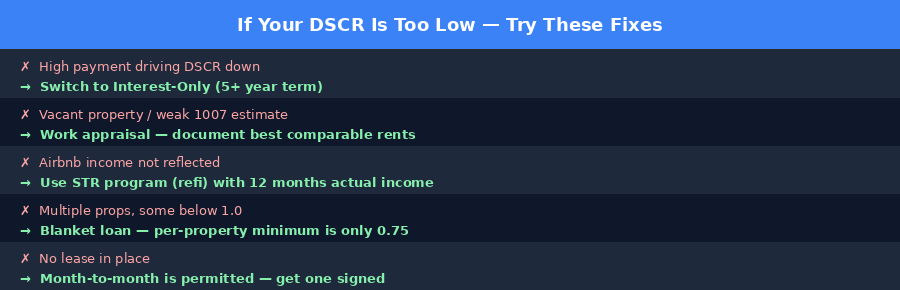
Here’s a quick breakdown of the most common problems and the fix for each:
Divide up your assets for extra income (we try this first)
High payment driving DSCR down ➞ Switch to Interest-Only (5+ year term)
Vacant property with weak 1007 rent estimate ➞ Work the appraisal and document comparable rents
Airbnb income not captured in market rent ➞ Use the STR program with 12 months of actual income history
Multiple properties, some below 1.0 individually ➞ Blanket loan — per-property minimum is only 0.75
No lease in place ➞ Month-to-month is permitted. Get one signed
If you’ve been told a deal doesn’t work, it’s worth a second look. Most of the time there’s a version of it that does.
DSCR loans are one of the most powerful tools in the investor financing world. No W-2s, no tax returns, no income documentation. The property does the qualifying. You’re lending on the asset basically.
But the difference between an approval and a denial is usually in the details — how income gets calculated, how the loan is structured, which program you’re actually using.
Most investors don’t know these options exist. Now you do.
If you want to run through a specific deal and see which of these approaches applies, schedule a quick call. I’ll walk you through what it looks like for your situation.
Book a call: https://link.crm-u.co/widget/bookings/stefquickcall
Ben Stef, Mortgage Advisor | NMLS# 2018674
No posts
Comments
Nothing yet. Say the first thing.
Sign in to join the conversation.