
Hey,
Most investors who own 3 or 4 properties get stuck in the same spot. I keep seeing with with ones I’m talking to weekly.
And regardless of their market or city it’s a common issue over and over again…
They’ve got equity. Sometimes a lot of it. The market’s been good, the properties have gone up, and on paper they look like they’re doing well. But when they go back to the bank to pull some of that equity out and buy the next deal, the bank says no.
And the reason isn’t what you think.
The bank isn’t saying no because your properties aren’t performing. They’re saying no because of your tax returns. Your write-offs, your depreciation, all the things your accountant told you to do correctly, those same things make your income look low on paper. The bank sees a mess and says no. Honestly it’s not WRONG what you’re doing, I would do the same thing so that I can save on taxes.
So the Equity is locked up. No way forward through the normal channels. Portfolio stuck.
I’ve talked to a lot of people in this exact position. And what frustrates me isn’t just that the bank said no, it’s that the investor assumes there’s nothing left to try. That the bank is the only option.
It’s not. Not even close.
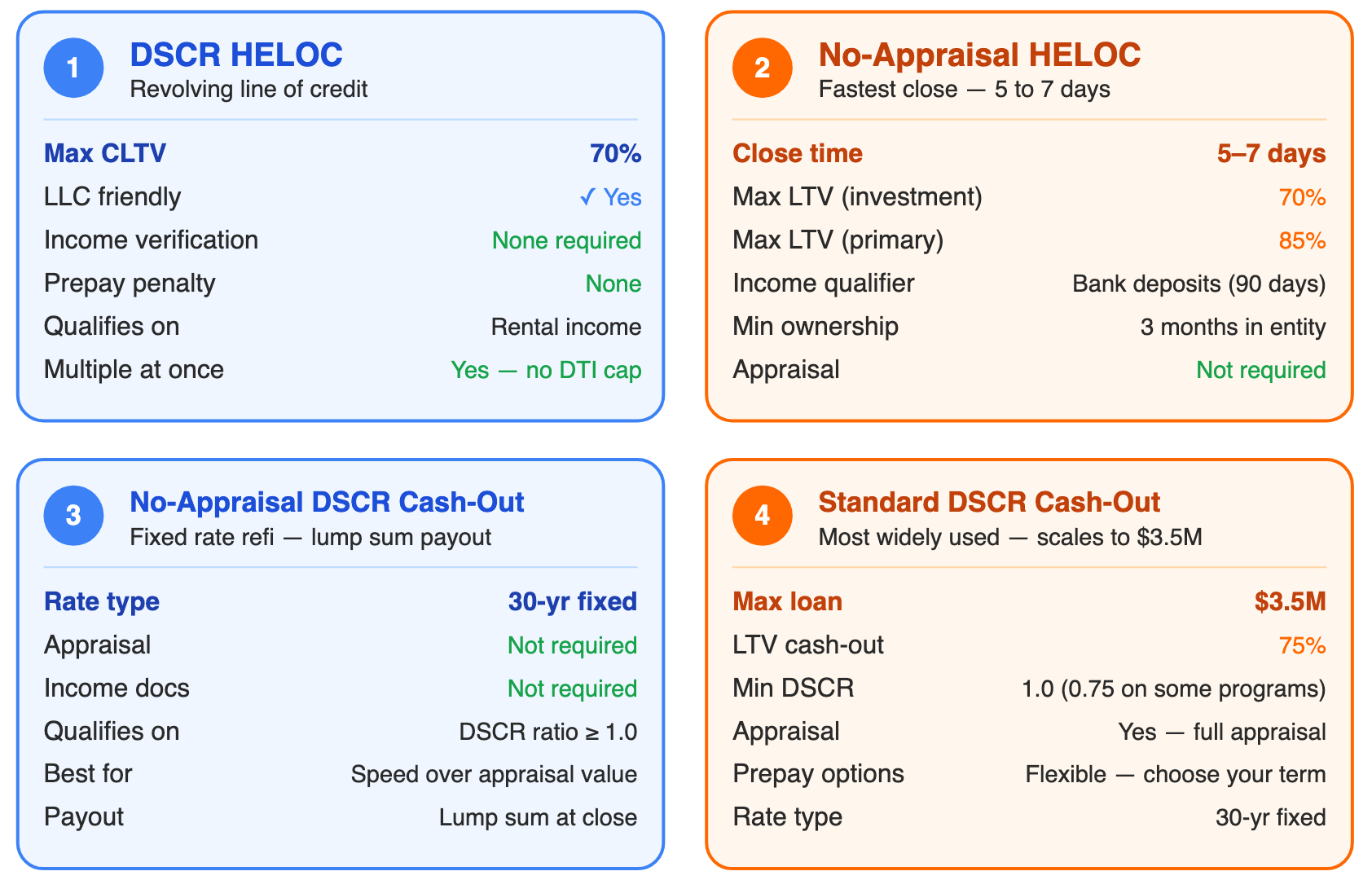
There are four programs I use specifically for investors in this situation. None of them require W-2 income. None of them need your tax returns to qualify. They look at your rental income, your bank deposits, or just the property itself, and they make a decision based on that.
I’m going to walk through all four, including a couple most investors have never heard of, so you can see which one fits where you are right now.
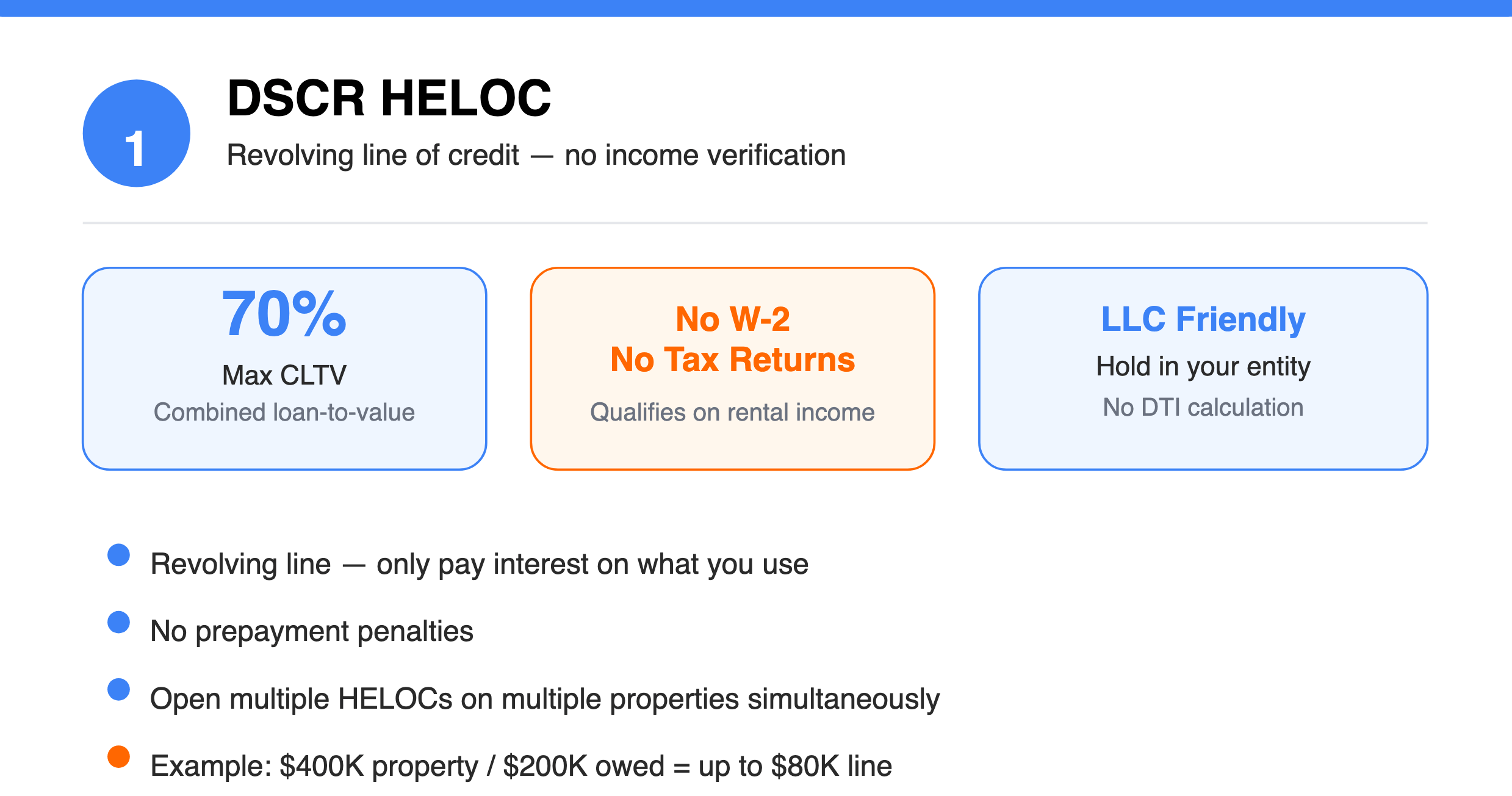
A HELOC on a rental property, with no personal income verification. No W-2, no tax returns required. The loan qualifies based on the rental income the property generates.
You can go up to 70% combined loan-to-value. So if your property is worth $400,000 and you owe $200,000, you could potentially pull out a line of credit up to $80,000 depending on your credit and rates. It’s a revolving line, so you’re only paying interest on what you actually use.
The part most people don’t know about: you can hold this in your LLC. A lot of programs won’t allow that. This one does.
I had an investor come to me who owned several properties inside LLCs. His bank wouldn’t touch him for a line of credit. We pulled multiple HELOCs on multiple properties at the same time because there’s no DTI calculation. He got all of them open and had cash ready to move on the next deal his team found. That’s how it’s supposed to work.
No prepayment penalties either, which matters if you plan to pay it down and draw again as you grow.
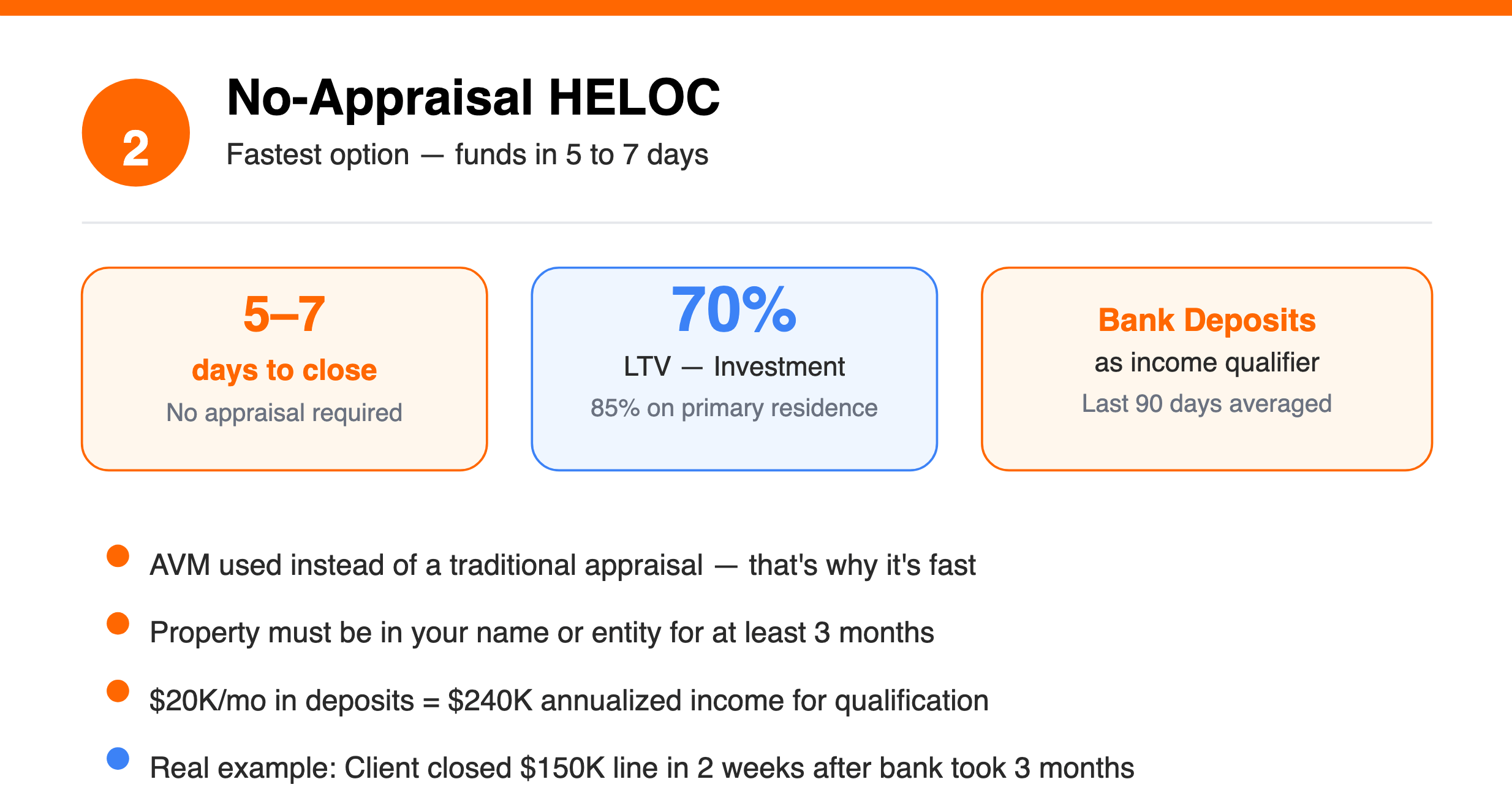
This one is fast. We’re talking funds in 5 to 7 days.
The reason it moves quickly is because there’s no appraisal. The lender uses an automated valuation model to determine property value instead of sending someone out. Up to 70% LTV on investment properties, up to 85% on a primary residence.
Same story on income: no W-2 or tax returns required. What we can use instead is your bank statements. The system looks at your deposits over the last 90 days, averages them out, and annualizes that number. If you’ve been averaging $20,000 a month in deposits, it treats your income as $240,000 a year.
The one requirement is that the property has to have been in your name or your entity for at least 3 months.
A client named Brie owns 7 LLCs. She spent 3 months trying to get a $150,000 line of credit through her bank. They kept dragging it out because of how complicated her paperwork looked across multiple entities. She came to me and we closed in 2 weeks. The only delay was some title work we had to sort out on one property.
That’s the gap between a bank trying to fit you into their one product and someone who works with investors every day.
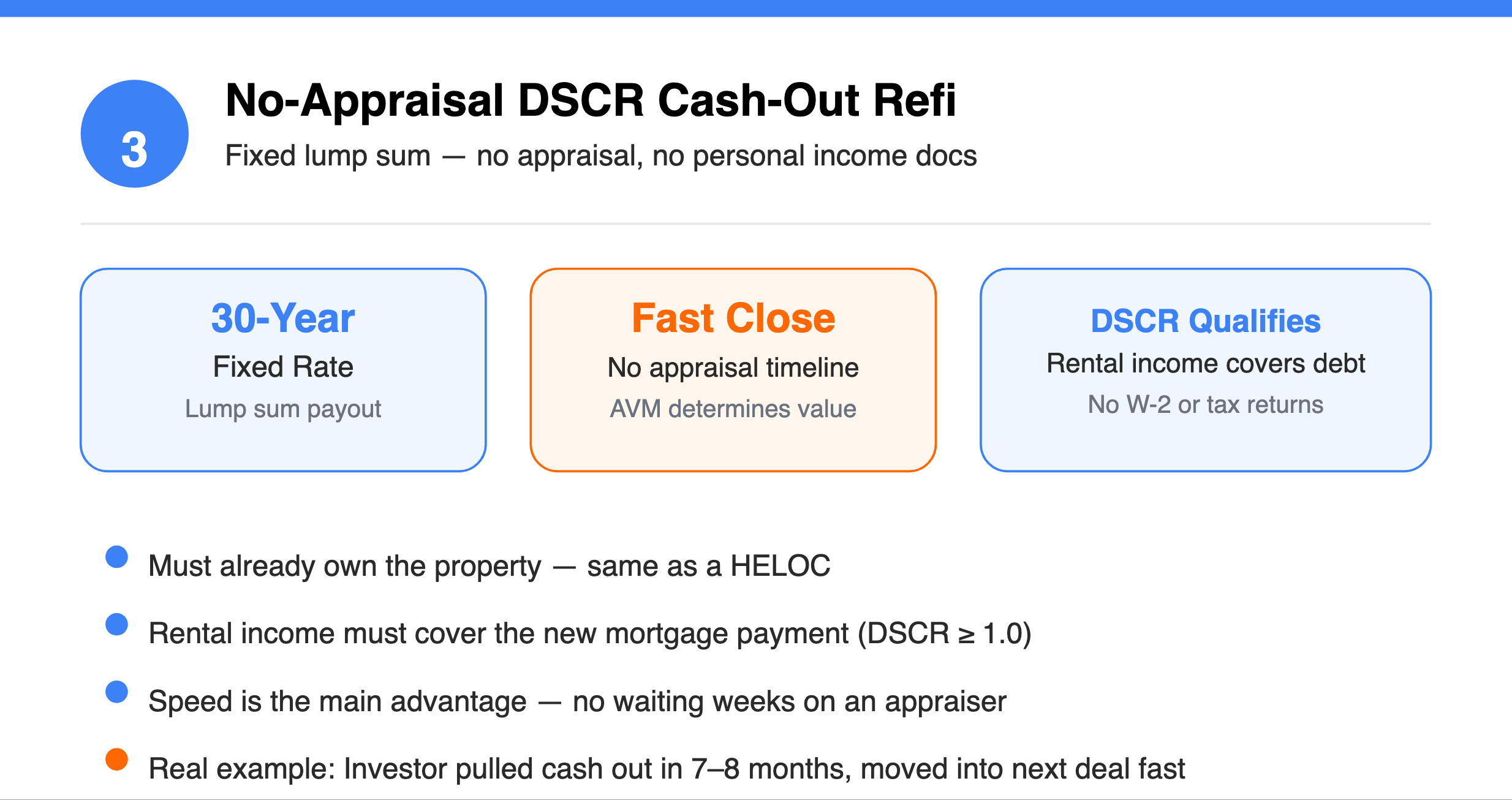
This is a fixed cash-out refinance on a rental property, no appraisal, no personal income verification. You get a 30-year fixed rate and walk away with a lump sum.
It qualifies like a standard DSCR loan, meaning the rental income on the property has to cover the debt service. And because there’s no appraisal, it closes faster than most people expect.
I used this recently for an investor who flipped a property and decided to hold it as a rental instead. About 7 or 8 months in, he wanted to pull cash out and move into his next deal. He didn’t want to sit around waiting on an appraisal timeline. We went with the no-appraisal DSCR cash-out, got it done quickly, and he had capital ready for the next acquisition.
The speed is the thing here. When you’ve found a deal and you need to move, waiting weeks on an appraisal can cost you the opportunity.
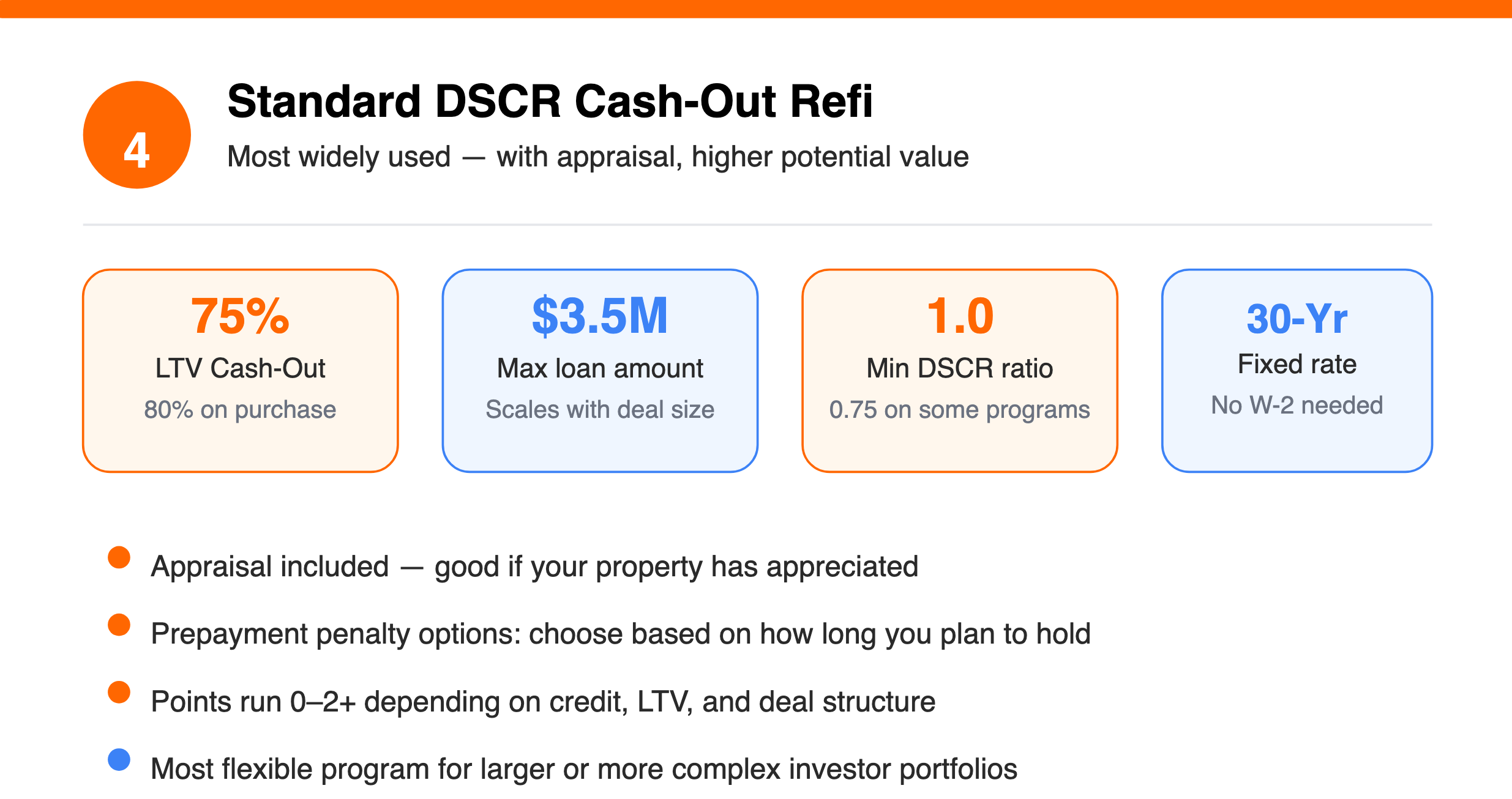
Same structure as the no-appraisal version, with an appraisal included. Which means in markets where property values have run up, you might actually get a higher number than you expected.
The rental income still needs to cover the mortgage payment. A DSCR ratio of at least 1.0 is the baseline. Some lenders will go down to 0.75 depending on credit and LTV.
You can go up to 75% LTV on a cash-out, up to 80% on a purchase for most credit tiers. Loan amounts go up to $3.5M depending on the deal.
On rate structure, there are prepayment penalty options you can choose based on how long you plan to hold the loan. If you want the lowest rate possible and you’re comfortable with a longer runway, take the 5-year prepayment. If you’re planning to sell or refi again in a couple years, a shorter one at a slightly higher rate makes more sense. There’s no universal right answer, so it’s worth talking through your specific situation before you commit.
Your bank doesn’t offer any of these programs. They’ll keep sending you emails about conventional refinances because that’s the product they sell and it’s the easiest transaction for them.
These four programs exist specifically for investors. Most standard loan officers won’t bring them up because they don’t know about them or because working through investor deals takes more effort than a straightforward W-2 purchase.
My team works with investors, and several of them are investors themselves. The way we approach a deal is different because we’re asking the same questions you’re asking. Is this going to move fast enough? Can we hold it in the entity? Will the numbers actually work?
If any of this sounds like where you’re at right now, book a quick call. We’ll go through your properties, run the numbers, and tell you in the first conversation whether you qualify and which program makes the most sense for you.
Some of these close in a week. There’s no reason to sit on equity you could already be using.
Ben Stef, Mortgage Advisor, NMLS# 2018674.
No posts
Comments
Nothing yet. Say the first thing.
Sign in to join the conversation.