
Hey,
Most investors hear “no W-2s, no tax returns, no income check” and assume the DSCR loan is basically a free pass.
So they find a property, run a quick mental calculation, and think they’re good to go. The rent covers the mortgage, it’s simple math and you’ve got a done deal.
Then they get into the file, and things start falling apart. The underwriter wants mortgage statements on every property they own. Or the rental income comes out lower than expected because the appraiser’s number was different from the lease. Or they didn’t have enough reserves sitting in a US account after closing. Or their credit score was at 630 and nobody told them that changes how much they need to put down.
The deal dies and then weeks are wasted, sometimes months.
Here’s the thing. DSCR loans are genuinely great for investors. No personal income docs. The property qualifies on itself. You can close in an LLC the week you open it. That’s all real and I use them constantly. But “no income verification” gets misunderstood as “no documentation at all,” and that’s where people walk into problems they didn’t see coming.
I’ve funded over $50M in investor deals. A big chunk of that has been DSCR. And the deals that get messy are almost always messy for the same reasons, not because the investor wasn’t qualified, but because nobody walked them through what underwriters actually look for before they got deep into the process.
So that’s what this is. The full picture. What you need, what can sink the deal, and what to do when your numbers don’t quite hit.
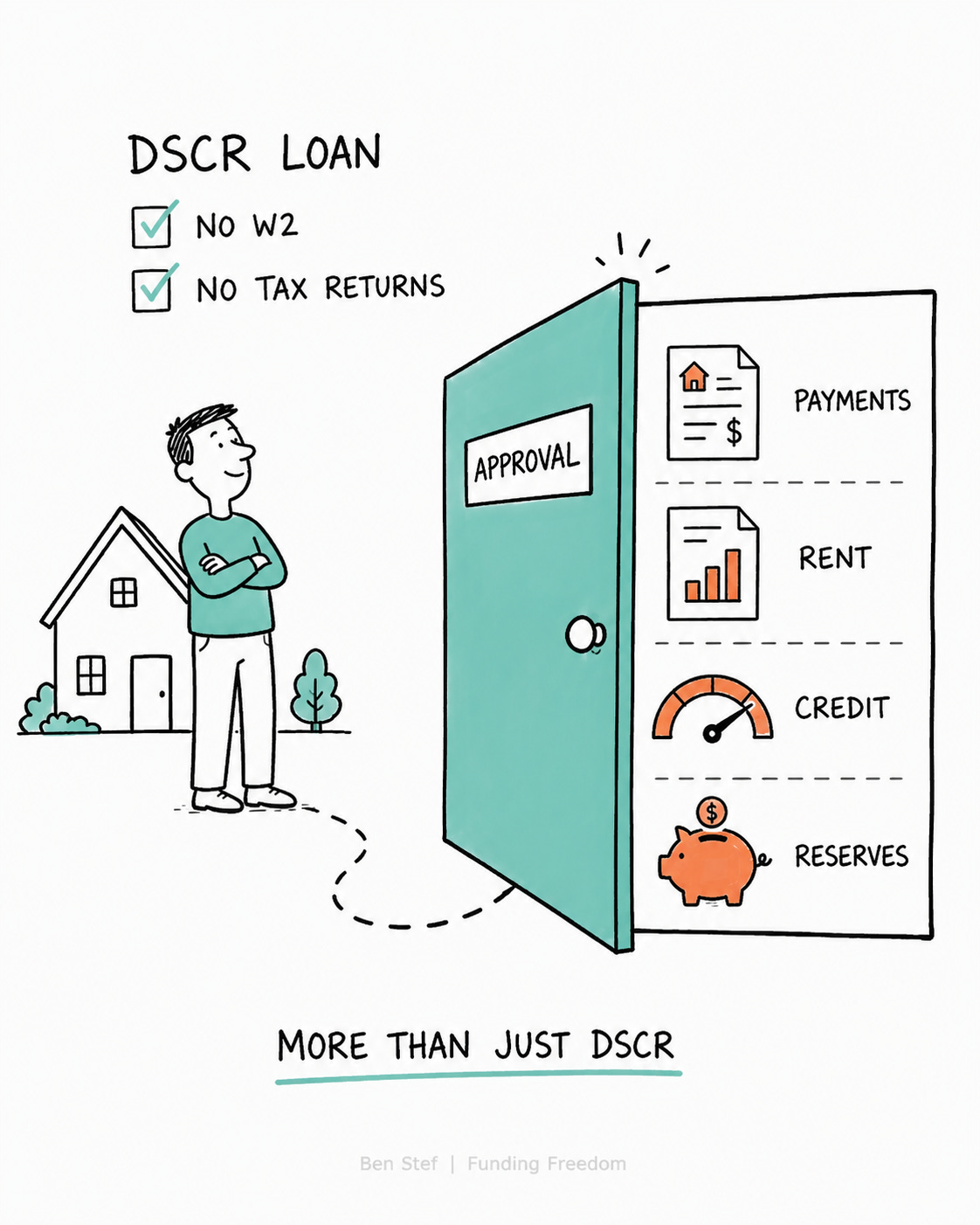
The whole concept is simple. The property needs to pay for itself.
You take the gross rent and divide it by the total mortgage payment. That payment includes principal, interest, taxes, insurance, and HOA if there is one. If that number is 1.0 or above, you’re in good shape. Below 1.0 and it gets harder, though not impossible.
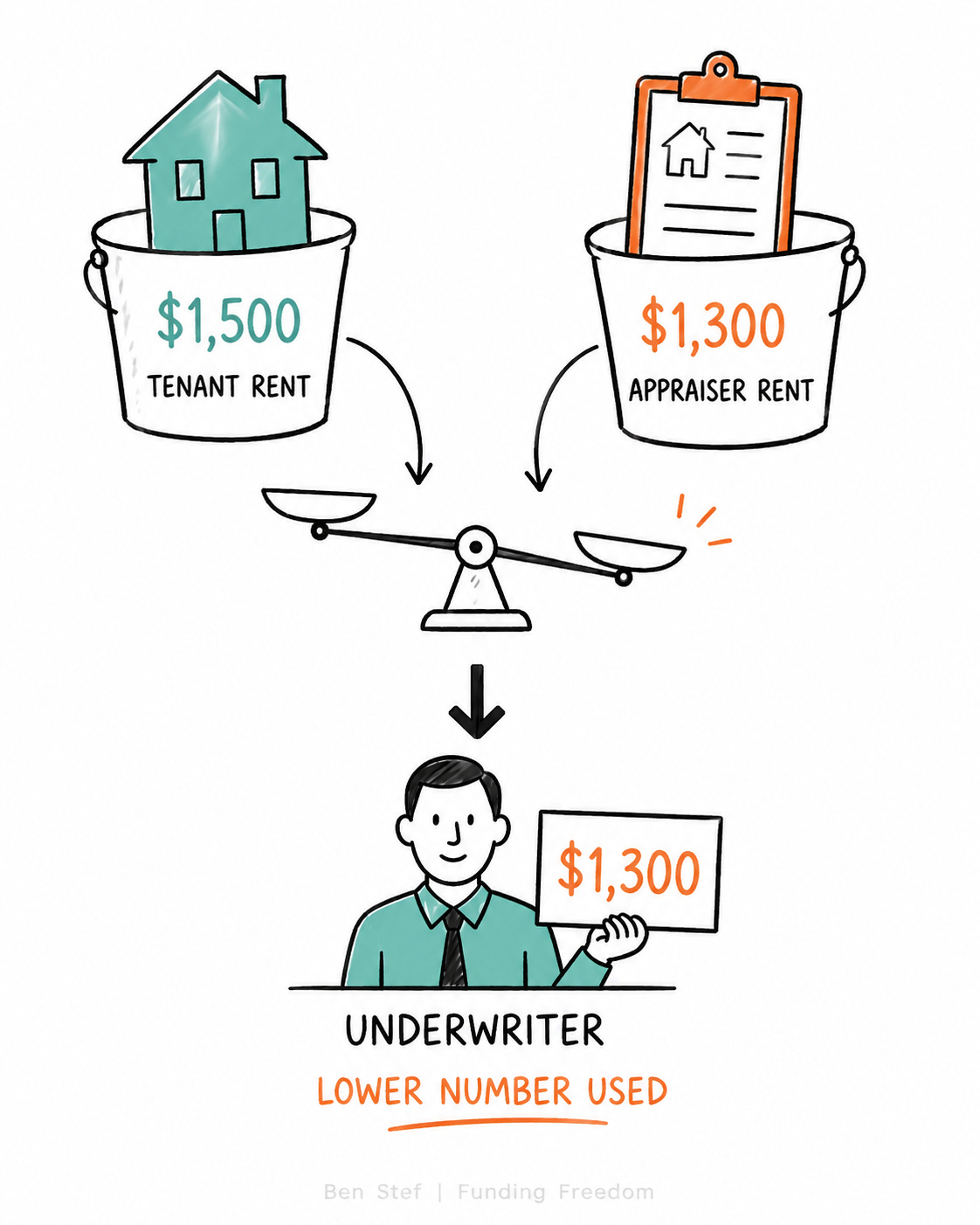
Here’s what people miss. The rent the underwriter uses may not be the rent you’re expecting.
Say you have a tenant paying $1,500 a month. The appraiser goes out and says market rent in that area is $1,300. The underwriter is going to use $1,300, because they always take the lower of the two numbers, unless you can show two months of bank statements proving you’ve actually been collecting $1,500. If you can prove it, they’ll give you the higher number.
If the property is vacant, there’s no lease to compare. The appraiser’s number is your number.
And one more thing. If you just signed a brand-new lease at a higher rent, don’t assume the underwriter will just run with it. They want proof the tenant actually paid. First month’s rent. Security deposit. Bank statements showing the money came in. A signed lease alone won’t cut it. I’ve seen deals get flagged for this. We always review docs before submitting to make sure we don’t accidentally kill a deal we could have closed.
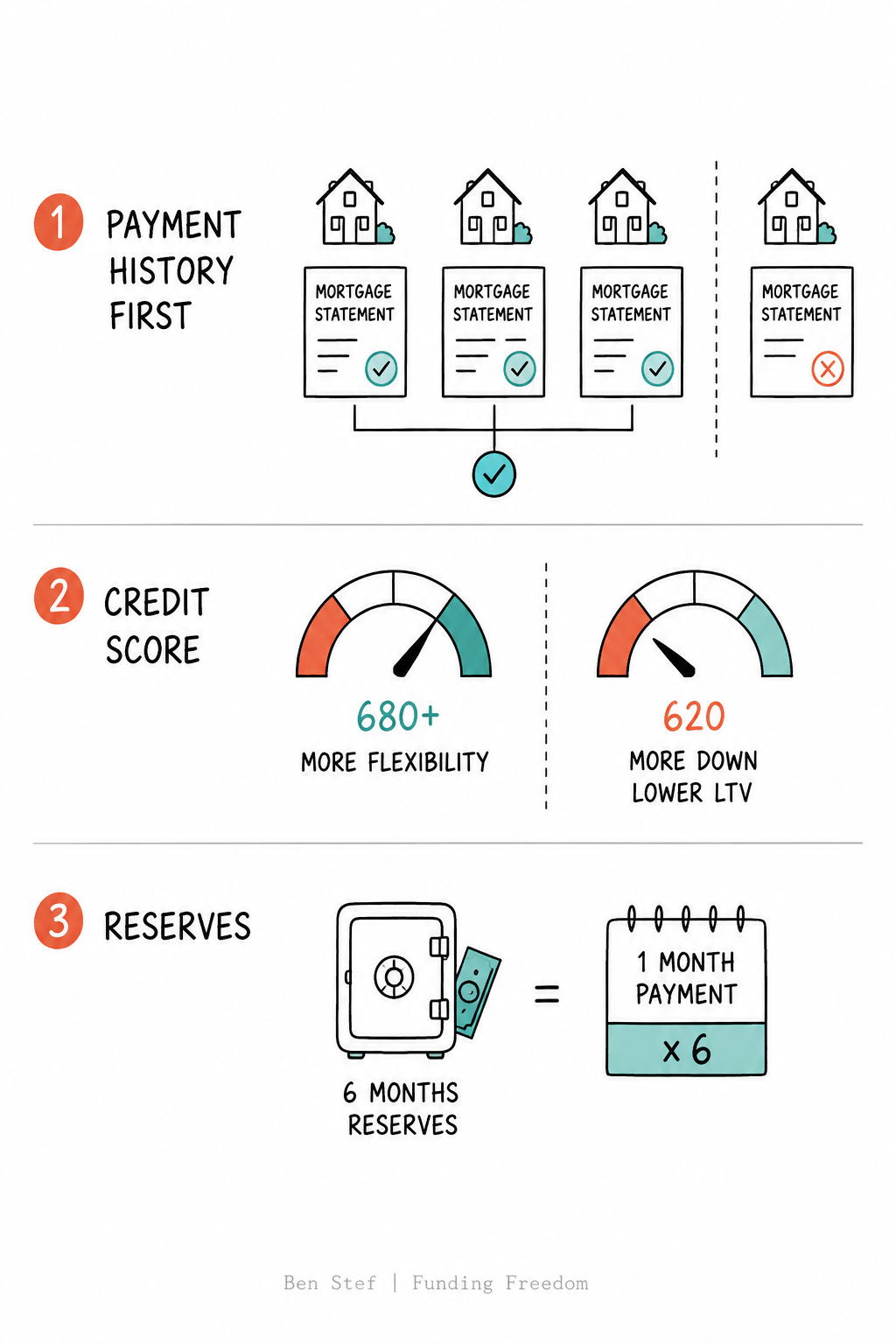
Three things people underestimate every time.
Payment history first: If you own multiple properties, the underwriter wants mortgage statements on all of them. Not tax returns or insurance docs, but actual payment history across every mortgage you’re carrying. One 30-day late payment is often a hard stop. Most lenders won’t move forward from there. If it’s a private lender situation, you can sometimes get a verbal or written verification of mortgage instead, but for institutional loans, they want the paper.
Credit score: DSCR loans go down to 620. You can still get approved there, but a lower score usually means more money down, somewhere around 25 to 30 percent instead of 20 percent. On a cash-out refinance, a lower score also means they’ll cap your LTV tighter, maybe 60 to 65 percent instead of 75 to 80. Better score, more flexibility. 680 or above and you’re in a solid spot.
Reserves: After your down payment and closing costs, most lenders want six months of mortgage payments still sitting in a US-based account. Checking, savings, retirement, all fine. But it has to be a US institution. So if your mortgage payment is $1,500 a month, that’s $9,000 in reserves the lender needs to see. On a cash-out refinance, you can usually use the proceeds to cover reserves, so you’re not pulling from your own pocket.
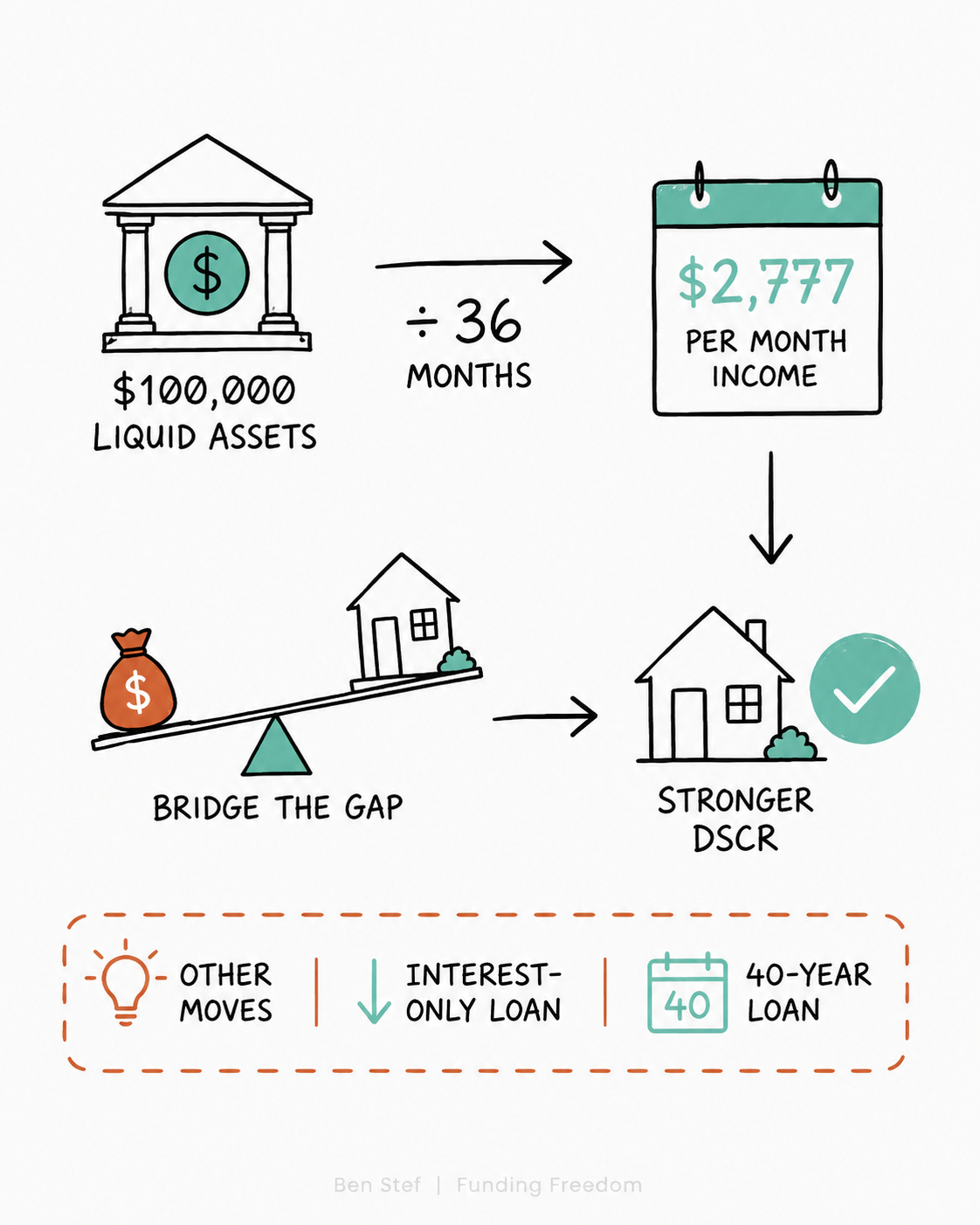
This is where a lot of deals die that don’t have to.
If the gross rent doesn’t fully cover the mortgage payment, you have a few moves.
One is switching to an interest-only loan. That drops the monthly payment and can push the ratio over 1.0. Another is going to a 40-year loan instead of 30, which also lowers the payment.
The third is something most lenders won’t even offer, and honestly it’s one of my favorites right now. We can take a borrower’s liquid assets, divide that number by 36 months, and count it as additional income to bridge the gap on the DSCR ratio.
Here’s what that looks like. If you’ve got $100,000 sitting in a bank account, we divide by 36, which gives you $2,777 per month in qualifying income. That’s real money that can push a borderline deal across the line. I’ve heard they may extend the window out to 72 months eventually, which would make it even more flexible. But right now at 36 months, it already works well on deals that are close but not quite there.
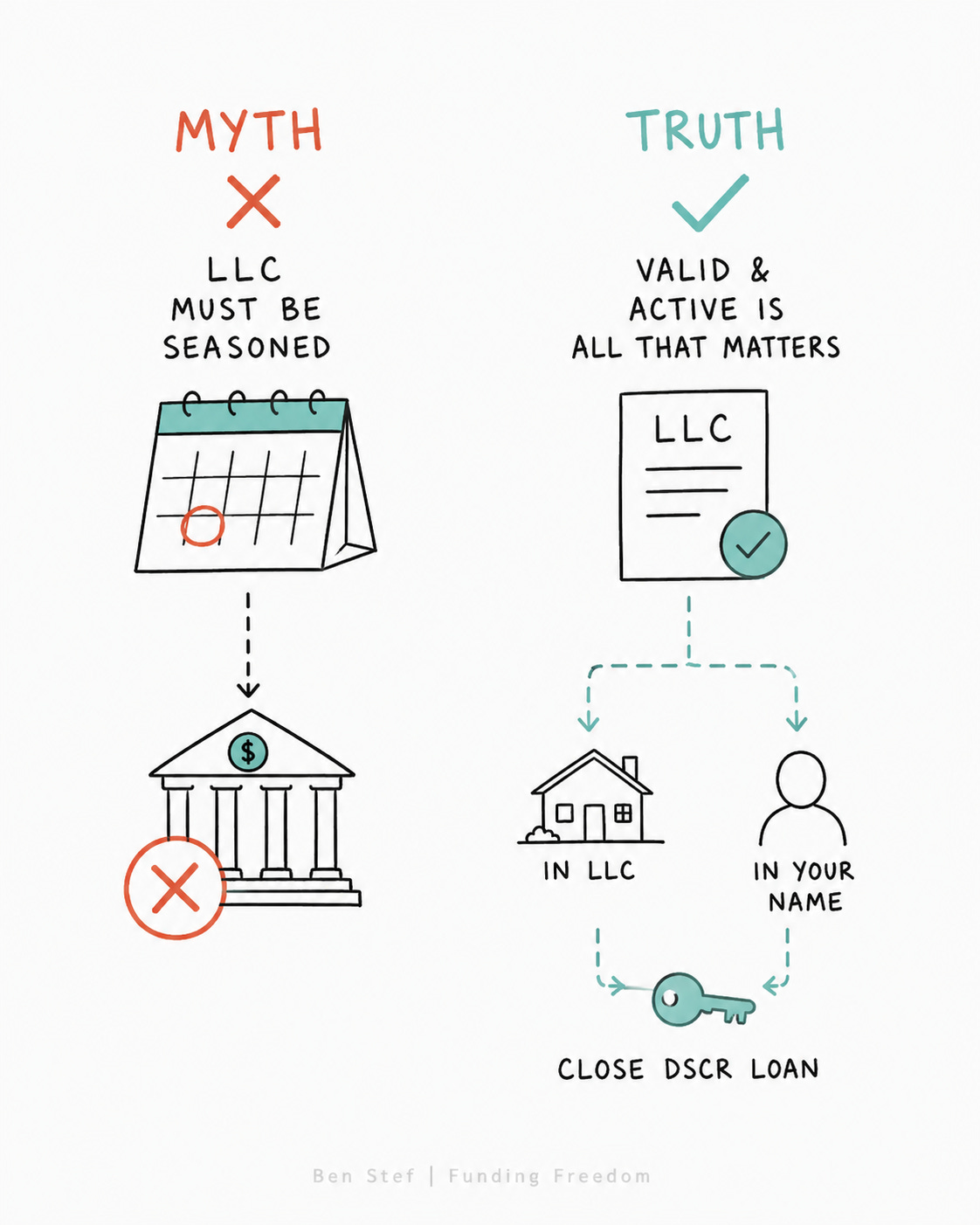
People think they need a seasoned LLC to close a DSCR loan. I hear this constantly.
That’s a myth. The lender doesn’t care how long your LLC has been open. They just need to see the entity is valid and active so they can record the title and mortgage correctly. You could open an LLC the week before closing and be completely fine. We’ve done it. Plenty of clients have done it.
You don’t have to close in an LLC either, personal name works too. The choice is yours.
Rent that covers the mortgage at a 1.0 ratio or better (or options to get there)
Clean payment history on all existing mortgages
Credit score of 620 or above, with better terms as the score goes up
Six months of reserves in a US account after closing
Proof that your rental income is real, not just a signed lease
If you’re looking at a specific deal and want to know whether it qualifies, I’m happy to run through the numbers with you. No pressure, just takes a quick call.
Book a call here: https://link.crm-u.co/widget/bookings/stefquickcall
Hope that helps.
Ben Stef, Mortgage Advisor | NMLS# 2018674
No posts
Comments
Nothing yet. Say the first thing.
Sign in to join the conversation.