
Many many many investors hear ‘no income verification’ and think the hard part is already over.
They find a rental property. They run the numbers. The rent covers the mortgage. BUT IT IS NOT THAT SIMPLE LADIES AND GENTLEMEN (they are really good loans though)
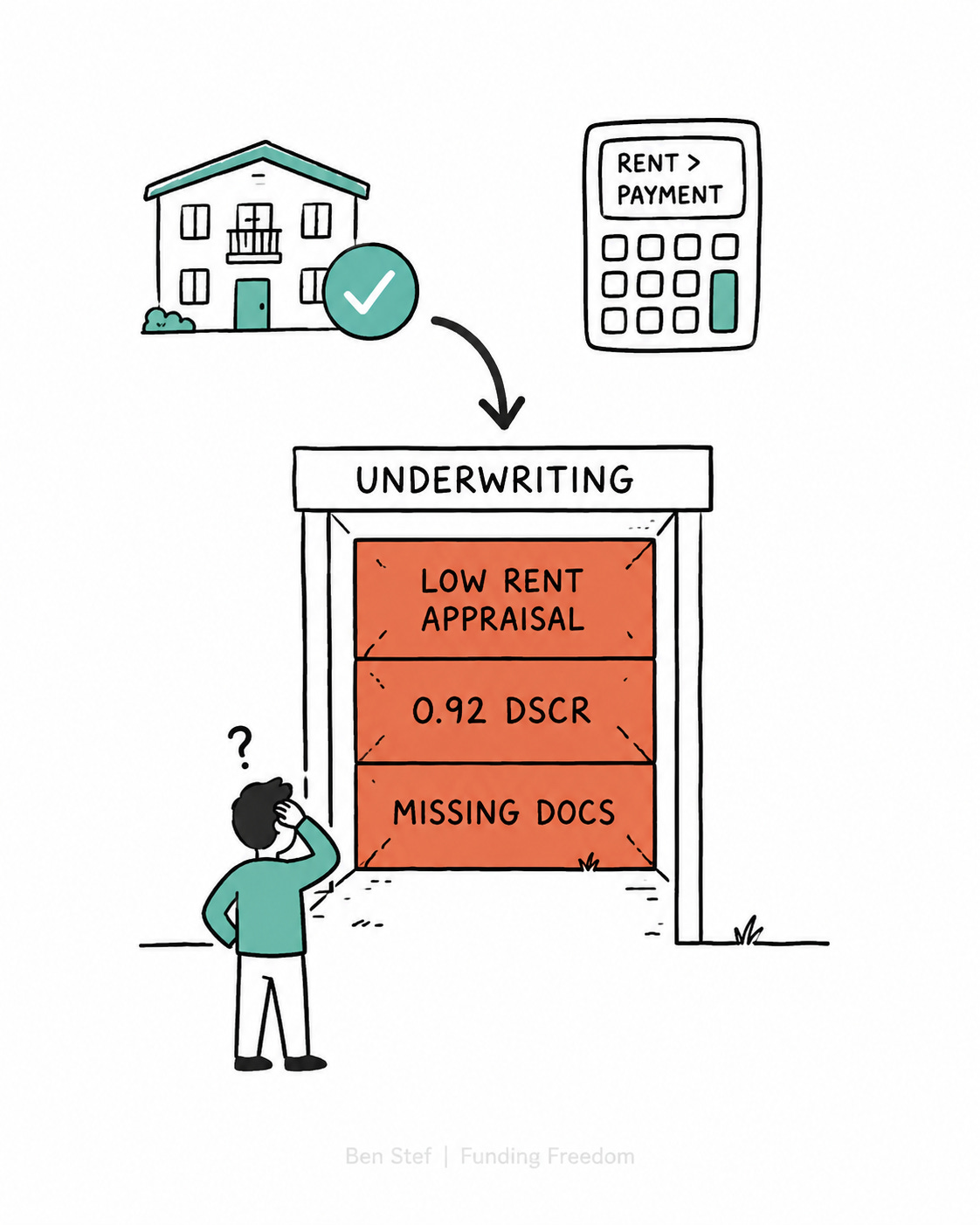
Then the file gets to underwriting and things start to unravel. The appraiser comes in with a rent estimate that is lower than the actual lease. The underwriter wants mortgage statements on six different properties. The DSCR ratio is sitting at 0.92 instead of 1.0, and now the lender is saying the deal does not qualify. The investor is confused because nothing in that conversation felt like it was supposed to happen.
I work with real estate investors every day, and this situation is not rare. People understand the concept of a DSCR loan just fine. The property qualifies on its own cash flow, not on your personal income. That part makes sense. But there is a big gap between understanding the concept and actually getting through underwriting without the deal falling apart.
Here is what I want to walk you through: what DSCR loans actually require, where deals die that do not have to, and a few options most lenders are not going to offer you when your numbers are close but not quite there. Some of this stuff is genuinely overlooked, and I want to make sure you are not finding out about it for the first time when you are already deep in a file.
The Basics Most People Think They Already Know
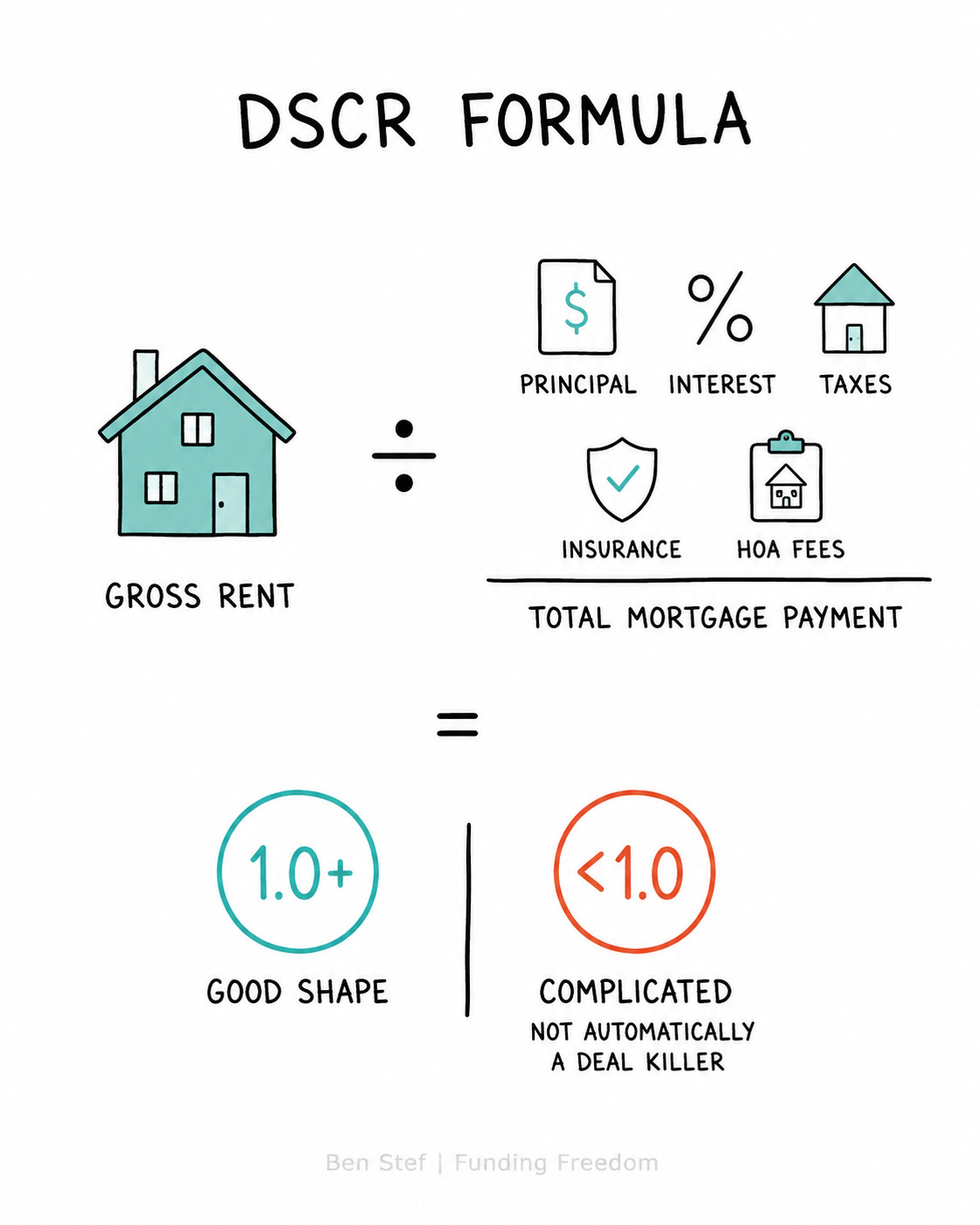
The math on a DSCR loan is straightforward. You take the gross rent and divide it by the total mortgage payment. That payment includes principal, interest, taxes, insurance, and any HOA fees. If that number is 1.0 or above, you are in good shape. Below 1.0 is where things get complicated, but it does not automatically kill the deal. More on that in a minute.
What trips people up is the documentation side. No income verification does not mean no paperwork. I have seen investors come in expecting something close to a no-doc loan and then get surprised when the underwriter needs mortgage statements on every single rental property they own.
Here is a real example. Marcus owns five rental properties, all with mortgages. He comes to me thinking this is going to be easy. No personal income docs, clean cash flow on the new property, should be smooth. But once we get into the file, the underwriter needs mortgage statements for all five of his existing properties, not to verify income, but to confirm he has been making payments on time. If the credit report is not showing the most current payment history, which happens more than you would think, those statements are how we prove he is current.
This is one of the most overlooked requirements in the whole process. A 30-day late payment on any mortgage is a hard stop for most lenders. It does not matter how good the new deal looks. You have to be current across the board. If you are dealing with a private lender and do not have the actual statement, sometimes a verbal or written verification of mortgage works. For institutional lenders, they want the real paper.
Credit Score, Down Payment, and How the Two Connect
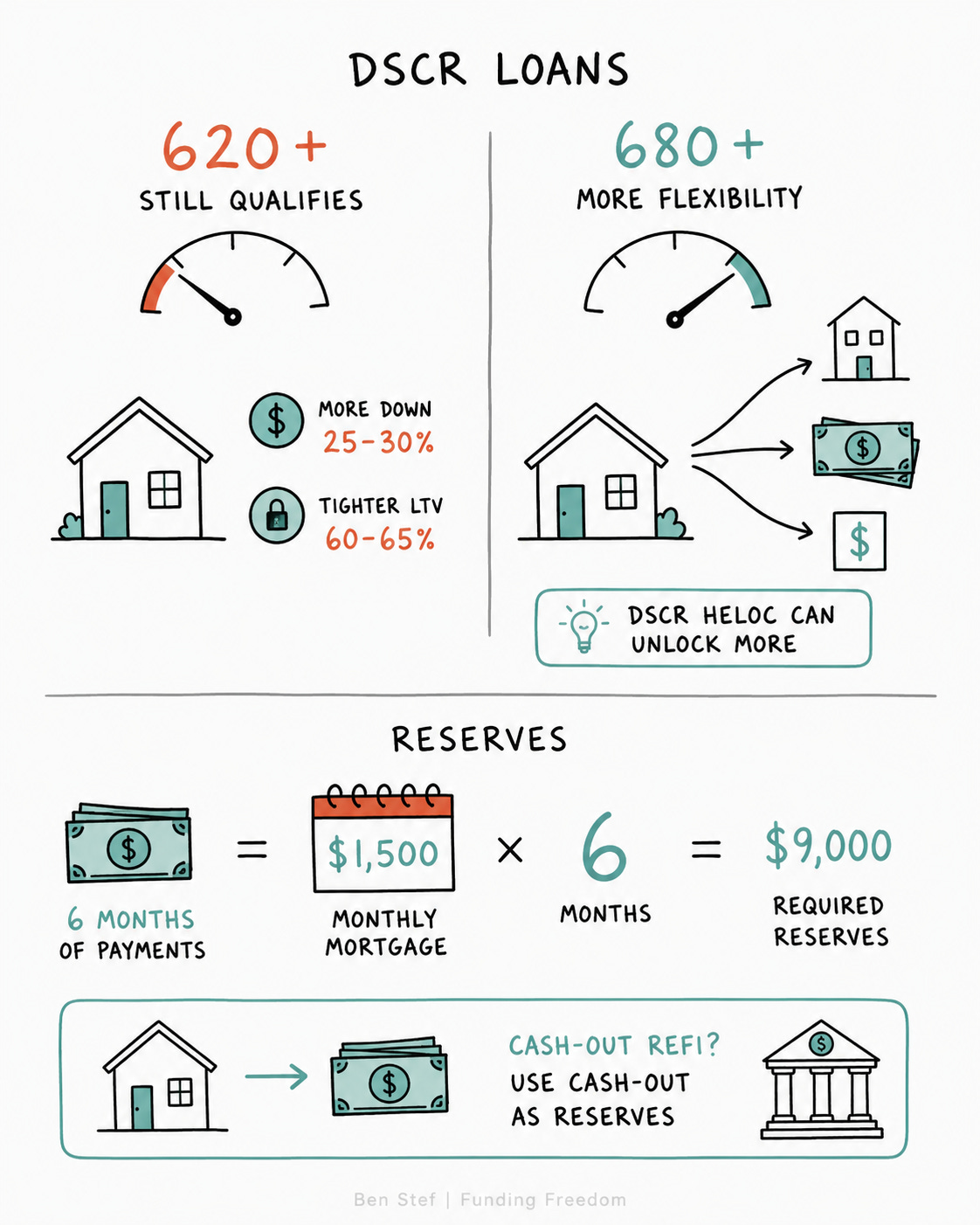
DSCR loans go down to a 620 credit score, so you can still get approved in that range. The catch is that a lower score usually means more money down. If you are buying, you might be looking at 25 or 30 percent down instead of 20. On a cash-out refinance, a lower score is going to cap your loan-to-value pretty tight. They might let you go to 60 or 65 percent LTV instead of the 75 or even 80 percent you could access with a strong score.
If your score is 680 or above, you are in a solid position. There is a lot more flexibility in how we can structure things. And if the LTV limits on a cash-out refinance feel too tight for your score, a DSCR HELOC on the property might actually get you more money. Worth knowing that option exists.
On reserves: after your down payment and closing costs, most lenders want to see six months of mortgage payments still sitting in a US bank account. Checking, savings, retirement accounts all count. A quick example: if your mortgage payment is $1,500 a month, that is $9,000 in reserves the lender needs to see after closing. On a cash-out refinance, most lenders will let you use the cash-out proceeds as your reserves, so you are not pulling that from somewhere else.
When the Rent Does Not Quite Hit 1.0: Here Is the Play
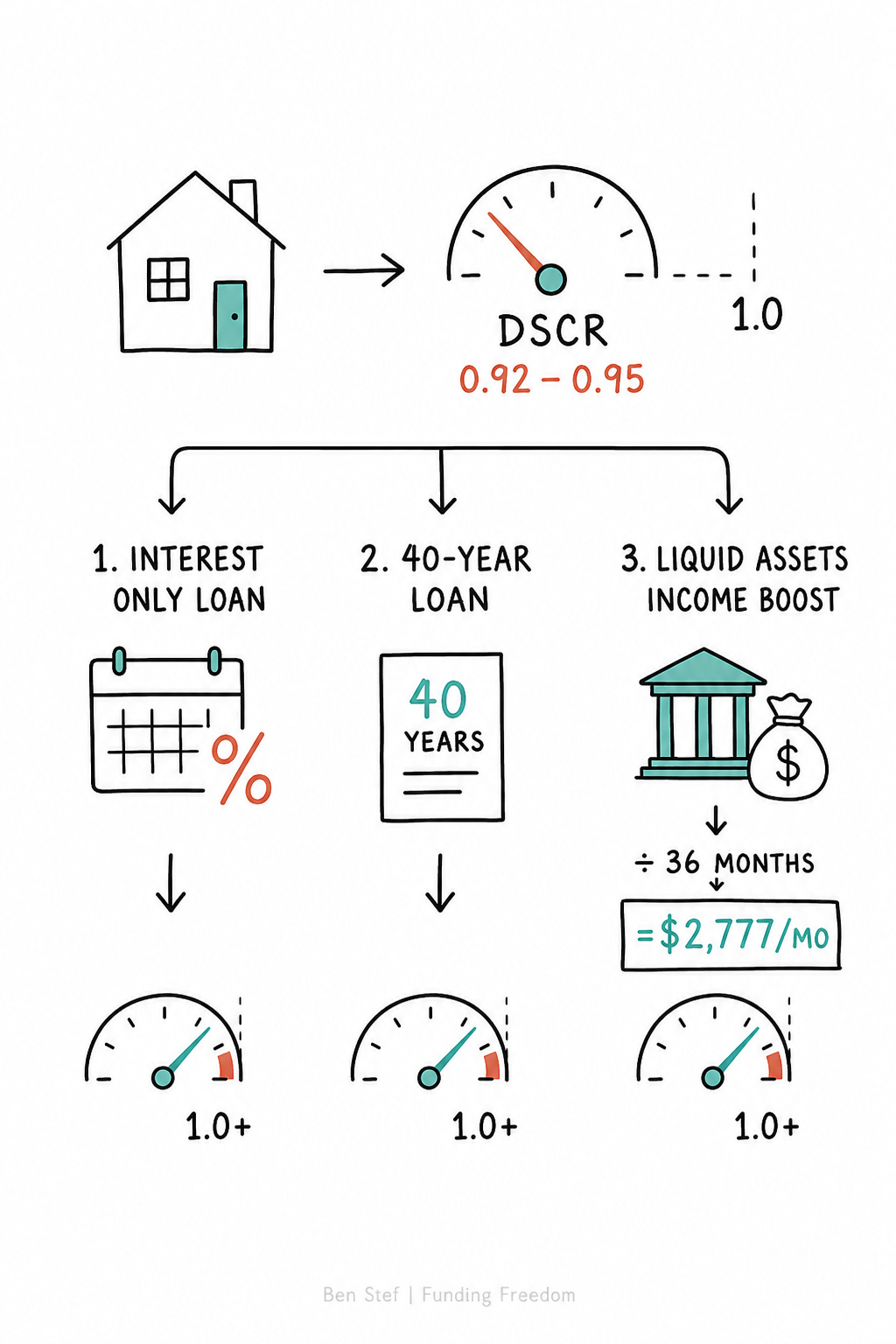
This is where a lot of deals die that honestly should not. The rent is close to covering the mortgage but not quite there. Maybe the DSCR ratio is sitting at 0.92 or 0.95. That feels like the end of the conversation with a lot of lenders.
There are a few ways to fix this that I see work in practice.
First is switching to an interest-only loan. That drops the monthly payment, which can push the ratio over 1.0 without changing anything about the property or the rent.
Second is going to a 40-year loan instead of a 30-year. Same idea. Lower monthly payment, better ratio.
Third is one that most lenders are not going to offer you, and honestly it is my favorite one right now. We take a borrower’s liquid assets and divide them by 36 months. That number counts as additional income to bridge the gap on the DSCR ratio. If you have $100,000 sitting in a bank account, divide that by 36. That is roughly $2,777 per month in additional income we can use. It is aggressive, it works, and I want to be clear that most lenders do not do this. I am hearing that the 36-month window might get extended out to 72 months at some point, which would make it even more powerful.
So before a deal dies on a ratio miss, it is worth having a real conversation about what tools are actually on the table.
How Underwriters Actually Calculate Your Rent (This Part Matters)
This is the piece that catches investors off guard the most, and usually not until they are already deep in the process.
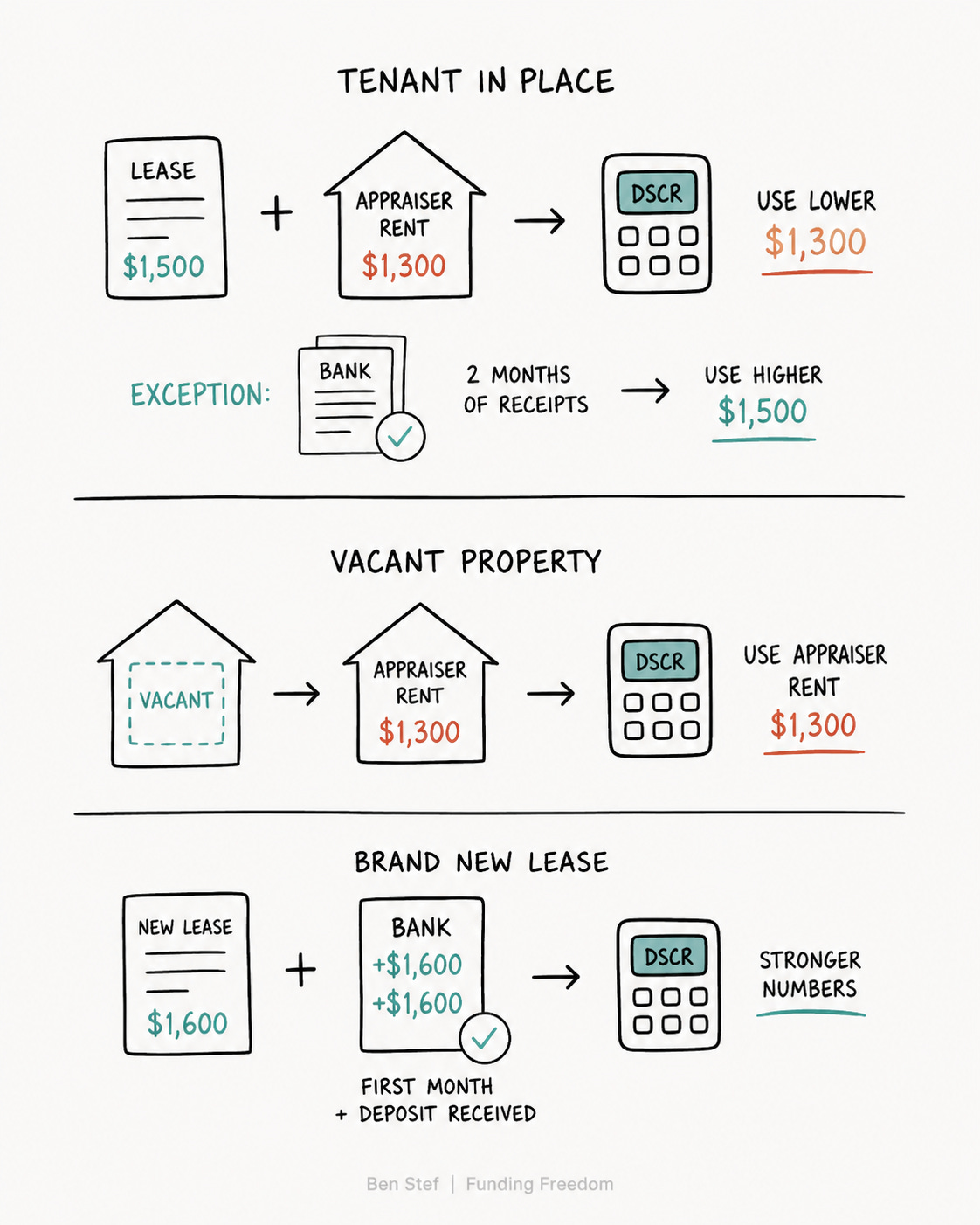
When you have a tenant in place, the appraiser goes out and gives their opinion on what the market rent should be. The underwriter then looks at two numbers: what your lease says and what the appraiser said. They use the lower of the two.
So if your tenant is paying $1,500 a month but the appraiser says market rent is $1,300, the underwriter is running the DSCR calculation on $1,300. That can change whether a deal qualifies. The exception is if you can show two months of bank statements proving the tenant actually paid $1,500. Show that, and they will use the higher number. That threshold, two months of receipts, is what unlocks it.
If the property is vacant, there is no lease to compare to. The underwriter just goes off whatever the appraiser says the market rent is.
Brand new leases are another thing to be careful about. If you signed a lease a month ago, the underwriter is going to want more than just the document. They want proof the tenant actually paid the first month’s rent and security deposit, with a bank statement showing the money hit your account. I have seen deals get complicated because an investor came in with a fresh lease showing strong numbers and could not back it up with proof of payment. The underwriter is going to question whether the lease is legitimate if no money actually moved.
The LLC Question (And One Speed Option Most People Miss)
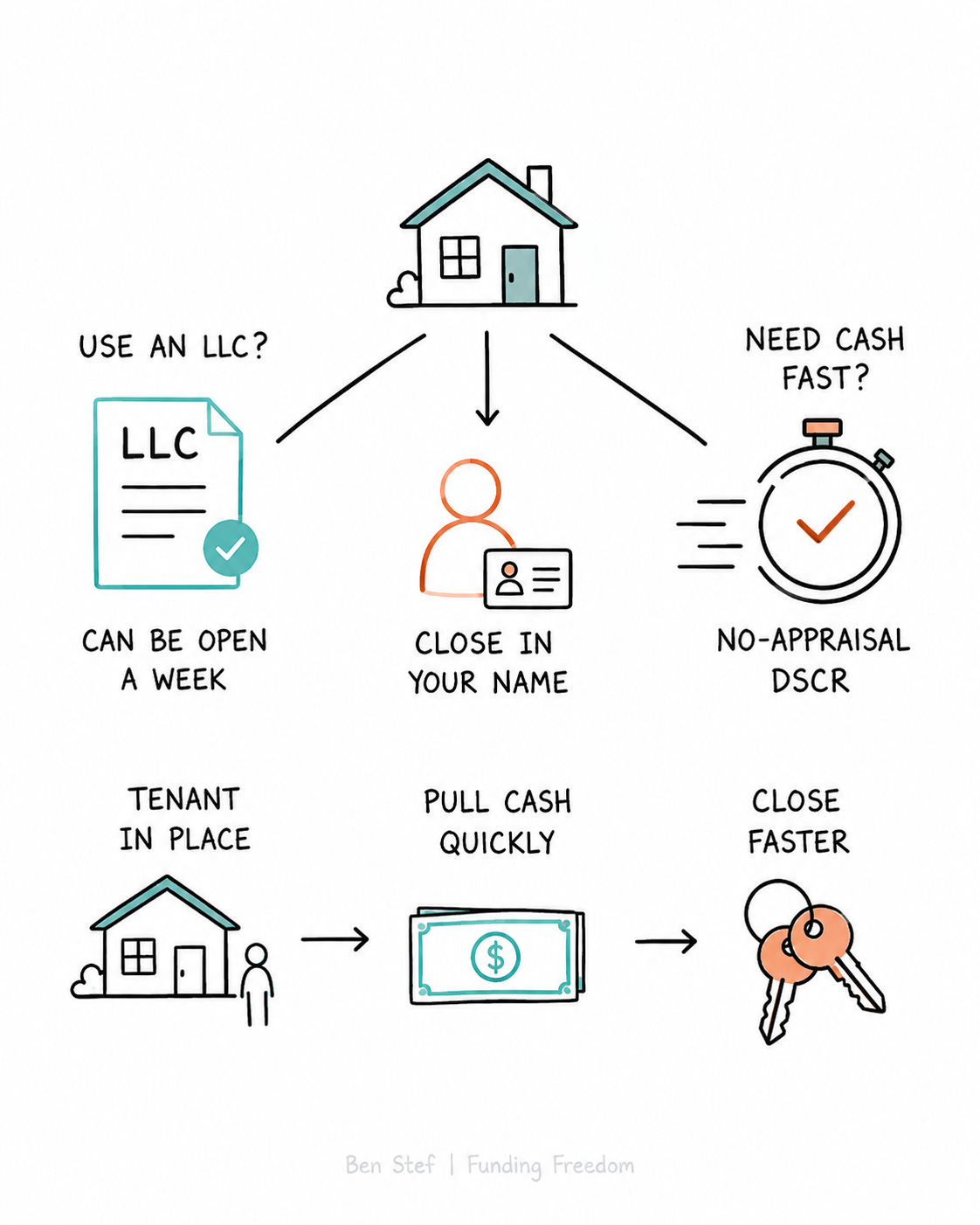
People think they need their LLC to have been open for some minimum period of time before they can close a DSCR loan through it. That is not true. The lender does not care how long the LLC has been open. They need to see the entity information is valid and the LLC is active so they can record the title and mortgage correctly. We have closed deals where the client opened the LLC the week before. That is completely fine on a purchase.
You also do not have to close in an LLC at all. If you would rather close in your personal name, that works. The choice is yours.
One more option worth knowing about: if you want to pull cash out quickly and you already have a tenant in place, there is a no-appraisal DSCR program that skips the appraisal entirely. You can do a HELOC or a fixed program. The property just needs to be currently rented. That speeds up the whole timeline significantly if you are trying to move fast on something.
The Full Picture
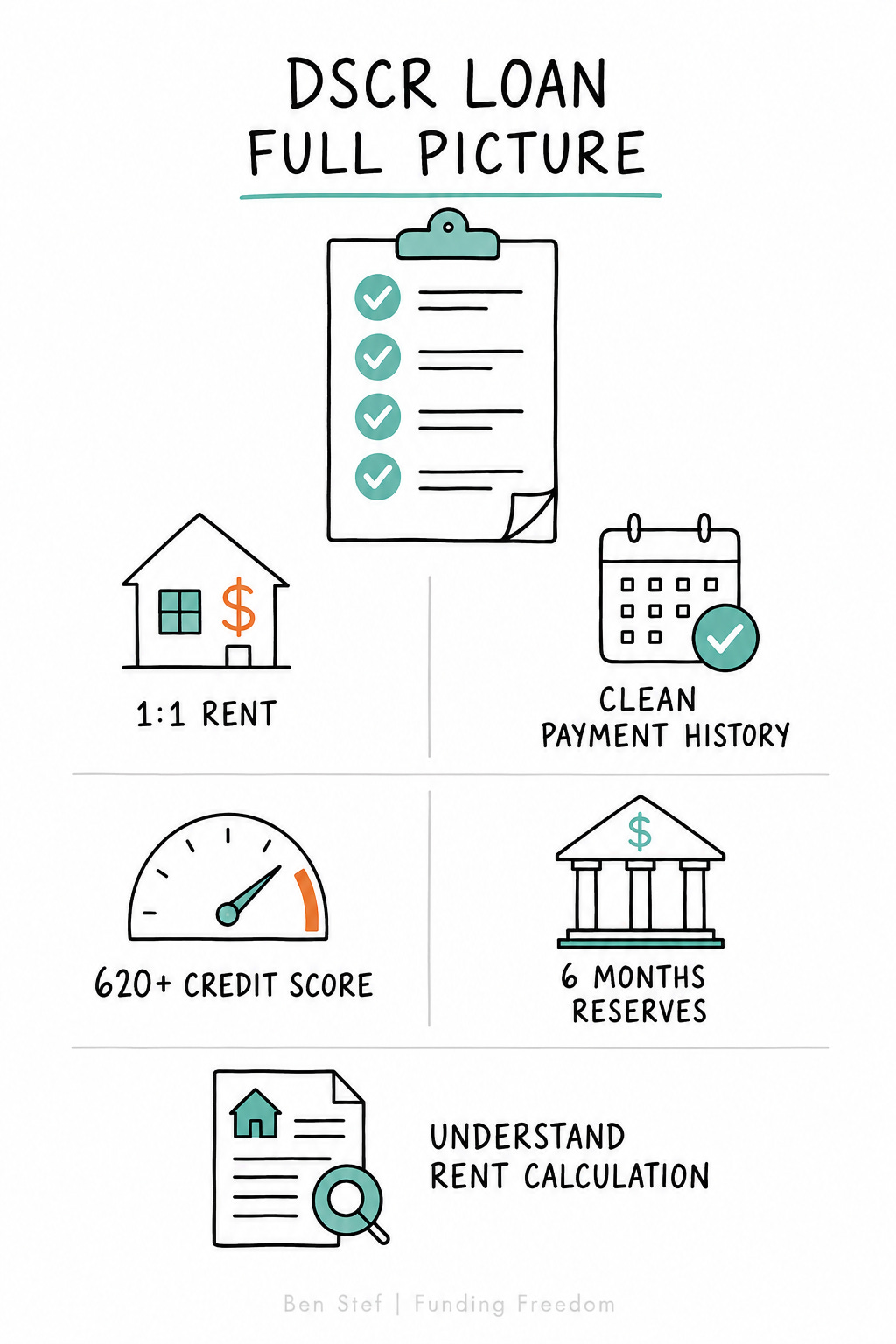
To summarize what you actually need to get a DSCR loan across the line:
Rent needs to cover the mortgage at a 1:1 ratio or better, and if it does not, there are real options to fix that.
Clean payment history on all your existing mortgages. A 30-day late is a hard stop.
Credit score of 620 or above, with better terms the higher your score is.
Six months of reserves in a US account after closing.
An understanding of how underwriters calculate rent from your leases, because that number might not be what you expect.
If you are trying to figure out whether a specific deal qualifies, or if you are close but not sure how to get it across the line, I am happy to run the numbers with you.
Book a quick call here:
https://link.crm-u.co/widget/bookings/stefquickcall
No pressure. Hope that helps.
Ben Stef, Mortgage Advisor | NMLS# 2018674
Comments
Nothing yet. Say the first thing.
Sign in to join the conversation.