
Rocket, Mr. Cooper, SoFi and all these guys text/email/call nonstop and they can’t do more than half the loans I talk about on my YouTube Channel lol
And before you think that’s because they care about your portfolio, they obviously don’t. They’re pushing a standard refinance because that’s what they sell. It’s profitable, it’s easy to close at scale, and it fits their system.
B the time you hit property 3 or 4 the traditional banking system basically stops working for you. You’ve got equity sitting in your rentals, but your tax returns look like a disaster on paper because of write-offs and depreciation. The banks look at that DTI number, and they say no.
So investors either sit on that equity and do nothing, or they burn time chasing a loan that was never going to close.
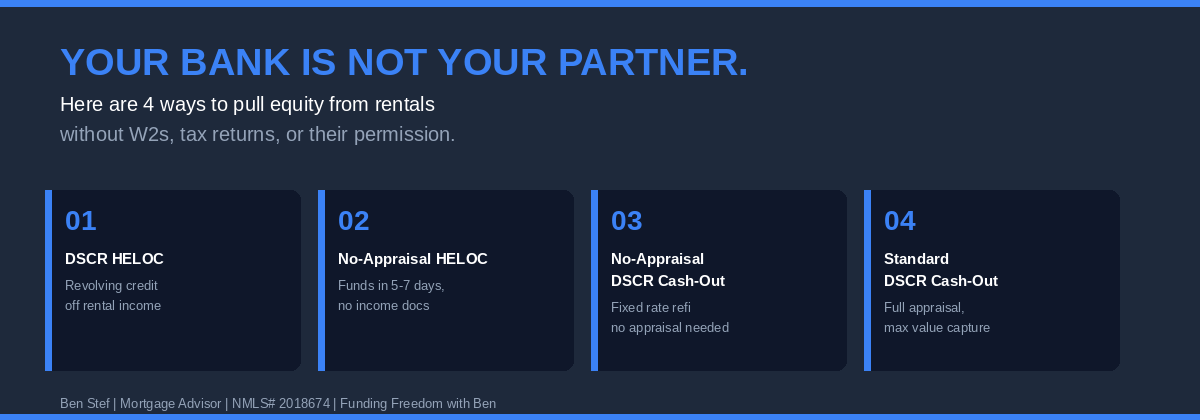
So there are 4 GREAT options for you.
These are programs built specifically for investors. No W2 required. No tax returns etc. They qualify off the property’s income, not yours. And your bank doesn’t offer any of them because their whole system is built for the average homebuyer. You are not the average homebuyer.
I’ve funded over $50 million in investor deals. The investors who keep growing while everyone else stalls are the ones using programs like these. Let me break down all four.
The DSCR HELOC
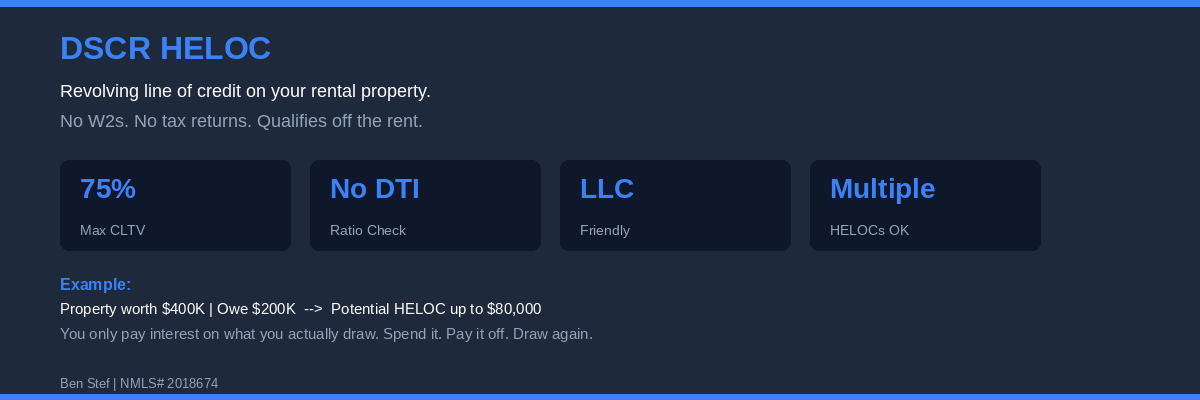
A HELOC on a rental property. No W2. No tax returns. The loan qualifies off what the property makes, not what you make personally, just like any other DSCR product.
Here’s what makes this one different from a typical cash-out refi:
It’s a revolving line of credit. You draw, pay it off, draw again.
You only pay interest on the balance you actually use.
You can go up to 75% combined loan-to-value (CLTV).
No debt-to-income ratio check at all.
You can hold it in your LLC. Most programs don’t allow that.
You can get multiple HELOCs on multiple properties at the same time.
Real example from the transcript:
→ Investor owns several properties in an LLC.
→ His bank wouldn’t give him a line of credit.
→ We used only his rental income to qualify.
→ Got multiple HELOCs across multiple properties simultaneously.
→ He had capital ready to move on his next deal without touching his cash reserves.
No prepayment penalties either. Pay it down, draw again as your portfolio grows. That’s exactly how you keep scaling without selling anything.
The No-Appraisal HELOC
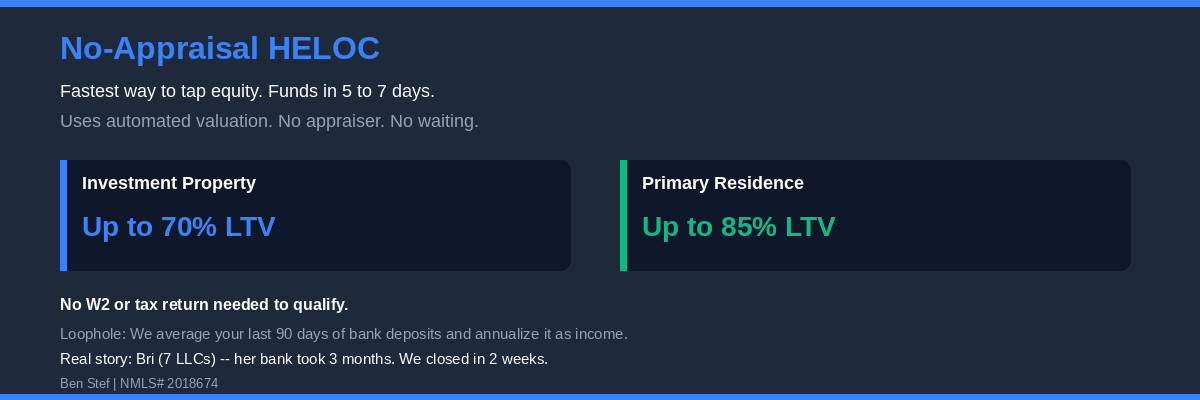
This one moves fast. We’re talking 5 to 7 days from application to funded. The lender uses an automated valuation model instead of scheduling an appraiser, which cuts out a big chunk of the timeline.
The numbers:
Investment properties → up to 70% LTV
Primary residence → up to 85% LTV
No W2 or tax returns required to qualify
There’s also a bank statement loophole built into this program. The system looks at the last 90 days of deposits in your bank accounts, averages them out, and annualizes it as income. So if you’re depositing $20K a month on average, the system treats that as $240K per year in income. Pretty wild.
One condition: the property has to be in your name or your entity’s name for at least three months before you can use this.
Real story:
Bri runs seven LLCs. She’d been working with her bank for three months trying to get a $150,000 line of credit. Three months. The bank kept dragging it out because her paperwork is complicated. She came to me and we closed in two weeks. The only reason it took that long was a paperwork mismatch that got cleared up fast once someone was actually paying attention.
That’s the difference between a bank trying to fit you into their product and a lender who works with investors every single day.
No-Appraisal DSCR Cash-Out Refi
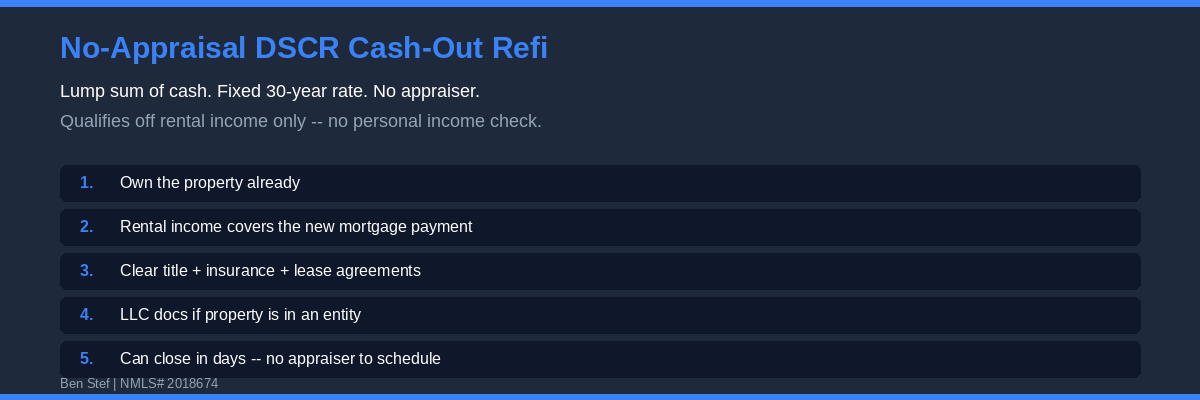
This one is a fixed cash-out refi on a rental you already own. No appraisal. No personal income verification. You walk away with a lump sum of cash and a 30-year fixed rate, currently somewhere around 6.5% depending on where rates are when you read this.
What you need to qualify:
You have to already own the property.
Rental income has to cover the new mortgage payment.
Clear title.
Insurance docs.
Lease agreements.
LLC docs if it’s held in an entity.
That’s basically it. Because there’s no appraisal to schedule, the process moves quickly. No waiting on an appraiser’s calendar. No having to bother your tenants with a stranger walking through.
I used this recently for a flipper who decided to hold a property as a rental about seven months in. He had a semi-rural property and didn’t want to sit around waiting on an appraisal. We got it done quickly, and he had his capital ready for the next acquisition.
Sometimes the no-appraisal version misses on value-adds. If you’ve added a bedroom, rehabbed the kitchen, whatever, the automated model might not fully catch those improvements. In that case, Option 4 is probably the better play.
Standard DSCR Cash-Out Refi
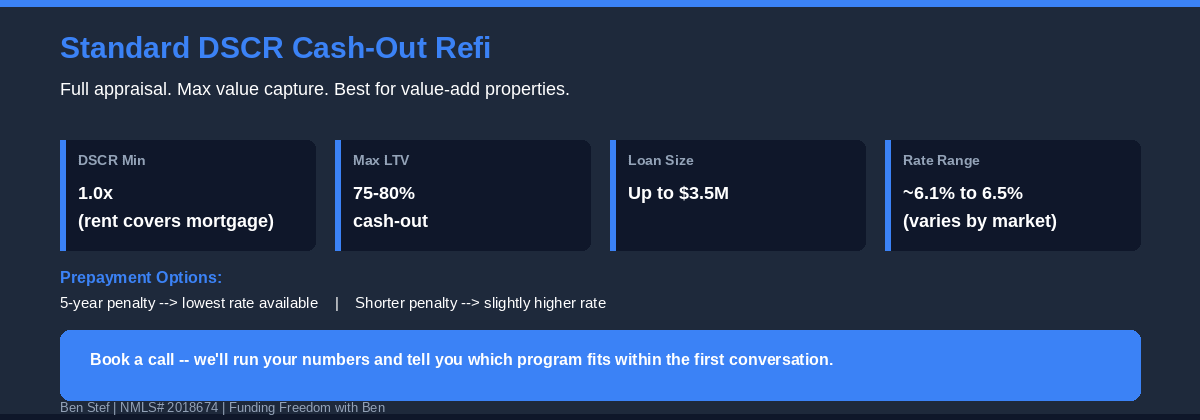
The most widely used of the four. Same concept as Option 3, but with a full appraisal. Which actually matters if you’ve done a lot of work to the property and want the appraiser to see it in person.
Here’s the breakdown:
Qualifies off DSCR ratio - rent needs to cover the mortgage at 1.0x. Some programs go down to 0.75x depending on credit and LTV.
Up to 75% LTV on cash-out. Some scenarios we can push to 80%.
Loan sizes up to $3.5 million.
Rates recently in the low to mid 6s for well-structured deals.
20% down required on purchase loans for most credit tiers.
Prepayment penalty options:
→ 5-year prepay penalty → lowest rate possible
→ Shorter penalty term → slightly higher rate, more flexibility
If you’re planning to hold long-term and want the best rate available right now, the 5-year makes sense. We just closed a couple of DSCR refis at 6.125% and 6.3% for investors who went that route.
If you think you might sell or refi again in a year or two, the shorter penalty might be worth the slightly higher rate.
Which One Is Right for You?
Honestly, that depends on your situation. How much equity do you have? Is the property in an LLC? Have you done significant improvements? How fast do you need to move?
None of these programs are one-size-fits-all, which is exactly why your bank doesn’t offer them. They can’t scale a custom conversation. We can.
My team are investors themselves. They think like investors. So when you come in with a messy LLC structure or a complicated income picture, we’re not going to look at it and say no. We’re going to find the program that actually fits.
Some of these can close in a week. There’s no reason to sit on equity you could already be using.
Book a call using the link below. We’ll go through your properties together, run the numbers, and you’ll know within the first conversation whether you qualify and which program makes the most sense.
Book here: https://link.crm-u.co/widget/bookings/stefquickcall
No pressure. If you’re an investor and you want to use these programs, they basically speak for themselves.
Ben Stef
Mortgage Advisor | NMLS# 2018674
Funding Freedom with Ben
Comments
Nothing yet. Say the first thing.
Sign in to join the conversation.