
I’ve seen investors come to me with solid deals. Good credit. Positive cash flow. A tenant already in place. Everything looking clean on paper.
And then the loan gets denied.
DSCR loans are supposed to be simpler than conventional financing. You’re not jumping through income documentation hoops or explaining your tax returns. The property’s rent is supposed to do the heavy lifting. So why do so many of these deals fall apart?
Almost every time I see a DSCR denial, it comes back to one of three things. And almost every time, it was preventable. The problem is that most lenders just take your documents, submit the file, and let underwriting find the issues. By then it’s too late. You’ve paid for an appraisal. The process has dragged on for weeks. The deal is in jeopardy.
I’m Ben Stef, and I specialize in financing for real estate investors. Over the last couple of years, we’ve closed 100% of our DSCR loans outside of appraisal and title issues. The reason is pretty simple. We catch these problems before they go anywhere near underwriting.
I’m walking you through each one below with real client examples so you know exactly what to look for before you submit your next deal.
There’s also a bonus mistake at the end. Most people are not going to like what I have to say about it, but it’s something I’m seeing all over the country right now and I think you need to hear it.
Mistake 1: Your DSCR Calculation Is Using the Wrong Income Number
A guy named Marcus came to me about eight months ago. He had a rental property in Tennessee, lease already signed, tenant in place paying $2,100 a month. His monthly payment on the mortgage was going to be around $1,850. The numbers worked.
Then the appraisal came back.
The appraiser completed what’s called a Form 1007. That’s a market rent analysis specific to the property. The 1007 said market rent in that area was $1,700 a month. Once the underwriter plugged in $1,700 instead of $2,100, the DSCR ratio dropped below the program minimum. Loan had issues qualifying.
Here’s what most people don’t know: your DSCR is not always calculated off your lease. It’s calculated off the lower of two numbers. Either what your lease says, or what the appraiser puts on the 1007. Whichever one is lower, that’s the number underwriting uses.
Marcus had a $2,100 lease but a $1,700 market rent on the form. So his DSCR was calculated on $1,700.
The fix sounds simple, but almost nobody does it upfront: run your DSCR calculation using the lower number before you submit. If the deal still pencils at the floor, you’re fine. If it doesn’t, you need to know that now. Not after the appraisal comes back and you’ve already paid for it.
Marcus’s deal got restructured and closed. But it almost didn’t.
Mistake 2: Assuming Your Lease Overrides the Appraiser
This one catches experienced investors. People who’ve already done DSCR loans before and think they know how the math works.
A client named David had two properties in his portfolio already. He was refinancing a property where his tenant was paying $2,400 a month. Lease confirmed it.
His previous lender plugged in $2,400, ran the DSCR calculation, and submitted. Straightforward.
Underwriting came back and recalculated at $1,950. Because that’s what the 1007 said market rent was. The cash-out refinance no longer worked. Denied.
Here’s the rule. If your lease is higher than what the appraiser says market rent is, you can use the higher lease number. But only if you can document that the tenant has been paying that amount for at least two consecutive months. Bank statements, payment history, something concrete showing two months of receipt.
If your tenants pay cash, pay inconsistent amounts, or you can’t document the payment history, the underwriter throws out your lease and uses the 1007. Every time.
David had the payment history. We pulled it together, resubmitted with the documentation, and the loan closed. Two months of bank statements is all it took. That’s the entire difference between an approval and a denial on a cash-out refinance.
Before you submit, ask yourself: if the appraisal comes in lower than my lease, can I prove the tenant is actually paying the higher amount?
The Bonus Mistake: Your Property Is Probably Worth Less Than You Think Right Now
I work with investors across the country. That means I’m seeing a wide pattern that most people only see in their local market.
Real estate investors in 2026 are consistently overestimating their property values, especially on refinances. I see this again and again. Purchase appraisals tend to come in at or near the contract price. Refinance appraisals keep coming in lower than what the investor expected.
Here’s basically why this is happening. Some markets saw bidding wars over the last few years. Those sales became comps. But appraisers know when a sale was inflated by a bidding war or a desperate seller. So even if the comp near you sold for $230,000 when it was listed at $199,000, the appraiser may discount it or weigh it differently because they know the market didn’t fully support that number.
The result is that your refinance appraisal comes in lower than your comps suggested it would.
My recommendation: be conservative when you’re projecting values on a refinance or cash-out. You would rather be surprised upward than have a low appraisal kill a deal you were depending on. If you have questions about what your property might appraise for before you go through the process, I have tools that can help you run those numbers. Book a call below and we can talk through it.
Mistake 3: A Hidden Credit Problem You Don’t Know About Yet
This one blindsides people because they think their credit is fine. And their credit is fine. The problem is somebody else’s.
An investor named Tim came to me wanting to buy a duplex through his LLC. His credit score was 755. Rents looked solid. Everything on paper looked good.
I asked him one question: is anyone else on the entity or guaranteeing this loan?
He mentioned his business partner. She was on the LLC and would need to sign as a guarantor. Her credit score was 618.
DSCR loans use the lowest credit score among all borrowers and guarantors as the representative score for the file. Not an average. The lowest one. It doesn’t matter that Tim had a 755. The moment his partner’s 618 came into the picture, that became the number the underwriter evaluated the entire file against. Most programs have a minimum of 660.
Most lenders would’ve denied it there and moved on.
What we did was find a DSCR program that uses the higher of the two scores rather than the lower. That’s the advantage of working with someone who has access to multiple programs. If it doesn’t work in one place, you take it somewhere else and get it funded.
Before you submit a DSCR deal through an LLC or with any partner involved, pull credit on everyone on the entity. Find out the lowest score in the room before you go anywhere near underwriting.
What This Actually Comes Down To
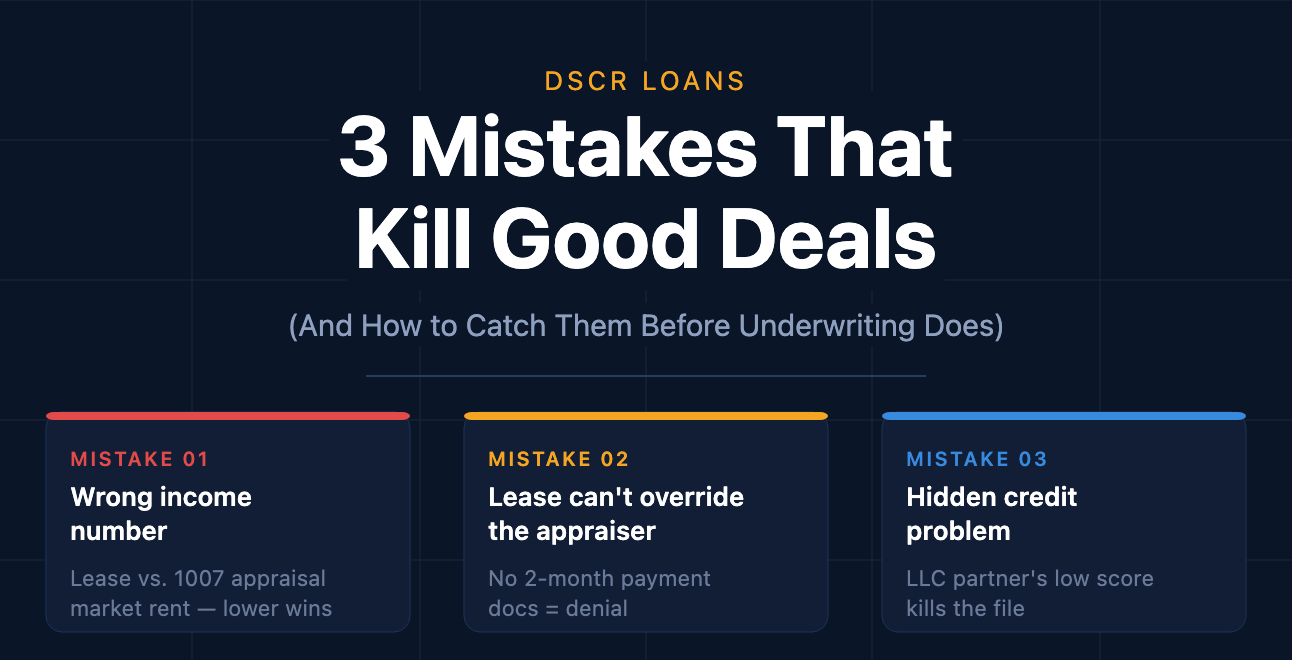
These three things, the wrong income number, a DSCR ratio that doesn’t survive the appraisal, and a credit issue hiding somewhere in the file, are some of the most common reasons good deals fall apart. And they’re almost always preventable.
The difference is working with someone who reviews the deal and thinks through the problems before documents ever go to underwriting. I’m not saying we can catch everything. There are always things outside of anyone’s control. But the stuff that’s predictable should be caught on the front end.
If you’ve got a deal you’re looking at, or you’ve already been denied on a DSCR loan and you’re not sure why, book a call with me. We’ll go through your deal, look at the numbers, and tell you exactly what you’re working with.
And if this was helpful, forward it to another investor who needs to see it.
Ben Stef | NMLS# 2018674
Funding Freedom with Ben
Comments
Nothing yet. Say the first thing.
Sign in to join the conversation.