

Before the main story, here are some signals that point in the same direction.
Google is making AI-generated advertising easier to identify. Users can now open an ad’s details on Search, Discover, or YouTube to see whether it was created or edited using AI. Google will automatically disclose ads produced with its own tools, while advertisers are responsible for identifying work created elsewhere. For marketers, creative provenance is quickly becoming another part of campaign governance, alongside privacy, brand safety, and regulatory compliance. (The Verge)
The debate over AI’s economic impact is moving from prediction to preparation. More than 200 economists and researchers, including 15 Nobel laureates and experts from OpenAI, Anthropic, and Google, are calling for immediate action on workforce disruption and the distribution of AI’s economic gains. Their warning is that a transformation comparable to the Industrial Revolution could unfold in years rather than decades. Waiting for certainty may itself become one of the riskiest choices business and government leaders make. (Reuters)
ChatGPT Work moves OpenAI from answering questions to completing workflows. The new agent can operate across connected apps and files, stay with a project for hours, and produce finished documents, spreadsheets, presentations, websites, and other deliverables. It can also run scheduled tasks while allowing users to monitor progress, redirect the work, and approve important actions. The larger shift is from giving employees an AI assistant to placing AI directly inside the operating rhythm of the company. (OpenAI)
Palantir CEO Alex Karp is warning companies not to surrender their institutional intelligence. Karp argues that frontier AI providers can gain enormous insight from the proprietary data and decision-making processes their enterprise customers expose to them—the “magic sauce” behind how those businesses compete. His comments capture a growing tension between adopting the most capable outside models and retaining control of the knowledge that creates enterprise value. AI sovereignty is rapidly becoming a board-level strategy question, not simply an IT or data-security concern. (The Wall Street Journal)
Taken together, these stories point to a larger shift. AI is moving beyond generating content and answering questions. It is entering workflows, absorbing institutional knowledge, influencing decisions, and forcing companies to reconsider where human authority should begin and end.
When the Machine Changes the Score
Late in Egypt’s World Cup match against Argentina, Mostafa Ziko scored what appeared to be a glorious, field-crossing goal. Egypt had moved the ball from one end of the field to the other, the crowd erupted, and for a moment the goal was simply real. Then the video assistant referee system traveled backward through the play and found a foul roughly 100 yards away from where the goal was scored. The referee reviewed the footage. The goal disappeared. Argentina eventually won, Egypt was furious, and a World Cup conversation became less about the players than the machinery reviewing them.

It is tempting to treat this as another argument about VAR, refereeing, and whether replay technology is ruining soccer. But the more interesting question is not whether the ruling was technically defensible. It is that the intervention felt disproportionate to the event, disconnected from how the play had unfolded, and hostile to the emotional logic of the game. Technology had not simply corrected something obvious that everyone had missed. It had reconstructed the past with such completeness that a moment nearly 100 yards away acquired the power to erase everything that followed.
That is what made people so angry. The system may have been right, but its version of being right did not feel legitimate. Which brings me to artificial intelligence and the workplace, where the parallels may be deeper than we realize.
When correctness becomes authority
For the last several years, we have framed AI as a tool that helps people work faster. It drafts the email, summarizes the research, analyzes the customer data, develops campaign variations, writes code, prepares the presentation, and removes the administrative paper cuts that consume too much of the working day. That framing made sense when the systems were largely reactive and the human being remained visibly in command. We asked the question, reviewed the response, and decided what to do with it. The AI system produced output, but authority and control remained with us.
That model is already beginning to feel dated. AI is moving beyond helping us create individual pieces of work and toward understanding, reconstructing, and acting across the entire sequence through which work gets done. It can examine the documents that informed a decision, the meetings where it was discussed, the data used to justify it, the people who approved it, the changes made along the way, and the results that followed. It does not have to experience organizational life as we do, one conversation, political interaction, or incomplete memory at a time. Given the necessary access, it can see the whole field.
That may become the defining advantage of AI at work. It will not simply be faster than us. In many circumstances, it may be more right than us because it can hold more information, compare more possibilities, preserve more context, and revisit the history of a decision without the same distortions of memory, hierarchy, ego, exhaustion, or self-interest. A person may remember the conclusion of the meeting. The AI system may remember the rejected alternatives, the buried research finding, the financial assumption that shaped the recommendation, and the moment when a senior executive redirected the conversation. Like VAR, it can travel backward through the play.
What makes this prospect more consequential is that the models themselves are also becoming more capable of examining and revising their reasoning. Recent Anthropic research makes this possibility more interesting. Researchers found evidence of an internal space within Claude where concepts appear to be held, combined, and considered before the model responds. It would be a mistake to treat this as proof of consciousness or assume the system is thinking as a human does. But it would be equally shortsighted to dismiss the significance of models developing more sophisticated ways to integrate information, compare possibilities, and reconsider an initial response.
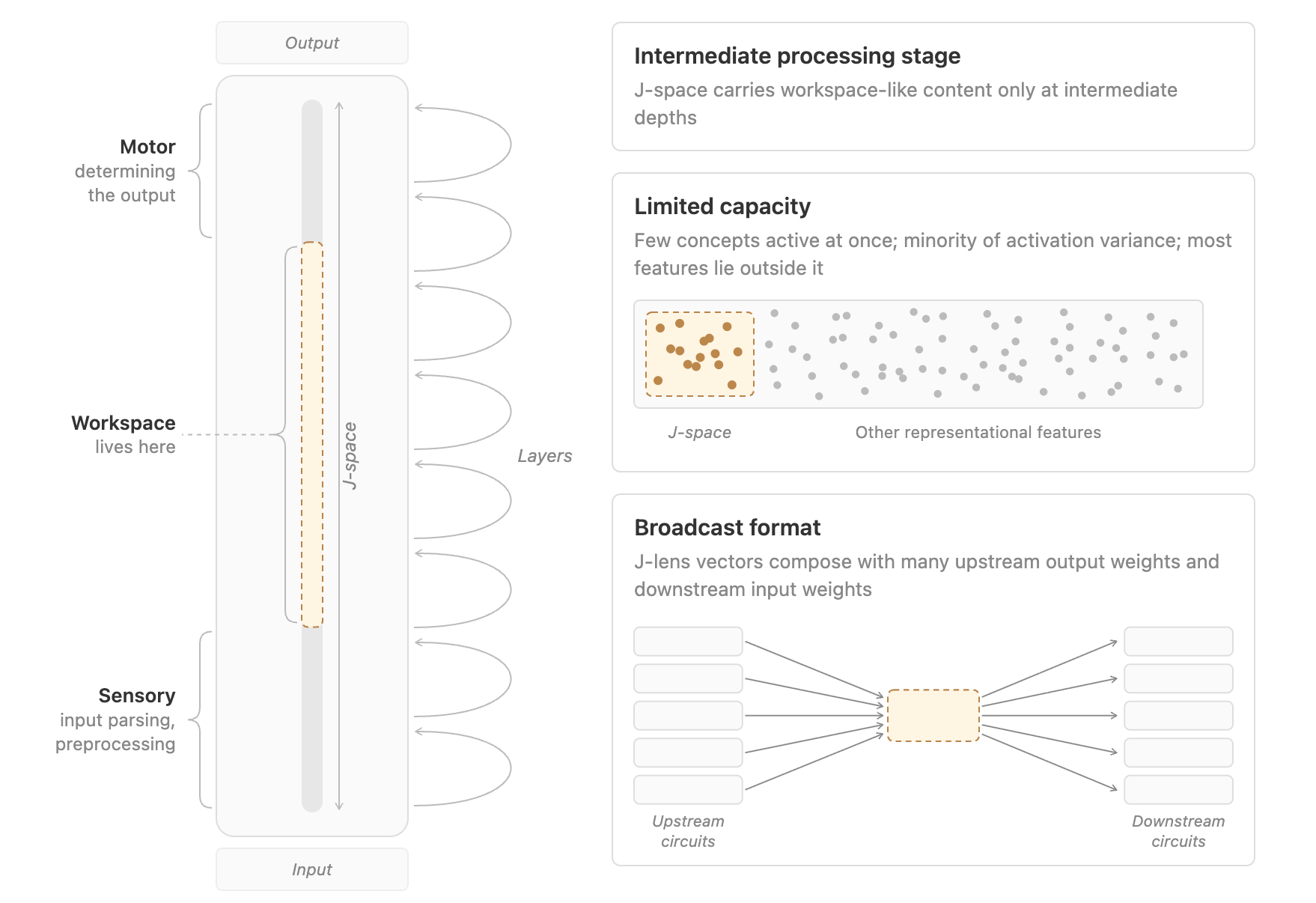
These systems do not need to think exactly like us to perform more of the functions we associate with thinking. They only need to recognize contradictions, compare competing interpretations, assemble a coherent account of a situation, and do those things reliably enough that organizations begin to trust their judgment.
As that happens, correctness begins to turn into authority. That is what occurred in the World Cup match. The machine did not merely offer another interpretation of events. It became the final arbiter of what had happened.
The workplace becomes reviewable
Imagine a major product launch that underperforms. Today, the postmortem is an imperfectly human process. Marketing believes the product was not differentiated enough. Product believes the positioning changed too late. Sales argues that the launch materials did not address the real objections in the market. Finance points to the pricing. The agency says the creative was weakened through approval rounds. The executive team blames execution. Everyone has evidence, everyone has partial memory, and everyone has an incentive to tell the version of the story that preserves their own judgment.
An AI system connected across the company could eventually reconstruct the entire sequence. It might find that the original customer research correctly identified a serious weakness in the proposition, but that the finding was softened in an executive presentation. It might identify the meeting where an uncomfortable insight was reframed, the email where the launch date became non-negotiable, the budget decision that eliminated an important test market, and the product change that forced marketing to rewrite the campaign six weeks before launch. It could show that the failure everyone is debating in October began with a seemingly minor decision made the previous March.
That could be enormously valuable. It would allow companies to learn more honestly, identify root causes, improve accountability, and prevent the same mistake from being repeated. It could also be profoundly uncomfortable. The AI would not merely be summarizing the postmortem. It would be adjudicating between competing human accounts. It would be deciding whose interpretation of events most closely matched the evidence. It could conclude that the most senior person in the room had been wrong, that the team’s celebrated strategic process had failed, or that a role long considered essential had added delay rather than value.
There is an important complication here too. AI may judge yesterday’s decisions using a completeness of evidence that no one possessed when those decisions were originally made. A reconstruction can be factually accurate while still failing to capture the uncertainty, time pressure, incomplete information, and organizational constraints under which people acted. The ability to see the entire play afterward does not necessarily make the original human decision irrational. It may simply make hindsight far more powerful.
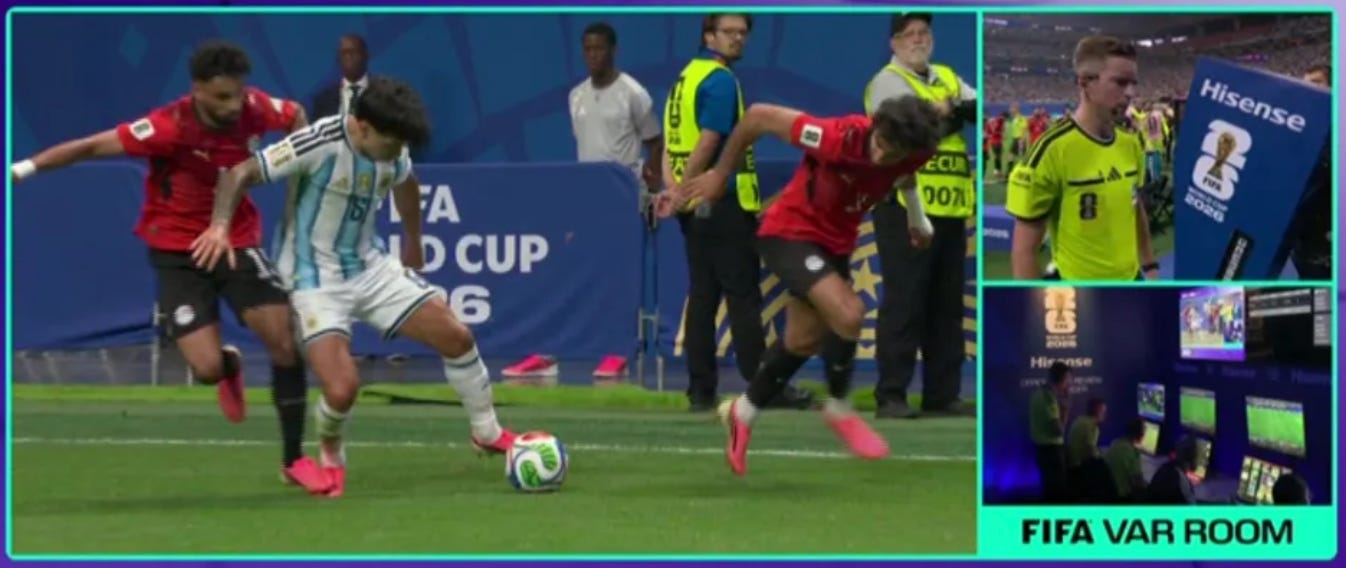
This is where the comparison with VAR becomes useful. The technology changes more than the accuracy of the decision. It changes the status of every human judgment that came before it. The referee’s initial call becomes provisional. The player’s celebration becomes provisional. The audience’s understanding of what just happened becomes provisional. Everything is subject to later review by a system that sees more angles, preserves more detail, and can rewind the sequence further than any person on the field.
Work is heading in the same direction. A recommendation will be reviewable. A forecast will be reviewable. A hiring decision will be reviewable. A performance evaluation will be reviewable. The rationale for an agency appointment, product investment, media allocation, or organizational restructuring will be reviewable. As the systems become better at reconstructing how decisions were reached, leaders will have to confront a difficult question. When the machine’s account is more complete than the human one, whose judgment should prevail?
This is also why the familiar language around AI and jobs is becoming less useful. We continue to say that AI will augment people, eliminate tasks rather than roles, and free employees for more strategic work. But the deeper change may be about authority. When a system can not only perform the work but evaluate how well it was performed, reconstruct why a decision failed, and identify which parts of a workflow add little value, it begins to influence which forms of human expertise still matter. The question is no longer simply what work AI can do. It is what happens to the people, functions, and institutions whose authority was built around doing and judging that work.
Being right is not the same as being legitimate
The problem with VAR is not that technology has no place in soccer. Few people want a decisive goal to stand when the scorer is clearly offside, or a dangerous foul to go unpunished because the referee’s view was blocked. The problem is that once the technology exists, its authority tends to expand. The exception becomes an expectation. The review travels further backward. The distinction between correcting a clear error and re-refereeing the entire sequence becomes harder to maintain.
The technology does not merely improve the existing game. It changes the nature of the game. Players hesitate before celebrating. Supporters know that the emotional truth of the moment may be reversed minutes later. Referees can defer to a system outside the field. The action continues, but the final meaning of the action now belongs somewhere else.
That is the risk for the workplace too. AI may begin by checking the calculation, reviewing the contract, or flagging the unsupported claim. Few people will object. It will then evaluate the recommendation, score the employee’s performance, suggest the organizational structure, decide which projects deserve investment, and identify which roles are no longer required. At every stage, the argument for greater authority will sound reasonable. The system has more data. It is more consistent. It is less political. It can find patterns that humans miss.
Eventually, we may discover that the human is still in the loop but no longer meaningfully in control. A person may approve the recommendation without having the time, evidence, expertise, or confidence to challenge it. The machine will not need formal authority if disagreeing with it becomes professionally indefensible. When the AI system has reviewed every relevant document, compared the available alternatives, modeled the likely outcomes, and produced a clear rationale, the burden of proof shifts to the human being who wants to say no.
That may be appropriate in some cases. Human judgment is not sacred simply because it is human. We are biased, inconsistent, forgetful, political, and frequently wrong. There are decisions where a more evidence-based machine recommendation should carry greater weight. But accuracy is not the only quality that gives a decision legitimacy. Organizations also care about proportionality, context, values, accountability, institutional commitments, and the ability of affected people to understand and contest what has been decided.
A prediction can be accurate without being fair. An optimization can be efficient without being wise. A reconstruction of what happened can be factually complete while failing to capture what the organization owes its employees, customers, or society. The machine may be able to tell us which decision will maximize the measurable outcome. It cannot, on its own, decide whether that is the outcome we should maximize.
This is where AI governance will have to move beyond principles, committees, and acceptable-use policies. Organizations will need to define where machines advise, where they decide, how their conclusions can be challenged, which evidence they must reveal, and who remains accountable when the system is followed. Employees may need a meaningful right to appeal machine-supported decisions, particularly when those decisions affect performance, compensation, advancement, or employment. Leaders will need to distinguish between a system that improves judgment and one that silently replaces it.
The question will not be whether a human remains somewhere in the process. It will be whether that human still has the knowledge, authority, and courage to make a different call.
The World Cup controversy offers a preview of an increasingly common organizational experience. The system will review the tape, reconstruct the sequence, and identify an upstream error that no one considered decisive at the time. It will explain why the outcome should be reversed. The evidence may be strong, the reasoning coherent, and the conclusion correct. People may still reject it because the intervention feels disproportionate, because the system can see the recorded actions but not the human context surrounding them, or because a decision made under uncertainty is being judged later with information that was not available at the time.
They may also reject it because the technology has crossed an invisible line from supporting human judgment to invalidating human agency. No one enjoys being overruled by a machine, especially when that machine has no identity, accountability, or personal stake in what follows.
We have spent much of the AI era debating whether machines will replace us. The more immediate tension may be whether they will become better judges of our work than we are. They may recognize which strategy is more likely to succeed, which campaign is weaker, which forecast is unrealistic, which explanation is self-serving, and which part of the workflow exists only because no one has questioned it recently.
The hardest thing about AI may not be discovering that it can perform parts of our jobs. It may be discovering that it can identify, with evidence, which parts of our jobs were never as uniquely valuable as we believed.
The future of work will not arrive only when AI can do everything. It will arrive when the machine reviews the play, finds the foul far upstream, and persuades the organization to change the score. By then, companies will need more than accurate systems. They will need a philosophy for where machine authority begins, where it ends, and what forms of human judgment are worth preserving even when they are less efficient.
Otherwise, the system may be right. The organization may become more productive. The decision may be entirely defensible. And everyone involved may still feel that the game has been taken away.
Where I’ve been
At the Cannes Festival of Creativity in late June, AI Trailblazers hosted the Cannes Reworked Summit, bringing together senior marketing, creative, and technology leaders for an in-depth conversation about where marketing and creativity are headed in the AI era.
With executives from Microsoft, Google, JCPenney, LinkedIn, Mastercard, Victoria Secret, U.S. Bank, Visa, Novartis, Sephora, Coca-Cola, Indeed, and others, the conversation explored how AI is reshaping creativity, workflows, organizational design, and the role of human judgment.
View the photographs and read the key takeaways from the summit. Special thanks to Transparent Partners and Celtra for helping make it such a memorable afternoon.
What I’ve written lately
The Front Door Moves (July 2026)
The Execution Layer is Collapsing (June 2026)
The End of the Segment (May 2026)
When Intelligence Enters the Org Chart (May 2026)
The End of the Brief as We Know It (April 2026)
Shiv Singh is the CEO of Savvy Matters, which helps business teams translate AI disruption into practical business and marketing strategies, organizational design, executive-ready roadmaps, and bespoke education programs. He is also the Co-Founder of AI Trailblazers, a vibrant community uniting marketers, technologists, entrepreneurs, and venture capitalists at the forefront of AI.
A former two-time Chief Marketing & Customer Experience Officer and author of Marketing with AI for Dummies (4th print run, translated into five languages), Shiv built his career at LendingTree, Visa, PepsiCo, and The Expedia Group, and serves as a public-company board member of a Fortune 300 company and private investor.
Comments
Nothing yet. Say the first thing.
Sign in to join the conversation.