

Before the main story, here are some important happenings this week.
OpenAI's latest research suggests AI is doing more than automating tasks. It is helping employees perform work outside their traditional roles. The opportunity for business leaders isn't just efficiency; it's redesigning teams and functions around broader, AI-enabled capabilities. (OpenAI)
AI won't save you from bad management. A provocative New York Times opinion piece argues that many companies are using AI as cover for layoffs while overlooking the far harder work of redesigning organizations, workflows, and management. The technology may be advancing rapidly, but as the former CIO of Lululemon explains, realizing its value still depends on people. (New York Times)
Time Inc. is testing “agent ads,” FAQ-style text placements embedded in stripped-down webpages that only AI crawlers see. The aim is for AI systems to ingest brand information and potentially reflect it in answers shown to consumers, creating a new advertising channel aimed at machines rather than people. It is promising, but raises major questions about transparency, influence and whether AI platforms will permit it. (Martech)
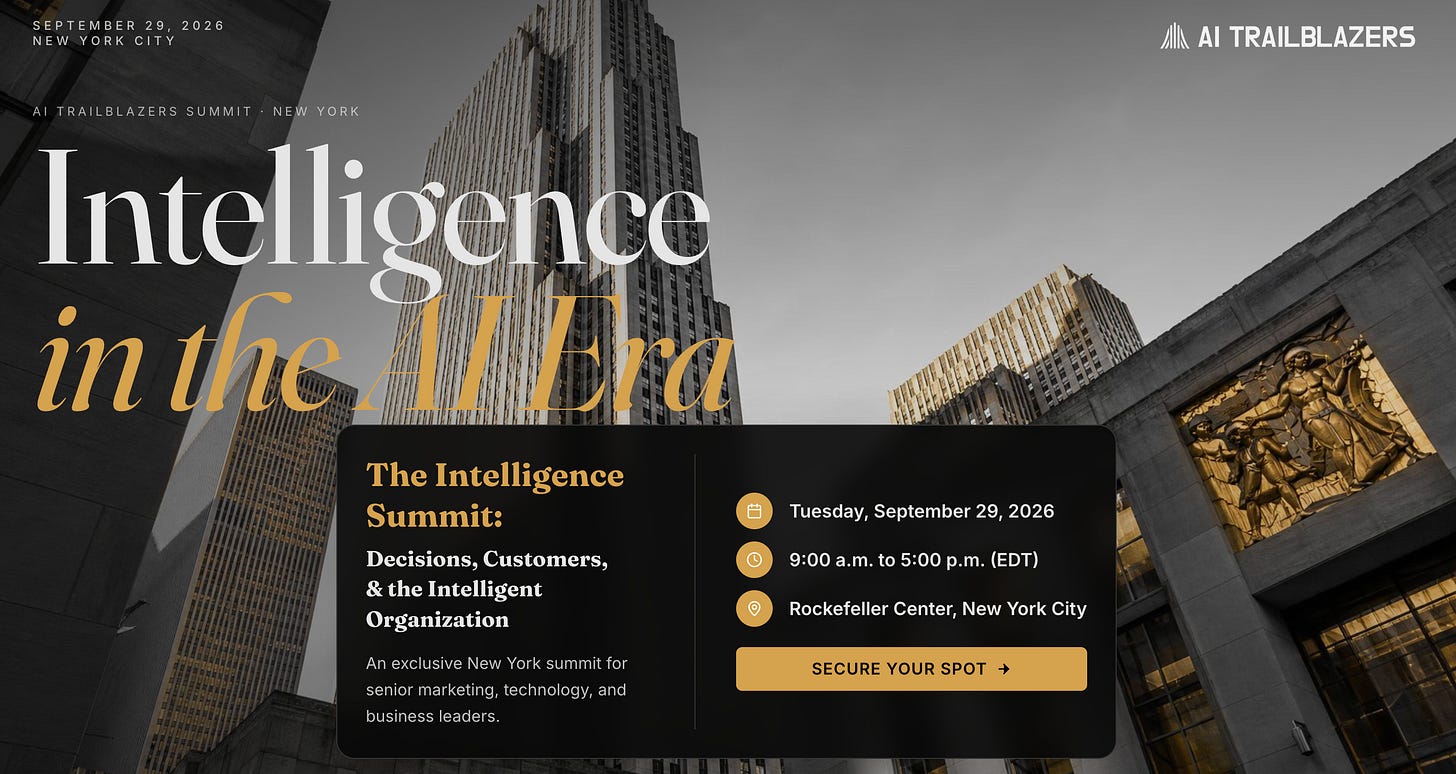
Registration is now open for the AI Trailblazers Intelligence Summit, taking place on September 29 at Rockefeller Center in New York City. Join fellow senior marketing, technology, and business leaders for practical strategies to move from AI experimentation to measurable business impact, with a strong focus on honest lessons learned, real-world case studies, and actionable insights. Learn more at fall26.aitrailblazers.io.
Taken together, these stories point to the same tension. AI is changing what is possible faster than most organizations are changing how they work.
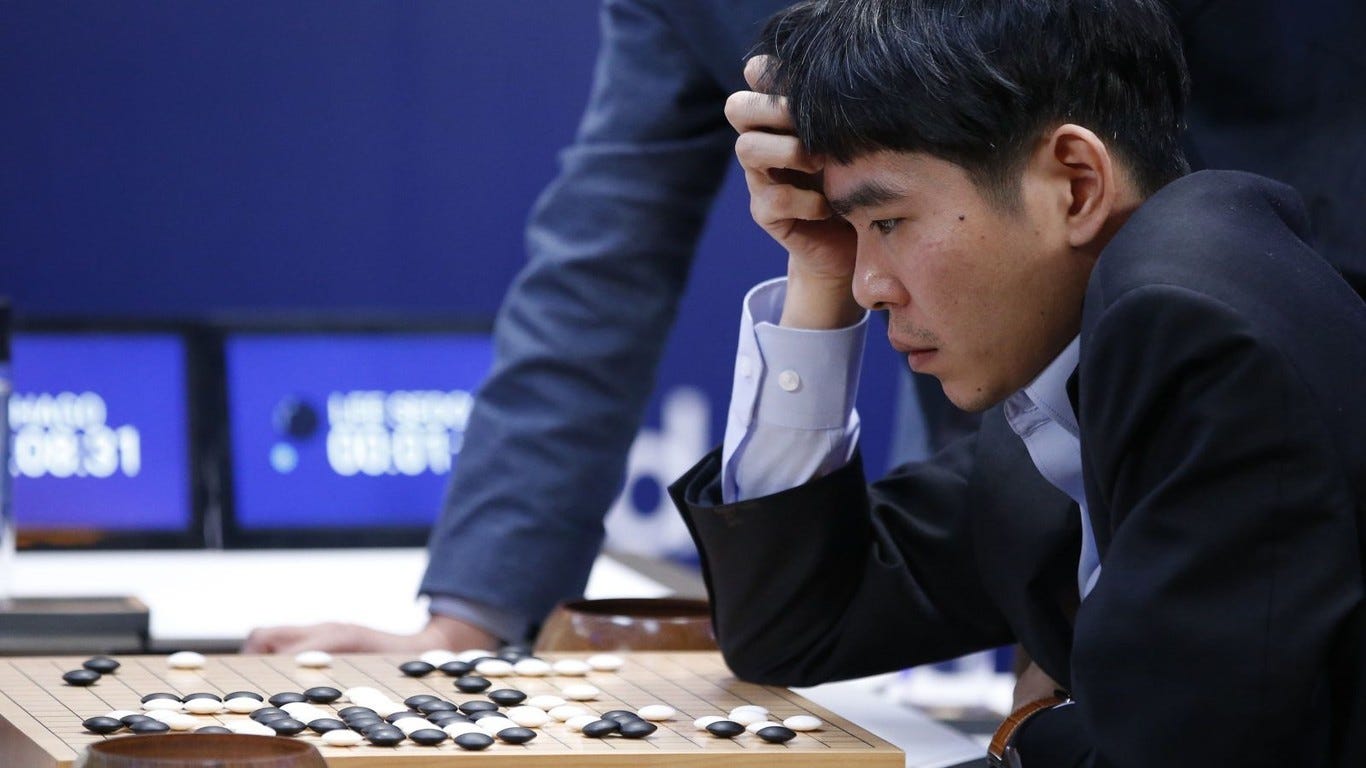
In 2018, I wrote my second book with Dr. Rohini Luthra. Savvy, an award-winning Amazon bestseller, was about distinguishing truth from performance in the post-trust era. In that book, one of the anecdotes I kept circling back to was a single black stone placed on a Go board in Seoul. Second game of the match. Thirty-seventh move. AlphaGo, the AI system developed by Google DeepMind, played a shoulder hit on the fifth line, a move so far outside three thousand years of accumulated human wisdom that commentators assumed the machine had malfunctioned. Lee Sedol stepped away from the table to collect himself. Roughly two hundred moves later, that stone would prove pivotal to AlphaGo’s victory.
Researching that sequence gripped me for weeks. At the time, explaining why it mattered took several pages, because almost nobody outside the research community had heard of it.
So I smiled yesterday morning, reading “Move 37 Is the Moment AI Changes Everything” in the Wall Street Journal. Ten years on, the article argues, the entire world has started to feel like one very large Go board, and the moments that once required a documentary crew to explain now arrive weekly. Andrej Karpathy’s description, quoted in the piece, remains one of the best I know: actions that are new, surprising and “secretly brilliant,” even to expert humans.
That is an observation about what’s happening at the frontier labs today but it raises a more uncomfortable question about your company.
I don’t mean in a demo or in a vendor’s exaggerated case study. I mean in your offices, on your P&L, in front of your team and among your peers.
A Move 37 moment inside an enterprise does not look like a chatbot answering a policy question. It looks like the machine proposing a sequence no one on the team would have proposed and the team, after arguing about it, conceding that it is better. Or maybe the machine identifies an underserved customer segment and recommends a series of actions that drive up market share. Maybe it produces a creative idea that births a new campaign and generates mind-blowing returns for the business.
It can show up in a handful of other places too. It may change how you organize, producing a structure that no consultant’s org chart template would have created because the work no longer decomposes the way it did when humans were the only processors. It may change how work gets done, allowing a campaign, pricing decision or market entry to skip four steps everyone assumed were load-bearing. It may appear in the dashboard as a genuinely anomalous result that survives your first three attempts to explain it away as measurement error. And in the place that matters most, with customers, it may reveal a benefit nobody had articulated as a need but which suddenly feels obvious in hindsight.
If none of that is happening, it is worth asking whether you are actually benefiting from all that AI has to offer.
Buying tools is the easy part. Licenses, enablement sessions, an internal assistant grounded in your own knowledge base, a governance committee, a slide showing seat penetration climbing quarter over quarter. All of that is table stakes now, and all of it produces competence rather than surprise. Competence is the machine doing your existing work faster. Surprise is the machine revealing that some of your existing work was never the point in the first place.
Getting to surprise requires more than better prompting. It requires fluency not merely in how to use AI, but in AI itself. You need some understanding of what these systems are actually doing when they generate an answer, because you cannot recognize a brilliant move if you lack the vocabulary to distinguish it from a confident error.
It also requires a willingness to let go of methods you may have spent a decade or two perfecting. That is often harder for the accomplished executive than for the junior employee, and may explain why some of the most interesting experimentation inside large companies happens quietly, without permission. But then comes the hardest part. The courage to make genuinely difficult calls about how work gets done, how value is realized, and who is still required to do it.
Most transformation programs stall at the first of these and never reach the third.
There is a coda to the Seoul match that gets less attention than Move 37. Two games later, Lee Sedol found his own one-in-10,000 move. Move 78 was a wedge into the center of the board that AlphaGo had barely considered possible. That mattered because AlphaGo’s strength came partly from knowing where not to look. Faced with an almost infinite number of possibilities, it used what it had learned to concentrate its search on the moves most likely to matter. Move 78 sat outside those expectations.
And suddenly, the machine that had seen something no human could see had failed to see something a human could.
That may be the more important lesson for the rest of us. Move 37 demonstrated that AI can dismantle human priors. Move 78 demonstrated that AI has priors of its own. Lee had spent three games confronting a machine that did not play Go the way humans played Go. Rather than simply defer to it, he absorbed what it was teaching him, reconsidered his own assumptions and eventually found something the machine had discounted.
That is the human role I find most interesting. Not standing stubbornly outside the technology. Not blindly accepting what it produces either. Staying sufficiently engaged with the work to recognize when the machine has discovered something profound and when it may be confidently looking in the wrong direction.
Regulation will protect some companies for a while. Product moats and switching costs will protect others a little longer. Both are rented time, and the rent is rising. The stone has been placed. The question is whether anyone in your organization is studying the board closely enough to recognize the move that could transform your business, and occasionally, to see the move the machine does not.
Join us at the AI Trailblazers Fall Summit at the Rockefeller Center in New York on September 29th. You can find more details and register here.
Here’s a snapshot of some of the public conferences where I’ll be speaking at in the coming months, alongside company-specific speaking and training engagements.
Taste Is No Longer a Human Advantage (July 2026)
When AI Becomes the Referee (July 2026)
The Front Door Moves (July 2026)
The Execution Layer is Collapsing (June 2026)
The End of the Segment (May 2026)
Shiv Singh is the CEO of Savvy Matters, which helps business teams translate AI disruption into practical business and marketing strategies, organizational design, executive-ready roadmaps, and bespoke education programs. He is also the Co-Founder of AI Trailblazers, a vibrant community uniting marketers, technologists, entrepreneurs, and venture capitalists at the forefront of AI. A former two-time Chief Marketing & Customer Experience Officer and author of Marketing with AI for Dummies (4th print run, translated into five languages), Shiv built his career at LendingTree, Visa, PepsiCo, and The Expedia Group, and serves as a public-company board member of a Fortune 300 company and private investor.
Comments
Nothing yet. Say the first thing.
Sign in to join the conversation.