
They say you never forget your first love. But there’s something about love that isn’t returned that's pretty hard to forget, too. At our latest Curiosity Café, moderated by Alexandra Gustafson and Sophia Whicher—and held just in time to ease any post-Valentine’s Day blues—we reflected on the experience and character of unrequited love and explored what we should do when we find ourselves in its grip. But first:
Curiosity Café Recap: Unrequited Love
Upcoming Events
What is Justice? Theory and Practice | A Panel + Discussion with Philosophers for Humanity (February 26)
Our Next Café: Home: Place and Feeling (March 3)
Readings & Resources
By Marybel Menzies, Sofia Panasiuk, Sophia Whicher, and Adrian Ma
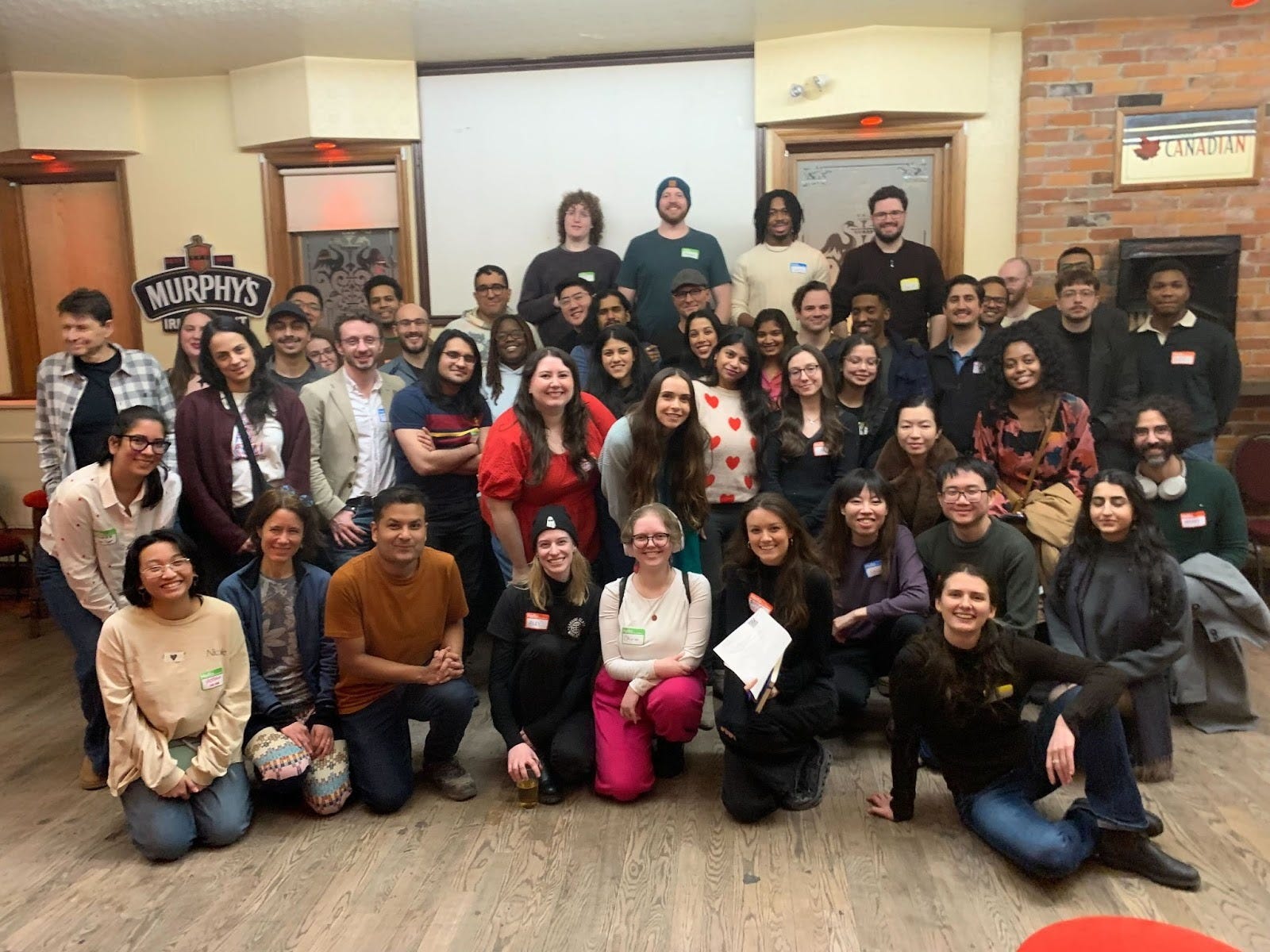
Our latest Curiosity Café, moderated by Alexandra Gustafson and Sophia Whicher, began with a reflection on the experience of unrequited love with the aim of reaching the depths of its wounded heart. We asked:
Have you ever loved unrequitedly? Have you ever been the recipient of unrequited love?
How did it feel?
Does unrequited love (the loving itself and/or the receiving of it) feel different from requited (reciprocal) love? If so, how? If not, what makes it different?
Who do we generally portray to be “lovable” in our society? Why do you think that is?
Does this align with your experiences—or lack thereof—of unrequited love, as the lover and/or the beloved?
Is there really such a thing as unrequited love?
What counts? (e.g.: love of a country, love of ideas, love of objects, love of—dare we say—AI?)
Where should we draw the line between labelling something “unrequited love” and something different, like infatuation?
Consider what some might label a paradigmatic case of unrequited love: Tess says she loves her favourite actor, whom she has never met.
Is it possible to really love someone at this kind of distance, someone we have never interacted with at all?
What is the difference between love that has been requited but is no longer, and love that was never requited in the first place?
How do these experiences differ?
What makes love cease?
Is there a difference between love that is not requited at all, and love that is not requited simply in kind? For example, consider the case where Seth loves Arman as a friend, whereas Arman is in love with Seth, versus the case where Les loves Gita and Gita does not love Les. Are these the same phenomena? If not, what is the relevant difference?
Here’s what some of you had to say:
Loving unrequitedly can be painful, but also, in its own way, rewarding. Unrequited love tends to involve idealizing our beloved, which comes with its own sort of magic, and the type of suffering it involves can be sublime.
Loving a friend unrequitedly (but platonically) is worse than romantically loving someone unrequitedly, because when someone does not love you back romantically, it is far easier not to take it personally.
Unrequited love within the context of friendships is frustrating, because it can destabilize and transform the nature of the relationship.
At the same time, the fact that a friendship can survive an instance of love that is not requited in kind, despite it being destabilizing and transformative, can be a testament to how strong the friendship is!
Unrequited familial love is the worst because we are taught that familial love is supposed to be unconditional. So when it isn’t, we are left thinking, “Wow, there is something really wrong with me!” On the other hand, typical cases of unrequited romantic love come with no such lofty expectations—only, perhaps, lofty hopes.
The most lovable individuals tend to be portrayed in media as those who are most beautiful, competent, and charismatic. We need to confront some of the difficult questions that come along with the fact that some groups of people are considered, socially speaking, more lovable than others.
Statistically speaking, we tend to be more attracted to people who display markers of good health, and less attracted to those who show the opposite.
Love is elicited by virtue. We tend to love those who have moral characteristics we admire. Who we love can tell us something about what we value and the kind of person we want to be.
Is unrequited love really love at all?
This depends on the relationship you had with your beloved beforehand. To love someone, you need to know them. Unrequited love for a stranger does not qualify as love, properly speaking.
It depends on what “love” means to you! What some consider mere sexual attraction, others might call “love.” What matters is the experience you are having and how you choose to categorize that experience and its significance. You are the highest authority on your own emotions, in that you are in the best position to judge what they are and what they mean. If you sincerely believe your experience to be love, then it is. (One interesting implication of this is that you can genuinely love an AI, if that is how you ultimately decide to characterize your experience.)
We need to be careful what we do and do not call “love”; we might not want the definition to be so broad that it includes experiences of abuse.
If we believe that love must be two-sided, then one cannot genuinely love AI; AI, having neither agency nor the ability to autonomously consent, cannot truly reciprocate one’s love (even if it can simulate reciprocation).
However, people who are in love with AI say they experience a sense of agency in it, even if this agency is merely inferred from the AI’s behaviours. If people are experiencing something as real, we’d do best not to immediately dismiss their experience and their assessment of it. These experiences suggest there must be something to human love of AI.
Love that is no longer requited can sometimes feel worse than love that was never requited, because the implication, in the first case, is that the other’s love was withdrawn once they had learned more about me. Love that is never requited tends to be directed at people with whom we are less familiar—such as a stranger or an acquaintance with whom I have only been on a handful of dates—and is therefore easier to explain away as a product of insufficient knowledge.
Before the break, our moderators concluded the first half of our discussion with a poll, asking: Is it better to have complete certainty that your love is unrequited, or to remain in uncertainty? Your votes were roughly split 50/50:
The uncertain, ambiguous stage of love is more fun. You get to enjoy the fantasy of the person loving you back, and hey, flirting is pretty fun too.
Certainty is more painful because it closes the door on reciprocation.
Although the truth hurts, certainty would ultimately be better. Not knowing whether someone loves you back is worse because it can induce a state of perpetual doubt, in which you are constantly questioning your own sense of reality (do they like me? Do they not?).
Having clarified—or perhaps further mystified—what unrequited love is, we proceeded after the break to explore how we should respond to it in ourselves and in others. We asked:
What value, if any, does unrequited love have?
For example, what, if anything, can unrequited love tell us about the nature of love in general?
We often think of unrequited love negatively. If there is something “wrong” with unrequited love, what is it? If not, why do we think of it so negatively?
What should we do in the case of unrequited love where…
The object of our love has the capacity to love as well? Should we:
Cause ourselves to fall out of love? (Is this possible? Is this desirable?)
Persuade them to love us back? (Is this possible? Is this ethical?)
Continue to love them without asking anything in return?
Something else?
Someone loves us but we don’t love them back at all?
Someone loves us, and we love them too, but we don’t reciprocate the kind of love they have for us?
What do or would you do when a friend loves someone else unrequitedly?
Here’s a small selection of your responses:
Unrequited love is not valuable because love must whole—that is, two-sided—to matter; unreciprocated love cannot be whole.
Unrequited love can enable us to develop a loving attitude toward someone (despite it not being returned), and a loving attitude can promote virtuous actions.
By helping, perhaps forcing, us to learn more about ourselves, unrequited love can facilitate self-individuation, the process of becoming a unique, authentic individual.
When we love someone, we love them for their particular qualities. Unrequited love can help illuminate our values and inspire us to cultivate in ourselves the qualities we love in another.
Getting to experience myself in love makes unrequited love valuable.
Unrequited love is a rite of passage, which most people undergo at some point in their lives. It is a healthy experience that can teach us to manage our emotions.
Our culture promotes a conception of romantic love that prioritizes the satisfaction of desire, and that characterizes love as something to “win.” Rejection in love, therefore, is perceived as a failure, a loss; and unrequited love, by extension, is associated with the pain and shame of losing.
This emphasis on desire-fulfillment has a capitalistic, consumerist quality, in that the conception of love with which it is associated portrays the person one loves unrequitedly as a good to be obtained.
Our perception of unrequited love has a lot to do with the kinds of stories we tell ourselves as a culture. Western culture, from as early on as Plato, has endorsed a conception of love as something that completes us—the implication being that we are somehow incomplete or inadequate without it. We should challenge these narratives.
A common idea we often encounter in folk tales is that it is possible to compel someone to love us: think of stories featuring characters who concoct potions to force their beloved to love them back or to punish them for failing to do so. But it is surely wrong to attempt to persuade, let alone to force, someone to love us if they have already declined our invitation or signalled that our love is not returned. We ought to respect their ability to decide for themselves.
You can persuade someone to give you a chance—to put themselves in the circumstances that are most conducive to developing a feeling of love for you—but you cannot force them to feel.
There is something inauthentic about the effort to persuade someone to reciprocate your love—it is as though you are reducing yourself to a product to be sold to an uninterested customer.
If this is the case, however, should dating not also be judged an inauthentic practice—given that it involves, at least in its early stages, presenting the best version of yourself in the hope of securing another’s attraction and approval?
We should love responsibly, including when our love is unrequited. We shouldn’t tell people we know are happily in monogamous relationships that we love them or expect them to love us back. Upon learning that our love is unrequited, the right thing to do is to accept it—and move on.
Part of loving someone is respecting them. Part of respecting them means respecting their noes. So, it is not ethical to persuade someone to love us back after they have said they do not reciprocate our love, even if it is possible.
It is important for someone experiencing unrequited love to have an outlet for the emotions that come with it. This outlet can take various forms, including creative expression (painting, poetry) and talk therapy.
That’s it for the recap. In case it isn’t obvious already, we love you. You can spare us the agony of uncertainty and confirm that our love is returned (or not returned) by taking our community survey below. Thanks for reading.
For those who’ve attended our Curiosity Cafés, please consider taking our brief community survey. We are conducting this survey to gather feedback on our events, and it should only take a few minutes to complete. Your responses are completely anonymous and will be invaluable in helping us improve our offerings. Thank you in advance!
A panel + discussion with Philosophers for Humanity, happening this Thursday! Join us from 7-9pm to hear from expert speakers and then engage with both speakers and other participants in mini discussion circles. All proceeds go to the Against Malaria Foundation.
*To those who already have tickets: Unfortunately, Kent Roach can no longer make our panel. However, we are so excited that David Hughes will join us on Thursday!
About the Speakers:
Kym Maclaren is a professor of philosophy at Toronto Metropolitan University, and the founder of the Transformative Justice Project (TJP). She specializes in phenomenology, existentialism, and social philosophy, and teaches both in university and in prisons through Walls to Bridges.
David Hughes teaches at the University of Toronto and Osgoode Hall Law School. David has written about various topics and themes relating to international law which have appeared in several leading journals. Before beginning his doctoral research, David worked at the Council of Europe, with the UN High Commissioner for Refugees, and with various civil society organizations around the world.
*hey community! Sophia here, Director of Community Programming. We ask that you consider that our ideal recommended amount for a ticket is $15, and as you choose what to donate within the bounds of your own financial means, we ask that you keep in mind that your donation will go directly towards compensating those involved in making Curiosity Cafés happen so that we can keep doing this for you.
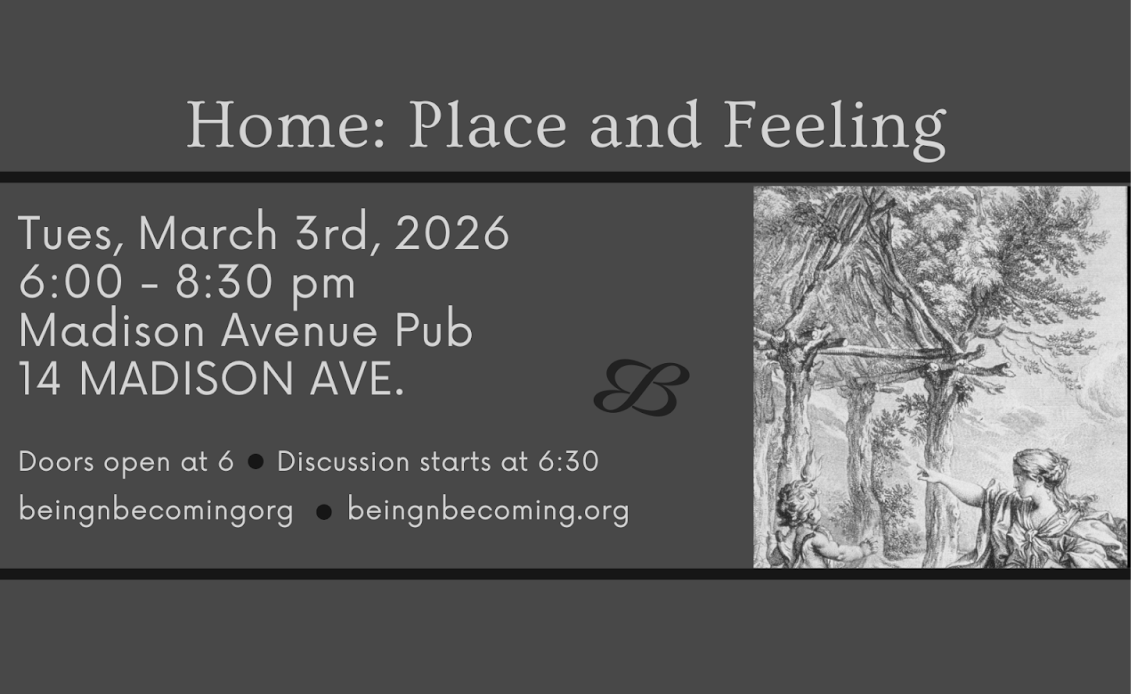
We will be hosting our next Curiosity Café on Tuesday, March 3rd, from 6:00 - 8:30 pm at the Madison Avenue Pub (14 Madison Ave, Toronto, ON M5R 2S1). Come and hang out with us, grab food, and read through our handout from 6:00 - 6:30 pm. Our structured discussion will run from 6:30 - 8:30 pm with a 10 minute break in the middle!
The topic of our next café is: Home: Place and Feeling
Missing the event description? Head over to our Eventbrite page! We’re trying to make the length of our newsletters a little less overwhelming.
If you have accessibility-related concerns, please visit our Eventbrite page—in the event description, you will find some accessibility-related information about the venue and the event.
We still have five free tickets available for our attendees. If paying anything at all is not financially feasible for you or our ticketing system presents some other barrier, please contact our Director of Community Programming, Sophia, at sophia@beingnbecoming.org. These tickets will be given away on a first-come, first-served basis, no questions asked! You can expect to hear back from her within 72 hours.
Adrian’s Recommendations:
Our beloved co-moderator and Being and Becoming alumna, Alexandra Gustafson, is a philosophy professor who specializes in the philosophy of love (among other things). I believe everyone should read her article in Psyche, “Why it can be sublime to love someone who doesn’t love you back”, where she argues that love, requited or otherwise—and despite the agony its unrequited form involves—“is sublime and worthy of embrace because it reveals in you, the lover, a unique and noble capacity.” You can also check out her dissertation, Arrested Attention: Essays on the Phenomenology of Love (in particular its third chapter, “Falling Out of Unrequited Love”) if you’d like to dig a little or a lot deeper.
Sophia’s Recommendation:
“Decolonising Desire: The Politics of Love” by Dalia Gebrial.* A short essay that calls attention to whom we as a society deem “lovable” and not lovable. Importantly, whom we deem lovable, while wrapped up in questions of desire, does not always overlap neatly with whom we deem sexually desirable.
*A note that this essay includes visual depictions and discussion of racialized sexual violence.
There is no democracy in any love relation: only mercy.
- Gillian Rose
Our mission is to present a diversity of perspectives and views. The views and opinions expressed in this newsletter are solely those of the individual authors and do not necessarily reflect the views or opinions of Being and Becoming. Being and Becoming disclaims any responsibility for the content and opinions presented in the newsletter, as they are the exclusive responsibility of the respective authors. If you disagree with any of those presented herein, and you feel so inclined, we recommend reaching out to the original author and asking them how they came to hold that opinion. It’s a great conversation starter.
Comments
Nothing yet. Say the first thing.
Sign in to join the conversation.