
Introduction
By Adrian Ma
“Home” is a term that feels at, well, home in many contexts. It can refer to a physical location, such as a house, an apartment, a city, or a country. We speak of feeling at home in the company of other people, and of finding a home in a community or movement with which we passionately identify. But what, exactly, makes a home a home? At our latest Curiosity Café, moderated by Robert Raynor and Sofia Panasiuk, we engaged in a cozy philosophical exploration of how “home” is or should be defined and the values and responsibilities associated with this idea. But first:
Featured Content:
Curiosity Café Recap: Home: Place and Feeling
Upcoming Events
Our Next Café: Pain (March 24)
Curiosity Café REVISITED: Laughing Matters: Humour in Our Lives (March 29)
The 3rd Annual Philosophers for Humanity Benefit for Change! (March 31)
Curiosity Café Recap: Home: Place and Feeling
By Adrian Ma
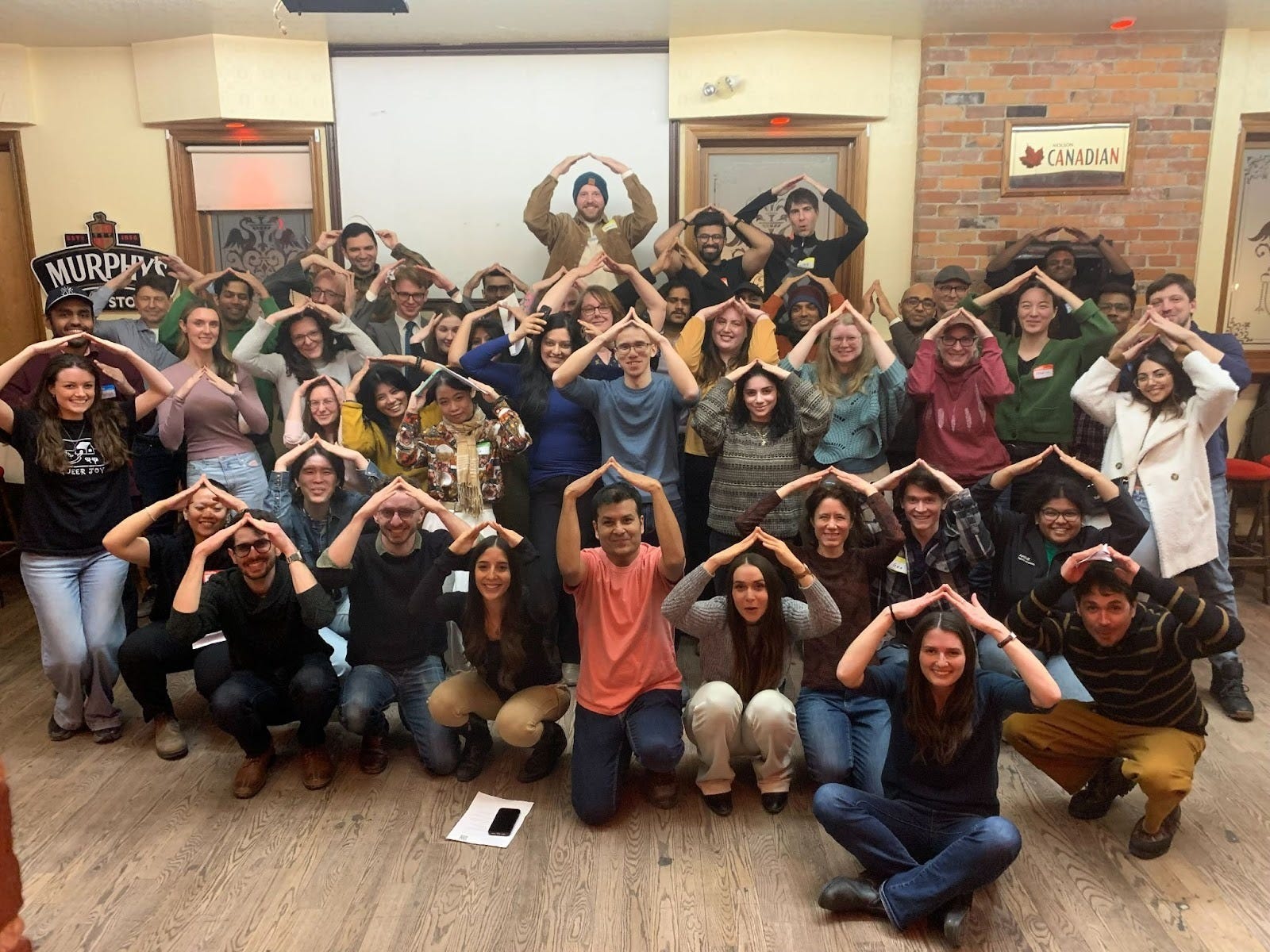
Our latest Curiosity Café, moderated by Robert Raynor and Sofia Panasiuk, began with an inquiry into the meaning of that familiar and yet strangely elusive word, “home.” We asked ourselves:
What is home for you?
Where do you consider your “home” to be located? Is it a country? A city? A neighbourhood? A specific place? Something else?
Describe your home. What makes it “home” for you?
Its location?
Its physical attributes?
Some secret third thing?
Describe what you experience when you’re home. What do you experience when you miss home? What do these experiences feel like?
Consider the following uses of the term “home”:
It’s a Friday afternoon, and you’re discussing weekend plans with classmates or coworkers. You overhear someone say, “I’m going home this weekend to see family.”
You arrive at a friend’s house, and as you take off your coat, they casually tell you to “make yourself at home.”
You’re watching your favourite romantic comedy, and at a pivotal moment, the lead describes their love interest by saying: “I can’t describe it… being with them just feels like home.”
How is the term “home” similar or different in each of these expressions? Do they convey ideas similar to what you discussed earlier? Where might there be nuance?
What makes something into “home” for you?
Is it always its physical features?
How about the people who are there?
The memories you associate with that place?
Certain cultural experiences that are meaningful to you?
Are these necessary for a place to be a home? Are they sufficient?
They say that “home is where the heart is.” Is home always a physical location?
Here’s what a few of you had to say:
Home is where you don’t need to justify your existence.
Home is defined by freedom from the need to perform; it is where I can take off the mask and be my authentic self. This condition can be satisfied by a physical location, like my apartment, but also by the company of other people.
I am skeptical of the existence of an authentic self. Does this mean I can’t have a home? Different contexts draw out different dimensions of ourselves, none of which can be said to take priority over all the others. I may feel more grounded, comfortable, relaxed, in the contexts I call “home,” but this seems to be the manifestation of a different self, rather than the disclosure of a single true self.
Home consists in neither a place nor a feeling, but in a relation between a person and the systems they inhabit. These systems can take many forms, ranging from families and friend circles to broader sociopolitical contexts. Home is when you are part of a system you resonate with. It does not presuppose the existence of a single authentic self, nor is it confined to a single context; you can belong to multiple homes, or systems with which you feel yourself to be in harmony.
The presence of other people can dramatically influence whether a context feels like home—even if it is home. Consider this: a place feels like home when the people you love are there with you. But would it still feel this way if it were occupied by 100 other people, in addition to those you love? Almost certainly not! In such a case, the homey feeling established by the company of your loved ones would be severely diluted.
The longing for home is often prompted by and associated with memories of particular sensory experiences. As I stroll down a city street, the aroma from a nearby restaurant might trigger memories of mom’s cooking, causing nostalgia and homesickness to come rushing in.
Home is a space that is held; it is not simply a place that exists, but one with a particular character that is actively produced and sustained. Think of the (perhaps now somewhat old-fashioned) term “homemaker,” with its implication that a home is made, that “home” is in some sense a verb as well as a noun. One way homes are typically made is through rituals, through familiar, established proceedings that prepare a space and give it structure and significance—much like the proceedings undertaken by the Being and Becoming team members before, during, and after each café. (This comment was not made by a team member.)
Home is a place or person you can return to, and in which or around whom you feel safe. Knowing that you have a stable home can provide you with the security and energy you need to venture away from it.
Home is not just a space you can return to for comfort, but a kind of safety net you can carry around with you, and that provides the assurance (and insurance) needed to take risks and confront challenges. Physical spaces, being bound to a single location, can’t serve this portable function—but relationships can.
One’s idea of home is tied to various elements—to one’s culture, to one’s socioeconomic status, to one’s childhood experiences, to other dimensions of one’s identity. One can have multiple homes, each associated with a different element or combination of elements.
Curation plays a big role in whether a location feels like home. A space is more likely to produce a sense of warmth and belonging when it has been intentionally chosen, arranged, and decorated to fit your tastes, needs, and circumstances.
After the break, we zeroed in on a potential distinction—implied in many of your contributions above—between a house and a home. Our starting point was a quotation from the influential architect Le Corbusier, from his 1923 collection of essays Towards a New Architecture:
A house is a machine for living in. Baths, sun, hot water, cold water, warmth at will, conservation of food, hygiene, beauty in the sense of good proportion. An armchair is a machine for sitting in and so on.
We then asked:
What is the relationship, if any, between a house and a home? (For the purposes of this discussion, we defined a house inclusively as a building meant for long-term human habitation, such as an apartment, a condo unit, a single-detached dwelling, a townhouse, a dorm, and so on.)
Have “house” and “home” referred to different things in your life?
How might our house change over time? How about our home? Why might this be?
Can we modify our house to make it feel more like home?
Consider the following scenario: an outreach worker is visiting Allan Gardens to support residents of a large encampment there. During a conversation, Mo, who lives in a tent there, describes himself as “homeless.” Moments later, the outreach worker is speaking with Grace, who proudly says that Allan Gardens is her home.
What do we do in the face of a housing crisis that leaves many outdoors or in precarious living situations? What is our responsibility to create housing? What is our responsibility to create homes?
French philosopher Simone Weil wrote that: “To be rooted is perhaps the most important and least recognized need of the human soul.” How might roots relate to home, and how might we cultivate a sense of home for ourselves and others?
Some of you said:
A house and a home refer to the same physical object. Emotional associations and personal attachment are what distinguish a home from a mere house.
A house is a physical thing. A “home” is something quite distinct—a context where one feels comfortable and fulfilled. The identification, or confusion, of the two things is the product of a marketing strategy to sell more houses.
Calling a place “home” requires that I stand in a special relationship to it, such that I do not merely occupy it but can call it “mine.” I must be able to exercise a meaningful degree of control over it, to shape it according to my needs and desires, such as by rearranging its furniture and selecting its decor. Locations I frequent or inhabit, but to which I enjoy no such connection, can qualify as houses, but not quite as homes.
It is hard to develop the feelings that distinguish a home from a house, such as comfort and belonging, from scratch; one needs to have been previously acquainted with such feelings, which can only develop under conditions of physical safety. Those who have grown up in places where physical safety could not be taken for granted are significantly disadvantaged when it comes to finding or making homes, because they have no such experiences to draw from.
(An extra question from the moderator): Have you ever prioritized having a house over having a home, or vice-versa? (For example, someone who purchases a house in the middle of nowhere might be said to be prioritizing the former, because they are willing, for the sake of owning a house, to live in an area where they are likely to feel isolated, even alienated. Conversely, someone who is willing to share an apartment with several others in order to stay in an otherwise unaffordable city to which they feel deeply connected might be said to be prioritizing the latter.)
The choice is rarely binary. Someone who buys a house in a remote location can still develop a homelike connection to their surroundings. Even in the absence of other people, they can cultivate a relationship with the land, with nature.
People who emphasize decor—and whose first destination, after moving into a new place, is a department store like Winners—often seem to rely on major material changes, on the installation of furniture and artwork and other decorations, as a means of turning a house into a home. On the other hand, all I need to feel at home in a new space are material items that I have history with: my books on a shelf and cherished cards from my childhood scattered on the table. This minimal reliance on material changes allows me to easily turn a house into a home, reducing the need to choose between one and the other.
A house must retain a sense of familiarity to remain a home. It does not cease to be a home just because the furniture in the living room has been rearranged, or the posters in the bedroom have been replaced. However, some changes can so dramatically affect one’s experience of a location that it no longer feels appropriate to the label “home.” Sometimes this happens because the location itself has changed; other times—or perhaps at the same time—because we have changed.
Home is largely about what you do in a place. Activities such as cooking, cleaning, and playing, and the objects that allow them to happen, are what contribute above all to making a house a home. Elements that are merely decorative are less important.
What is our responsibility when it comes to creating homes, and housing? From a policy standpoint, it is tempting to conclude that all we need to do for victims of the housing crisis is provide more shelter—but this would be inadequate. People need more than shelter to live fulfilling lives: they also need layers of “wraparound” support that provide community and a sense of purpose.
The feeling of home is characterized by routine; a home is a place that makes it easy to establish routine. Creating “homes,” then, means creating and sustaining systems that allow people to cultivate and follow routines. The shelter system is one example, but there are others, such as the library system, that can also be said to promote the same function.
Home is a place where you hold and are held. The decisions that go into furnishing and decorating a home—from the blanket you pick up during your initial shopping spree at Winners, to the appliances you use to cook, to the decorations that adorn your bathroom—contribute to this feeling of being held, of being comforted and cared for. Every such decision is an investment made for the good of your future self, and of others—friends, partners, children—who will benefit from this space.
Home requires at least two things. It must be a place I want and have voluntarily chosen to live in, and it must contain the things I want and have chosen to put in it. Home, in other words, depends in large part on whether a place was selected and shaped through the exercise of my agency and autonomy.
Thank you, all, for making our community feel like home—to us and to many others. See you at the next one.
Upcoming Events
Curiosity Café: Bi-weekly on Tuesdays, tickets below!
*hey community! Sophia here, Director of Community Programming. We ask that you consider that our ideal recommended amount for a ticket is now $15, and as you choose what to donate within the bounds of your own financial means, we ask that you keep in mind that your donation will go directly towards compensating those involved in making Curiosity Cafés happen so that we can keep doing this for you.
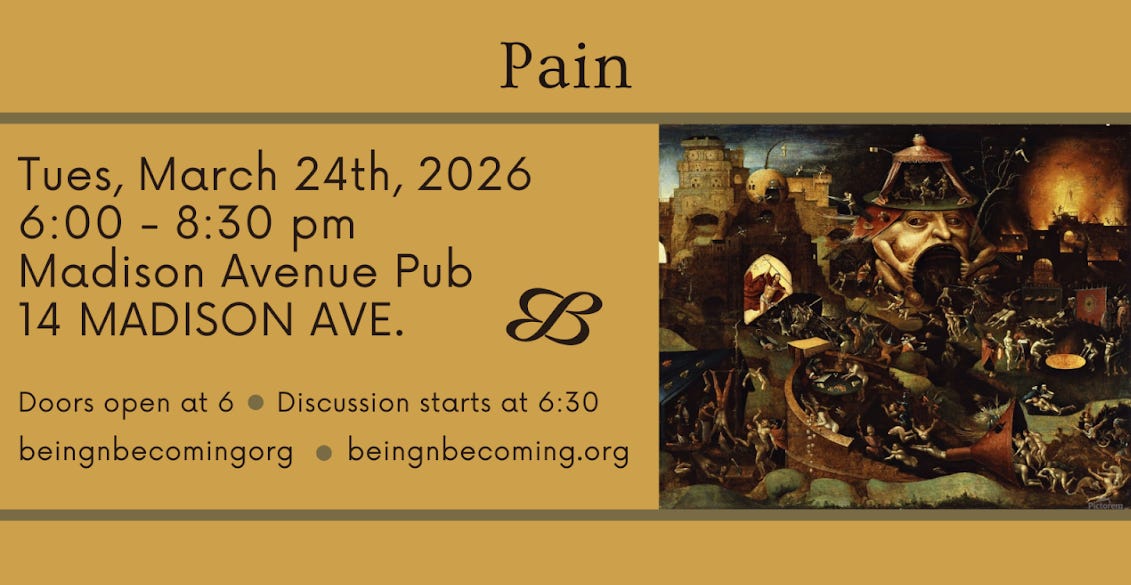
We will host our next Curiosity Café on Tuesday, March 24, from 6:00 to 8:30 p.m. at the Madison Avenue Pub (14 Madison Ave, Toronto, ON M5R 2S1). Come and hang out with us, grab food, and read through our handout from 6:00 to 6:30 p.m. Our structured discussion will run from 6:30 to 8:30 p.m. with a 10-minute break in the middle!
The topic of our next café is: Pain
Missing the event description? Head over to our Eventbrite page! We’re trying to make the length of our newsletters a little less overwhelming.
If you have accessibility-related concerns, please visit our Eventbrite page—in the event description, you will find some accessibility-related information about the venue and the event.
We still have five free tickets available for our attendees. If paying anything at all is not financially feasible for you or our ticketing system presents some other barrier, please contact our Director of Community Programming, Sophia, at sophia@beingnbecoming.org. These tickets will be given away on a first-come, first-served basis, no questions asked! You can expect to hear back from her within 72 hours.
Curiosity Café REVISITED: Back and Better than Ever, People!
Every four(ish) weeks, we revisit a previous Café. In this series, we will be repeating topics, sometimes with a slight twist, sometimes with the same questions (but rest assured, even if you went to the first iteration and the questions were exactly the same, the discussion will change based on who is in attendance. Maybe you’ve even changed too…).
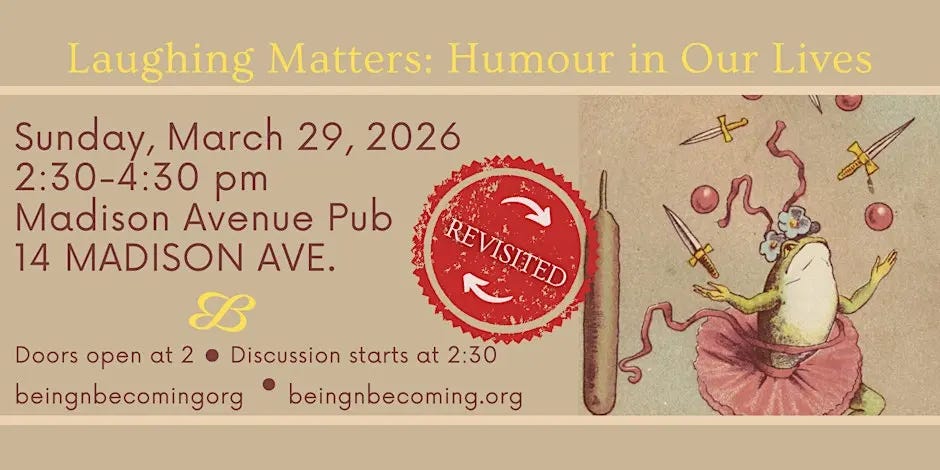
The topic of our next revisited café is: Laughing Matters: Humour in Our Lives. Come join us on Sunday, March 29!
Missing the event description? Head over to our Eventbrite page! We’re trying to make the length of our newsletters a little less overwhelming.
If you have accessibility-related concerns, please visit our Eventbrite page—in the event description, you will find some accessibility-related information about the venue and the event.
We still have five free tickets available for our attendees. If paying anything at all is not financially feasible for you or our ticketing system presents some other barrier, please contact our Director of Community Programming, Sophia, at sophia@beingnbecoming.org. These tickets will be given away on a first-come, first-served basis, no questions asked! You can expect to hear back from her within 72 hours.
The Third Annual Philosophers for Humanity Benefit for Change!
From our friends over at Philosophers for Humanity:
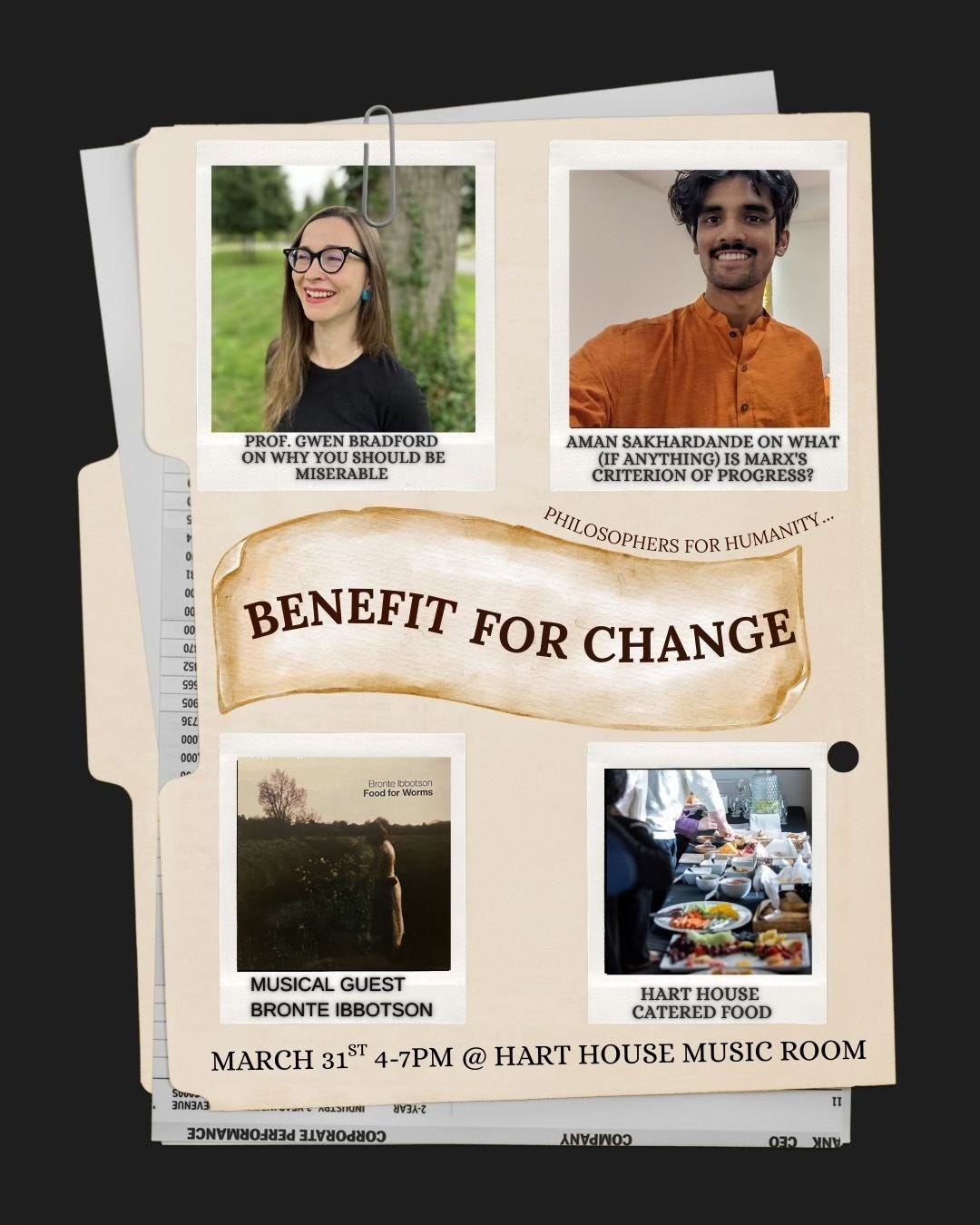
Philosophers for Humanity is an organization founded on the premise of using philosophy as a driver for philanthropic change. Join us for our large end-of-year event, the Philosophers for Humanity Benefit for Change! There will be insightful talks from Professor Gwen Bradford and PhD student Aman Sakhardande (with time for Q&As), networking, catered food, an artistic performance by Bronte Ibbotson, and a reflection on our accomplishments as we end our third year! Tickets are $12; proceeds will go to the Against Malaria Foundation. For more information and to purchase tickets, visit the link below:
You can also check out our Instagram @philosophersforhumanity. We hope to see you there!
Featured Quote
The places we have known do not belong only to the world of space on which we map them for our own convenience. They were only a thin slice, held between the contiguous impressions that composed our life at that time; the memory of a particular image is but regret for a particular moment; and houses, roads, avenues are as fugitive, alas, as the years.
- Marcel Proust
Our mission is to present a diversity of perspectives and views. The views and opinions expressed in this newsletter are solely those of the individual authors and do not necessarily reflect the views or opinions of Being and Becoming. Being and Becoming disclaims any responsibility for the content and opinions presented in the newsletter, as they are the exclusive responsibility of the respective authors. If you disagree with any of those presented herein, and you feel so inclined, we recommend reaching out to the original author and asking them how they came to hold that opinion. It’s a great conversation starter.
Comments
Nothing yet. Say the first thing.
Sign in to join the conversation.