
Introduction
What is shame? How does it differ from related or overlapping experiences like embarrassment, humiliation, and guilt? How and when do we learn what we should feel ashamed about? At our latest Curiosity Café, we engaged in a collaborative exploration of the experience of shame and the social and cultural context in which it occurs. But first:
Featured Content:
Curiosity Café Recap: Shame
Community Survey
Upcoming Events:
Our Next Café: The Value of Democracy (November 18)
Curiosity Café REVISITED (November 27)
Curiosity Café Recap: Shame
By Adrian Ma
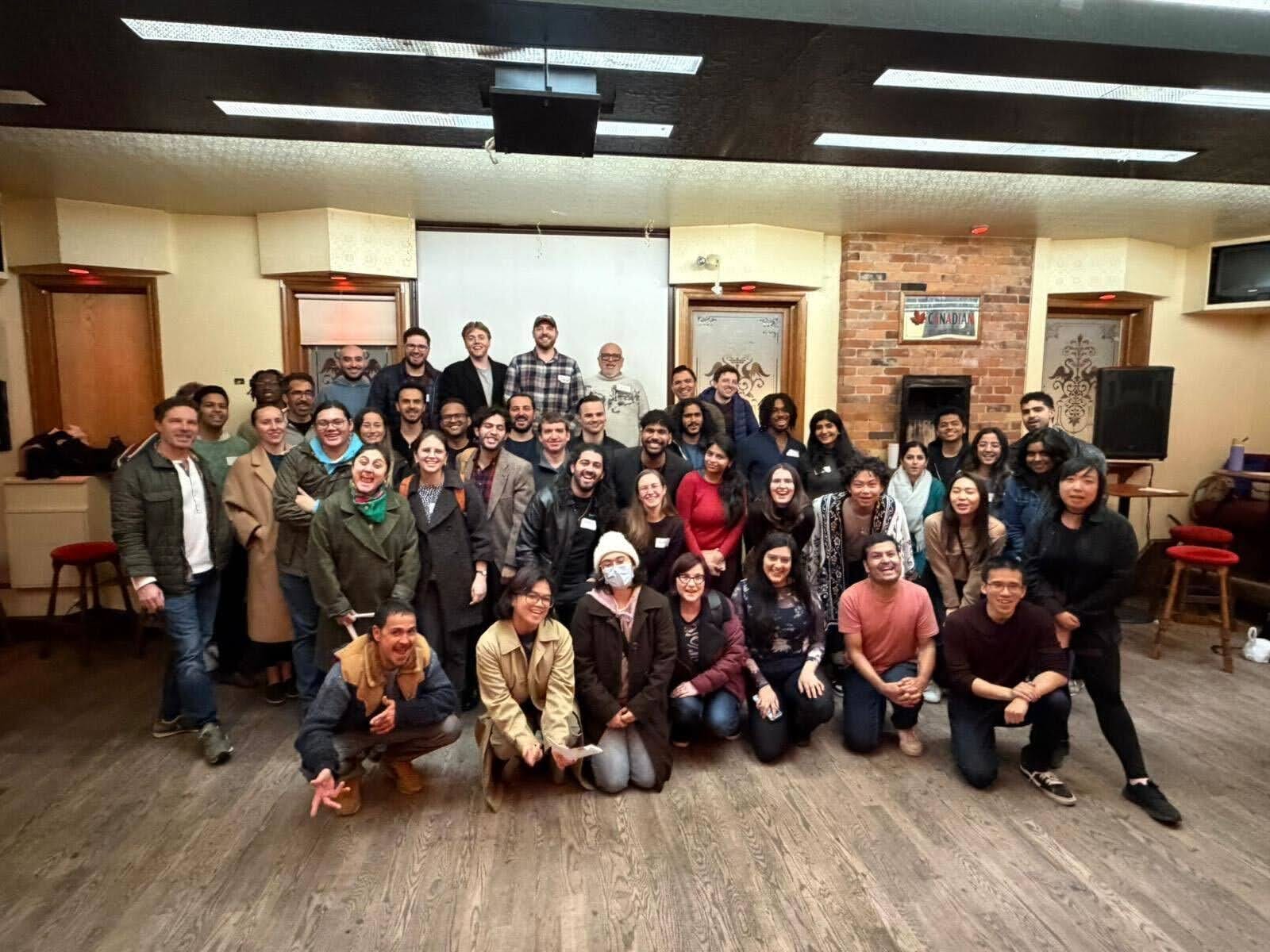
Our latest Curiosity Café began with a discussion of the experience of shame—what it looks like, what it might signify, and how it might affect one’s development or self-perception. We asked:
Think about experiences that are related to shame.
How would you describe the experience of shame? What does it feel like? What responses does it usually prompt?
What kinds of experiences tend to evoke shame? What is it about those experiences that evokes shame?
Shame can feel similar to experiences of embarrassment, humiliation, and low self-esteem. How is shame similar to these experiences? How is shame different?
Guilt is often confused or conflated with shame. How are they similar? How are they different?
Emotions are often thought to be signals that a need is not being met. What needs might be unmet when someone is feeling shame? (You might think of things that are the opposite of shame).
When we feel ashamed about something (a decision, an experience, a trait), we might feel ashamed because we believe it means something fundamental about ourselves (i.e., our identity, self-worth, or abilities, or whether we belong).
What are the ways in which shame might play a role in the development of our individual identities?
When you feel ashamed about something, what helps you feel less ashamed?
Here’s what a few of you had to say:
Shame is, or involves:
A loss of pride.
Defensiveness.
The desire to hide, to assume the fetal position, to crawl into a hole.
The fear of judgment.
There is a public, interpersonal aspect to experiences of shame: shame requires that we do something that others perceive to be wrong.
Shame involves a sense of external pressure, a sense that we ought to, but failed, to adhere to a social norm.
Shame is linked to belonging and inclusion. Someone who is shamed is thereby socially isolated and suffers a resulting loss of social status.
Praise is an appropriate contrast to shame, because, like shame, it is inherently relational. Shame arises when others judge that I have done something bad; praise occurs when others judge that I have done something good.
Shame is not just about the perceived failure to live up to other people’s standards; it is also about our perceived failure to live up to our own, and thus also concerns our sense of self-worth.
Embarrassment and humiliation are more transient than shame. Embarrassment is tied to action witnessed by other people; humiliation involves appealing to an embarrassing act to degrade the person who committed it. Shame, however, involves a more lasting judgment about one’s character and worth, which can persist even when one is alone.
To draw from Brené Brown’s distinction, guilt is characterized by the feeling that I have done something wrong or bad, and shame by the feeling that I (as a person) am bad. Shame poses an obstacle to self-acceptance, which involves perceiving myself as a whole person, with all my strengths and shortcomings, and telling myself that I am complete and worthy.
Shame can be attached not only to the deeds I’ve done, but also to vulnerabilities and deficiencies over which I have little or no control (but which nonetheless lead to a reduction in my social status). For example, I can feel ashamed for not being as intelligent as I believe I should be, or for belonging to a marginalized group, even though my actions are not responsible for either.
We can distinguish between healthy and toxic forms of shame. Healthy shame can be a spur to self-improvement—we feel ashamed of having done something wrong and resolve to do better. Toxic shame, conversely, makes us feel helpless, and seems to brand our identity with the mark of the shameful deed, making it difficult to move past the wrongdoing or summon the will to reform.
Self-esteem acts as a kind of modulator that varies the intensity of shame. Someone with high self-esteem is more protected against intense feelings of shame, whereas someone with low self-esteem is more susceptible to them.
Experiences of shame can be a liability to one person but an asset to another. Think of the comedian who draws from their past encounters with shame or their past shameful deeds for creative ammunition.
The connection between shame and self-esteem can create a vicious loop. By dealing blows to one’s self-esteem, shame can chip away at one’s psychological armour, making subsequent experiences of shame increasingly damaging and lasting in their effects.
Shame can be intensely personal, in the sense that it is triggered by one’s perceived failure to be who one wants to be. On the other hand, shame can also arise from one’s departure from culturally and socially constructed, and perhaps ultimately problematic, norms to which one does not or should not subscribe. The remedy for such experiences of shame lies in liberation from these norms, which consists in identifying and embracing one’s authentic self.
After the break, we spent the second half discussing the social and cultural context of shame, asking:
Shame can be thought to indicate a violation of expectations or norms around how we should be.
When did we first learn to feel shame?
How do we learn what to feel ashamed about?
Many think that the anticipation of feeling shame might shape our behaviour by compelling us to follow social norms, regardless of whether we agree with them.
Do you agree?
When can shame be helpful?
When can shame be harmful?
How can we tell whether shame is helping or harming us in a given situation?
When a person is visibly feeling ashamed, others around them respond in different ways. This includes providing compassion or reassurance as well as reinforcing their feelings of shame or shaming them for expressing their shame.
What might be some unhelpful ways to support someone who is struggling with shame?
What might be a helpful way to support someone who is struggling with feelings of shame?
Imagine a world where shame as a social mechanism did not exist. What would this world look like? Is this a better world?
Here’s a small selection of your contributions:
Shame originates from our theory of mind, the ability to recognize that others have desires, beliefs, feelings, and so on that differ from our own.
This recognition of difference is not sufficient for shame: for an experience to constitute shame, there must be an element of negative judgment, which results in or aims at a reduction in one’s social status.
Nonhuman primates like chimpanzees have shame-adjacent practices, whereby violations of certain norms result in the social isolation of the perpetrator. This suggests that shame might have roots in our evolutionary history.
Our capacity for shame might originate from a pre-linguistic phase of our development, before we could even put a name to our emotions. A child who has not yet learned to speak can still feel something resembling shame when they do something (like spilling their cereal) of which people around them vaguely appear to disapprove.
Shame can be harmful because:
It can lead to our essentializing ourselves as failures (”I am a bad person”). This can induce a kind of paralysis, where we stop ourselves from acting as we want or should in the belief that we cannot do anything right.
It can trap us in our own heads, desensitizing us to contextual changes and preventing us from taking in new information. Having internalized the shame I experienced at school, my interactions in other social settings might be coloured by the belief generated by that experience (that I am a loser, a failure, and so on), which inhibits my ability to feel genuinely included.
Its expectation can deprive us of new and meaningful experiences. Shame, in other words, can be anticipatory—I might avoid putting myself in social contexts where I expect I will feel shame.
But shame can also be helpful, because:
It is part of the system of social checks and balances that allows human beings to live together in relative peace and harmony.
It is often required to cultivate self-awareness concerning one’s bad behaviour. It’s generally not considered a good thing for someone to “have no shame.”
The experience of it can make one more empathetic, even when the shame is unwarranted or unjust (like in the case of a victim of bullying).
What is the best way to deal with shame, or to support someone who is struggling with it?
Don’t internalize it too much. Localize it to a particular part of yourself; avoid making generalizations about yourself on the basis of a shameful experience. You are more than your mistake.
Evaluate actions (“You did a bad thing”) instead of judging people (“You are a bad person”).
Try to make the person experiencing shame feel heard. Instead of focusing exclusively on the wrongness of what they did, try to understand the reasons that might have driven them to act in such a manner—which can be done without excusing or justifying their wrongdoing.
Help the person experiencing shame feel accepted rather than isolated. Listen and empathize. Get into the mud with them. Help them see that their shame is a transient thing and their deed just a part and not the whole of who they are.
That’s it for the recap. If you believe we have done something we should be ashamed of, please let us know by taking the community survey below (but feel free to praise us, too). Thanks for reading.
Community Survey
For those who’ve attended our Curiosity Cafés, please consider taking our brief community survey. We are conducting this survey to gather feedback on our events, and it should only take a few minutes to complete. Your responses are completely anonymous and will be invaluable in helping us improve our offerings. Thank you in advance!
Upcoming Events
Curiosity Café: Bi-weekly on Tuesdays, tickets below!
*Psst: hey community! Sophia here, Director of Community Programming. Right now, we are working towards the goal of providing those who contribute to making the cafés happen equitable financial compensation for the work they do, so that we can feasibly and sustainably develop as an organization and provide more programming for all of you. We also want to keep our cafés as accessible as possible, so we are keeping the pay-what-you-can model in place for tickets. We ask that you consider that our ideal recommended amount for a ticket is now $15, and as you choose what to donate within the bounds of your own financial means, we ask that you keep in mind that your donation will go directly towards compensating those involved in making Curiosity Cafés happen so that we can keep doing this for you.
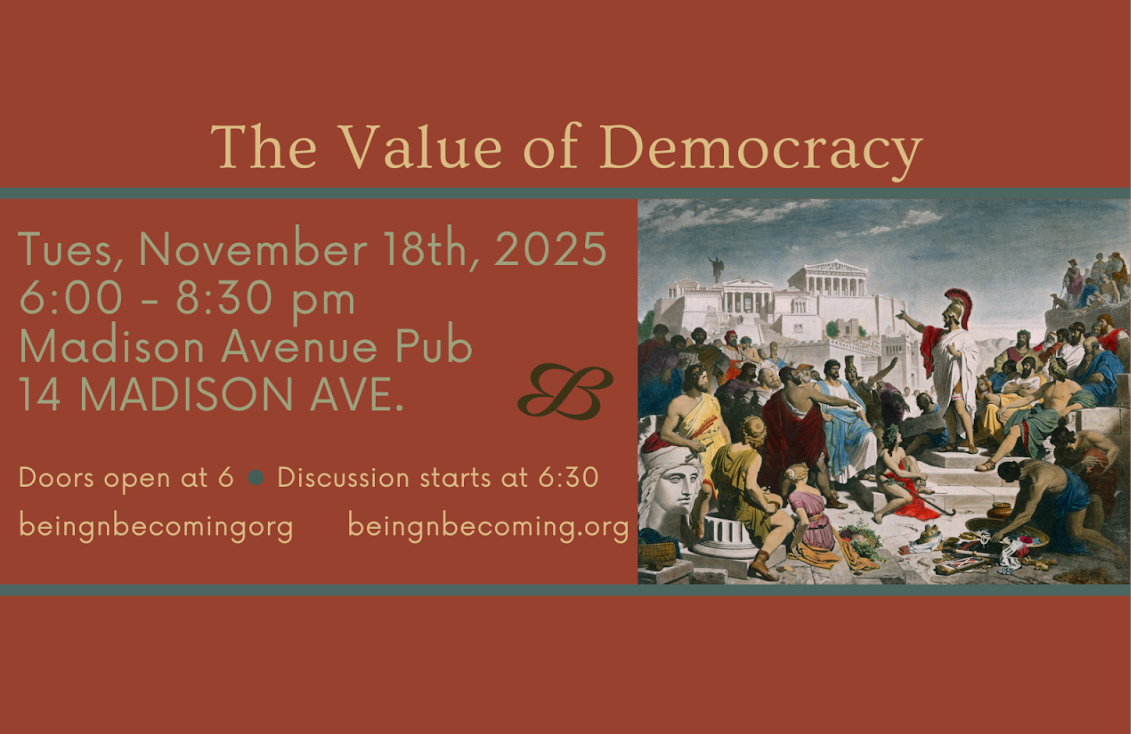
We will be hosting our next Curiosity Café on Tuesday, November 18, from 6:00 - 8:30 pm at the Madison Avenue Pub (14 Madison Ave, Toronto, ON M5R 2S1). Come and hang out with us, grab food, and read through our handout from 6:00 - 6:30 pm. Our structured discussion will run from 6:30 - 8:30 pm with a 10 minute break in the middle!
The topic of our next café is: The Value of Democracy
Missing the event description? Head over to our Eventbrite page! We’re trying to make the length of our newsletters a little less overwhelming.
If you have accessibility-related concerns, please visit our Eventbrite page—in the event description, you will find some accessibility-related information about the venue and the event.
We still have five free tickets available for our attendees. If paying anything at all is not financially feasible for you or our ticketing system presents some other barrier, please contact our Director of Community Programming, Sophia, at sophia@beingnbecoming.org. These tickets will be given away on a first-come, first-served basis, no questions asked! You can expect to hear back from her within 72 hours.
Curiosity Café REVISITED: Back and Better than Ever, People!
Being and Becoming has just introduced a new Curiosity Café series, which isn’t actually new at all: Every four(ish) weeks, we revisit a previous Café. In this series, we will be repeating topics, sometimes with a slight twist, sometimes with the same questions (but rest assured, even if you went to the first iteration and the questions were exactly the same, the discussion will change based on who is in attendance. Maybe you’ve even changed too…).
Our next revisited café will take place on Thursday, November 27, from 6:00 to 8:30 p.m. at the Madison Avenue Pub (14 Madison Ave, Toronto, ON M5R 2S1). Stay tuned for the announcement of the topic on our website, Instagram, and Eventbrite page!
Featured Quote
The thing that moves us to pride or shame is not the mere mechanical reflection of ourselves, but an imputed sentiment, the imagined effect of this reflection upon another’s mind.
- Charles Horton Cooley
Our mission is to present a diversity of perspectives and views. The views and opinions expressed in this newsletter are solely those of the individual authors and do not necessarily reflect the views or opinions of Being and Becoming. Being and Becoming disclaims any responsibility for the content and opinions presented in the newsletter, as they are the exclusive responsibility of the respective authors. If you disagree with any of those presented herein, and you feel so inclined, we recommend reaching out to the original author and asking them how they came to hold that opinion. It’s a great conversation starter.
Comments
Nothing yet. Say the first thing.
Sign in to join the conversation.