
Introduction
By Adrian Ma
Most of us take it for granted that we have minds—I like to think I am using mine as I write this sentence, and you are using yours as you read it—but on what grounds can we attribute minds to dogs and cats, or to any non-human creature? At our latest Curiosity Café, moderated by Beatrice Turner and our very own Marybel Menzies, we zeroed in on the question of the “mindedness” of non-human animals (but using human animals as a starting point). You can find a recap of our discussion below—plus exciting contributions on the topic from Beatrice and B and B board member David M. Peña-Guzmán, a humanities professor at San Francisco State University whose specialties include animal studies, the history and philosophy of science, and theories of consciousness. But first:
Featured Content:
Curiosity Café Recap: Other Animal Minds
Community Survey
“Other Minds” by David M. Peña-Guzmán
“On Being Unsure About Animal Minds” by Beatrice Turner
Upcoming Events:
Curiosity Café REVISITED: Personal Identity and Transformation (October 29)
Our Next Café: Shame (November 4)
Curiosity Café Recap: Other Animal Minds
By Adrian Ma
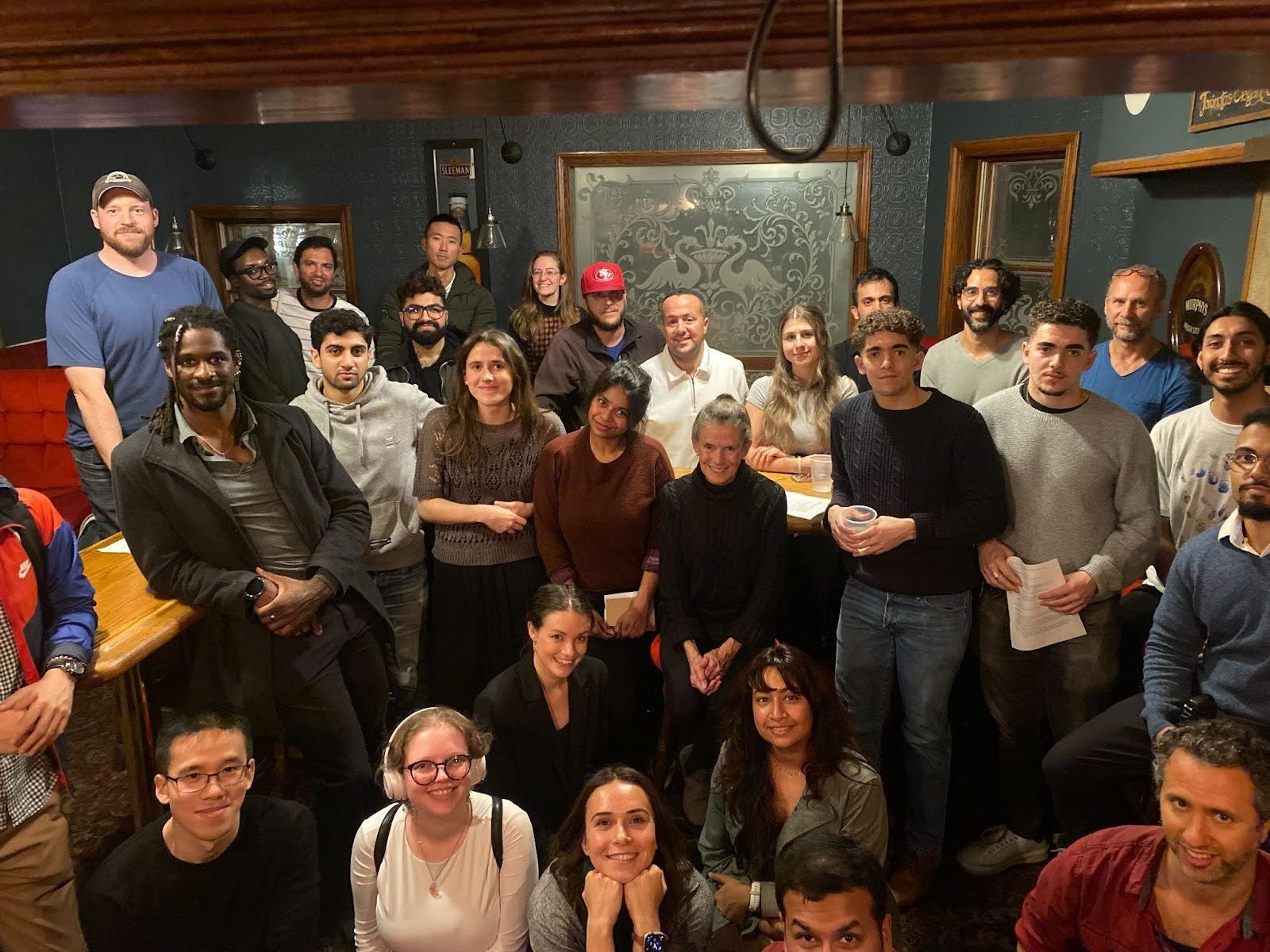
Our latest Curiosity Café, moderated by Beatrice Turner and our very own Marybel Menzies, began with a reflection on our own experiences as (supposedly) minded animals, from which we transitioned into the broader question of what it means to have a mind at all. In breakout groups, and then collectively, we asked:
Reflect on your individual experience with mindedness:
How do you know that you have a mind? What is it about your first-person experience that leads you to believe you have a mind?
How do you know that other people have minds? What kinds of assumptions or behaviours do you base this on?
What are your intuitions about mindedness?
Do you think your pets have minds? What about plants? What about rocks? Why some and not others?
Are certain kinds of experiences necessary for something to qualify as “minded”, or is any kind of experience sufficient?
Consider the experience of “seeing a blue dot.” Would the experience of seeing a blue dot, and only seeing a blue dot, suffice for an entity to count as being minded?
If yes, why? If not, why not?
If merely seeing a blue dot is insufficient for mindedness, what else is needed?
Do some kinds of capacities weigh more heavily than others? For example, consider things like pain and pleasure perception, intelligence, self-awareness, and time perception.
Is verbal report necessary for mindedness?
Is locomotion necessary for mindedness?
Are certain brain structures necessary, or a certain number of neurons?
Here’s what some of you had to say:
The question of agency—the capacity to act according to one’s will—is ultimately distinct from the question of whether one has a mind, although it is often a test of mindedness. In fact, we can imagine an entity having a mind but no agency—like a sentient robot that is unable to control its actions.
In healthcare, the word “mind” is rarely used; the word “brain” is far more common, as in the term “brain death.” This suggests that we tend to identify the mind with the brain, and it may be more helpful to speak of the latter. “Mind,” after all, is quite a broad and poorly defined term.
Maybe the existence of other minds is less a belief we acquire through inference and observation than a foundational assumption that we take—perhaps must take—for granted. Our experience of the world and our ability to navigate it would be dramatically shaken if we were to seriously doubt that other minds exist. Even the most skeptical philosophers cannot avoid using the pronoun “we.”
Our belief in the existence of other minds requires a leap of faith: we cannot prove it beyond all doubt, but we hold onto it anyway, perhaps for largely pragmatic reasons. Major aspects of meaning in our lives, such as our relationships and our personal projects, depend on the belief that people with other minds exist—that, for example, the friend for whom I feel such affection is capable of feeling affection themselves, or that the audience for whom I am writing a book can have a genuine experience of that book. All of that would be destabilized by sustained skepticism as to whether other minds exist.
We have a natural tendency to treat entities as though they have minds; mindedness, so to speak, is a lens through which many of our experiences are filtered by default, even in the case of things we know to be mindless. Consider the times when I am angered by Amazon’s Alexa because she has rudely barged into my conversation, or when I curse at a video game character to whom I have died countless times—as though they are somehow capable of malice or negotiation.
The mere capacity for sensation—say, a sensation of a blue dot—is not sufficient to establish the existence of a mind. Part of what it means to have a mind is the ability to make value judgments about one’s experiences—for example, to classify experiences as positive or negative.
All that is required to qualify an entity as having a mind is the capacity for conscious experience, or the fact that there is something it is like to be that entity. Thus, an entity whose sole experience is the unchanging sight of a blue dot would still count as having a mind.
Suppose the ability to “see” is enough to establish the existence of a mind. In that case, there is a sense in which even putatively mindless entities, like robots, can be said to have minds: an AI model fed a blue image can “see” the image and recognize its colour.
After the break, we shifted our attention to the mystery of other animal minds, and the moral risks and implications attached to our attributions or denials of mindedness. We asked:
What does it mean to know that another animal has a mind?
Is there a difference between attributing mindedness to humans compared to non-human animals?
Can we ever be certain that another being has a mind?
What are the risks, if any, of overextending (anthropomorphization) or underextending (anthropocentrism) mindedness to non-human animals?
When you are unsure about an animal’s mind, should we overextend or underextend mindedness? Why?
Is speciesism the same as racism and sexism?
Singer writes, “Speciesism—the word is not an attractive one, but I can think of no better term—is a prejudice or attitude of bias in favour of the interests of members of one’s own species and against those of members of other species.”
Here are a few of your responses:
We can make reliable inferences about the minds of non-human animals because they exhibit similar behavioural responses to humans when confronted with certain triggers. Although other animals do not verbally communicate, we can determine with a reasonable degree of confidence whether they are happy, sad, in pain, and so on.
Non-human animals can communicate their needs and experiences in their own way; the lack of verbal communication does not make knowledge of their minds impossible.
What matters from a moral point of view is not whether a being has a “mind,” however that is defined. What matters is whether the entity is capable of experience (i.e., there is something it is like to be them, in the first-personal sense), which is key to grounding an entity’s moral status. All animals have a moral status because they are capable of experience, as a table or a chair is not.
Imagine everything (including seemingly inanimate objects) had a mind: would that force us to disentangle the notions of mindedness and moral status? It’s hard to imagine how one could navigate the world while respecting the moral status of everything; in such a world, we would still need to devise a way to draw moral boundaries such that certain entities are “in” and others are “out.” That said, many Indigenous groups—who show enormous respect for the natural world while still drawing on its resources—provide an example of how our ideas of moral status can be extremely inclusive without being utterly impractical.
There is a sense in which other animals have minds that are superior to our own, depending on the criteria we adopt. For example, studies have suggested that chimps are more present-minded than humans, whereas humans have a better capacity for abstraction. The minds of creatures cannot be arranged in any straightforward hierarchy.
Given that we are human and our imaginations and capacity to inhabit the lives of other species are limited, can we ever hope not to underappreciate the mindedness of non-human animals?
The pervasive idea that animals are mindless or possess less sophisticated minds than they actually do seems to be a product of the human hive mind, which has created serious moral blind spots. Consider how we often treat poorly even the animals we purport to love most—like our pet dogs and cats. (People often keep their dogs confined in one spot for long stretches of the day while they sip on their Starbucks coffee, for example.) This seems to happen as a result of our underextending mindedness to animals, of a failure to appreciate their subjective experience.
Where we are uncertain, as we generally are when it comes to the minds of other animals, we should err on the side of overextending rather than underextending in our attributions of mindedness. The risks of underextending are far greater and include subjecting animals to all sorts of cruelties and neglect in the belief that they cannot feel the difference.
One risk of overextending when we consider the minds of other animals is that we subject them to standards that are appropriate only for human beings. This could have silly or dangerous outcomes, like putting a non-human animal on trial for its actions (as was done in the Middle Ages) or forcing them into environments to which they are ill-suited.
Overextending who or what counts as having a mind can also lead to evasion of human responsibility. For example, by attributing mindedness to drones in warfare, human beings using drones to commit war crimes can evade their own responsibility for the drone’s actions by attributing moral responsibility to the drone itself.
Thanks for reading. If you don’t mind, please give us feedback through the community survey below to let us know how we can improve. Then, stick around and read two wonderful contributions on this week’s topic from co-moderator Beatrice and B and B board member David M. Peña-Guzmán.
Community Survey
For those who’ve attended our Curiosity Cafés, please consider taking our brief community survey. We are conducting this survey to gather feedback on our events, and it should only take a few minutes to complete. Your responses are completely anonymous and will be invaluable in helping us improve our offerings. Thank you in advance!
Other Minds
By David M. Peña-Guzmán
We cannot step inside the mind of another living being. How, then, can we know what they think, feel, and perceive? Or are we destined to live without ever knowing whether any of the many “Others” with whom we share this planet have minds of their own?
The “problem of other minds” has a long history in philosophy. With roots in solipsism and skepticism, it maintains that we all find ourselves in an epistemologically unpalatable position when it comes to those around us. We live our lives treating others as minded beings, yet we cannot justify our belief that other living beings—human or otherwise—are indeed conscious. This leaves us in a state of unjustified belief, the epistemologist’s version of limbo.
The problem, it turns out, is particularly thorny.
For starters, it’s unclear what counts as evidence in this debate. How do we prove that someone is conscious? Do any behaviors prove consciousness? If so, which ones? And what happens if we discover that those behaviors can also be performed unconsciously? If behavior won’t solve the problem, maybe the brain will. Are there patterns of brain activity, such as those revealed by fMRI and EEG technology, that necessarily entail subjective awareness? If there are, we would have at our disposal the holy grail of the philosophy of mind: the “neural correlates of consciousness.” The issue, of course, is that scientists can’t agree on what those correlates actually are, and philosophers have pointed out that even if they did agree, we would still need to explain why those specific patterns are conscious when so many other ones are not. And, as of now, we don’t even know what such an explanation would look like.
Even our subjective intuitions are unreliable when it comes to the problem of other minds. Consider that until the late 1970s, the consensus among physicians was that babies weren’t conscious and couldn’t feel pain. This belief, abhorrent to us now, informed and justified the practice, common at the time, of performing surgery on newborns without anesthesia, a clear error of under-attribution. On the other end of the spectrum, research in robotics has demonstrated that the average person tends not to attribute conscious states to robots, except when said robots superficially take animal forms and make animal movements. We think that robots that “look like” robots aren’t conscious, but those that “look like” dogs are. Thus, we over-attribute.
To make matters worse, some philosophers have argued that the problem of other minds isn’t a problem at all. It’s a pseudo-problem, one invented by philosophers with too much free time on their hands. According to this view, nobody really worries about other minds. We don’t go to the post-office and freeze in front of the clerk because we cannot tell whether he’s conscious or not. We also don’t let the problem of other minds prevent us from playing fetch with our dog or recognizing hunger in our cat. So, the problem is only a problem for philosophers. It’s philosophers who insist on having reasons for believing that other people have minds. The real problem here is the philosophers’ assumption that other minds are “inferred.” In reality, other minds are perceived. We perceive the minds of others directly, much in the same way we perceive colors, sounds, and tastes. When I play with my dog, I perceive her canine consciousness in her way-of-being, and this perception is all the evidence I need to treat her as having a mind. I don’t need further proof.
The point is meta-philosophical. Is the problem of other minds really a “problem,” and for whom and under what conditions? Furthermore, let’s assume that we all agreed that this is a genuine problem that we need to address. How much weight should we give to its solution? What would change if we solved it? And what would happen, concretely, if we never did? Not only do we need to determine whether the problem “is” a problem; we also need to determine its stakes because they are not self-evident.
I’m not saying the problem is irrelevant or inconsequential. On the contrary, I think it’s fascinating (perhaps in the etymological sense of this term as “bewitching”). That’s why I have devoted so much of my own work to it, especially in connection to non-human animals. But this problem may be one of those puzzles whose appeal, in the end, may reside in its intractability rather than its solvability.
On Being Unsure About Animal Minds
By Beatrice Turner
What makes a human being worthy of moral concern? You might say it’s in our desire to avoid pain and suffering, or our capacity for well-being and happiness. You might instead give precedence to more sophisticated faculties like intelligence, our sense of self, or our ability to act morally towards others. But, these attributes tend to hold a different weight when we apply them to non-human animals.
That is, while people claim to give moral value to other beings based on such capacities, this doesn’t seem to fully extend across species lines. When presented with hypotheticals in which other animals have human-level intelligence or capacity for experience, we still tend to see human beings as more valuable. This is likely in part due to an intuitive kind of speciesism which gives moral credit to species membership alone. But I think it’s also because of the unique epistemic challenge animals present: we doubt our capacity to possess knowledge about their experience.
We therefore struggle to accept the premises of these mind-swap hypotheticals. The notion that other animals have a rich inner experience similar to ours requires a leap of faith that can feel categorically different from what we do when inferring the experience of our fellow humans. This is made worse by their inability to communicate with us in a language we share. From our human vantage point, it’s much easier to take the less costly route, minimizing the minds of animals rather than swallowing the moral cost of granting them complex experience.
This tendency to systematically under-extend mindedness to animals has been demonstrated empirically. In one study, people received a piece of evidence suggesting either less or more sentience in a non-human animal. People showed an asymmetrical pattern of belief updating: they readily denied non-human animals’ minds when presented with evidence that they lacked sentience, but were comparatively slow to grant them mindedness given positive evidence that they were sentient. Given that we tend towards mind-denial, a moral framework that has concern for all sentient life needs to correct for this.
Philosopher Jeff Sebo suggests that we attribute mindedness liberally in cases of uncertainty. This means erring on the side of caution and assuming sentience in other organisms, even without significant positive evidence—he even includes insects and crustaceans in his moral calculus. He sees the moral risks of under-extending sentience as far greater than the costs of over-extension. In denying minds where they could exist, we risk causing an immeasurable amount of suffering.
This view presents challenges, and extreme over-extension could lead to a sort of moral paralysis where the potential for harm in every action makes moral choice seem impossible. We must, of course, accept some inevitable harm that comes from our merely existing, and acknowledge that nature is already rife with suffering beyond our control. But liberally attributing minds doesn’t mean we treat all life as equally morally significant. Instead, we can think of it as a subtle kind of error correction for our tendency to deny non-human animals’ minds, a necessary kind of humility until we have more knowledge about what gives rise to conscious experience.
Upcoming Events
Tomorrow!!! Curiosity Café REVISITED: Back and Better than Ever, People!
Being and Becoming has just introduced a new Curiosity Café series, which isn’t actually new at all: Every four(ish) weeks, we will be revisiting a previous Café. In this series, we will be repeating topics, sometimes with a slight twist, sometimes with the same questions (but rest assured, even if you went to the first iteration and the questions were exactly the same, the discussion will change based on who is in attendance. Maybe you’ve even changed too…).
Looking for Halloween plans? Well, we heard change is scary 👻 and arguing with a vampire might be too. Come and philosophize about it.
The topic of our next revisited café is: Personal Identity and Transformation, happening on Wednesday, October 29!
Missing the event description? Head over to our Eventbrite page! We’re trying to make the length of our newsletters a little less overwhelming.
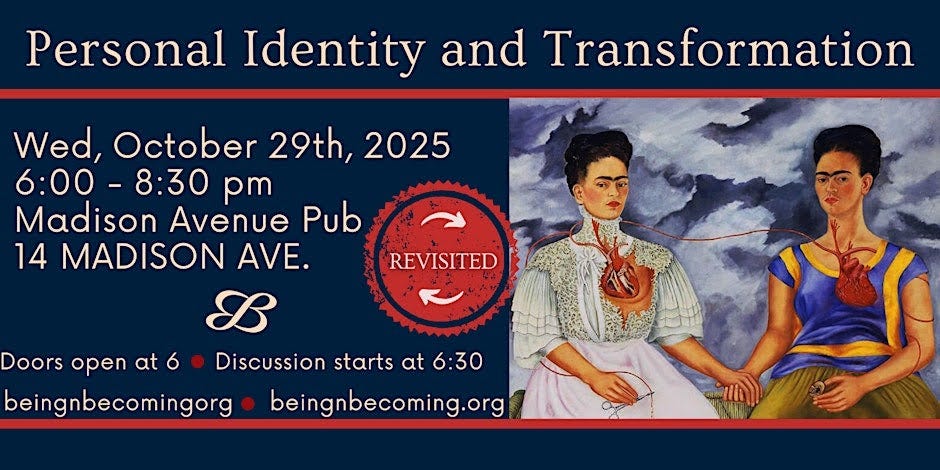
You can find information on accessibility and ticket cost in the announcement of the next Curiosity Café below.
Curiosity Café: Bi-weekly on Tuesdays, tickets* below!
*Psst: hey community! Sophia here, Director of Community Programming. Right now, we are working towards the goal of providing those who contribute to making the cafés happen equitable financial compensation for the work they do, so that we can feasibly and sustainably develop as an organization and provide more programming for all of you. We also want to keep our cafés as accessible as possible, so we are keeping the pay-what-you-can model in place for tickets. We ask that you consider that our ideal recommended amount for a ticket is now $15, and as you choose what to donate within the bounds of your own financial means, we ask that you keep in mind that your donation will go directly towards compensating those involved in making Curiosity Cafés happen so that we can keep doing this for you.
We will host our next Curiosity Café on Tuesday, November 4, from 6:00 to 8:30 p.m. at the Madison Avenue Pub (14 Madison Ave, Toronto, ON M5R 2S1). Come and hang out with us, grab food, and read through our handout from 6:00 to 6:30 p.m. Our structured discussion will run from 6:30 to 8:30 p.m. with a 10-minute break in the middle!
The topic of our next café is: Shame
Missing the event description? Head over to our Eventbrite page! We’re trying to make the length of our newsletters a little less overwhelming.
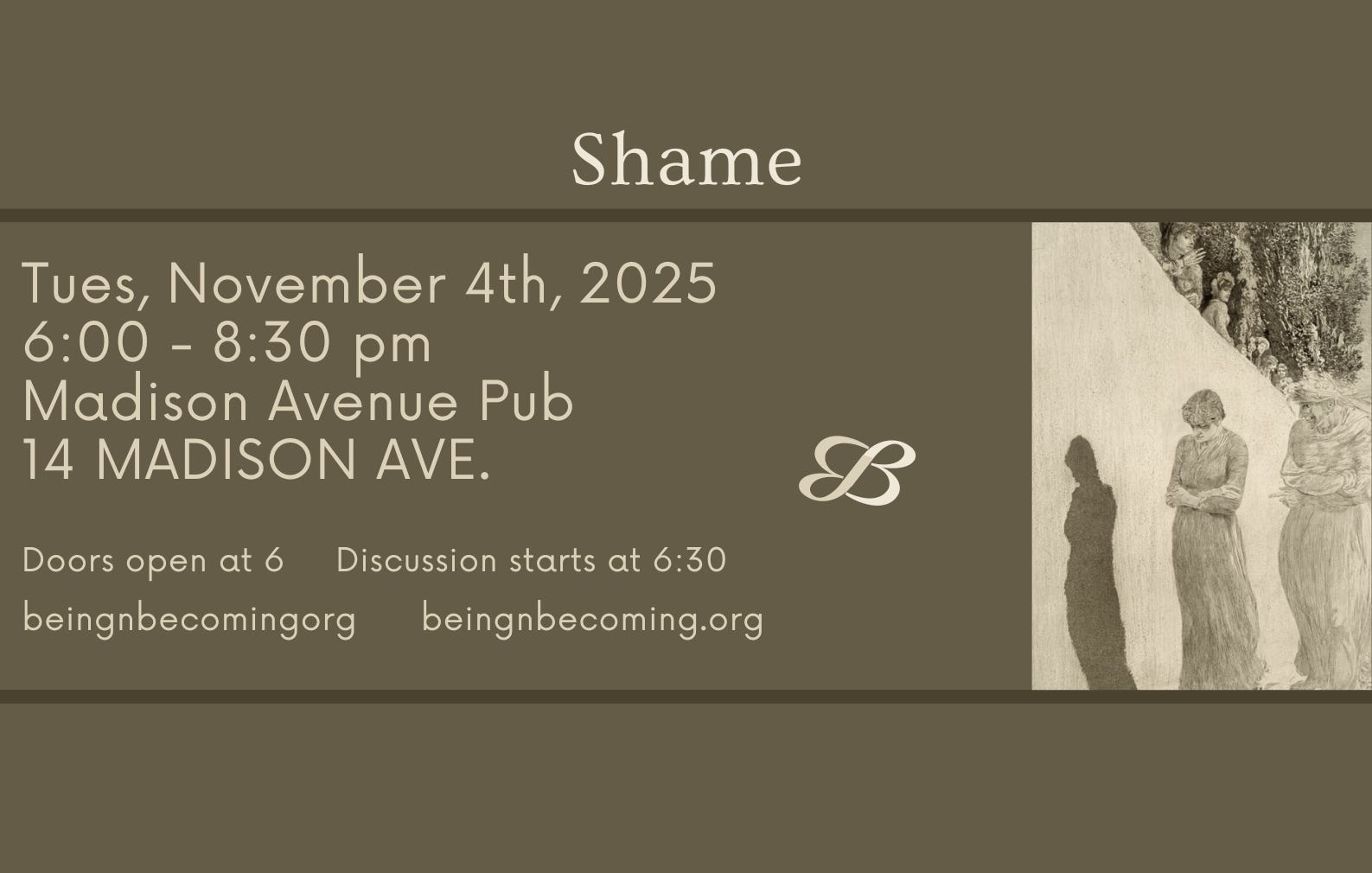
If you have accessibility-related concerns related to our Curiosity Cafés, please visit their respective Eventbrite pages—in the event descriptions, you will find some accessibility-related information about the venue and the event.
We still have five free tickets available for our attendees. If paying anything at all is not financially feasible for you or our ticketing system presents some other barrier, please contact our Director of Community Programming, Sophia, at sophia@beingnbecoming.org. These tickets will be given away on a first-come, first-served basis, no questions asked! You can expect to hear back from her within 72 hours.
Featured Quote
The question is not Can they reason? or Can they talk? but Can they suffer?
- Jeremy Bentham
Our mission is to present a diversity of perspectives and views. The views and opinions expressed in this newsletter are solely those of the individual authors and do not necessarily reflect the views or opinions of Being and Becoming. Being and Becoming disclaims any responsibility for the content and opinions presented in the newsletter, as they are the exclusive responsibility of the respective authors. If you disagree with any of those presented herein, and you feel so inclined, we recommend reaching out to the original author and asking them how they came to hold that opinion. It’s a great conversation starter.
Comments
Nothing yet. Say the first thing.
Sign in to join the conversation.