
By Adrian Ma
Democracy—at least in the places that have adopted it—is widely perceived as a good thing, despite the growing list of challenges and accusations it is reportedly facing around the world. Critics have argued, and even supporters have conceded, that democratic systems can be slow and inefficient; that they have produced societies marred by inequality and injustice or allowed these problems to persist or metastasize; that they are prone to instability, swaying back and forth according to the whims of the governing parties or the vagaries of public opinion; that they have empowered ill-advised majorities to steer their countries into dangerous and even anti-democratic directions. Why, then, do we continue to value democracy as much as we do—while recognizing that it often does not work as intended? At our latest Curiosity Café, moderated by Louis Chiu and our very own Sophia Whicher, we explored what, if anything, makes democracy so valuable, and whether it is possible to make it better. But first:
Curiosity Café Recap: The Value of Democracy
Community Survey
Upcoming Events
Curiosity Café REVISITED: Art: What’s the Point? (November 27)
Our Next Café: Coincidence (December 2)
By Adrian Ma
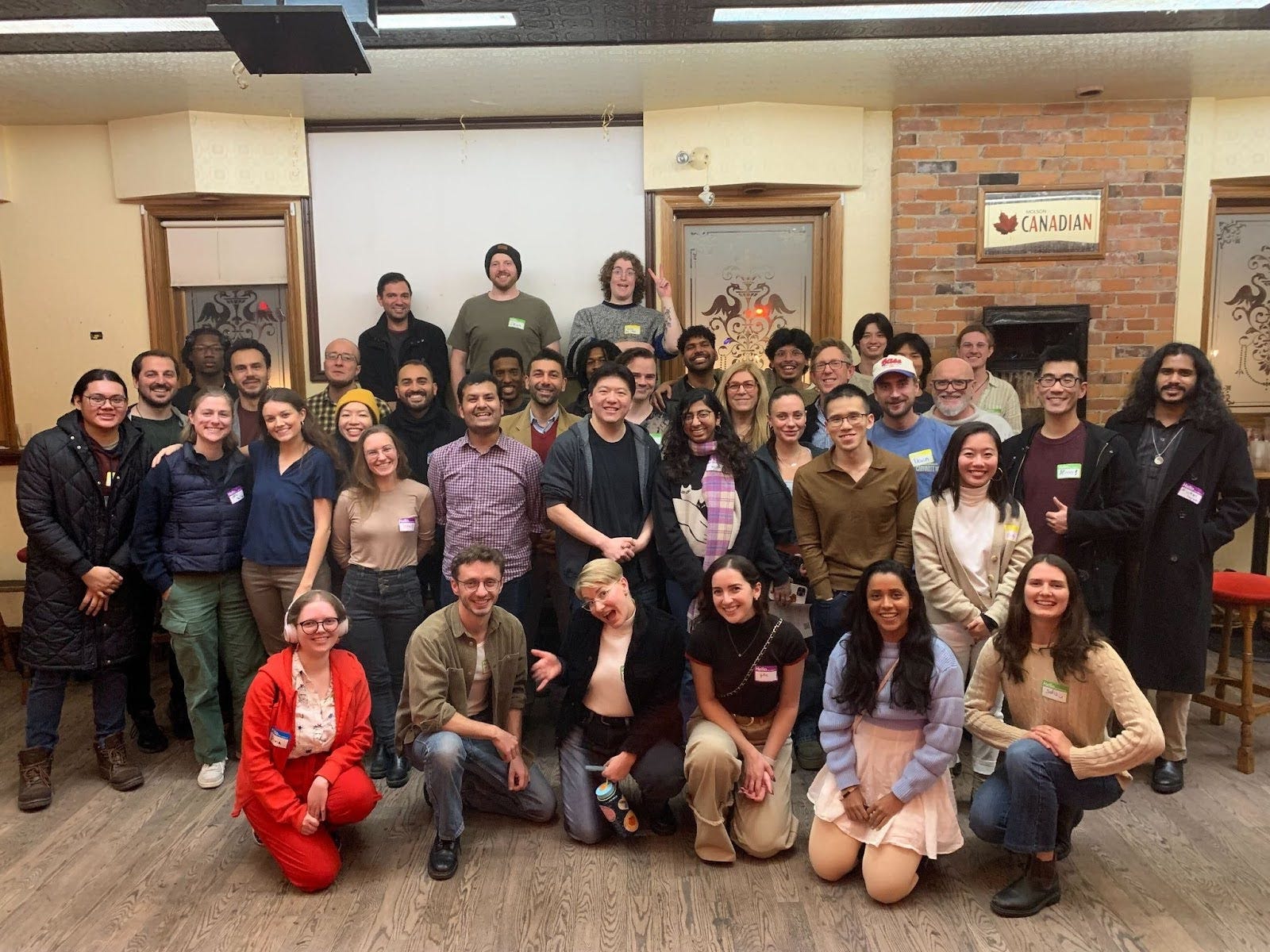
Our latest Curiosity Café began in appropriately democratic fashion, with our casting a vote for one of two imaginary (but perhaps not entirely fictional) nations. Consider the following:
Imagine two nations of comparable wealth and influence. Nation A is a monarchy, ruled by an educated and compassionate queen. This nation has some wealth inequality, but every citizen is guaranteed housing, food, healthcare, and education. Human rights are cherished and protected. Nation B is an electoral democracy that holds regular elections, which are fair and have high voter turnout, to determine who leads the government. Although wealthy, the wealth is distributed unevenly in the nation, and housing, food, healthcare, and education are only accessible to those with the financial means. Human rights are only protected as much as the current government chooses to do so.
With this thought experiment in mind, we asked:
Would you rather live in Nation A, or Nation B? What does your answer reveal about the kind of value democracy has? Is democracy intrinsically valuable, or merely instrumentally valuable?
What makes a political system a democracy?
What, if anything, makes democracy instrumentally valuable?
What, if anything, makes democracy intrinsically valuable?
Further, we reflected:
Must a democracy involve elections? What else, if anything, must a political system have in order to be considered a democracy?
What role does deliberation play in democracy?
Here’s what some of you had to say:
My choice of A or B will depend on why the monarch is as benevolent as she is. Is it because she belongs to and rules over a society in which kindness is widely valued and practiced? Or is her benevolence simply due to some fortunate idiosyncrasy in her nature? In the former case, I can rest assured that the monarch and her successors will continue to rule with kindness, and that her subjects will continue to enjoy the goods of housing, food, healthcare, and education, in addition to strong protections for their fundamental rights; in the latter case, however, nation B would be the better choice.
According to the philosopher Karl Popper, democracy is valuable because it creates the conditions that enable us to adjust to new evidence, test new ideas, and improve society through gradual reform. It allows for change and the removal of bad leaders without the use of violence. This is why democratic systems are preferable to monarchies, even when the latter sometimes yield superior results: monarchies tend not to come with a built-in safety mechanism that allows subjects to remove cruel or ineffective leaders.
The portrayal of nation A is implausible in one key respect: that “[h]uman rights are cherished and protected.” Would a right like freedom of speech really receive full protection in this nation, to the point where even dissent and criticism of the monarch are tolerated? Threats to her rule or reputation are where the monarch is likely to draw the line.
Our discomfort with nation A might have more to do with our aversion to the word “monarchy,” rather than what monarchy actually entails.
Democracy is not valuable in itself, but only insofar as it promotes just societies.
Democracy, or at least democracy without sufficient guardrails, can fall prey to the tyranny of the majority, where the interests and rights of minorities are disregarded or suppressed in favour of the interests of everyone else.
Maybe the things we like about democracy are not due to democracy per se, but to democracy paired with liberalism. However, the two elements can and do conflict, as suggested by the notion of an “illiberal democracy.” Figures such as Hungary’s leader Viktor Orbán have argued that liberalism is anti-democratic because its strong protections for individual rights run counter to the values and interests of the nation (that, for example, protections for LGBTQ+ rights are incompatible with Hungary’s Christian conservatism), and have championed a form of “illiberal” democracy instead. Maybe democracy alone is not enough to achieve a just society.
A democracy does not require elections as they are currently practiced, where our votes are filtered through representatives whose decisions may or may not reflect our will or our interests. We would be better off with a lottery system in which citizen representatives are randomly drafted, and can participate directly in the democratic process rather than by proxy.
The need for a system of representative democracy, such as we see practiced in nearly all Western democratic countries, might become increasingly obsolete due to advances in technology. It is now easier than ever to get large numbers of people to make their voices heard on a single issue. For example, it isn’t hard to imagine a world where questions can be disseminated instantly to everyone’s cellphone like Amber Alerts. Representatives might have been necessary in a period when direct democracy would have required physically moving enormous groups of people to a single location using rather primitive means of transportation; now, however, we might have the means to make direct democracy happen.
At the same time, we should be wary of a world where technology plays such a dominant role in the democratic process. After all, technology is built by humans, often with their own agendas in mind. It can be exploited and controlled by those in power—we can’t be confident that it will work in the service of democracy.
After the break, we engaged in a critical reflection on a mechanism that is typically regarded as an essential component of democracy: elections. First, we reflected on the importance of deliberation, and how its absence might explain why elections may not be as democratic as they should be:
One of the things we value in a democracy is the ability for everyone to deliberate with their own opinions and values. However, deliberating involves actually engaging with people! The act of voting isn’t actually a deliberative process. Perhaps sometimes this is why it feels like voting isn’t as democratic as it could be. After all, someone who refuses to deliberate with others and votes uncritically for a party in the same way they support their favourite sports team feels like it misses the spirit of democracy.
We then did some deliberating of our own with the following questions as a guide:
Think of the last time you worked in a diverse group with different abilities and skills. Were you able to achieve your goal as a group? Did you have to deliberate to work towards that goal? How did you settle differences of opinions?
Thinking critically about elections:
What interests do your elected representatives represent? What interests should they represent?
Is your MP/MPP more competent than you? Do they have specialized skills you don’t? Do you have specialized skills that might make you a better politician?
What if we selected members of the public to participate in politics instead of representatives?
If we trust the use of juries in the justice process, is there any reason to not trust a lottery as part of our democratic process?
Would a group of citizens drawn from a lottery produce better or worse results than elected representatives, assuming they can rely on the same level of expert advice and have access to the same resources to make informed decisions?
How might a group of citizens perform in solving a problem compared to politicians? Does it make any difference if citizens don’t have to worry about being elected or public opinion?
Here are a few of the ideas you shared, beginning with how deliberation can succeed or fail:
Deliberation succeeds when there are people in the group who are strongly motivated to achieve the desired goal. This means the factors of success are not always evenly distributed throughout the group. It’s like a group science project in elementary school, where one or two particularly enthusiastic students do a disproportionate amount of the work.
One reason deliberation can fail is our tendency to retreat into self-protection mode when our ideas are challenged—particularly when those ideas are extensions of our identity. In such cases, we become more defensive, less curious and open-minded, and more inclined to debate than to dialogue.
Deliberation is hard because it requires that we distance ourselves from our deeply held beliefs and ideas, that we place them in a sort of plastic container we observe at arm’s length.
Deliberation succeeds when we assume all parties are engaging in good faith, that they are motivated by a desire for the truth and the good, rather than by personal gain.
Deliberation is a skill! The more we deliberate, the better we get at it.
Many of you also weighed in on the flaws of the electoral process, and how and whether it could be improved:
In many cases, the power of elected representatives to change anything is limited, because they are voted into a system where laws, norms, institutions, and so on have already solidified and perhaps fossilized. They can make little changes here and there, but they are unlikely to wield much influence over the broader system in which they operate.
Elected representatives represent the constituents who are most interested in being represented—that is, those individuals who are most vocal and engaged.
One major problem with elections is that those who are most passionately invested can have a disproportionate impact on the outcome compared to those who are more apathetic. The electorate is like a friend group debating where to eat, in which the outcome is decided by the one or two people with the strongest opinions, rather than the majority who hardly care.
In a perfect world, politicians would be kind, just, good, charismatic, and persuasive. However, our existing political climate and/or system largely favours those who only possess the last two traits. Can we imagine a system where the first three are required or rewarded?
Our current political system awards leadership to those who are associated with status, regardless of whether that status has anything to do with one’s ability to lead.
When it comes to being a good politician, general skills are more important than specialized ones, which can be left to bodies like the cabinet or the civil service. What is most important for a politician to succeed is the ability to communicate effectively, to relate to ordinary people, and to persuade voters or political opponents.
Some decisions are too important and require too much specialized knowledge to be safely entrusted to common citizens selected through a lottery system. Perhaps one way to mitigate the risk is to narrow the pool from which citizens are drawn such that only those with certain qualifications (such as a certain level of education) are eligible.
A strong civil service, composed of unelected career personnel with specialized knowledge in their respective areas, can counterbalance the weaknesses and incompetence of elected leaders. Despite getting a bad rep, government bureaucracies serve a crucial purpose: they ensure that government decisions conform to established rules and procedures and apply the brakes where needed, thus reducing the risks associated with change.
But while government bureaucracies are primarily concerned with maintaining the status quo, it is often elected officials who have the power or the will to enact meaningful change. Both play important roles.
That’s it for the recap. If you care about the things we do, or believe you have been too apathetic for your own good, please make your voice heard by taking our community survey below. Thanks for reading.
For those who’ve attended our Curiosity Cafés, please consider taking our brief community survey. We are conducting this survey to gather feedback on our events, and it should only take a few minutes to complete. Your responses are completely anonymous and will be invaluable in helping us improve our offerings. Thank you in advance!
Curiosity Café REVISITED: Back and Better than Ever, People!
Being and Becoming has just introduced a new Curiosity Café series, which isn’t actually new at all: Every four(ish) weeks, we revisit a previous Café. In this series, we will be repeating topics, sometimes with a slight twist, sometimes with the same questions (but rest assured, even if you went to the first iteration and the questions were exactly the same, the discussion will change based on who is in attendance. Maybe you’ve even changed too…).
The topic of our next revisited café is: Art: What’s the Point?, happening on Thursday, November 27!
Missing the event description? Head over to our Eventbrite page! We’re trying to make the length of our newsletters a little less overwhelming.
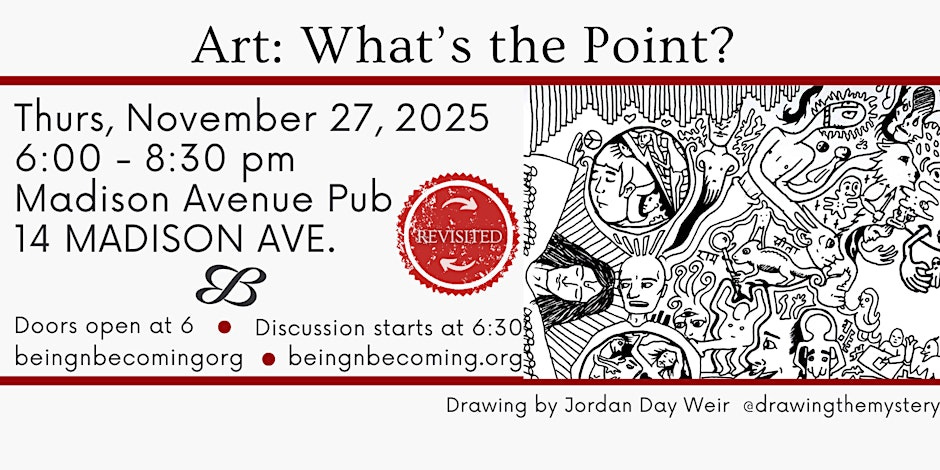
You can find information on accessibility and ticket cost in the announcement of the next Curiosity Café below.
We will be hosting our next Curiosity Café on Tuesday, December 2 from 6:00 - 8:30 pm at the Madison Avenue Pub (14 Madison Ave, Toronto, ON M5R 2S1). Come and hang out with us, grab food, and read through our handout from 6:00 - 6:30 pm. Our structured discussion will run from 6:30 - 8:30 pm with a 10 minute break in the middle!
The topic of our next café is: Coincidence
Missing the event description? Head over to our Eventbrite page! We’re trying to make the length of our newsletters a little less overwhelming.
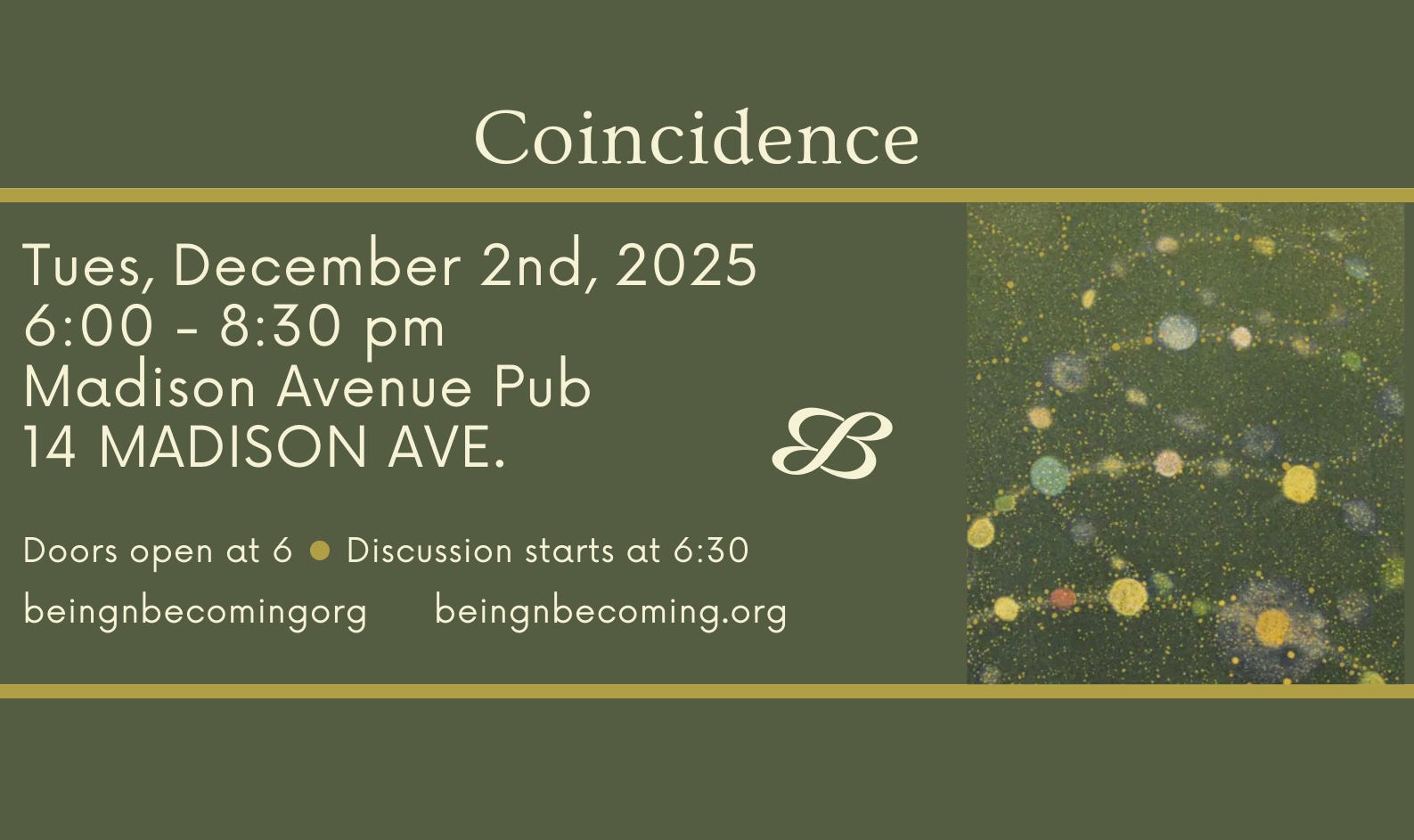
If you have accessibility-related concerns related to our Curiosity Cafés, please visit their respective Eventbrite pages—in the event descriptions, you will find some accessibility-related information about the venue and the event.
We still have five free tickets available for our attendees. If paying anything at all is not financially feasible for you or our ticketing system presents some other barrier, please contact our Director of Community Programming, Sophia, at sophia@beingnbecoming.org. These tickets will be given away on a first-come, first-served basis, no questions asked! You can expect to hear back from her within 72 hours.
Did you, too, O friend, suppose democracy was only for elections, for politics, and for a party name? I say democracy is only of use there that it may pass on and come to its flower and fruits in manners, in the highest forms of interaction between men, and their beliefs—in religion, literature, colleges, and schools—democracy in all public and private life, and in the army and navy.
- Walt Whitman
Our mission is to present a diversity of perspectives and views. The views and opinions expressed in this newsletter are solely those of the individual authors and do not necessarily reflect the views or opinions of Being and Becoming. Being and Becoming disclaims any responsibility for the content and opinions presented in the newsletter, as they are the exclusive responsibility of the respective authors. If you disagree with any of those presented herein, and you feel so inclined, we recommend reaching out to the original author and asking them how they came to hold that opinion. It’s a great conversation starter.
Comments
Nothing yet. Say the first thing.
Sign in to join the conversation.