
By Adrian Ma
We tend to justify our choices by appealing to reasons, to some version of a “because.” I studied philosophy because I enjoy it; I limit my alcohol consumption because it is bad for my health; I donate to charities because I want to help others. At the same time, reasons appear to stand in a complicated relationship to our reasoning and decision-making processes. We often find ourselves acting without knowing why, convinced of a decision we can hardly explain to others, or skeptical of an action that reason appears to favour. And as Pascal wrote in his Pensées, “The heart has its reasons of which reason knows nothing.” At our latest Curiosity Café, moderated by Jesse Vriend and Marybel Menzies, we engaged in a reasonable and heartfelt discussion of reasons—of what they are, where they come from, and whether they are always, or ever, enough. But first:
Curiosity Café Recap: Reasons and Justification
Upcoming Events:
Our Next Café: Censorship (May 19, 2026)
Curiosity Café REVISITED: Work and Identity (May 28, 2026)
By Adrian Ma
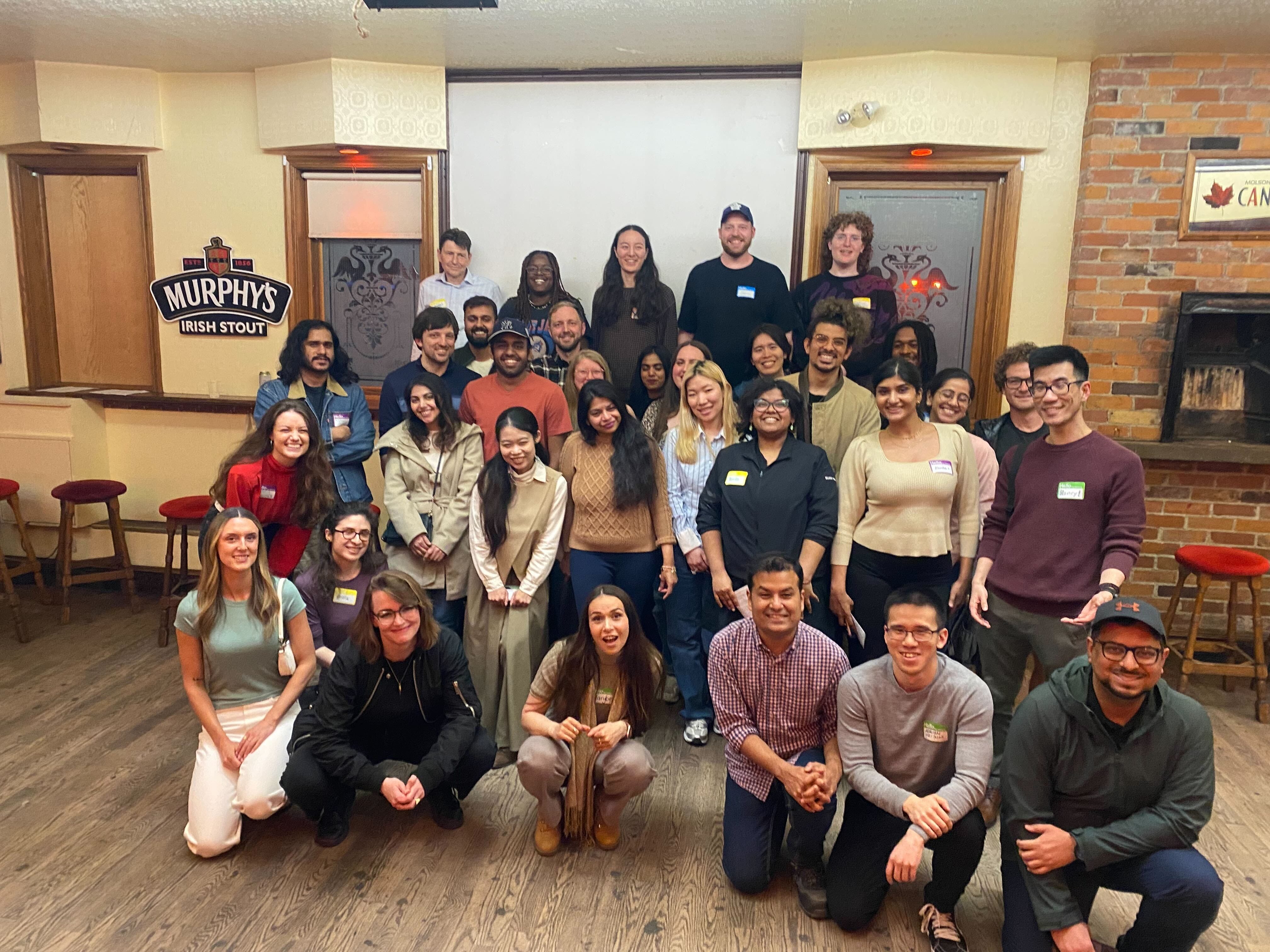
Our latest Curiosity Café, moderated by Jesse Vriend and Marybel Menzies, began with a distinction between what philosophers call “normative” and “explanatory” reasons. Normative reasons determine what should or should not be done: they justify our choices. On the other hand, explanatory reasons merely describe the causes that led to our choices. For example, I may donate a generous sum to charity in the belief that this will make a good impression on my crush (who, in reality, doesn’t care, or actively despises the cause to which I am donating). This would be an example of an explanatory reason. On the other hand, a normative reason for donating—the reason I should give money to the charity—is that it would alleviate the suffering of innocent people. But while it is intuitive to treat the two types of reasons as distinct, they can and often do overlap: indeed, it is natural to assume that a rational person’s normative reasons would also double as a causal explanation of their behaviour—as in a case where I donate to charity because that would alleviate the suffering of innocent people.
With this distinction in mind, we reflected on the variety of ways in which we relate to our normative reasons, asking:
Your reasons may feel especially important when they go missing or don’t add up.
Consider the last time you realized in hindsight that you acted without a normative reason. What was that experience like? Is it different than acting for a reason?
Do you find yourself justifying your actions in hindsight—finding a reason that justifies why you should have done something, even though that’s not actually what motivated you to do it? Why?
How do you make choices when you’re genuinely conflicted?
Consider two kinds of normative reasons: internal and external. An internal reason expresses one of your existing motivations, whereas an external reason is derived from considerations that exist independently of your existing motivations. For example, your preference for sunlight would be an internal reason to go outside. In contrast, the fact that sunlight is “good for” you, independent of your preference, may be an external reason.
Can you justify an action by preference alone, or do you need to cite external factors to justify the action adequately?
Are there external sources of reasons that can adequately justify an action on their own? For example, biological, cultural, evolutionary, religious and ethical reasons. Can you name any? If not, why not?
You may be familiar with the Why Game, a childhood favourite. However you justify something, your little cousin may still ask, “Why?” Philosophers call this the problem of “justificatory regress.” It casts doubt on the idea that any action can be fully justified.
Play the Why Game. Start by justifying some choice you recently made.
Is there any reason that can justify itself? If so, how?
Here are a few of the responses you gave—along with your reasons:
When reflecting on the reasons behind my choices, I am always careful to distinguish between moral justifications (why I should or should not have done something) and purely descriptive explanations (“I was in a bad mood”). The latter can easily become an excuse, whereas the former are what prevent me from repeating my moral mistakes.
We do not only justify our own actions after-the-fact; we do the same for the actions of others as well. When a loved one confesses that they have done something of which they are less than proud, my first inclination is to convince them (and myself) that they have in fact done the right thing, and to find some way of rationalizing their actions.
I sometimes find myself saying things impulsively in a reactive state, then doubling down and attempting to justify what I said instead of retracting or apologizing for it. This creates a spiral in which my doubling down leads to further pushback, which in turn makes me more defensive, and thus more uncompromising in my commitment to my impromptu position.
We can distinguish between different levels or tiers of reasons. Lower-tier reasons are based on immediate, short-term desires, like my craving for a chocolate bar or a glass of wine. Higher-tier reasons are based on long-term goals concerning what I want to do or be. When the two conflict, the higher-tier goals should take priority: my goal of being healthy, for example, should override my immediate desire for a chocolate bar.
All thought processes about reasons are conversations. There is always an “other” party—whether real or imagined—to whom I am explaining my reasons and reasoning. These conversations are often uncomfortable: they feel as though you are being interrogated or policed. Perhaps they can also feel liberating, when judgment by the other party is not a concern. But can such a judgment-free conversation really be a sincere conversation about reasons?
Yes! In some cases, conversations about reasons without the fear of judgment are possible. Think of conversations with loved ones you trust.
How can we distinguish between good and bad reasons, or at least better or worse reasons? All sides in any war, for example, can provide reasons for their position that would seem legitimate or even compelling to a sufficiently empathetic audience. But it would be wrong to conclude, on this basis, that these arguments are all equally persuasive, or that it is impossible to compare and arbitrate between them.
We seek reasons for our choices because we find uncertainty disquieting. We are social creatures who value certainty and knowledge, and thus often feel compelled to act in ways that “make sense,” for reasons that would be acceptable to ourselves or our community.
The internal versus external reasons dichotomy should be reconceptualized as more of a dotted line distinction between “this side of the skin” and “that side of the skin.“ Our reasons do not fundamentally change in nature depending on whether they are inside or outside of us in this purely physical sense. Consider a fence that divides a field of grass. You can speak of the grass on this or that side of the fence, but neither side can be said to be “internal” or “external.” This becomes especially clear when you are looking straight down the fence, and the distinction between this side and that side, between the here and the there, evaporates.
As the Why Game progresses, we must eventually run up against some fundamental assumptions, which are taken for granted and are not themselves justified by any further assumptions. Among these may be the assumptions that consciousness is valuable and that life is worth preserving. Once we reach this point, the regression, and therefore the game, must end.
It is often unproductive to play the “Why Game” for too long, to dig into the underlying reasons behind our desires and motivations. Such a level of intellectual scrutiny tends to undermine our motivations and the value we find in the experiences we seek.
All conversations are Why Games to some extent. To keep the conversation going, you must express interest—implicitly or explicitly—in why your interlocutor says the things they do, or believes what they believe. We are always playing the game, whether we know it or not.
After the break, we considered how society and culture influence our normative reasons. We asked:
In what situations do you find yourself justifying your choices to other people?
How does it feel to justify your choices to someone else?
Have you ever been unable to justify a choice to someone but still felt confident in it?
Has anyone ever rejected your justification of your choices? Why? How did it feel?
Do we always have to justify ourselves to others? Why or why not?
How do you distinguish between “good” and “bad” reasons?
Do we, individually, determine what counts as a “good” reason, or does society?
What pushes you to look for “good” reasons? Is the motivation personal or social?
Have you ever felt limited by what your society accepts as a “good” reason?
Do you relate differently to reasons that are personal vs. reasons you share with others?
Is there anything everyone in your community has a reason to do? If so, why?
Considering the full diversity of human beings (such as volunteer firefighters, Buddhist monks, CEOs, etc.), is there anything everyone in the world has a reason to do? Are there reasons that don’t apply to everyone?
Here’s what some of you had to say:
I often feel the need to justify my choices to other people when they are unlikely to figure it out themselves. This is especially the case when my reasons depart from, or cannot be expressed in terms of, the cultural or societal status quo.
Even when I am not explaining myself to others in real life, I am doing so in my head, anticipating objections and developing my finer points.
I tend to explain my reasons only to people whose opinions I value. Such conversations give me the chance to consider alternative perspectives, refine my thinking, and perhaps even change my mind.
Vocalizing the reasons behind my decisions is an act of love. It is a way of sharing a part of myself, and communicating transparently to others about choices of mine that might affect them. Such expressions of love can be as simple as explaining to my friend why I am declining her invitation to dinner, instead of giving her reason to worry and room to catastrophize about the state of our friendship.
It is easier to explain myself to certain people than to others. When I give my reasons for wanting to pursue a certain ambitious project to my closest friends, I can expect sympathy and encouragement. When I do the same to my parents, I am likely to receive a lecture and a warning.
Reasons are often judged to be good or bad in relation to tradition. Traditions can be understood as experiments that work, as systems that have endured because they have proven beneficial in some way.
But traditions do not always achieve dominance through the sheer merit of their ideas and practices. Not all traditions are supported by good reasons: they can also be mere expressions of power.
We may have different ideas about what constitutes good and bad reasons, but this doesn’t mean that everything is relative and that there is no fact of the matter. These ideas can still be wrong. Consider a case where what you feel is right conflicts with culturally taken-for-granted conceptions of good and bad. This is an experience with which marginalized people who are excluded from dominant frameworks are deeply familiar; having to constantly justify themselves against the assumptions of the status quo can be disproportionately exhausting.
Although ideas about what constitutes a good or a bad reason widely differ, it doesn’t follow that everyone is free to do what they wish, to pursue what they believe—often mistakenly—to be good. (Terrible atrocities have been committed because their perpetrators believed they were doing the right thing.) Such differences do not remove the need or the obligation to hold people accountable for the wrongs they do or the beliefs they have.
Perhaps talking about reasons is a way of drawing us out of our own solipsistic worlds, our private realities, and back into a relationship with a shared, public reality in which we are accountable for our choices and their consequences for others.
Understanding is generated through the friction between competing ideas, perceived as good by their proponents and bad by their critics.
We often speak of reasons as though they are merely propositions, broadly understood as declarative sentences that can be true or false (like “The floor is made of wood,” and unlike, “What year were you born?”). But reasons seem to do more than state facts, or potential facts. They carry an element of “should” or “should not” that propositions do not intrinsically entail.
Any proposition can be a reason: it depends on the role it plays in your reasoning. “It is raining outside” might seem like a basic statement of fact, but if I am concerned about not getting wet, it also constitutes a reason to bring an umbrella.
The biological impulse to survive, and the human need to belong (the drive to “go along to get along”), are foundational, and will always influence our reasoning about what to do.
Everything we do is motivated by the pursuit of the good, however that may be defined. We seek things that we perceive as desirable, and we perceive them to be desirable because we believe they are good.
It isn’t clear that a habit of evaluating your own reasons is necessary for, or even conducive to, individual well-being. Perhaps the opposite is even true. History has demonstrated, and continues to demonstrate, that unreflective, inconsiderate people, who indulge their every whim and desire with neither thought nor hesitation, can live accomplished, happy lives.
Thanks for reading, but don’t stop yet. The reason? We have two exciting upcoming events, on which you can find more details below.
*hey community! Sophia here, Director of Community Programming. We ask that you consider that our ideal recommended amount for a ticket is now $15, and as you choose what to donate within the bounds of your own financial means, we ask that you keep in mind that your donation will go directly towards compensating those involved in making Curiosity Cafés happen so that we can keep doing this for you.
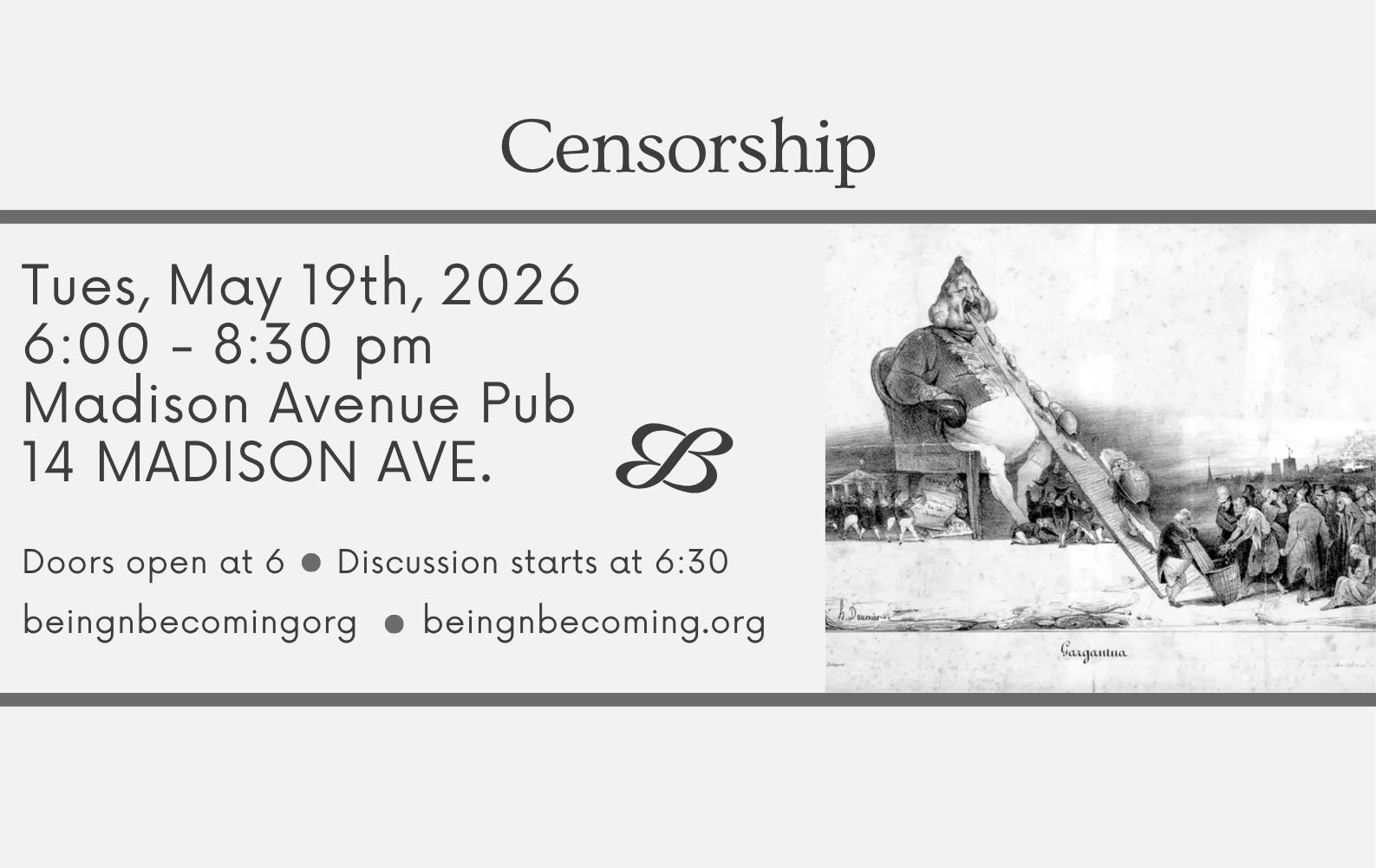
We will host our next Curiosity Café on Tuesday, May 19, from 6:00 to 8:30 p.m. at the Madison Avenue Pub (14 Madison Ave, Toronto, ON M5R 2S1). Come and hang out with us, grab food, and read through our handout from 6:00 to 6:30 p.m. Our structured discussion will run from 6:30 to 8:30 p.m. with a 10-minute break in the middle!
The topic of our next café is: Censorship
Missing the event description? Head over to our Eventbrite page! We’re trying to make the length of our newsletters a little less overwhelming.
If you have accessibility-related concerns, please visit our Eventbrite page—in the event description, you will find some accessibility-related information about the venue and the event.
We still have five free tickets available for our attendees. If paying anything at all is not financially feasible for you or our ticketing system presents some other barrier, please contact our Director of Community Programming, Sophia, at sophia@beingnbecoming.org. These tickets will be given away on a first-come, first-served basis, no questions asked! You can expect to hear back from her within 72 hours.
Curiosity Café REVISITED: Back and Better than Ever, People!
Being and Becoming has introduced a new Curiosity Café series, which isn’t actually new at all: Every four(ish) weeks, we revisit a previous Café. In this series, we will be repeating topics, sometimes with a slight twist, sometimes with the same questions (but rest assured, even if you went to the first iteration and the questions were exactly the same, the discussion will change based on who is in attendance. Maybe you’ve even changed too…).
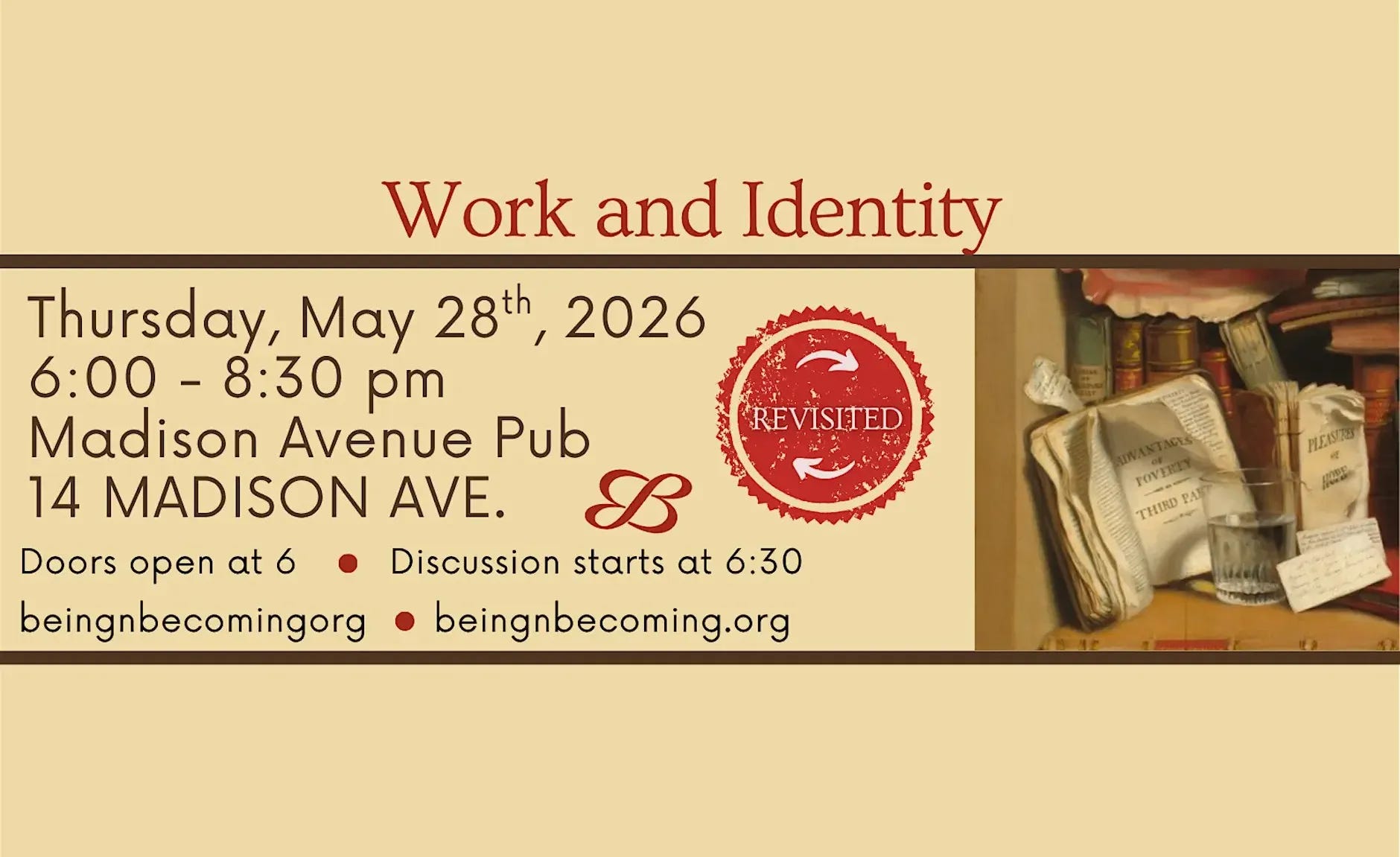
We will host our next REVISITED Curiosity Café on Tuesday, May 28, from 6:00 to 8:30 p.m. at the Madison Avenue Pub (14 Madison Ave, Toronto, ON M5R 2S1). Come and hang out with us, grab food, and read through our handout from 6:00 to 6:30 p.m. Our structured discussion will run from 6:30 to 8:30 p.m. with a 10-minute break in the middle!
The topic of our next revisited café is: Work and Identity
Missing the event description? Head over to our Eventbrite page! We’re trying to make the length of our newsletters a little less overwhelming.
If you have accessibility-related concerns, please visit our Eventbrite page—in the event description, you will find some accessibility-related information about the venue and the event.
We still have five free tickets available for our attendees. If paying anything at all is not financially feasible for you or our ticketing system presents some other barrier, please contact our Director of Community Programming, Sophia, at sophia@beingnbecoming.org. These tickets will be given away on a first-come, first-served basis, no questions asked! You can expect to hear back from her within 72 hours.
Text within this block will maintain its original spacing when published
Ah, when to the heart of man
   Was it ever less than a treason
To go with the drift of things,
   To yield with a grace to reason,
And bow and accept the end
   Of a love or a season?
- Robert Frost
Our mission is to present a diversity of perspectives and views. The views and opinions expressed in this newsletter are solely those of the individual authors and do not necessarily reflect the views or opinions of Being and Becoming. Being and Becoming disclaims any responsibility for the content and opinions presented in the newsletter, as they are the exclusive responsibility of the respective authors. If you disagree with any of those presented herein, and you feel so inclined, we recommend reaching out to the original author and asking them how they came to hold that opinion. It’s a great conversation starter.
Comments
Nothing yet. Say the first thing.
Sign in to join the conversation.