
By Adrian Ma
The term “censorship” has been used to refer to a wide variety of actions and omissions perceived to restrict or penalize expression, from the banning and burning of books to the behind-the-scenes shenanigans of social media algorithms. But what, exactly, is censorship? Does it always involve a formal prohibition or the use of coercive power, or might it also encompass less explicit de facto barriers to the circulation of ideas or information? At our latest Curiosity Café, moderated by Yiming Jia and yours truly, we engaged in a loud and non-punitive exploration of the nature and function of censorship—of what it is, what it does, and when (or whether) it is morally justified. But first:
Curiosity Café Recap: Censorship
Upcoming Events:
Curiosity Café REVISITED: Work and Identity (May 28, 2026)
Our Next Café: Meaning in the Mundane (June 2, 2026)
By Adrian Ma
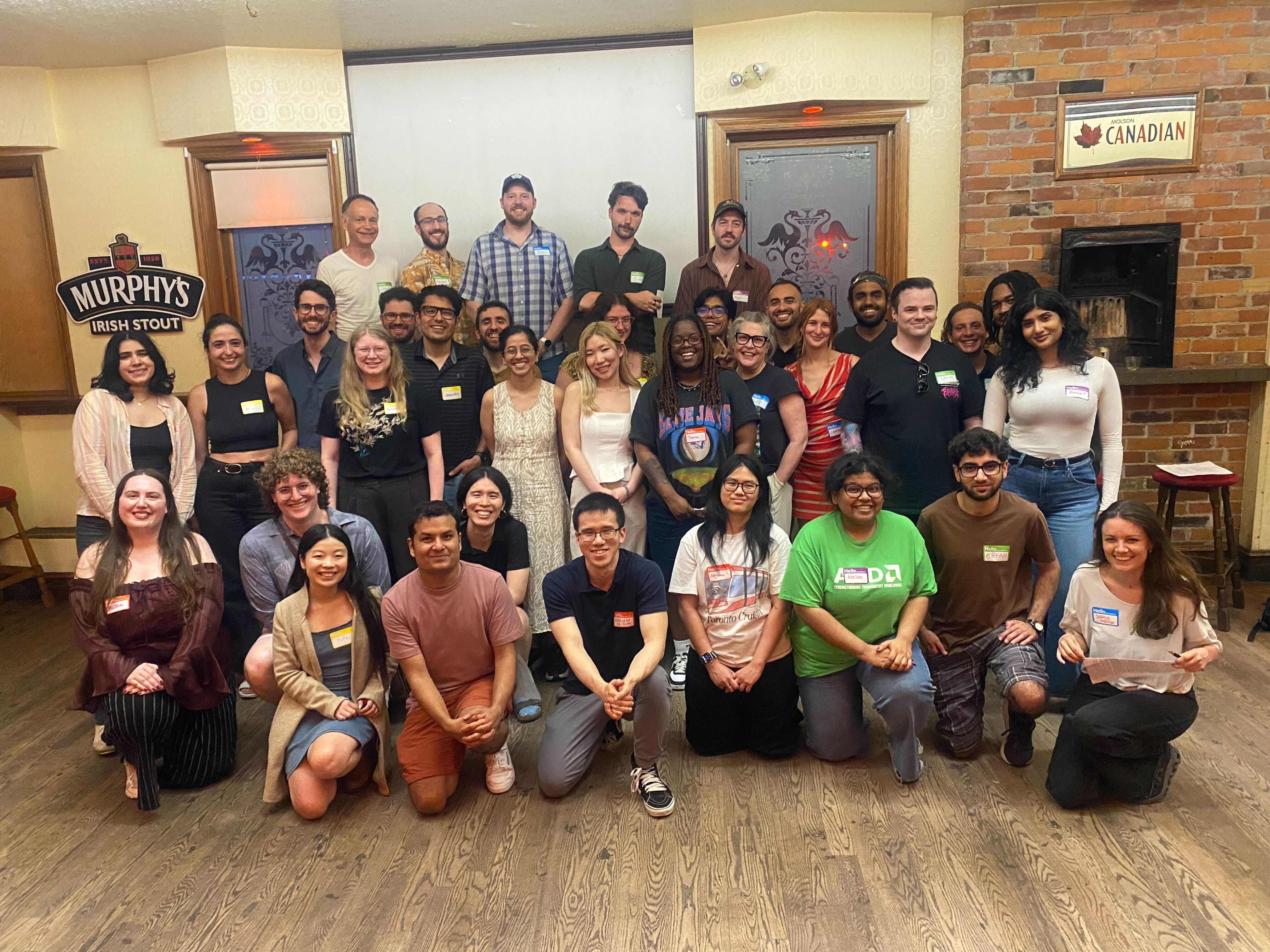
Censorship is typically seen to define the bounds of what can and cannot be said. Our latest Curiosity Café, moderated by Yiming Jia and yours truly, began with an attempt to trace the boundaries of the concept of censorship itself. We asked:
Which of the following do you consider censorship?
A government arrests journalists and dissidents for publishing content critical of those in power
An internet filter blocks certain websites in a country without users being notified of what has been blocked or why
Hollywood studios voluntarily adopt a code banning depictions of homosexuality and interracial relationships
A streaming platform quietly omits 2SLGBTQ+ titles from its catalogue in certain countries to protect market access, with no legal obligation to do so
Bots or humans flood the Internet with misinformation, making certain facts or opinions harder to find
Has there ever been something you chose not to say or post because of who might see it?
Is that censorship or just being socially aware?
Is freedom of expression still meaningful if the infrastructure to be heard doesn’t exist?
If an algorithm decides nobody sees your content, and nothing is officially removed, is that censorship?
What about a case where the market, and not the government, makes that call (that is, if content is withheld or restricted by private companies for the sake of profit and protecting market access)?
If you use a platform that restricts content in other countries to keep its market access, are you participating in censorship?
Based on your answers to the above, can you come up with a general definition of censorship?
Is “soft” or “indirect” censorship meaningfully different from “direct” censorship? Is it better or worse?
Here’s what we allowed some of you to say:
The code voluntarily adopted by Hollywood studios appears to straddle the line between censorship and non-censorship. It may qualify as censorship on the grounds that it prevents the dissemination of content. At the same time, it is also a decision motivated by profit, not the desire to protect the public good. The latter appears to be the motivation most characteristic of censorship.
But is censorship not always about money, in the end? Private companies engage in censorship to avoid alienating, say, their investors and consumers; governments do the same to protect their economic interests.
There is a reason the law treats censorship by the government (which is generally prohibited) and censorship by private companies or citizens differently: there is a serious risk that a government equipped with strong censorship powers will be able to force speech, to compel its subjects to say things they don’t believe or stay silent about things they oppose.
Should the power of a private entity be taken into account when considering the limits of censorship? Certain private entities are powerful enough to impose censorship measures as severe and consequential as any available to an unrestrained government.
Does intent matter when determining what does and doesn’t count as censorship? Censorship is most typically characterized by the desire to control thought. At the same time, the effects of censorship can also be achieved as a byproduct of the pursuit of other goals, such as harm prevention.
Self-censorship occurs when we have internalized the voice of an external authority. There exists, therefore, an intimate connection between censorship and power, which is often manifest in the judgments of such an internalized voice. Marginalized people, being excluded from dominant frameworks, and finding themselves on the other side of the status quo, feel particular pressure to censor themselves.
Self-censorship often involves the presence of such an internalized authority, but not always. I may, for example, refrain from discussing certain topics at a family dinner out of consideration for my interlocutors’ sensibilities. This appears to be an example of self-censorship without any reference to an internalized authority.
Censorship requires an authority who (or which) decides what is and is not acceptable to see, hear, or say. This is true even in cases where non-human entities, in particular algorithms, appear to be the proximate decision-makers. Algorithms, after all, are designed and pushed by private companies, which certainly count as authorities.
There are many examples of censorship, however, in which no such authority can be identified. Look at commonplace instances of what might be considered self-censorship. I present different sides of myself depending on the context—on where I am and who I am with—which involves hiding or de-emphasizing the other aspects of my identity. I am not the same person around my friends as I am around my grandparents or my boss. This selective presentation can be understood as a form of self-censorship, and yet there appears to be no external authority deciding what I can and cannot do or say.
An algorithm’s decisions not to display or promote certain content may not themselves constitute censorship, but we must also consider how that algorithm was created. If we look closely at an algorithm with exclusionary results, we are likely to find censorship somewhere upstream—in, for example, its developers’ decisions to include or not include certain information sources in its training data.
After the break, we muzzled our discussion of what censorship is and proceeded to explore what its role and effects are, or should be. We asked:
What is the purpose of censorship?
What are the reasons that have been cited to justify restrictions on speech or information? Enforcing public morals? Preserving traditional values? Protecting vulnerable populations? Preventing discomfort? Something else?
Do you find any of these arguments convincing?
Who (or maybe, what) gets to decide what should and should not be restricted?
Do you think censorship is ever morally permissible, or even good?
If your answer is “yes,” why, and in what cases?
If your answer is “no,” why not?
What, if any, are the harms that result from censorship?
Censorship sends a message about what is acceptable and what isn’t. But can it actually change minds and hearts?
If a community has been told for long enough that something is inappropriate or immoral, do they eventually start believing it themselves?
Can censorship actually reinforce censored ideas?
Here’s what a few of you ventured to share:
Censorship is justified when it is necessary to protect children. I am more concerned about my children’s exposure to harmful media, like pornography and depictions of gory violence, than I am about their exposure to harmful ideas. I feel equipped to talk to my children about harmful ideas, and help them understand why they are problematic and should be rejected. The effects of harmful media seem more insidious and difficult to manage.
Cue Karl Popper’s notion of the “paradox of tolerance,” whereby tolerating intolerant people will ultimately lead to the destruction of tolerance. (Consider how hate speech can intimidate members of the targeted groups into silence.) It might be wise, then, to impose minimal, surgically targeted censorship measures to prevent this—just enough to stop the speech of the intolerant from inhibiting the expression of others.
There is no single party we can point to as the authority on what kind of speech is or is not permissible. Authorities will often draw the line in a way that best conforms to their particular values or serves their interests. But also, the responsibility of drawing the line can be daunting, especially when it means speaking on behalf of entire groups—such as when a person of colour is tasked with deciding what is and is not racist, or a queer person what is or is not homophobic.
The appropriateness, or necessity, of censorship depends on your relationship with the people you are talking to. There are certain relationship containers within which you might want to be able to speak your mind without fear of being censored, or without having to censor yourself. But there are relationships where such transparency would be inappropriate or destabilizing.
There should be a presumption against censorship; censorship will always be an item in the minus column, even if its wrongness can be outweighed by other considerations. If we cannot have a world totally free of censorship, we should still avoid it wherever possible. Censorship inhibits the free exchange of ideas, which is key to our individual and collective well-being.
Censorship can be justified when expression would lead to clear and tangible harms, like when the publication of a book could result in violent backlash against the author or others involved. It is tempting, in theory, to stand on principle and resist censorship come what may. But when actual human lives are at stake, it’s easy to see why one would hesitate.
To see the harms of censorship, which are well-documented, we need only look to its victims, to its role in the oppression of marginalized groups around the world—to women silenced in patriarchal societies, to Black artists and activists whose voices and historical contributions have been ignored.
When censorship is at its most effective, do we even know it’s happening?
The means of combating bad information should never be less information. It should be more, and better, information.
Before silencing myself, I should remind you that we will be hosting two exciting cafés in the coming weeks, which you can (and must) read more about below. Please do that, voluntarily. See you there.
Hey community! Sophia here, Director of Community Programming. We ask that you consider that our ideal recommended amount for a ticket is now $15, and as you choose what to donate within the bounds of your own financial means, we ask that you keep in mind that your donation will go directly towards compensating those involved in making Curiosity Cafés happen so that we can keep doing this for you.
Every four(ish) weeks, we revisit a previous Café. In this REVISITED series, we will be repeating topics, sometimes with a slight twist, sometimes with the same questions (but rest assured, even if you went to the first iteration and the questions were exactly the same, the discussion will change based on who is in attendance. Maybe you’ve even changed too…).
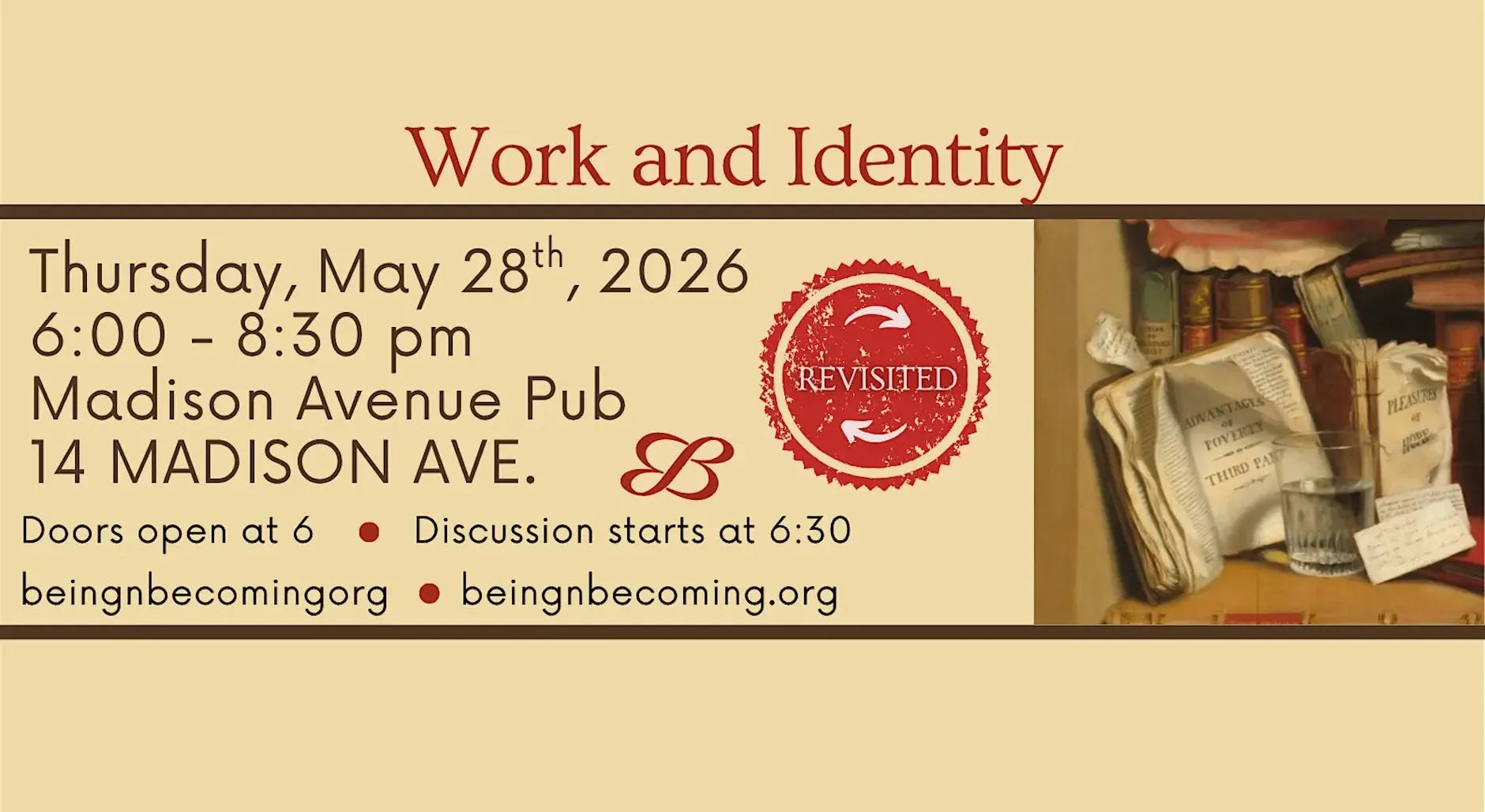
We will host our next Curiosity Café on Thursday, May 28, from 6:00 to 8:30 p.m. at the Madison Avenue Pub (14 Madison Ave, Toronto, ON M5R 2S1). Come and hang out with us, grab food, and read through our handout from 6:00 to 6:30 p.m. Our structured discussion will run from 6:30 to 8:30 p.m. with a 10-minute break in the middle!
The topic of our next revisited café is: Work and Identity
Missing the event description? Head over to our Eventbrite page! We’re trying to make the length of our newsletters a little less overwhelming.
If you have accessibility-related concerns, please visit our Eventbrite page—in the event description, you will find some accessibility-related information about the venue and the event.
We still have five free tickets available for our attendees. If paying anything at all is not financially feasible for you or our ticketing system presents some other barrier, please contact our Director of Community Programming, Sophia, at sophia@beingnbecoming.org. These tickets will be given away on a first-come, first-served basis, no questions asked! You can expect to hear back from her within 72 hours.
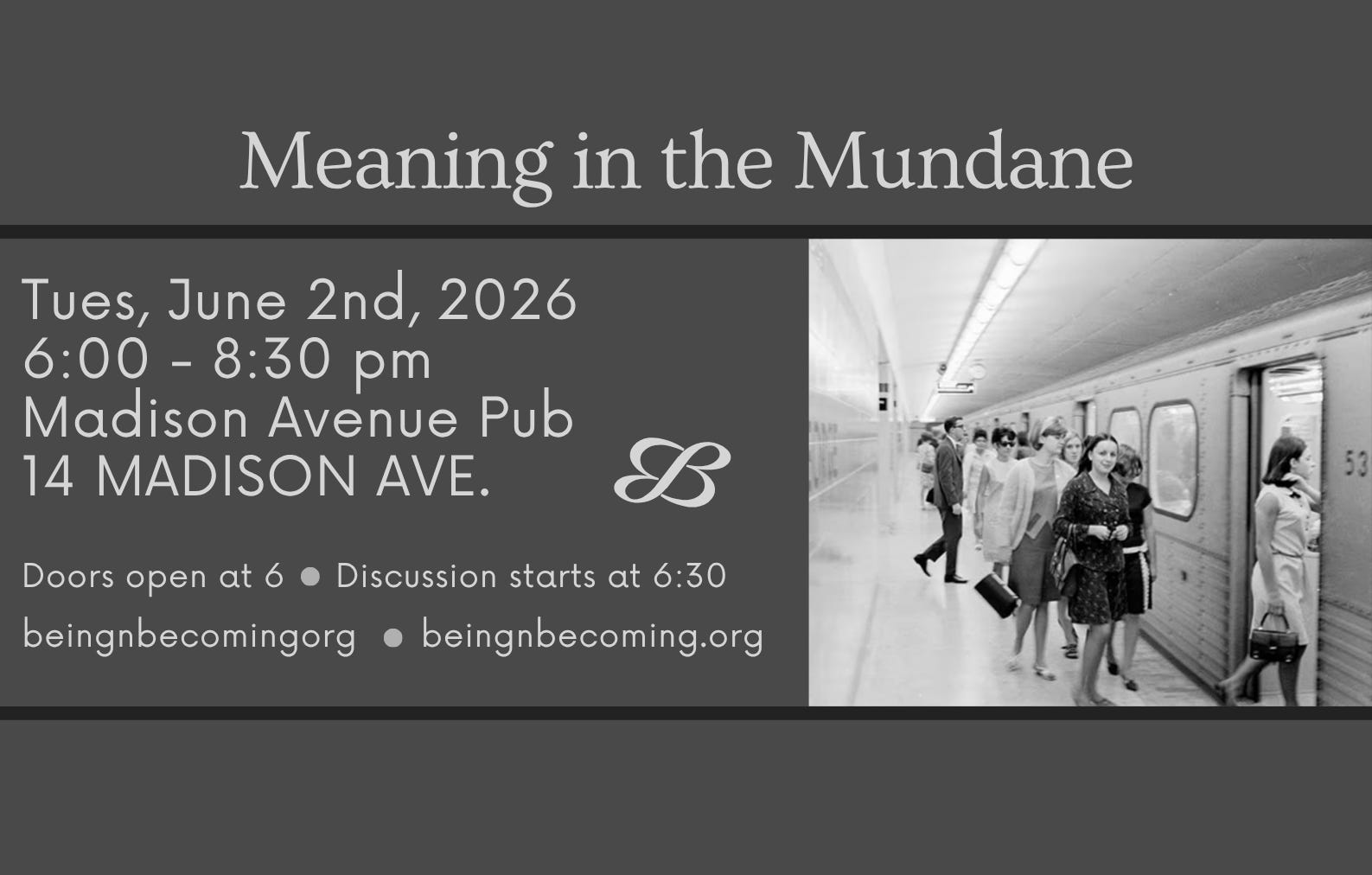
We will host our next Curiosity Café on Tuesday, June 2nd, from 6:00 to 8:30 p.m. at the Madison Avenue Pub (14 Madison Ave, Toronto, ON M5R 2S1). Come and hang out with us, grab food, and read through our handout from 6:00 to 6:30 p.m. Our structured discussion will run from 6:30 to 8:30 p.m. with a 10-minute break in the middle!
The topic of our next café is: Meaning in the Mundane
Missing the event description? Head over to our Eventbrite page! We’re trying to make the length of our newsletters a little less overwhelming.
If you have accessibility-related concerns, please visit our Eventbrite page—in the event description, you will find some accessibility-related information about the venue and the event.
We still have five free tickets available for our attendees. If paying anything at all is not financially feasible for you or our ticketing system presents some other barrier, please contact our Director of Community Programming, Sophia, at sophia@beingnbecoming.org. These tickets will be given away on a first-come, first-served basis, no questions asked! You can expect to hear back from her within 72 hours.
“[T]he peculiar evil of silencing the expression of an opinion is, that it is robbing the human race, posterity as well as the existing generation–those who dissent from the opinion, still more than those who hold it. If the opinion is right, they are deprived of the opportunity of exchanging error for truth; if wrong, they lose, what is almost as great a benefit, the clearer perception and livelier impression of truth, produced by its collision with error.”
- John Stuart Mill
Our mission is to present a diversity of perspectives and views. The views and opinions expressed in this newsletter are solely those of the individual authors and do not necessarily reflect the views or opinions of Being and Becoming. Being and Becoming disclaims any responsibility for the content and opinions presented in the newsletter, as they are the exclusive responsibility of the respective authors. If you disagree with any of those presented herein, and you feel so inclined, we recommend reaching out to the original author and asking them how they came to hold that opinion. It’s a great conversation starter.
Comments
Nothing yet. Say the first thing.
Sign in to join the conversation.