
Confession: We are resending this newsletter because the previous version used a picture from another café, and referred to the wrong café in the heading of the recap. Sorry. - Adrian
By Adrian Ma
What is a family? The boundaries of the concept are hazier than its status as a basic unit of social organization might suggest. For many, the term applies primarily, or even exclusively, to a group of people connected by blood or marriage. But what about close friends, or community members, or even pets? And must the family be the unit around which so much of society and our thinking about relationships are structured? At our latest Curiosity Café, moderated by Fallon Taylor-Kanary and Sophia Whicher, we discussed the meaning of “family,” how this category shapes our individual and collective lives, and whether its dominance as a natural or indispensable social unit should be challenged. But first:
Curiosity Café Recap: Family
Upcoming Events
Our Next Café: Reasons & Justification (May 5, 2026)
By Adrian Ma
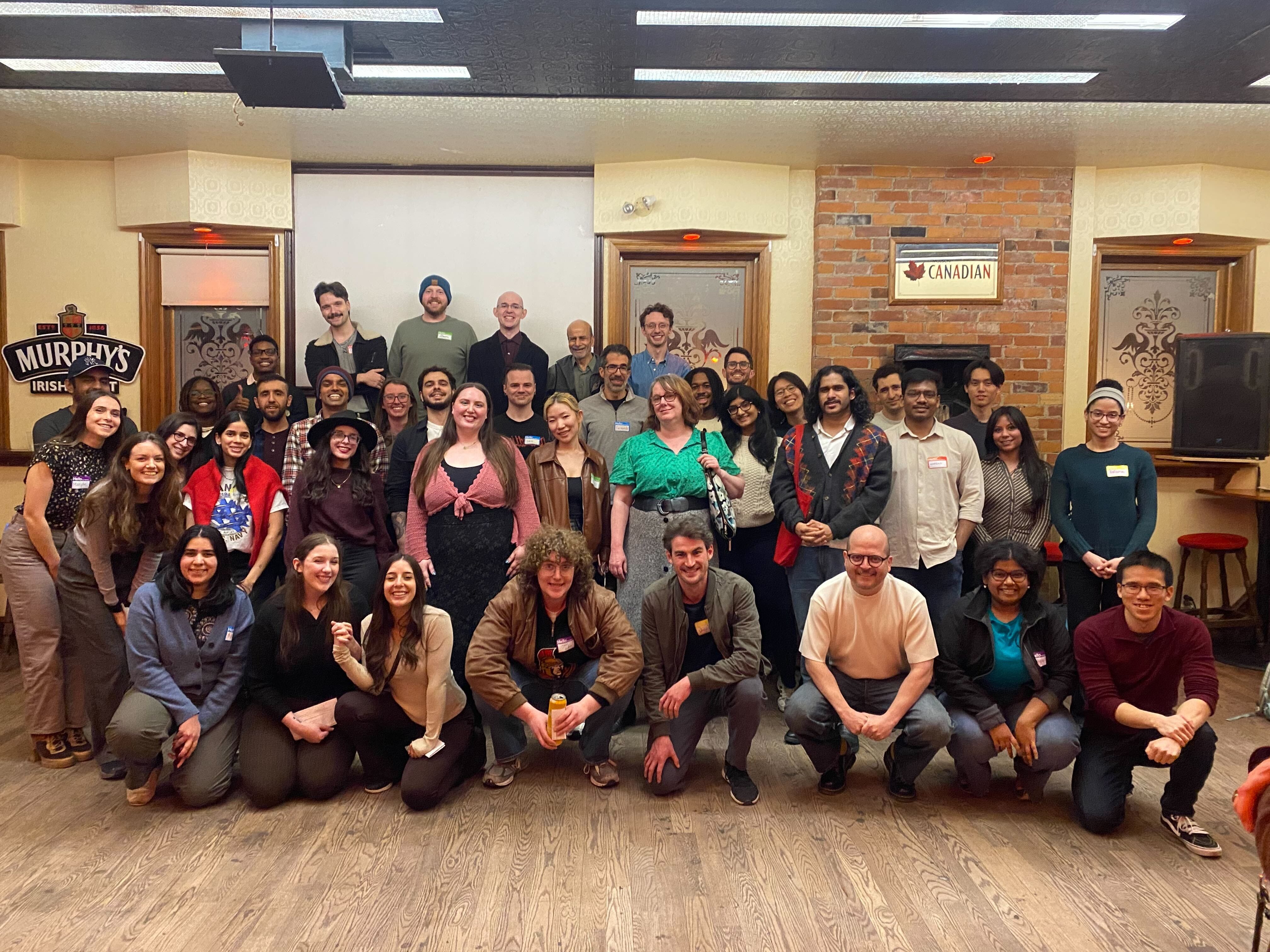
Last week’s Curiosity Café, moderated by Fallon Taylor-Kanary and Sophia Whicher, began with a reflection on what “family” even means—on what it both connotes and denotes. We asked ourselves:
When you hear the word “family,” what memories come to mind?
What are the emotions that you experience when recalling these memories? Are they positive, negative, or a mix of both?
Why do you think you feel that way?
When you think of your family, who, if anyone, do you think of?
How do you associate family with genetic relations?
Are long-term romantic partners family? Close friends? What about pets?
If family isn’t only determined by genetic relations, then what makes someone a part of your family?
What function(s) does family play in your life? What about in the lives of others?
How do dependence (economic and care) relations shape or determine families?
What other functions, if any, does family play in your life, or in the lives of others?
Given the above, what does it mean for someone not to belong to a family?
How are families similar to or different from a lottery system in determining someone’s economic status and access to quality care?
Why are families sites of so much violence?
Here’s what a few of you had to say:
Family is defined by responsibility and commitment. You are committed to being there for your family when they need you, and have grounds for expecting the same of them.
I was adopted, and my parents were very open about this with me from a young age. Because of this, I have always seen “family” as a very expansive term, and grew up thinking that those in your family are people you choose, since my parents “chose” me.
We can broaden our understanding of family by looking at how the term is used within certain subcultures. Consider the idea of a chosen family, commonly associated with the queer community. Family, according to this view, is not determined exclusively by biological relationships one does not control and must prioritize come what may; rather, one can choose one’s family, and receive from them the love and support that one’s unchosen family fails to provide.
The act of choosing a family is perhaps a means of exercising our free will, of shaping the world—or at least our world—according to our needs, especially when our unchosen family has failed to meet them. But often, in making such a choice, we are using the very template of “family” from which we have been rejected, and that we have purported to reject ourselves—only this time, we are populating the template with our own variables. Chosen families can also demand a tricky balancing act: how can we ensure that the family perseveres, while leaving space for its members to exercise their autonomy and form their own relationships?
The slogan “find your tribe” is often used to express what we want from a family: a space where we feel we truly belong. Our unchosen families may fall short of this ideal, in which case, we turn to friends, pets, and other sources of affection and support.
We can sort our relations with others into three concentric circles. Our family belongs to the innermost circle, which is characterized by the communist ideal of “from each according to their ability, to each according to their need.” Our surrounding community belongs to the middle circle, which we can call “socialist,” because it is marked by strong communal ties and responsibilities but also a greater degree of private “ownership” of our lives. The outermost circle is capitalist: this circle encompasses those to whom we have the weakest relational ties, and is characterized by individuality and atomization.
Families perform the basic function of teaching us how to survive in the world. Parents teach children fundamental skills and knowledge about what to do or avoid. However, the exercise of parental authority often spills far beyond these boundaries, and turns into manipulation and control. The parents themselves are often confused as to where the boundaries lie: they may demand that their child follow their religion just as fervently as they enforce the commandment: “Don’t touch the stove.”
We should be wary of defining family in terms of its “function.” Our family members do not always perform any identifiable function, nor does their inclusion in the family depend on their doing so. An elderly grandparent who is bedridden with a terminal illness does not provide for our needs in any obvious sense. Yet this does not, or should not, make them any less a part of our family, or any less entitled to our love, care, and support.
Generational trauma is one reason families are sites of so much violence. Hurt people hurt people. Victims of generational trauma often lack access to the tools and resources to understand the roots of their trauma and break the cycle.
Family structures often involve an element of hierarchy. Parents are the presumed authority, to whom the children are expected to defer. Yet at some point, the children should be expected to become independent enough to challenge authority and push boundaries. Tension arises when disobedience by the children is identified in the parents’ minds with disrespect, and this tension can explode into violence and abuse. As their children grow up, parents who abused their authority are sometimes abused by their children in turn. Preventing all this requires awareness and sensitivity to when one’s authority as a parent should or should not be enforced.
After the break, we turned our attention to the status of the family as the primary unit of social organization—and whether that ought to change:
Should the family be abolished? Statistically, families are the epicentre for cases of violence and abuse, and function to perpetuate economic, racial, and gender inequality. Given this, are there better ways that we can structure our relations to ensure everyone gets the care they need?
From here, we asked ourselves:
How is contemporary infrastructure (architecture, policies, institutions, etc.) designed around families?
How has this infrastructure shaped your goals?
Has family-centred infrastructure ever caused you difficulty?
How has it contributed to a lack of public spaces and/or social isolation?
How else could we structure our relationships so that we all get the care we need?
How might infrastructure differ if it weren’t shaped around families and instead focused on ‘society’ and community? For example, community kitchens rather than private kitchens.
Would eliminating reliance on the family for care require a different economic system?
If people were no longer dependent on their families for economic freedom, how might our relationships with one another look different?
Would a world without families necessarily have less love and care? Why/why not?
Here’s what a few of you shared:
Countless aspects of our infrastructure and laws, from roads to houses to tax policy, revolve around the family, and in particular the nuclear family unit. One housing-related example is zoning legislation that prevents the building of non-traditional living structures on much of the land across the country.
Family plays a major role in how we think about work. Often, the desire to find a stable, long-term career is informed by the need to take care of one’s family; otherwise, one would likely be more willing and able to get by with gig work or other flexible, short-term, but perhaps more precarious arrangements. Perhaps our options and incentives with respect to work would be different if we moved away from the “breadwinner” model, whereby one or two people in a family or a household are expected to be the sole or primary sources of financial support.
The nuclear family model tends to run counter to our need for community. This becomes particularly evident during the period of life that for many people lies between school and retirement. School provides a ready-made community; retirees may find community in retirement homes or through communal activities they now have the time to participate in. In between, however, community is much harder to find, and must be effortfully sought or created. During this period, it is difficult for the adults in a nuclear family to develop meaningful relationships beyond the household.
Traditional housing tends not to be conducive to community-building. Someone who lives in a condo unit at one end of the 17th floor, for example, is unlikely to have many interactions or meaningful relationships with their neighbours, due to the general absence of shared spaces. However, there exist other types of housing structures or living arrangements, such as multi-generational homes, where shared spaces—like communal kitchens and dining rooms—play a much bigger role, providing more opportunities to foster unity and build close relationships. How can we amend our traditional housing structures or living arrangements to be more conducive to community and sharing?
People are capable of love and care, even, and sometimes more so, outside of traditional family structures. Our current socioeconomic systems, however, are not conducive to love and care. Perhaps our ideas about family need to be reconceptualized in the face of modern political, economic, and technological developments, to which we must adapt, and which make new ways of relating possible and even necessary.
Education has a big influence on our views on the family and our perception of it as the default mode of social organization.
What we are taught about the family is also deeply tied to the things we are taught about other areas of life, like sex. Consider sex-ed classes with names like “Sex and the Family”!
Thanks for reading—and for contributing to the ties of curiosity, inclusion, diversity, and humility that bind our community together.
*hey community! Sophia here, Director of Community Programming. We ask that you consider that our ideal recommended amount for a ticket is now $15, and as you choose what to donate within the bounds of your own financial means, we ask that you keep in mind that your donation will go directly towards compensating those involved in making Curiosity Cafés happen so that we can keep doing this for you.
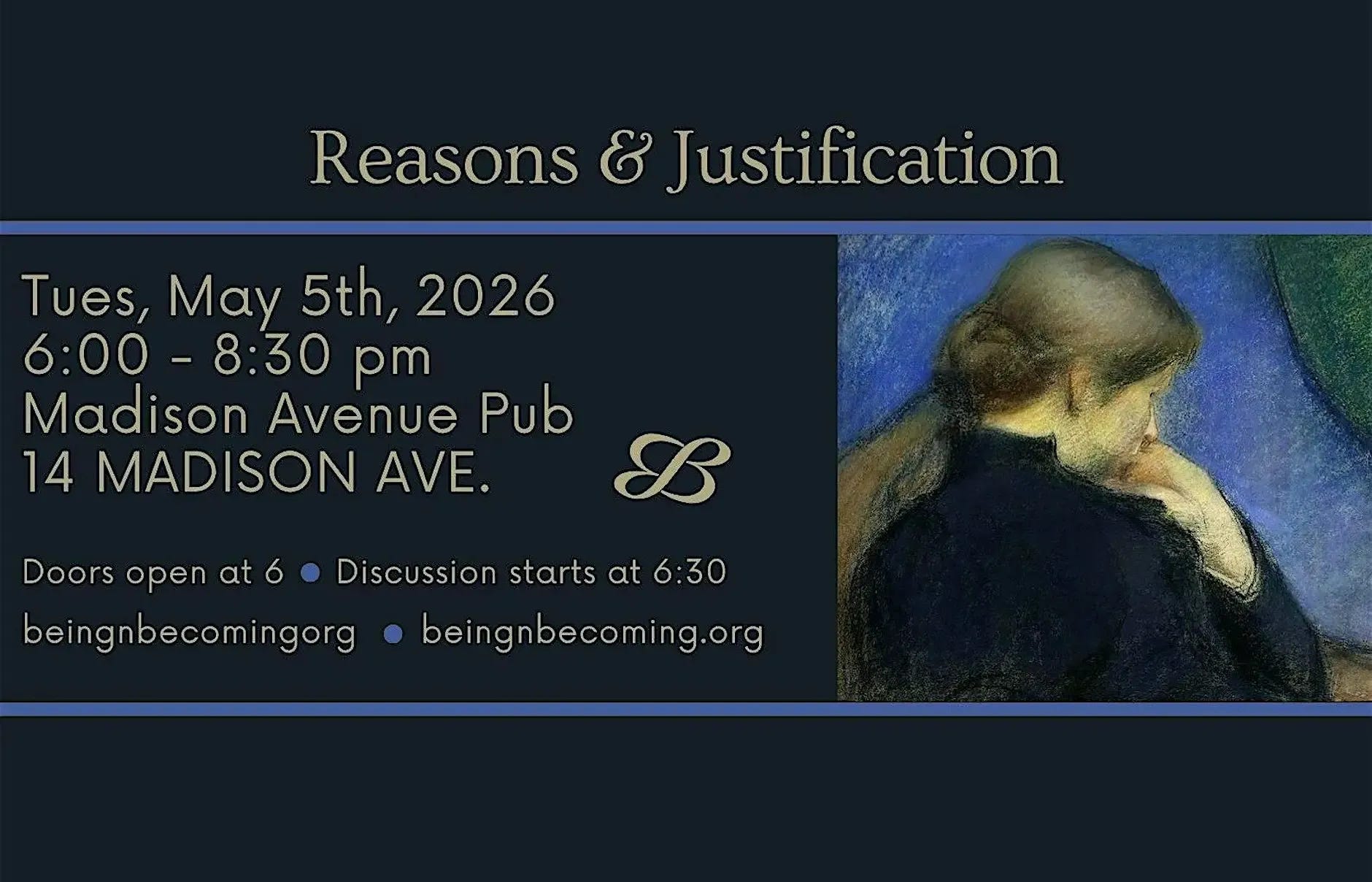
We will host our next Curiosity Café on Tuesday, May 5, from 6:00 to 8:30 p.m. at the Madison Avenue Pub (14 Madison Ave, Toronto, ON M5R 2S1). Come and hang out with us, grab food, and read through our handout from 6:00 to 6:30 p.m. Our structured discussion will run from 6:30 to 8:30 p.m. with a 10-minute break in the middle!
The topic of our next café is: Reasons & Justification
Missing the event description? Head over to our Eventbrite page! We’re trying to make the length of our newsletters a little less overwhelming.
If you have accessibility-related concerns, please visit our Eventbrite page—in the event description, you will find some accessibility-related information about the venue and the event.
We still have five free tickets available for our attendees. If paying anything at all is not financially feasible for you or our ticketing system presents some other barrier, please contact our Director of Community Programming, Sophia, at sophia@beingnbecoming.org. These tickets will be given away on a first-come, first-served basis, no questions asked! You can expect to hear back from her within 72 hours.
What is possible with a model in which love and relations are not considered scarce objects to be hoarded and protected, but which proliferate beyond the confines of the socially constituted couple and nuclear family?
- Kim Tallbear
Our mission is to present a diversity of perspectives and views. The views and opinions expressed in this newsletter are solely those of the individual authors and do not necessarily reflect the views or opinions of Being and Becoming. Being and Becoming disclaims any responsibility for the content and opinions presented in the newsletter, as they are the exclusive responsibility of the respective authors. If you disagree with any of those presented herein, and you feel so inclined, we recommend reaching out to the original author and asking them how they came to hold that opinion. It’s a great conversation starter.
Comments
Nothing yet. Say the first thing.
Sign in to join the conversation.