
By Adrian Ma
“If the immediate and direct purpose of our life is not suffering then our existence is the most ill-adapted to its purpose in the world[.]” So begins “On the Suffering of the World,” a cheery essay by the 19th-century German philosopher Arthur Schopenhauer. One need not share Schopenhauer’s notorious pessimism to recognize that the world is indeed full of suffering—and, specifically, of pain. Pain, for better or worse, might be the closest thing we have to a universal human experience; yet for all its familiarity, its mechanisms and functions remain surprisingly hard to understand. Is pain simply a physiological response to injury, from fractured bones to impalement by misplaced Lego blocks, or must it be consciously experienced? Why can some forms of suffering feel invisible, while others command immediate attention? What might pain reveal about what we value, fear, protect, or hold onto? At our latest Curiosity Café, moderated by Chris Norris and Marybel Menzies, we engaged in a productively painful exploration of what pain is, does, means, and morally demands. But first:
Curiosity Café Recap: Pain
“Time Heals Some Wounds” by Chris Norris
Upcoming Events
Our Next Café: Free Will (April 7)
By Marybel Menzies, Sofia Panasiuk, and Adrian Ma
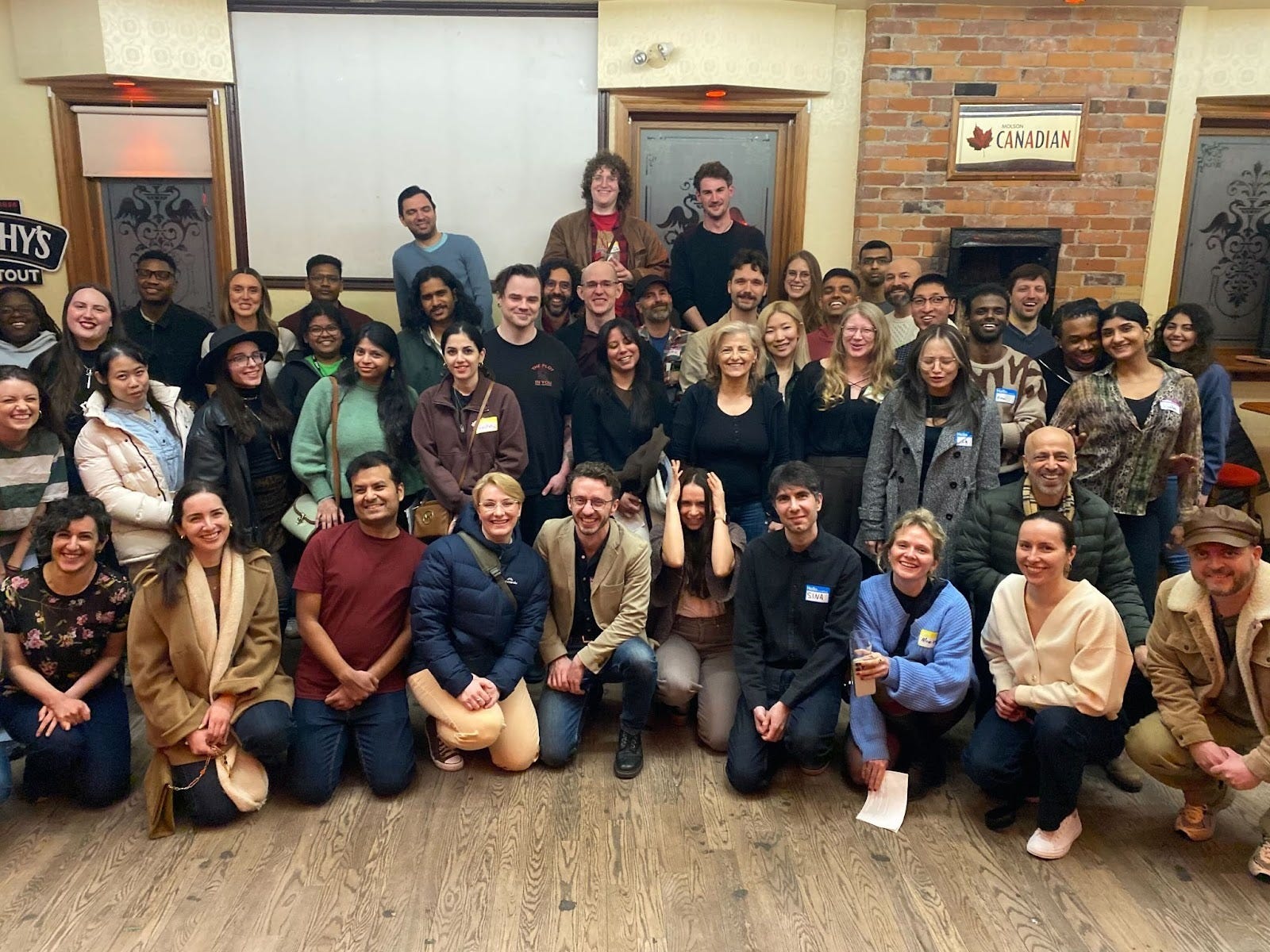
Our latest Curiosity Café, moderated by Chris Norris and Marybel Menzies, began with the deceptively simple question: What is pain? Our moderators introduced the mystery as follows:
Pain is often thought of as reducible to certain neural states. That is, we think that when an injury occurs, a signal is sent from the peripheral nervous system to the brain, which elicits pain and prevents us from repeating that behaviour. However, when unconscious, it’s not that the neural signals that underlie pain cease firing; we just don’t have any conscious awareness of it. So, this indicates that our conscious awareness is crucial to our experience of pain. This distinguishes nociception—the physiological, objective process by which the nervous system detects and encodes potentially harmful stimuli to avoid tissue damage—from the conscious experience of pain, which includes negative affect. If pain isn’t mere nociception, then what is pain?
With this background in mind, we asked:
Does something have to be consciously experienced to count as pain?
Do you think you can experience pain unconsciously?
Have you ever experienced pain in a dream?
Consider the blocking of latent sensitization. (Latent sensitization is when the nerve signals from a previous pain continue to fire significantly after the conscious pain is gone.) Here, the signals from the spine intervene so that one no longer consciously experiences pain.
Have you ever had pain “come back” after it was gone for a long time?
If a creature withdraws from harm but lacks awareness of what we might call the “feeling” of pain, does this count as an instance of pain at all?
Consider: When a reflex (where a sensory nerve directly elicits a motor nerve), such as the knee-jerk reflex, happens, our conscious experience doesn’t seem involved.
Does your experience of emotional pain differ from physical pain?
What makes emotional pain feel different from pain caused by injury?
Consider the Tylenol study about social pain and forgiveness. That is, the study found that when individuals who were disposed to forgiveness took Tylenol, it accelerated their recovery from emotional pain. What can this tell us?
Here’s what some of you had to say:
If we understand pain as a sensation, then it must presuppose consciousness.
If we take consciousness to refer to the subjective experience of an individual—to what it is like to be that person—then a definition of pain that presupposes consciousness seems rather narrow and potentially exclusionary. Perhaps we should think more broadly about how we define pain before asking whether one has to be conscious to feel it. Caution in this area is particularly important, given the implications of our definition for the moral status of, and obligations owed to, people in unconscious states.
Certain cases of emotional pain suggest that conscious awareness is not a necessary ingredient of pain. For example, we can imagine someone who is suffering from grief without being aware of it, or even quite feeling its symptoms: their grief, operating in the background, influences their mood, outlook, and decision-making, without ever drawing attention to itself.
Pain is distinct from suffering. In Buddhist terms, pain is the first “arrow”—it is something external that happens to us and that we do not control. The second arrow, however, is within our control: whether it strikes us is determined by how we react to being shot by the first arrow. Suffering derives from the second arrow, not the first: it can be avoided, depending on how we respond to and manage our pain.
We can understand suffering as the product of pain and a pain “coefficient.” Suffering is pain multiplied, often by the mind. This occurs, for example, when we dwell obsessively on the pain or on painful events, like a traumatic injury or a bad breakup.
Some people enjoy pain, at least under certain conditions, which suggests that pain does not always equal or entail suffering. Think of someone participating in an act of sadomasochism. Would we call the experience to which their pain contributes “suffering”? Or would their pain not, in such cases, give rise to a positive experiential state?
Expectations play a big role in the experience of pain. We might expect physical pain to be more, or emotional pain to be less, painful than it turns out to be, and these expectations can influence the quality and the intensity of the pain we ultimately experience. The anticipation of pain may itself be a form of self-inflicted pain.
Different languages classify and conceptualize pain in different ways. Certain languages contain words for very particular experiences—in German, for example, there is a word that refers specifically to despair at the state of the world—that have no precise counterpart in another language. Despite our lack of a shared pain vocabulary, however, we possess, somehow, the ability to empathize with the pain of others across linguistic and cultural lines.
It can be helpful to think of pain as a universal human experience, as a great unifier, because doing so can promote empathy. Interestingly enough, a study found that prolonged users of painkillers had a reduced ability to empathize with others!
It is possible to “transmute” or “alchemize” one’s emotional pain by expressing it through or channelling it into certain activities, such as going to the gym or engaging in creative work.
Are reflexes a reliable gauge of the ability to feel pain? Maybe not. Consider the C. elegans, a worm with a very simple nervous system that shows withdrawal behaviours when touched but lacks the higher-order brain processing required for the subjective experience of pain.
Therapists often help patients process experiences of trauma that are stored in the body but of which patients may not be aware. If this trauma was experienced early enough in childhood, when memories are not encoded efficiently or at all, the experience of pain, physical or emotional, may not have been registered as such in the mind.
I have a different relationship to emotional pain than to physical pain. Sometimes, I seek to prolong emotional pain out of attachment to the person who caused it, or to preserve a sense of self-righteousness. Conversely, I have never under any conditions wished to prolong physical pain.
The function of physical pain is to alert us to a particular cause, such as an injury or an illness, so that we can take action to address it. Mental pain tends not to point to a discrete cause, but sends a broader message indicating that something concerning our general well-being has gone awry.
But whether they are physical or emotional, negative feelings in general are a sign that something is wrong.
If emotional pain and physical pain are different, what are the reasons we call them both “pain”?
After the break, our discussion turned from the nature and underpinnings of pain to its value. Of course, not everyone agrees that pain has any value at all. As our moderators write:
In philosophical discussions, pain is often considered disvaluable. For instance, hedonism argues we ought to always promote what is pleasurable and avoid what is painful. However, as we’ve seen, pain can play an important role in protecting us from damage and danger. Are there ever cases where pain can help us, or cases where pain is more valuable than pleasure? Should we ever cause pain?
We asked ourselves:
Is pain ever useful?
Have you ever found that pain has been useful for you? How? Why?
Should we try to eliminate pain whenever possible?
How would you explain a life without pain?
Would such a life be better, incomplete, or something else entirely?
Consider the experience of heartbreak. It’s widely known as one of the painful experiences one can have. Are we better off being able to have it, or not?
Do you ever cling to pain?
Have you held on to something painful because it was familiar?
When does letting go of pain feel like losing something important?
Are there kinds of pain that are meaningless just in virtue of being the kinds of pain they are?
Are some pains political?
When does society pathologize pain instead of addressing its cause?
Whose pain is taken seriously?
Who is allowed to express pain publicly? Is invisibility a multiplier of pain?
Is causing pain ever justified? What, if any, are the moral differences between the following scenarios:
Causing pain for the purpose of causing pain
Doing something that you know will cause pain, but not doing it because it will cause pain (e.g., breaking up with someone because your values do not align)
Unintentionally causing someone pain
Here’s what a few of you shared:
Hedonism is often caricatured in popular culture. Epicurean hedonism does not say that everything is a free-for-all and we should pursue pleasure at all costs. Rather, it says that in the pursuit of pleasure, one must act wisely. Drinking all day for the sake of immediate gratification, for example, would be unwise, because of the excruciating hangover that is bound to follow.
Nozick’s “Experience Machine” thought experiment presents a popular argument against hedonism. Imagine a machine (not unlike the Matrix) that can give you any experience you want, creating perfect simulations of everything from professional success, to love, to creative achievement, to happiness. To those plugged in, the experiences induced by the machine are indistinguishable from reality. Would you agree to hook your brain up to this machine for the rest of your life? Most of us would say no: the fact that our experiences within the machine, perfectly pleasurable though they may be, are entirely simulated is a dealbreaker. We don’t just care about maximizing pleasure and minimizing pain; we also care about being in touch with reality, about actually doing things and being a certain kind of person. This suggests that our conceptions of the good life go beyond purely hedonistic considerations.
Some painful experiences are good for us. Think of the pain of fasting, working out, or using a sauna.
What productively painful experiences appear to have in common is that they are deliberately chosen rather than externally imposed.
Pain can be instructive when you have the agency to address, or in the future avoid, its cause: you can learn not to do anything that could cause such pain again. Pain you could not have foreseen, controlled, or avoided, however, tends to be much harder to learn from.
Pain can prompt us to take action when we otherwise would not. For example, the pain you feel in your right side when you have appendicitis can compel you to see a doctor and thereby save your life.
Pain can make you feel alive, and give your life meaning.
At the same time, we often undergo painful experiences that lack any discernible meaning. These experiences contribute nothing and simply make our lives worse.
Perhaps the purpose of life is to avoid unnecessary pain.
Sometimes pain is just the price of learning or progress. Extreme pain avoidance would deprive us of the positive outcomes to which pain is a necessary means.
Without pain, we wouldn’t know what a painless condition is like. Pain enables knowledge and enhances appreciation of its opposite.
A life without pain may be more blissful. Yet a life without the knowledge of what pain is like would seem to be missing something of value.
Holding onto pain isn’t always a bad thing. Not only can it drive creativity, but it can also remind us of what is important. Sometimes, it makes sense not to get over things—to hold onto injustices that have happened to us and to push ourselves to feel the pain associated with them. This can be a way for us to honour the part or version of us that got hurt. The same can be said about injustices happening to others: pushing ourselves to confront the realities of our world, to bear witness to injustice even when it is painful, and to feel that pain fully, even though it is hard, is an important part of solidarity.
The stories we tell ourselves about pain—in which pain is dignified, for example, as a meaningful or morally edifying experience—are just a means of coping with its inescapable reality.
But if this practice is genuinely beneficial, if it helps us confront or endure the pain we inevitably experience, what is the problem?
If society is improving, we should expect certain kinds of pain to become less common. Social, moral, and technological progress throughout history has resulted in the eradication of certain diseases; prohibitions on torture and certain particularly inhumane methods of punishment, such as immolation; and the disappearance of certain forms of cruel labour. (At least in some places.)
We spend much of our lives constructing narratives about ourselves and our relationship to our experiences of pain: we might, for example, portray a battle with cancer as an existential turning point that renewed our appreciation for our loved ones and reinvigorated our dream of starting a business or writing a book. Such stories are a way of integrating our pain into the broader narrative of our lives, and allow us to better connect and empathize with others.
Pain can easily transform victims into offenders: many people who have experienced great pain go on to inflict it. All things considered, can pain be all that useful if it tends to perpetuate itself?
Some people have a unique relationship with pain, due to their frequent and normalized exposure to it. These include people with chronic illnesses, or who undergo gendered experiences such as menstruation or childbirth. For them, pain is not simply an accidental or occasional aspect of their existence, but something that permeates their lives, and is perhaps even seen to define them.
We need to be more precise in how we define pain. If pain is stipulated to mean “all the bad stuff,” then of course we cannot imagine a life without pain: bad stuff does and will always exist. But if we take “pain” to refer specifically to physical discomfort, then it is easy to imagine a world without it—and conclude that such a world would be unequivocally better.
We appreciate you making it this far; that said, it would cause us a great deal of meaningless pain if you stopped now. Check out “Time Heals Some Wounds,” a poem by our co-moderator Chris Norris on the topic of this café, below. Then, scroll down just a little further for details on our upcoming café on free will. See you there.
By Chris Norris
Text within this block will maintain its original spacing when published
Pain makes a peculiar friend
The longer it lingers the less it bleeds
Initial desires for an end
Dissolve into duty as misery feeds
Somatic ache becomes tradition
A jagged wall with holds to climb
But grief has grander ambitions
Every wound feels like the first time
Pain that stays falls behind
The sharp wound of feelings lost
Felt absence wraps in binds
Sentient vacancy has a cost
*Hey community! Sophia here, Director of Community Programming. We ask that you consider that our ideal recommended amount for a ticket is now $15, and as you choose what to donate within the bounds of your own financial means, we ask that you keep in mind that your donation will go directly towards compensating those involved in making Curiosity Cafés happen so that we can keep doing this for you.
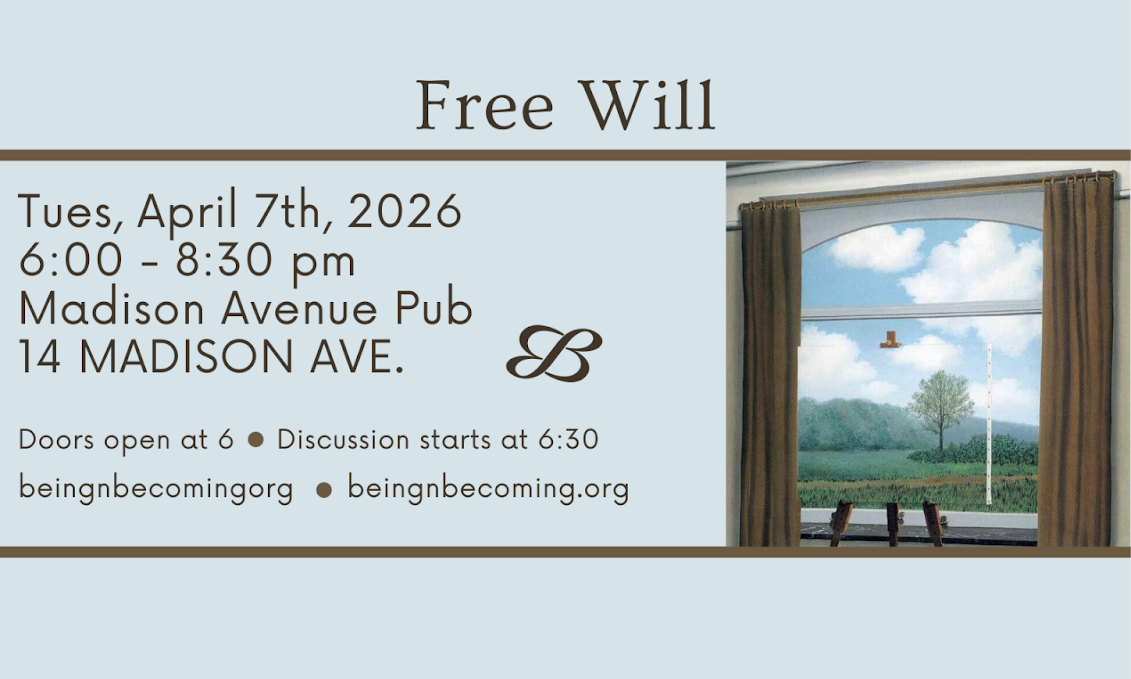
We will host our next Curiosity Café on Tuesday, April 7, from 6:00 to 8:30 p.m. at the Madison Avenue Pub (14 Madison Ave, Toronto, ON M5R 2S1). Come and hang out with us, grab food, and read through our handout from 6:00 to 6:30 p.m. Our structured discussion will run from 6:30 to 8:30 p.m. with a 10-minute break in the middle!
The topic of our next café is: Free Will
Missing the event description? Head over to our Eventbrite page! We’re trying to make the length of our newsletters a little less overwhelming.
If you have accessibility-related concerns, please visit our Eventbrite page—in the event description, you will find some accessibility-related information about the venue and the event.
We still have five free tickets available for our attendees. If paying anything at all is not financially feasible for you or our ticketing system presents some other barrier, please contact our Director of Community Programming, Sophia, at sophia@beingnbecoming.org. These tickets will be given away on a first-come, first-served basis, no questions asked! You can expect to hear back from her within 72 hours.
[W]hen pain is over, the remembrance of it often becomes a pleasure.
- Jane Austen
Our mission is to present a diversity of perspectives and views. The views and opinions expressed in this newsletter are solely those of the individual authors and do not necessarily reflect the views or opinions of Being and Becoming. Being and Becoming disclaims any responsibility for the content and opinions presented in the newsletter, as they are the exclusive responsibility of the respective authors. If you disagree with any of those presented herein, and you feel so inclined, we recommend reaching out to the original author and asking them how they came to hold that opinion. It’s a great conversation starter.
Comments
Nothing yet. Say the first thing.
Sign in to join the conversation.