
Introduction
By Adrian Ma
We generally take it for granted that our actions, in large part, are or at least can be free. That is, we like to believe that the things we do are in some important sense willed by, or originate from within, ourselves, and are not determined, or wholly determined, by some mechanical chain of cause and effect or the manipulations of some cosmic puppeteer. Yet for a long time, philosophers have grappled with a disturbing possibility: what if we're wrong? What if—beyond our subjective perception of being free—our every action is decided entirely by things we do not control, and we can no more influence how we act, or even what we think and feel, than a flower can decide when and whether to bloom? At our latest Curiosity Café, moderated by Ken Boyd (and prepared by both Ken Boyd and Marybel Menzies), we engaged in an apparently voluntary exploration of free will and its (potentially dramatic) moral, social, and political implications. But first:
Featured Content:
Curiosity Café Recap: Free Will
Upcoming Events
Our Next Café: Ethics of the Family (Tuesday, April 21)
Curiosity Café REVISITED: Hope, Despair, and Climate Action (Monday, April 27)
Curiosity Café Recap: Free Will
By Adrian Ma
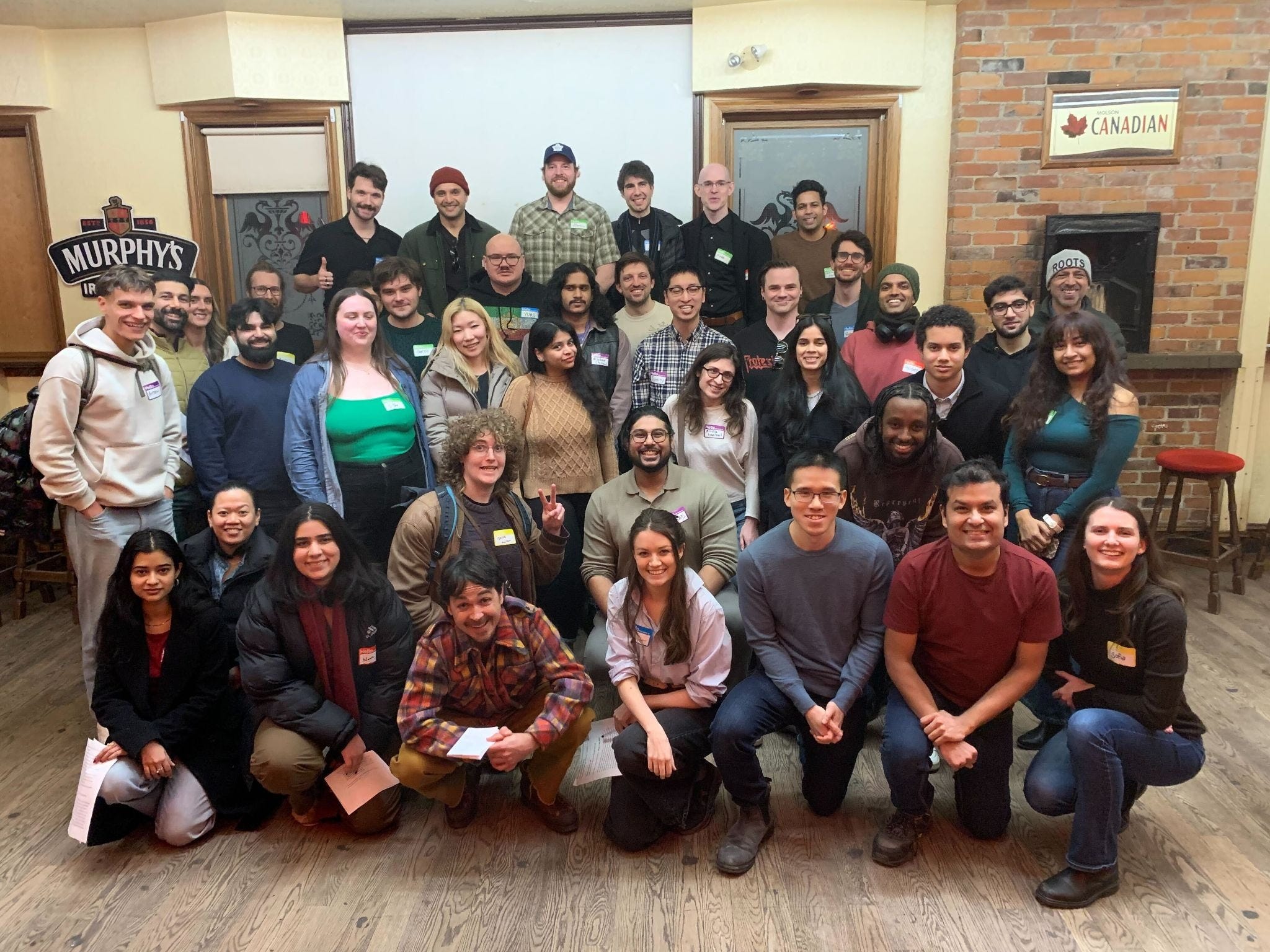
What is free will? Does it exist? And what is at stake in the arguments over its existence? The answer to that last question seems to be: a lot. As Ken and Marybel write:
Often, we believe that to have free will is to be able to do what you want, make your own decisions, and have control over your life. However, we know that we are physical beings governed by physical laws. And, physical laws are predictable, immutable, and determine how the world plays out. If that’s true, then is there any room for free will, since our actions are determined in the same way that other physical events are determined? Importantly, though, free will is crucial to our daily lives in how we choose to act and hold each other responsible. If we give up free will, then it seems as though we’re giving up much of what makes us human beings. Is there a way to “save” free will?
We are not egomaniacs at Being and Becoming, but we like to believe we run nice events that you all decide to attend of your own accord. Our latest Curiosity Café gave you the chance to dispute that assumption. We began by asking ourselves:
Did you come to the Curiosity Café out of your own free will?
If yes, why do you think so?
If not, why not?
Here are a few ways philosophers have attempted to resolve this dilemma.
Compatibilism: Free will and determinism are compatible because (i) for any given action we take, we could have done otherwise, or (ii) it is possible for us to act free from coercion
Hard Determinism: There is no free will because every action is determined by prior causes.
Indeterminism: There is free will because humans have unique causal powers: our actions aren’t causally determined, and we start a new causal chain when we perform actions.
—>Does one of these views seem more plausible to you? Why?
Consider the following thought experiment (adapted from an example by Harry Frankfurt):
Black is a neurosurgeon. Black is performing surgery on Jones. To do so, Black must insert a mechanism into Jones’s brain to monitor and control Jones’s activities. Meanwhile, Jones is unaware of this. One activity it monitors is his voting behaviour. If Jones has any inclination to vote for Poilievre, then the computer intervenes to ensure he votes for Carney. However, if Jones decides on his own to vote for Carney, the computer does nothing but continue to monitor.
Jones votes for Carney. Did he do so freely?
Here are the responses some of you (apparently) volunteered:
I’ll have you know that yes, I did come to the café of my own free will. I did not have to be here. I had a choice to stay home, or go somewhere else. I chose to come here instead. Thus, free will.
I, on the other hand, did not. My decision to come here was not really my decision: it was fixed by a long chain of cause-and-effect that extends seemingly indefinitely into the past, past my childhood and my birth, past even the lives of my parents and their parents. I never had a choice.
Free will consists in the exercise of agency, which is distributed throughout the physical universe and is possessed by organisms to a greater or lesser degree. Given that the question of whether or not we have free will is not a settled one (even among scientists: quantum physics has led us to question whether the laws of physics are indeed deterministic) it is important that we also believe our own experiences of freedom and of the lack of freedom as evidence that the two states are indeed different. Victims of oppression feel themselves to be unfree, and we rightly perceive their condition not as natural or inevitable, but as demanding change.
Compatibilists accept the truth of determinism, but their attempt to rescue free will from its conclusions amount to a terminological sleight of hand. We are physical bodies, chemical machines, bound by immutable physical laws. The key consideration when determining whether I have free will is this: Do I, in fact, have the ability to do anything other than what I ultimately do? If the answer is no—as even compatibilists would agree—then it follows I have no free will.
Free will does exist, and our recognition of its scope can grow incrementally. Consider this scenario. I seem to have lost control of my phone use, and feel I am picking up the device out of compulsion rather than choice. One day, I resolve to break this destructive habit. At first, I feel helpless, and my progress is minimal—I succeed in reducing my phone time only by a few seconds each day. Eventually, however (assuming I stick to my resolution) I reach a point where I have regained control and am no longer reaching instinctively for my phone as before. Exercising what little freedom I had in the beginning, then, opened the door to, and renewed my appreciation for, greater freedom.
We can argue for free will through the use of Ockham’s razor, the principle that says that where competing theories exist, the simplest one (the explanation that does not rely on more entities than it needs) should be preferred. Wielding Ockham’s razor, we can make the following argument: in our day-to-day lives, we feel ourselves to be the agents of our own actions; we don’t constantly pause and doubt whether our actions are determined by things beyond our control. Ordinary experience, then, seems to testify to the existence of free will: the latter offers the cleanest and most elegant way of making sense of our experience. From this it follows that the burden of proof lies not with the defenders of free will but with the determinists who reject it. What the determinists must do is show that each and every decision we make is, indeed, fully determined by physical laws and facts—something no determinist is capable of doing.
After the break, we explored what our conceptions of free will, and its existence or nonexistence, might entail for our moral and political understanding and practices. The implications may not be purely academic, as the following examples show:
Consider the case of the shooter, Robert Card, in Lewiston, who in 2024 was discovered to have a brain injury. Also, consider the case of the former football player Phillip Adams, who committed a shooting, and was discovered to have unusually severe CTE (chronic traumatic encephalopathy). Are these individuals responsible for their heinous actions? What about mental illnesses such as depression, bipolar disorder, or kleptomania (i.e., the person who compulsively steals)? How do certain mental states or illnesses impact our free will?
We then asked ourselves:
What, if any, are the differences between these cases? Why do we hold some of these individuals more accountable than others?
Consider the implications for different views of free will:
If you thought hard determinism was true, then it seems we shouldn’t be holding anyone accountable. Do you think that’s right?
If you thought compatibilism was true, then it seems the reason some ought to be held accountable is that they could do otherwise. Is that right?
Finally, if you thought indeterminism was true, then we should be holding everyone accountable. Is that right?
Have your views changed at all? If so, how?
What are the political implications of free will and moral responsibility?
Consider the Leopold and Loeb case. Their lawyer, Clarence Darrow, had a strategy to reduce moral blame by arguing that Leopold and Loeb were the products of heredity, environment, youth, and mental abnormality, not fully self-originating wrongdoers who simply chose evil in a straightforward, fully free way. He argued, “Nature made them do it, evolution made them do it, Nietzsche made them do it. So they should not be sentenced to death for it.” Surprisingly, this defence prevented them from receiving the death penalty.
Are you persuaded by this case?
To be morally responsible, it seems as though we need free will. Do we? Can we have moral responsibility in another way?
Here’s what a few of you had to say:
We should be careful to distinguish between accountability and punishment. Someone who has done something harmful, acted freely, and understood that their actions would cause harm, should be accountable for their actions, but this doesn’t automatically entail they should be punished for what they did.
We can impose punishments or constraints on violent offenders without necessarily holding them responsible. These measures can still be justified as deterrents, or as means of isolating the offender to prevent harm to other people.
To say that someone is not responsible for their actions is not to say that their actions warrant no consequences. The presence or absence of responsibility might, however, determine what the appropriate consequences look like. Someone who commits a violent crime due to a mental illness, for example, should be treated at a psychiatric facility, rather than sent to prison.
Someone who perpetrates violence due to a mental illness or other condition like CTE cannot be held responsible either legally or morally. They cannot be held legally responsible, because this responsibility cannot be demonstrated according to the high standard of proof (“beyond a reasonable doubt”) required in criminal law; nor can they be held morally responsible, because their mental illness or condition renders them a different person altogether.
Moral responsibility doesn’t matter; legal responsibility does, because it is what ultimately decides whether a violent offender can continue to pose a danger to society. Someone who commits violence due to a mental condition may not be their usual self; yet no matter who they really are, or used to be, there is no changing the fact that they are a threat to others at this moment, and must be stopped. They need to be held responsible for their actions to the extent needed to justify intervention.
Whether someone is acting under a perception of reality that differs from the “common” one (perhaps they are hallucinating) is a separate question from whether someone is acting freely. Someone who is “hallucinating” can still be said to be acting freely within the reality they perceive—even if their actions can still have very dangerous, and very real, consequences for others. It may be that the hallucinating individual must ultimately be held accountable for their actions, but this, too, is distinct from the question of whether they were free.
The capacity to act freely develops by degrees. We do not hold children morally responsible to the same extent as we do adults, because children lack, or are lacking in, some of the components required for truly free action—such as a sense of agency or a capacity for sophisticated reasoning. But at what point in one’s development can one be considered truly free, and thus wholly responsible for one’s actions?
Agency and moral responsibility exist on a spectrum. Some people have a high degree of agency: they know what they are doing, are aware of the potential consequences of their actions, are able to override their impulses through reasoned reflection, and so on. Other people have less agency, but it does not follow that they have no agency at all. Agency, therefore, is not an all-or-nothing affair, and neither is moral responsibility. Rather, the extent of the latter increases or decreases according to the extent of the former.
Although the arguments against free will are compelling, it is still useful for us to continue to believe in it. This is because the existence of free will is assumed by a wide and indispensable range of ethical concepts and practices, and even by certain moral emotions—such as guilt and indignation—that are fundamental to human experience. It would be odd to feel indignation over someone else’s wrongdoing, for example, unless we believed they had a choice not to do it. Similarly, the guilt I feel over a wrong I have committed implies that I had a choice not to do it. Dispensing with our belief in free will, then, would shake the foundations of entire ethical systems, categories, and experiences on which we have long relied to navigate our lives and our relations with others. It is unlikely that anyone can be prepared for such a seismic transformation.
That’s it for the recap. Thanks for reading (if you even had a choice). Can we now compel you to join us at our two upcoming events, below?
Upcoming Events
Curiosity Café: Bi-weekly on Tuesdays, tickets* below!
*hey community! Sophia here, Director of Community Programming. We ask that you consider that our ideal recommended amount for a ticket is now $15, and as you choose what to donate within the bounds of your own financial means, we ask that you keep in mind that your donation will go directly towards compensating those involved in making Curiosity Cafés happen so that we can keep doing this for you.
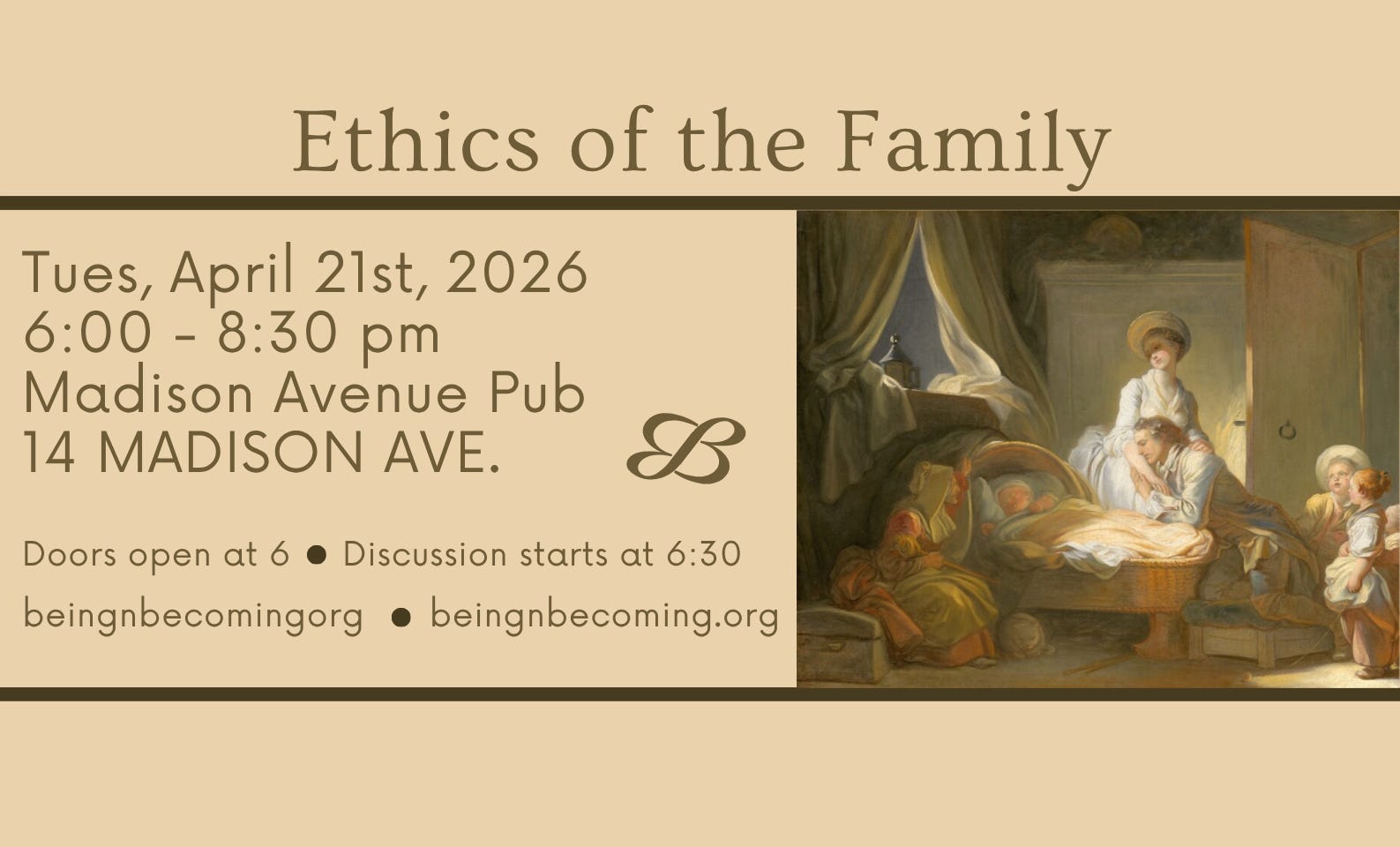
We will host our next Curiosity Café on Tuesday, April 21, from 6:00 to 8:30 p.m. at the Madison Avenue Pub (14 Madison Ave, Toronto, ON M5R 2S1). Come and hang out with us, grab food, and read through our handout from 6:00 to 6:30 p.m. Our structured discussion will run from 6:30 to 8:30 p.m. with a 10-minute break in the middle!
The topic of our next café is: Ethics of the Family
Missing the event description? Head over to our Eventbrite page! We’re trying to make the length of our newsletters a little less overwhelming.
If you have accessibility-related concerns, please visit our Eventbrite page—in the event description, you will find some accessibility-related information about the venue and the event.
We still have five free tickets available for our attendees. If paying anything at all is not financially feasible for you or our ticketing system presents some other barrier, please contact our Director of Community Programming, Sophia, at sophia@beingnbecoming.org. These tickets will be given away on a first-come, first-served basis, no questions asked! You can expect to hear back from her within 72 hours.
Curiosity Café REVISITED: Back and Better than Ever, People!
Being and Becoming has just introduced a new Curiosity Café series, which isn’t actually new at all: Every four(ish) weeks, we revisit a previous Café. In this series, we will be repeating topics, sometimes with a slight twist, sometimes with the same questions (but rest assured, even if you went to the first iteration and the questions were exactly the same, the discussion will change based on who is in attendance. Maybe you’ve even changed too…).
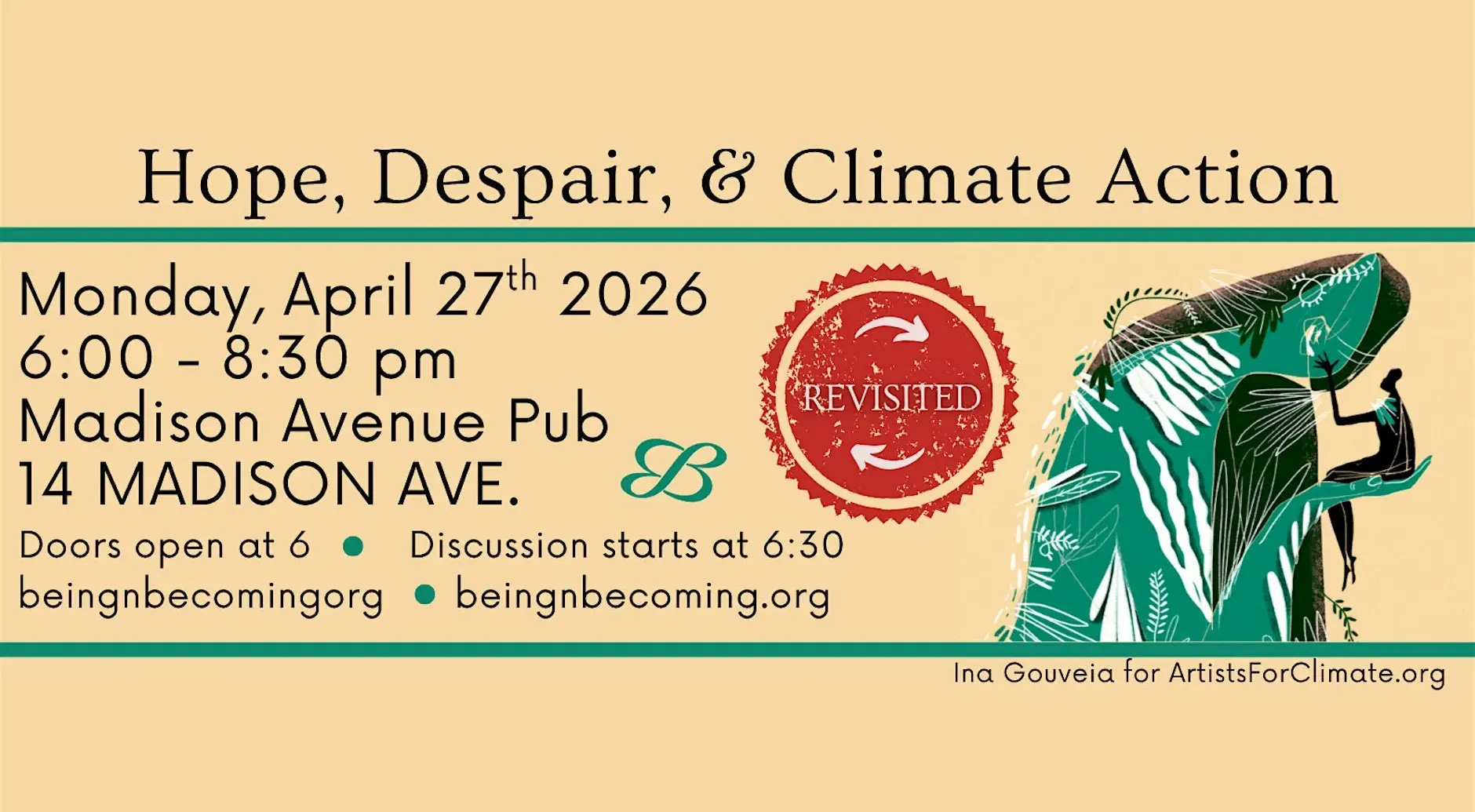
We will host our next REVISITED Curiosity Café on Monday, April 27, from 6:00 to 8:30 p.m. at the Madison Avenue Pub (14 Madison Ave, Toronto, ON M5R 2S1). Come and hang out with us, grab food, and read through our handout from 6:00 to 6:30 p.m. Our structured discussion will run from 6:30 to 8:30 p.m. with a 10-minute break in the middle!
The topic of our next revisited café is: Hope, Despair, and Climate Action
Missing the event description? Head over to our Eventbrite page! We’re trying to make the length of our newsletters a little less overwhelming.
If you have accessibility-related concerns, please visit our Eventbrite page—in the event description, you will find some accessibility-related information about the venue and the event.
We still have five free tickets available for our attendees. If paying anything at all is not financially feasible for you or our ticketing system presents some other barrier, please contact our Director of Community Programming, Sophia, at sophia@beingnbecoming.org. These tickets will be given away on a first-come, first-served basis, no questions asked! You can expect to hear back from her within 72 hours.
Featured Quote
Out of the manifold events of his life, his deeds, his feelings, his thoughts, he might make a design, regular, elaborate, complicated, or beautiful; and though it might be no more than an illusion that he had the power of selection, though it might be no more than a fantastic legerdemain in which appearances were interwoven with moonbeams, that did not matter: it seemed, and so to him it was.
- W. Somerset Maugham
Our mission is to present a diversity of perspectives and views. The views and opinions expressed in this newsletter are solely those of the individual authors and do not necessarily reflect the views or opinions of Being and Becoming. Being and Becoming disclaims any responsibility for the content and opinions presented in the newsletter, as they are the exclusive responsibility of the respective authors. If you disagree with any of those presented herein, and you feel so inclined, we recommend reaching out to the original author and asking them how they came to hold that opinion. It’s a great conversation starter.
Comments
Nothing yet. Say the first thing.
Sign in to join the conversation.