
Introduction
It’s not uncommon to meet people who don’t appreciate things like films, poetry, or fine art. We aren’t surprised by a friend who tells us they “just aren’t into movies”—this may seem perfectly reasonable and like a mere matter of personal taste. It is much more uncommon—and surprising—to find someone who “just isn’t into music.” But why should this be surprising? What is it about music that makes us assume it appeals to everyone? Is music meaningful? If so, to whom, and for what reasons? At our latest Curiosity Café, moderated by Roberto DiPlacido and Alexandra Gustafson, we reflected on the meaning we find in music both individually and collectively—and whether any such meaning exists objectively in the first place. But first:
Featured Content:
Curiosity Café Recap: Meaning in Music
Community Survey
Upcoming Events:
Our Next Café: Other Animal Minds (October 21)
Curiosity Café REVISITED: Personal Identity and Transformation (October 29)
Curiosity Café Recap: Meaning in Music
By Adrian Ma
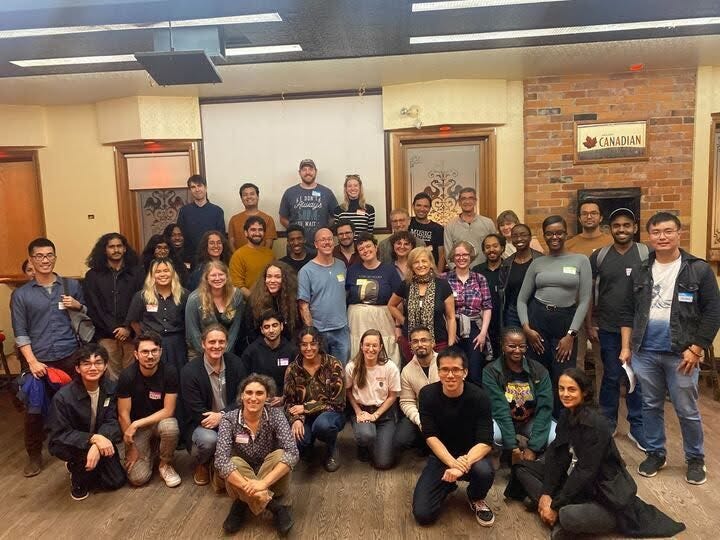
Our latest Curiosity Café, moderated by Roberto DiPlacido and our very own Alexandra Gustafson, began with an exploration of the meaning we find in our individual experiences of music. In breakout groups and then collectively, we asked:
Reflect on your individual experience of music:
Do you enjoy music? Why or why not?
Do you prefer some kinds of music over others? Is it because you find that music to be better than others, or some other reason?
How do you prefer to engage with music—by listening to it or creating it? Something else? Why?
What, if anything, do you find meaningful about the music you listen to or create?
How do you feel when you listen to or create music by yourself? Is there anything meaningful about this feeling?
Do you ever listen to or create (certain) music in order to feel, think, or remember something specific? Why or why not?
Does listening to or creating music by yourself make you feel more connected or more isolated? Why
How, if at all, is music related to your identity (that is, who you are and/or who you present yourself to be)?
Is the music you listen to or create in any way an expression of your identity? If so, how? If not, why not?
Has this music in any way shaped your identity? If so, how? If not, why not?
Is someone’s taste in music a reliable basis for drawing inferences about their identity? Why or why not?
On the one hand, taste in music does seem to be highly individual. On the other hand, there does seem to be general agreement about what “good” and “bad” music is: there are popular and unpopular genres; popular and unpopular artists. Are those who don’t appreciate music missing out on something that everyone else can see (or, rather, hear!), or is there nothing objectively meaningful about music after all?
Here’s what a few of you had to say:
Music appeals to me because it scratches a different itch than other forms of art do. Music’s impact is primarily concerned with the emotions; a medium like poetry, on the other hand, is more concerned with conveying an image.
The power of an aesthetic experience, including the experience of music, depends largely on personal associations and projection, making it difficult to identify intrinsic features of the music itself that would fully explain its appeal to any individual person.
My choice in music does express the values I hold, and this is most straightforwardly demonstrated by my interest in “preachy” music.
There is a difference between something that reflects and something that shapes my identity. For the most part, music merely reflects my identity, in that it provides an external expression of who I am and what I like, but does not play a role in forming it.
Music provides a transcendent experience. It makes us whole, both individually and collectively; it has a special power to unite people across the dividing lines of time, politics and culture.
Music allows me to feel connected, not only to other people in the present, but also to people in the past. It allows me to better imagine what life and culture were like in other times and places, and to feel more connected to my own culture and history in particular.
My enjoyment of music is influenced by my knowledge of the artists behind them, and by my ability to identify with them. This is why learning more about musical artists as people, and feeling personally connected to them, can help improve my experience of their music. Biographical considerations are not simply superficial add-ons to the experience, but help determine the very quality of that experience.
The relationship between my identity and my choice in music has evolved over time. When I was young, for example, I listened to pop music partly as an outlet for my rebellious spirit. Now, however, I listen to a much wider range of genres, and there is no obvious connection between my identity or beliefs and the content of the music I listen to.
One’s taste in music is not a reliable basis for drawing inferences about their identity, because music is often appealing for reasons that have nothing to do with one’s values, beliefs, or character (like the catchiness of its refrain).
It seems taste in music is even less revealing of one’s identity than one’s taste in other forms of media—like books or movies. This is because the music we are exposed to tends to be less curated. We generally need to go out of our way to read a book, watch a film, or appreciate a famous painting, but our musical horizons tend to expand much more organically as a byproduct of our going about our day. We are exposed to new music when we go to the mall, attend a party, or even watch movies or play video games.
After the break, we reflected on our collective experiences of music—when we listen to music together with other people, like at a party or in a concert hall, rather than in isolation through our earbuds. We asked:
Reflect on your collective experiences of music (e.g. with friends, at concerts, in your community):
Do you enjoy listening to, etc. music with others? Why or why not?
When you are with others, does the music you listen to, etc. change? Why or why not?
Do you prefer to engage with music by yourself or with others? Why?
What, if anything, do you think people in general find meaningful about music?
How do you feel when you listen to, etc. music in a group? Is there anything meaningful about this feeling?
Do you think the purpose of music is the same for groups as it is for individuals? Why or why not—and what might those purposes be?
Does listening to, etc. music with other people make you feel more connected or more isolated? Why?
How, if at all, is music related to collective identity (that is, who we are and/or who we present ourselves—collectively—to be)?
Is the music of a particular culture, era, or movement in any way an expression of identity? If so, how? If not, why not?
How can the music of a particular culture, era, or movement shape collective identity? What about individual identity?
Can the music that is popular with a particular culture, era, or movement be a reliable basis for drawing inferences about the identity of the individual people within that culture, era, or movement? Why or why not?
Here are a few of the thoughts you shared:
When I was younger, listening to music was a largely solitary activity, but over time, I came to find joy in sharing the music I love with others and using it as a stepping-stone for connecting with other people.
Whether experienced individually or collectively, music has a special way of building bridges—between people, between cultures, between the present and other times.
When listening to music in the company of other people, I often feel pressure to compare myself to others with respect to the depth of my appreciation. (Imagine going to a jazz concert with jazzheads, while not being particularly knowledgeable about jazz yourself.) Listening to music alone allows me to enjoy the experience without feeling the need to compare, or to worry about whether I am doing it right.
Music in certain contexts is intended to serve a communal function, like the music used in a religious ritual. But this does not mean such music is strictly confined to the context for which it was originally intended; it wouldn’t be “wrong” to listen to it alone and in non-religious settings.
Listening to music alone allows me to participate in the music and appreciate it in ways that I would hesitate to do in the company of other people, for fear of judgment or embarrassment—like dancing to the beat or singing along.
Music used to be a bigger part of our everyday lives together, whereas now, listening to music together is often done only at specific events geared towards this (concerts, for instance).
Music is often bound up with stereotypes—it is often assumed that someone enjoys a certain type of music because they belong to a certain group. Some people, in particular members of marginalized groups, feel the need to think carefully about and curate the music they listen to in order to avoid feeding those stereotypes.
Many people are drawn to certain genres of music because of their countercultural status. But there is also the phenomenon of “rejecting the rejection”—that is, of expressing one’s identity by explicitly rejecting the counterculture and embracing the mainstream.
Thanks for reading. If the thought of more Curiosity Cafés is music to your ears, please scroll down for details on two cafés coming up this month. Along the way, please take our community survey to let us know how we can improve our offerings. See you at the next one.
Community Survey
For those who’ve attended our Curiosity Cafés, please consider taking our brief community survey. We are conducting this survey to gather feedback on our events, and it should only take a few minutes to complete. Your responses are completely anonymous and will be invaluable in helping us improve our offerings. Thank you in advance!
Upcoming Events
Curiosity Café: Bi-weekly on Tuesdays, tickets below!
*Psst: hey community! Sophia here, Director of Community Programming. Right now, we are working towards the goal of providing those who contribute to making the cafés happen equitable financial compensation for the work they do, so that we can feasibly and sustainably develop as an organization and provide more programming for all of you. We also want to keep our cafés as accessible as possible, so we are keeping the pay-what-you-can model in place for tickets. We ask that you consider that our ideal recommended amount for a ticket is now $15, and as you choose what to donate within the bounds of your own financial means, we ask that you keep in mind that your donation will go directly towards compensating those involved in making Curiosity Cafés happen so that we can keep doing this for you.
We will be hosting our next Curiosity Café on Tuesday, October 21, from 6:00 - 8:30 pm at the Madison Avenue Pub (14 Madison Ave, Toronto, ON M5R 2S1). Come and hang out with us, grab food, and read through our handout from 6:00 - 6:30 pm. Our structured discussion will run from 6:30 - 8:30 pm with a 10 minute break in the middle!
The topic of our next café is: Other Animal Minds
Missing the event description? Head over to our Eventbrite page! We’re trying to make the length of our newsletters a little less overwhelming.
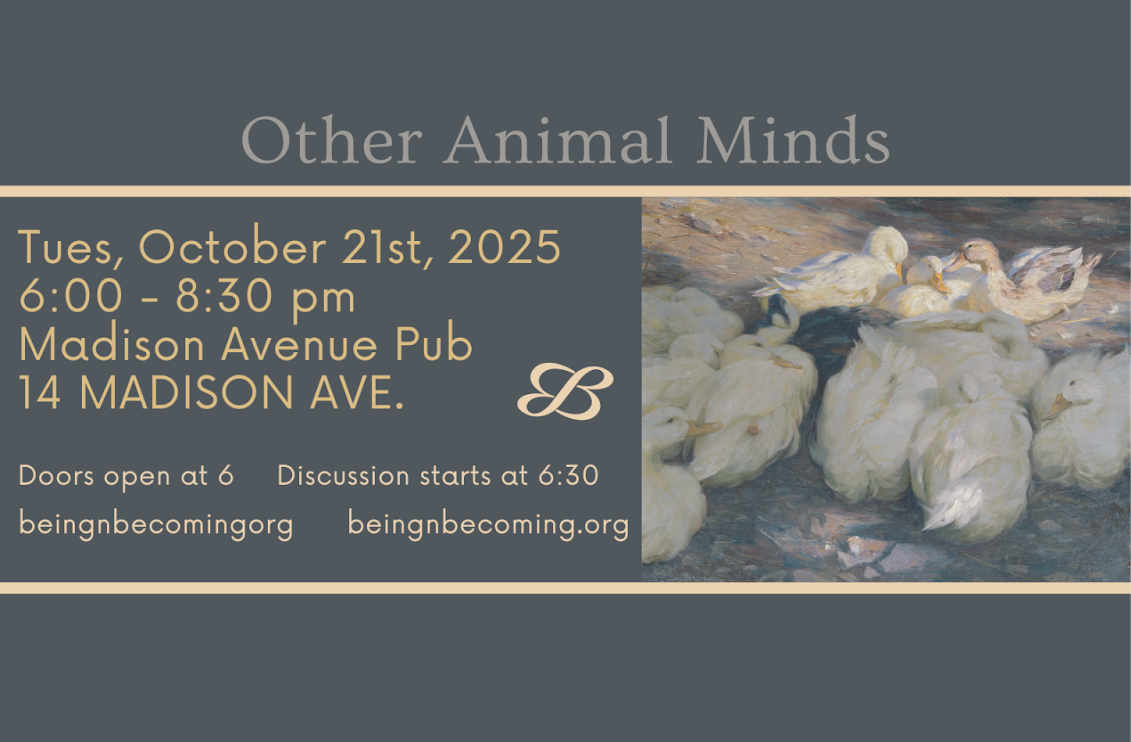
You can find information on accessibility and ticket cost in the announcement of the next Curiosity Café below.
Curiosity Café REVISITED: Back and Better than Ever, People!
Being and Becoming has just introduced a new Curiosity Café series, which isn’t actually new at all: Every four(ish) weeks, we will be revisiting a previous Café. In this series, we will be repeating topics, sometimes with a slight twist, sometimes with the same questions (but rest assured, even if you went to the first iteration and the questions were exactly the same, the discussion will change based on who is in attendance. Maybe you’ve even changed too…).
Looking for Halloween plans? Well, we heard change is scary 👻 and arguing with a vampire might be too. Come and philosophize about it.
The topic of our next revisited café is: Personal Identity and Transformation, happening on Wednesday, October 29!
Missing the event description? Head over to our Eventbrite page! We’re trying to make the length of our newsletters a little less overwhelming.
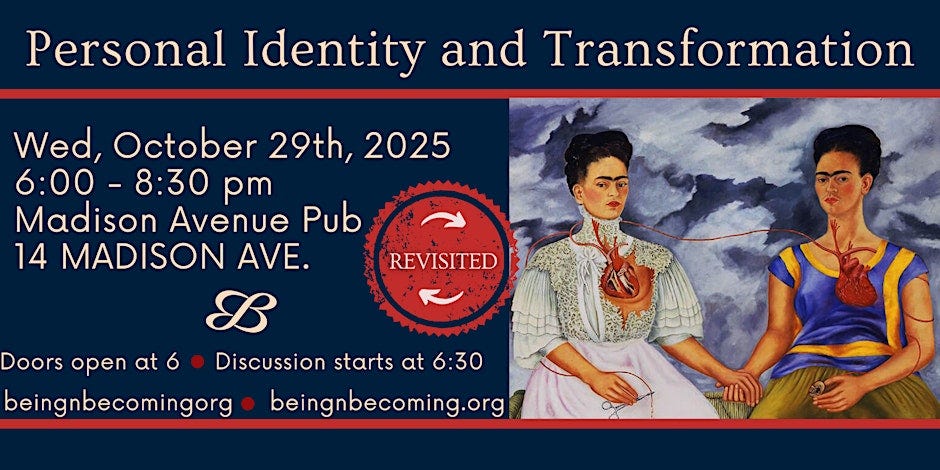
If you have accessibility-related concerns related to our Curiosity Cafés, please visit their respective Eventbrite pages—in the event descriptions, you will find some accessibility-related information about the venue and the event.
We still have five free tickets available for our attendees. If paying anything at all is not financially feasible for you or our ticketing system presents some other barrier, please contact our Director of Community Programming, Sophia, at sophia@beingnbecoming.org. These tickets will be given away on a first-come, first-served basis, no questions asked! You can expect to hear back from her within 72 hours.
Featured Quote
Without music, life would be a mistake.
- Friedrich Nietzsche
Our mission is to present a diversity of perspectives and views. The views and opinions expressed in this newsletter are solely those of the individual authors and do not necessarily reflect the views or opinions of Being and Becoming. Being and Becoming disclaims any responsibility for the content and opinions presented in the newsletter, as they are the exclusive responsibility of the respective authors. If you disagree with any of those presented herein, and you feel so inclined, we recommend reaching out to the original author and asking them how they came to hold that opinion. It’s a great conversation starter.
Comments
Nothing yet. Say the first thing.
Sign in to join the conversation.