
Introduction
By Adrian Ma
Our waking lives are dominated by experiences whose value we might be inclined to dismiss. Getting up, brushing our teeth, eating (the likely same old) breakfast, travelling to and from work—this is hardly the stuff of which the lives commemorated in history books, or even the days recorded in diaries or described in casual get-to-know-you conversations, are made. Whatever meaning our lives might have, we might think, is to be found not in such mundane moments, but in the extraordinary and the exceptional, in the pursuit of grand ambitions or offbeat adventures, or at least in the hills and valleys (and not the plains) of human experience—in writing a novel, travelling the world, overcoming hardships or falling in love. Can this be right? At our latest Curiosity Café, moderated by Jaber Abedin and Sofia Panasiuk, we explored, at times challenged, our seemingly commonplace distinction between the extraordinary and the mundane—and what role the mundane plays or ought to play in our meaning-seeking lives. But first:
Featured Content:
Curiosity Café Recap: Meaning in the Mundane
Upcoming Events:
Our Next Café: Power in Social Relations (June 16, 2026)
Curiosity Café Recap: Meaning in the Mundane
By Adrian Ma
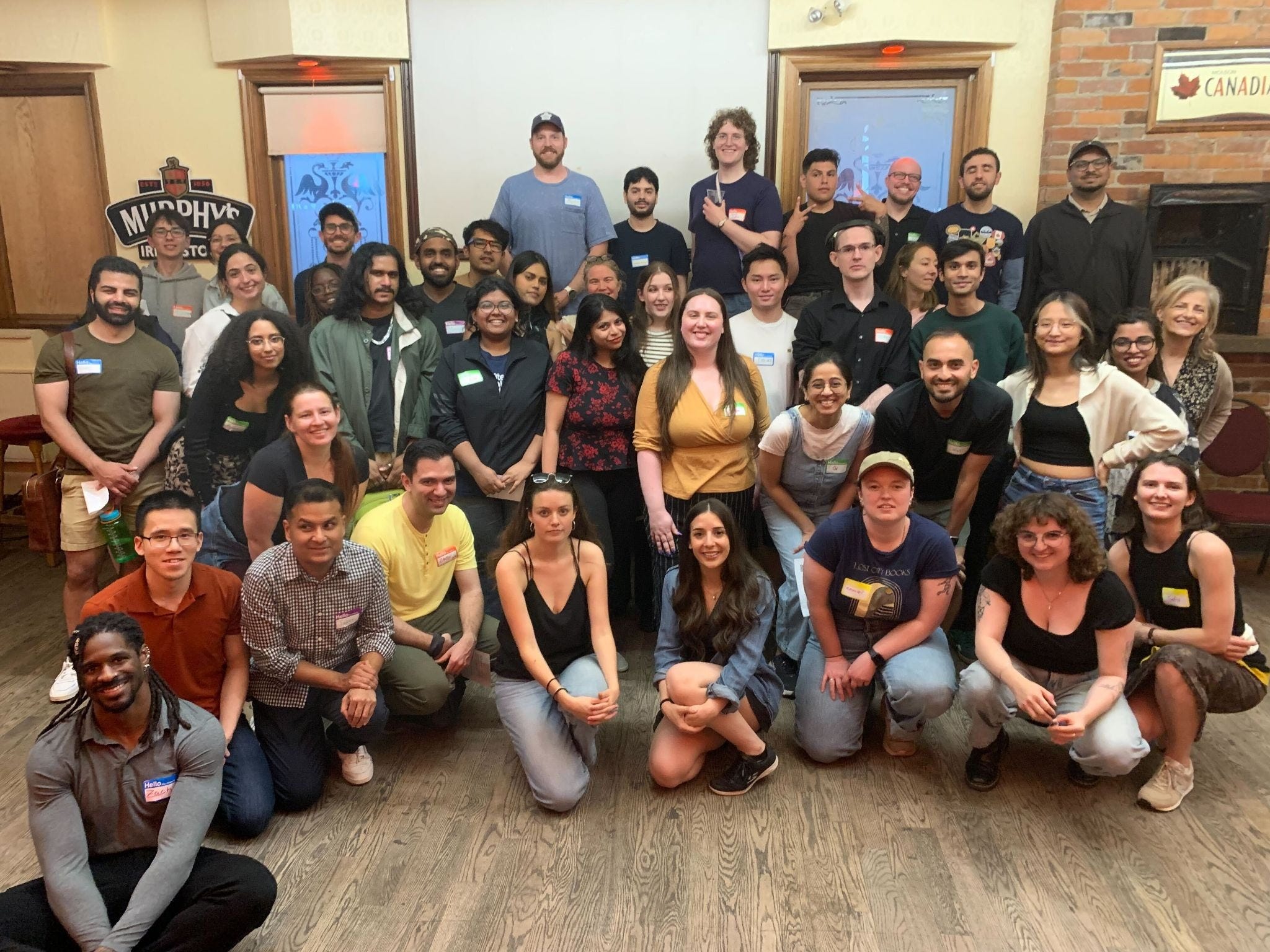
Our Curiosity Café on meaning in the mundane, moderated by Jaber Abedin and Sofia Panasiuk, began with an attempt to uncover why, in the first place, we call some things “mundane” and others “extraordinary.” We asked:
In your small group, take turns describing an ordinary day in your life.
Do you notice yourself skipping or omitting some very ordinary activities or experiences? Why do those seem too insignificant to mention?
What makes this an ordinary day?
What makes a day extraordinary?
What makes something (an experience, a place, an object) meaningful?
Does it involve frequency? Do things that happen infrequently have more inherent meaning?
Does it involve transience? Are things that are fleeting or temporary more meaningful?
Something else?
Are mundane experiences meaningful? If not, can mundane experiences become meaningful? If so, how?
Are some mundane experiences easier to draw meaning from than others? Which ones?
Do objects and experiences have inherent meaning? Or must there be an observer in order to perceive something as meaningful or meaningless?
For example, consider the fact that life emerges from non-living things, or the harmony of an orchestra playing a symphony. Is any of this complexity meaningful without observers?
Here’s what some of you had to say:
The experiences we tend to skip over in conversation are those we assume are familiar to everyone—getting out of bed, brushing our teeth, taking a shower.
Yet there are certain commonplace experiences, like preparing a meal, that we still seem to find worth sharing (“here’s what I made today”).
The passage of time can shape whether experiences are perceived as meaningful. Previously mundane experiences, which our younger selves might have taken for granted, can come to seem special, even profound, in retrospect, in part because of our knowledge that they belong to a time to which we cannot return.
Perhaps every moment becomes extraordinary once we appreciate its transience. No experience can be quite repeated again.
Many experiences are skipped or forgotten because they were experienced in an “autopilot” state of mind, in which everything seems flattened and nothing in particular makes an impression on our consciousness. Extraordinary experiences jolt us awake, and force us to be present.
Meaningful experiences are characterized by a state of flow, in which we are fully immersed in our task at hand and become ignorant of the passage of time.
There doesn’t seem to be anything inherently meaningful about the flow state. Meaningful experiences should feel grounded; flow states, if anything, tend to make me feel less grounded, and more detached from my immediate surroundings.
Whether an experience is meaningful depends on whether it elicits an emotional response, on whether it makes us feel something.
Our conversation about extraordinary versus mundane experiences has slipped into one about meaningful versus meaningless experiences. We seem to identify the extraordinary with the former and the mundane with the latter. But can’t there be a sense in which mundane experiences are also meaningful, without ceasing to be mundane? Or can we only find meaning in mundane experiences by perceiving them as somehow extraordinary, such as by telling ourselves that this is a moment we can never quite experience again?
I make my bed every morning. This is a mundane but meaningful experience. It provides order and structure to my life, as well as a sense of accomplishment.
Both extraordinary and mundane experiences can be meaningful in their own right. Take the example of someone learning to drive. The initial process will feel fresh, even extraordinary, as the driver is developing an entirely new set of skills that will dramatically enhance their ability to get around. Of course, once operating a vehicle has become second nature, the experience will become quite mundane; however, this mundanity will also free up the mental space for other kinds of valuable experiences they can have on the road, such as appreciating the scenery or conversing with their passengers.
Think of the older folks you often see at your local coffee shop, who appear to gather in the exact same place, with the exact same people, with the exact same orders, every morning. This routine might seem quite mundane, and each meeting, judged individually, may not seem particularly significant, to us or even to them. Even so, these gatherings are made precious by the fact that they are part of an extended ritual that is drawing to a close. It is the broader memory of this ritual, the fact of having gathered here with these same people day after day, that the members of this circle will cherish, especially once their circle has begun to shrink.
After the break, we asked ourselves what role—if any—the mundane plays or should play in a life well-lived. We asked:
Do you have everyday rituals and routines that are mundane, yet feel meaningful to you? What makes them meaningful?
Can a meaningful life exist without extraordinary experiences? What about a good life?
Why do we tend to chase meaningful or extraordinary experiences? Why is there a tendency to diminish a life that is mundane?
In psychology, there is a phenomenon known as hedonic adaptation: the tendency to adapt to both positive and negative experiences and return to baseline.
Have you experienced this before?
Why do you think this phenomenon exists?
Does our contemporary environment (e.g., urbanization, advanced state of technology, decline of third spaces, social media) make it difficult to celebrate and appreciate the mundane?
Should we work to cultivate and maintain a sense of wonder and meaning in the mundane? If no, why not? If yes, how?
Here’s what a few of you shared:
All experiences, including ordinary ones, can be made profound and meaningful by our perspective. Every moment acquires a special weight when I imagine it as a branching path in a story, with consequences for the rest of my life.
Even if I were locked in a prison cell, and forced to follow the same routine daily without the slightest variation, I might still be able to live a meaningful (although perhaps not a good) life by making meaning out of my experience.
It is hard to imagine a life composed purely of ordinary experiences. Even our experiences with routine activities admit of significant variation in quality: we can have unusually good or bad workdays and workouts. Everyone is bound to have experiences of this sort, and if these depart enough from the mean, wouldn’t we be justified in calling them “extraordinary”?
Meaning is derived from who and what we are, from our identities and our relationships, which are developed through an accumulation of countless ordinary experiences. For example, I may find meaning in travelling the world with a loved one. The travelling itself may qualify as an out-of-the-ordinary experience, yet its meaning is in large part derived from the particular relationship I have with my companion, a relationship that was built gradually through a long series of unexceptional interactions.
Many people lack the means to enjoy the experiences we typically consider “extraordinary.” We should not conclude from this, however, that their lives have no meaning. Instead, we should be wary of assuming that extraordinary experiences have a monopoly on meaning.
The attempt to outrun hedonic adaptation, to avoid getting used to positive events and returning to a baseline level of happiness, is characteristic of consumer culture, and in particular of the habits of the ultra-wealthy, who are constantly striving for bigger and ostensibly better experiences and possessions to surpass their current levels of enjoyment. But this is surely unsustainable!
Social media invites comparison between our own lives and the very polished, curated representations of other people’s lives that appear on our feed. As a result, we are likely to find our lives more mundane, and other people’s lives more exciting, than they are in reality.
Mundane experiences give our minds the space to work on what the psychologist and psychiatrist Carl Jung called the “shadow” (which refers, roughly, to the repressed, unconscious underside of our personality). We often miss the chance to engage, learn about, come to terms with, our shadow because we are always seeking stimulation from cellphones and other distractions which technology has made ubiquitous and easily accessible.
Mundane experiences are important because they allow my mind to wander, to daydream, and to channel the fruits of this process into meaningful creative—as opposed to consumptive—activities such as storytelling and art. Our constant attachment to our smartphones has left us with little room for the idle time conducive to daydreaming.
Whether you were a regular or a newcomer, whether you found our café mundane or extraordinary, we hope you found it—and this community—meaningful. Hopefully, you didn’t have to pretend it was the last café that would ever happen to reach this conclusion. It wasn’t. Scroll down for details on the next one.
Upcoming Events
Curiosity Café: Bi-weekly on Tuesdays, tickets below!
Hey community! Sophia here, Director of Community Programming. We ask that you consider that our ideal recommended amount for a ticket is now $15, and as you choose what to donate within the bounds of your own financial means, we ask that you keep in mind that your donation will go directly towards compensating those involved in making Curiosity Cafés happen so that we can keep doing this for you.
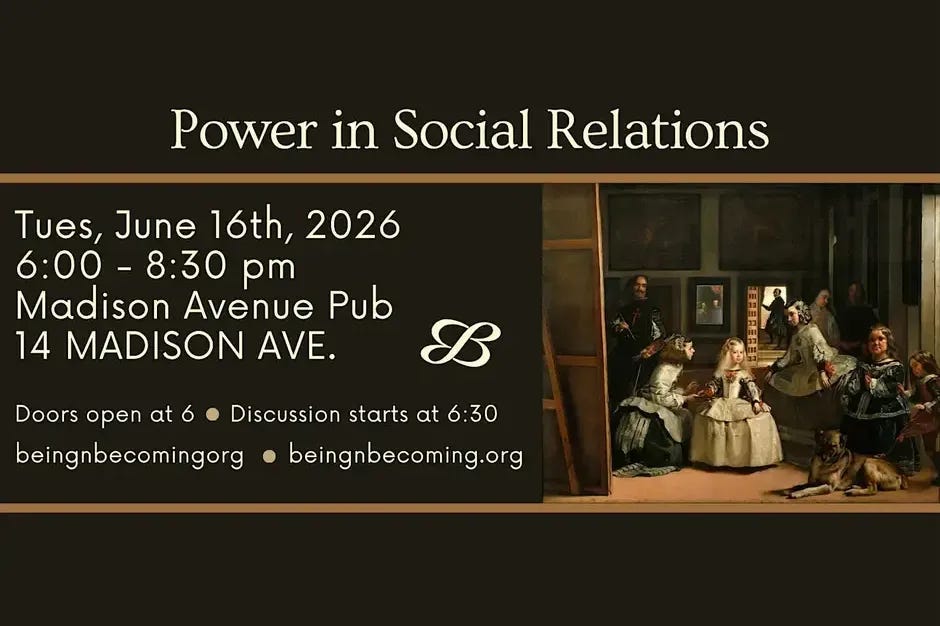
We will be hosting our next Curiosity Café on Tuesday, June 16 from 6:00 - 8:30 pm at the Madison Avenue Pub (14 Madison Ave, Toronto, ON M5R 2S1). Come and hang out with us, grab food, and read through our handout from 6:00 - 6:30 pm. Our structured discussion will run from 6:30 - 8:30 pm with a 10 minute break in the middle!
The topic of our next café is: Power in Social Relations
Missing the event description? Head over to our Eventbrite page! We’re trying to make the length of our newsletters a little less overwhelming.
If you have accessibility-related concerns, please visit our Eventbrite page—in the event description, you will find some accessibility-related information about the venue and the event.
We still have five free tickets available for our attendees. If paying anything at all is not financially feasible for you or our ticketing system presents some other barrier, please contact our Director of Community Programming, Sophia, at sophia@beingnbecoming.org. These tickets will be given away on a first-come, first-served basis, no questions asked! You can expect to hear back from her within 72 hours.
Featured Quote
To see a World in a Grain of Sand
And a Heaven in a Wild Flower
Hold Infinity in the palm of your hand
And Eternity in an hour.
- William Blake
Our mission is to present a diversity of perspectives and views. The views and opinions expressed in this newsletter are solely those of the individual authors and do not necessarily reflect the views or opinions of Being and Becoming. Being and Becoming disclaims any responsibility for the content and opinions presented in the newsletter, as they are the exclusive responsibility of the respective authors. If you disagree with any of those presented herein, and you feel so inclined, we recommend reaching out to the original author and asking them how they came to hold that opinion. It’s a great conversation starter.
Comments
Nothing yet. Say the first thing.
Sign in to join the conversation.