
Introduction
By Adrian Ma
How we relate to other people is often, perhaps always, shaped by some form of power. Bosses tell their employees what to do; police use force in the name of protecting public safety; teachers assign grades to reward “good” students and penalize “bad” ones. Yet, arguably, the functions of power in our social relations also take less obvious forms—including in our relationships with family, friends, and romantic partners. At our latest Curiosity Café, moderated by Bill Kroeger and Sophia Whicher, we explored the many, often invisible, ways in which power operates in our everyday lives, and whether these could, or even should, be eliminated or reformed. But first:
Featured Content:
Curiosity Café Recap: Power in Social Relations
Upcoming Events
Curiosity Café REVISITED: Grief (June 30, 2026)
Curiosity Café Recap: Power in Social Relations
By Adrian Ma
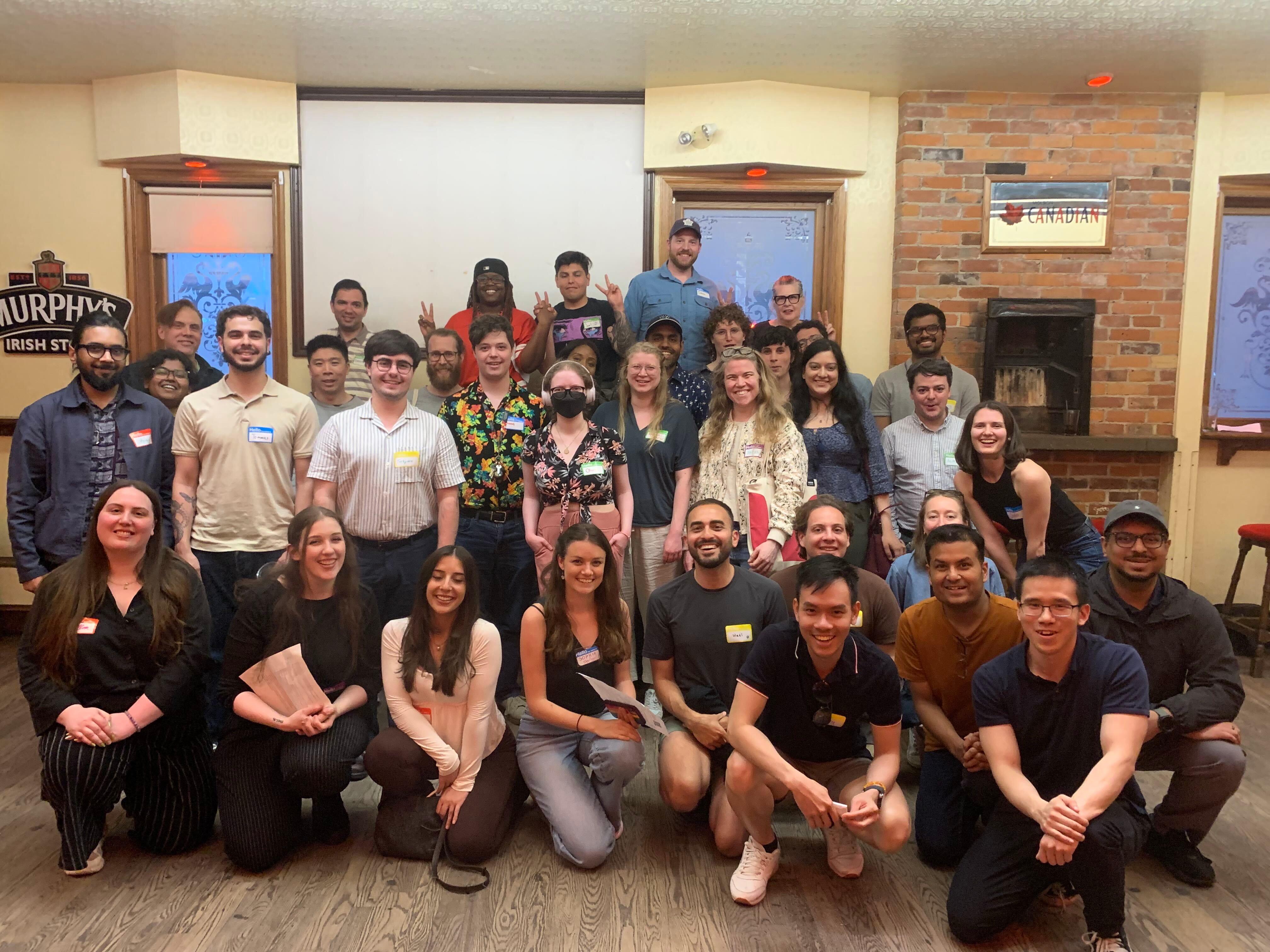
Our latest Curiosity Café, moderated by Bill Kroeger and Sophia Whicher, began with a reflection on how power influences the dynamics of our everyday lives. We asked:
What role does hierarchy play in your life?
When you are part of a team project, are you 1) more comfortable as the leader, 2) more comfortable as a participant, or 3) comfortable in different roles? Why do you think that is?
Why do we generally think of a group structure with a leader and participants as “hierarchical”?
In one way or another, we’re all embedded in social hierarchies. What markers of status in these hierarchies do you tend to pursue? Which do you avoid? (e.g. wealth, education, etc)
Are there any hierarchies that are “natural”? (For instance, think of the ways that we tend to put animals in hierarchies--like predator/prey-- Or different traits.)
Are there any hierarchies you were taught to think of as natural? Has that changed?
Is power in itself good, bad, or neutral?
Think about the following concepts: excellence, competition, collaboration, strength, and domination. What roles do power and inequality play in these?
When, if ever, is power positive (e.g. the feeling of empowerment)?
What does it feel like to have power?
What does it feel like to be powerless?
Can you have a caregiving relationship that isn’t shaped by power?
Does every relationship involve a power dynamic?
How do different kinds of power influence different kinds of relationships? Think about, for instance:
Self relationships (how you relate to different parts of yourself)
Caregiving relationships
Romantic Relationships
Sexual relationships
Parental or intergenerational relationships
Business relationships and partnerships
Friendships
What power do those close to you have over how you relate to others? What power do those close to you have over how you perceive the world?
How do the power dynamics of your past relationships (of all kinds) influence your current and future interactions?
Here’s what some of you had to say:
Hierarchies are discernible among non-human animals. Observing this, we infer that hierarchies must exist among humans as well, even if we do not believe they should.
We should avoid inferring hierarchies from the mere existence of role differentiations. That is, we cannot proceed from the observation that a society is divided into different roles, to which individuals may even be more or less suited, to the conclusion that some people are perceived to be superior to or more important than others.
Many hierarchies we assume to be natural are contingent rather than necessary: they are historically conditioned and subject to change, rather than expressive of immutable realities.
Our talk about natural hierarchies often ignores key assumptions about what those hierarchies are based on. For example: lions—the so-called “kings of the jungle”—are often placed at the top of the food chain (a “natural” hierarchy) because they eat other animals and are not themselves eaten or physically threatened. At the same time, lions are also extremely reliant on their prey to survive. If we adopt reliance or dependence as the criterion, lions may no longer be deserving of the throne.
Power is good, insofar as it refers to the ability to do things, to perform actions in the service of our needs.
Whether I perceive power as good or bad depends on whether it serves my interests, on whether I approve of its use. My judgment is also informed by whether I perceive power as zero-sum—that is, whether more power for others necessarily means less for myself.
Power dynamics derive from our dependence on others and our environment. Dependence in its various forms (financial, physical, emotional, and so on) is what creates power imbalances in our relationships. However, power dynamics are not static. As relationships change—as, say, children become financially independent from their parents, and parents become dependent on their children as caregivers—old dynamics shift, new ones are created, and the balance of power can tilt the other way.
We should distinguish between two concepts of power: power “over” and power “to.” Power “to” is simply the ability to do things, and can be understood without reference to any social relation. Power “over,” on the other hand, is inherently relational: it is the power to influence what another person does, thinks, or feels. Most, if not all, interpersonal relationships, including caregiving ones, involve some element of power “over.” This raises a disturbing question: are all relationships ultimately coercive, no matter how loving or egalitarian they are on the outside?
Relationships in which certain parties enjoy power “over” others are not necessarily coercive. Think of a generous, easygoing manager who demands little from their underperforming team.
Some people may be benevolent or restrained in their use of power, but that doesn’t mean there is no power imbalance. There’s a meaningful difference, for instance, between relying on someone else’s goodwill to continue providing for you financially, and having the means to provide financially for yourself.
To a large extent, power dynamics depend on how you see things. You have more agency than you might think, and you are dependent only to the extent you think you are. For example, your boss has power over you only if you care about keeping your job. The moment you stop caring, and become indifferent to the possibility of termination, that power imbalance disappears—they have nothing more to threaten you with.
But is this really having power in a meaningful way? While we technically “have a choice” to, say, leave our jobs when we’re being treated poorly, this choice has material ramifications that we can’t be reasonably expected not to care about, and that seem to confirm that shifting this kind of power dynamic requires more than shifting one’s perspective.
After the break, we tried to envision a world where our relations to each other are free of all hierarchy. Is such a world conceivable—or even desirable? We asked ourselves:
Which kinds of group power are you more or less comfortable with? Which are more or less likely to involve oppressive domination?
Bureaucratic power: the authority granted to you to do your job and having a set of responsibilities that have been allocated to you by an organization.
Police power: the authority (sometimes using force) to “keep the peace,” enforce laws, and maintain order.
Traditional or customary power: authority of a role inhabited by a patriarch, matriarch, mentor, or representative of a social class and station.
Social power: the authority of persuasion and influence - based on swaying a group of people who identify with someone or are compelled by their words and actions
Another kind of group power: e.g. intellectual power, technological power, etc.
Physical power: those who are stronger can exert force over those who are less physically able (or who are disabled). The stronger can also help the weaker.
Is it possible to undo or transform power?
Can we undo or limit the functioning of power in interpersonal relationships? How?
Can other kinds of social action change the dynamics of power and inequality? If so, which ones and how?
Deliberately creating different kinds of relationships, both individually and in groups.
Reforming hiring practices and/or focusing on equality.
Redistribution of wealth using social and political influence (legislation).
Revolution
Do the relations of power in a given society remain the same, even when the people inhabiting those positions change? In other words, is there a “structure of domination” that will persist, even if a different person or group has authority? Is this avoidable?
Is scapegoating a necessary part of how social hierarchies function? Are there ways to eliminate scapegoating, or its more subtle variation - the creation of in-groups that base membership on excluding someone?
Here’s what a few of you shared:
I’m less comfortable with covert power—power we can’t easily see or point to—than with overt power, which is easier to keep track of. Covert power is more insidious because it can influence us without our ever knowing it.
I take the opposite view: I am more worried about overt power (like police power), precisely because it is so explicit. Overt power also tends to involve oppressive domination. But must it? Or is this tendency a merely contingent fact that we have the power to do something about?
I am most uncomfortable with social power, because it can be easily exploited for immoral ends. White supremacist movements, for example, are driven by charismatic individuals who are idolized by their followers. There is no guarantee that whoever wields social power will be on the right side of history; in most cases, they are not.
I would like power to be restricted to contexts where its users can be held accountable.
Part of what makes certain forms of power so concerning is that their exercise can be extremely unpredictable. How a police officer uses or abuses their power, for example, can depend on factors over which we have no control. Do they happen to hold racist beliefs? Are they eager to brandish their authority to soothe their wounded pride? Are they simply having a bad day? Even if we acknowledge that certain forms of power are not problematic per se, we still have cause to worry—and doubt—whether they will be used responsibly.
When power is transferred—say, by a revolution that wrests power away from tyrannical authorities and puts it in the hands of ordinary people—does it really “undo” or dismantle the targeted power structure, or does it only change who occupies which positions within that structure? More often than not, it is the latter. This is not surprising: power structures are deeply ingrained and reinforced over hundreds of years—through politics, through institutions, through culture, through education—and it would be unrealistic to believe they can be transformed overnight.
Each form of power is associated with its own set of norms. Bureaucratic power, for instance, requires a certain type of person: someone who is serious, diligent, and consistent—someone who can be counted on to show up to work every day and meet their KPIs. Understanding the norms that govern a certain form of power can help us understand how its influence can be changed or challenged.
Our tendency to scapegoat others is tied to our subscription to an overly simplistic binary between good and bad people. We believe that to have done something wrong, and to be blameworthy for it, is to be a bad person—and not merely a person who has done the wrong thing. As a result, we become eager to absolve ourselves of responsibility and to put the blame on others. Perhaps loosening our attachment to these binary labels would also weaken our tendency to scapegoat.
The arrangement of this newsletter is not hierarchical: what appears on top is not more important than what appears below. So, please, scroll down and check out the details on our next café (it will be our last one before we take a break in July). Thanks for reading.
Upcoming Events
Curiosity Café REVISITED: Back and Better than Ever, People!
Every four(ish) weeks, we revisit a previous Café. In this REVISITED series, we will be repeating topics, sometimes with a slight twist, sometimes with the same questions (but rest assured, even if you went to the first iteration and the questions were exactly the same, the discussion will change based on who is in attendance. Maybe you’ve even changed too…).
We will host our next Curiosity Café on Tuesday, June 30, from 6:00 to 8:30 p.m. at the Madison Avenue Pub (14 Madison Ave, Toronto, ON M5R 2S1). Come and hang out with us, grab food, and read through our handout from 6:00 to 6:30 p.m. Our structured discussion will run from 6:30 to 8:30 p.m. with a 10-minute break in the middle!
The topic of our next REVISITED café is: Grief
Missing the event description? Head over to our Eventbrite page! We’re trying to make the length of our newsletters a little less overwhelming.

If you have accessibility-related concerns, please visit our Eventbrite page—in the event description, you will find some accessibility-related information about the venue and the event.
We still have five free tickets available for our attendees. If paying anything at all is not financially feasible for you or our ticketing system presents some other barrier, please contact our Director of Community Programming, Sophia, at sophia@beingnbecoming.org. These tickets will be given away on a first-come, first-served basis, no questions asked! You can expect to hear back from her within 72 hours.
Featured Quote
Power is not a means, it is an end. One does not establish a dictatorship in order to safeguard a revolution; one makes the revolution in order to establish the dictatorship. The object of persecution is persecution. The object of torture is torture. The object of power is power.
- George Orwell
Our mission is to present a diversity of perspectives and views. The views and opinions expressed in this newsletter are solely those of the individual authors and do not necessarily reflect the views or opinions of Being and Becoming. Being and Becoming disclaims any responsibility for the content and opinions presented in the newsletter, as they are the exclusive responsibility of the respective authors. If you disagree with any of those presented herein, and you feel so inclined, we recommend reaching out to the original author and asking them how they came to hold that opinion. It’s a great conversation starter.
Comments
Nothing yet. Say the first thing.
Sign in to join the conversation.