
As I write this in my New York City apartment, it’s raining. I hear the thunder overhead and see the lightning flash on my bedroom walls. I hear the patter of raindrops on the windowsill and on the air conditioner that’s still running, trying to keep the place below 85 degrees. The pigeons aren’t calling because they’re in hiding. It’s dark enough that I’ve switched on a few lamps just to get some daylight back into the room. All of it adds up to this ambiance of quiet, of sitting with your thoughts, of coziness in some way.
The thing about a rainy day is that we don’t really want to go outside. We think of rainy days as an opportunity. To read or write. To catch up on something, watch a show, or maybe be a little creative and make something. In the hustle and bustle of our lives, a little rain gives us permission to take things slow. Oh, it’s raining, I don’t feel like going for a walk. I can’t lay in the sun or wander the streets with one of those travel umbrellas that can barely cover your body, so you get wet anyway.
The itch to create comes from that, I think. We use the rain as a way to look inward, or at least I do. The quiet gives us space for ourselves.
But there are times when the blank canvas just sits in front of you. You want to be purposeful about what you put on the paper, or the canvas, or the miniature in my case, or the computer screen. Everything feels like it has to serve a purpose. In order to work, whatever that means. In order to feel good, whatever that means. And it’s easy to get stuck when you don’t know where to begin. We can plan for rain because of the forecast, but when it finally arrives, you’re not always sure what to do with yourself.
Thinking about the weather got me thinking: how does weather actually fit into our lives?
![ART] HOW WOULD YOU USE IT - 08: Rainy Path : r/DnD](https://substackcdn.com/image/fetch/$s_!snDN!,f_auto,q_auto:good,fl_progressive:steep/https%3A%2F%2Fsubstack-post-media.s3.amazonaws.com%2Fpublic%2Fimages%2F9eec3d3e-b9e6-482e-8a44-5b851fab17fb_3000x1800.png "ART] HOW WOULD YOU USE IT - 08: Rainy Path : r/DnD")
Mostly, we use it for idle conversation. It’s a way to fill the gaps when we’re talking to someone. How’s the weather today? Did you hear that thunder? What did you do during that storm last week? Man, the rain’s really coming down, but the grass and the flowers will love it.
At the D&D table, though, weather only matters when it’s in extremes. When you describe it, you say the party walks down the cobblestone streets and the rain patters against the smooth stone. That’s it. It’s window dressing. Do the players react? No. It’s just a word. Rain. Thunder. Wind. They set a tone, but they don’t carry much else. So the weather gets ignored most of the time. Because it’s weather, so who cares?
And that’s an interesting thing about a social hobby like D&D, or any TTRPG, where we play mostly through our words and the roll of the dice. Our words are conversation, and conversation at the table is purposeful. A player isn’t going to care about the weather unless it affects their ability to do a thing. How do I get this quest? How do I persuade this NPC to give me what I want? How do I attack this monster, or slip a spell past someone without it being noticed? That’s the real intention behind almost everything we say when we play. It’s how we know what to roll, whether it’s a hit or a miss, a success or a fail. We decide where our character moves, even though none of us are going anywhere.
And all the while, the weather is just there. Present. When you never mention it, everyone assumes it’s a normal day, whatever normal means for that region. Sunny, cloudy, overcast, a little drizzle. The weather isn’t obligated to do anything for you. Unless, of course, it’s in extremes. The torrential rain flooding the town. The tornado summoned by some mad weather wizard.
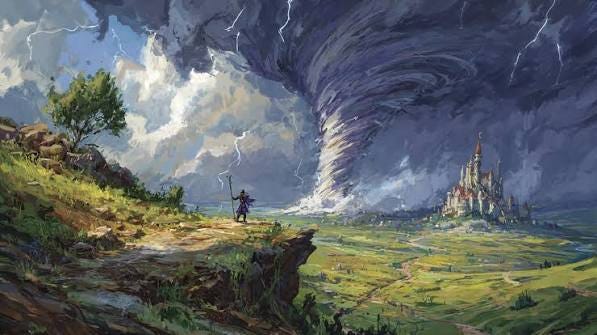
Those little details are the ones that get lost in our need to push the game forward. But sometimes it’s nice to sit in the inconsequential. It gives us room to think about what else is happening, and how it might change what we feel, what we do, or the world itself.
That’s what my rainy day reflection keeps circling back to: the purposeless details, and how they can make a world feel real. It’s worldbuilding in a small way. Do people here enjoy the rain because it’s rare? Is there a drought, and this is a relief? Or is it commonplace, like my partner’s family in Seattle, where it rains so often it’s just another day?
Here’s the distinction I keep landing on. The clues, the breadcrumbs, the secrets, the lore: those make the story feel real. The stuff that isn’t any of those things is what makes the world feel real. That difference matters, because it’s the seemingly worthless details that make a place feel lived-in and enjoyable.
It makes me think about the pointless details of my own world, and what the equivalent would be for people living in an imagined one. Faerûn, or Oerth, or Krynn, or any setting we can dream up. What do people eat for breakfast? How do they cook their eggs? Do apples exist? Does anyone bake pie? Do they talk about the weather to pass the time, the way we do? Where do you go on a first date? What color is the sky? How many moons hang over it? What’s the most popular curse word?
A lot of the time I forget to mention weather at all when I set a scene. Is the sky dark and ominous? Or is it bright and sunny while evil is quietly afoot, so the danger doesn’t wait politely for nightfall? Those things can matter. They can make a moment land a little harder. I hadn’t really thought to do it until now. Maybe I should start.
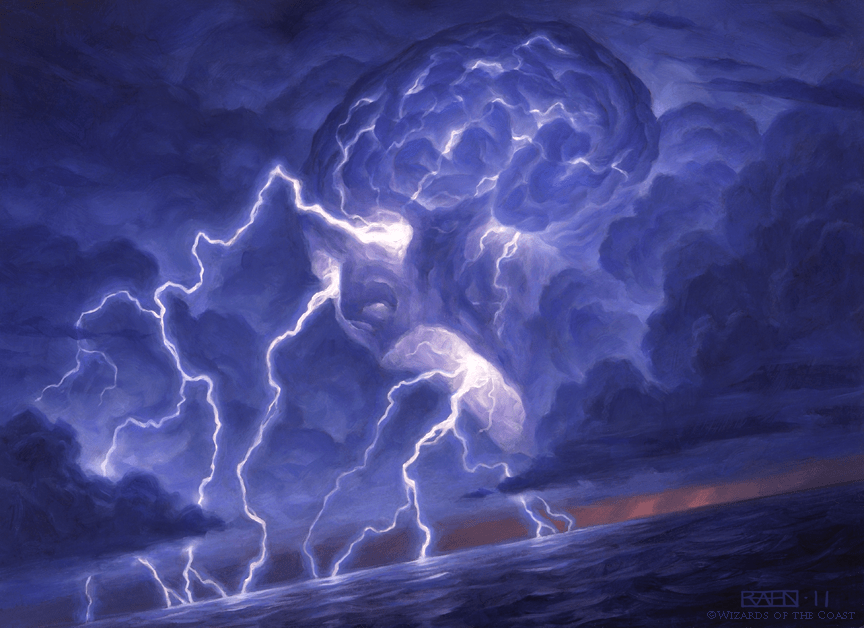
There are, of course, rules for weather. Cold weather survival, hot weather navigation, flooding, dehydration, drowning, damage from being thrown around by wind. But what about the parts that don’t need any mechanics attached?
If I were teaching a new DM how to establish mood, I’d start with the weather. And with the look on people’s faces as they go about their day. How drab or well kept the buildings are. Whether the streets are paved, and whether grass is growing up through the cracks. Whether you can see the sun, or whether there’s a haze of wildfire smoke hanging over everything, the way it has been here in New York, where the air smells like you just stepped away from a campfire. Those things matter, even when they have no mechanical connection to the story.
Details like this can and should be window dressing, because they’re the daily stuff of life. We carry an umbrella to deal with the rain, but we don’t have to. It’s fine if we don’t. Our hair gets wet, the things we’re carrying might suffer for it, and life goes on. The mundane is what makes a world feel real. Not everything has to be about action.
That’s how I tell the difference, actually. If a detail is mundane, simple, commonplace, it probably doesn’t need a mechanic. Temperature works the same way. Your food gets cold faster if you bought it hot from the tavern. You bundle up because there’s a chill in the air. Those are worth describing, and describing them just means leaning a little more into the creative writing side of the craft.
They’re easy to forget. A lot of the time a player will just say, I travel from here to here, and that’s it. Uneventful. As DMs, we do the same. And that’s okay. Sometimes you just need to get everyone from point A to point B. But sometimes those details help. Maybe it’s really just about slowing things down a little.

When I was a kid, I played a lot of video games, headphones on, and I never really heard the weather. So at 41, I’m trying to do a little more listening. I’m letting the mundane inspire me, the weather busy outside while I sit not so busy inside. It’s easy to ignore. It’s easy to say, ah, it’s a rainy day, and move on. But we can be just as dismissive of the mundane things in our worlds, and those are exactly the ripe opportunities for worldbuilding and storytelling.
I wonder what it would feel like to add a little real ambiance to the table. Not a soundtrack like some some canned dungeon or library loop, but a rainy-day-cafe kind of moment. It is raining and nobody’s outside. A couple of kids are splashing in a puddle. And then a dragon passes overhead. There I go, straight through the mundane and out the other side into the not-so-mundane. But sometimes a few words here and there are enough to make our worlds feel a little more real, instead of just playgrounds for our friends.
So if it’s raining where you are, listen to it. Sit with it. If it’s snowing, listen to that particular quiet snow lays down like a cushion over the world. What do you feel? What do you hear? Now imagine what someone in one of our invented worlds would feel or hear. The rain coming in. The wind off the ocean. The salt in the air that eats away at the paint on the town hall, so it has to be redone every year. Maybe there’s a paint shortage; aha, a breadcrumb.
Little things, true. But they’re the ones that make a world real.

No posts
Comments
Nothing yet. Say the first thing.
Sign in to join the conversation.