
Painters, just like musicians or actors, need patrons or a paying audience.
This might seem obvious, but it has a direct bearing on how we view history.
English society has been notoriously class-conscious since the first Norman warlords began erecting their stone fortresses - aka castles - among the British, Danish, and Saxon peoples of England after 1066.
These Normans/Northmen (of Normandy in France) were really just "Frenchified" Vikings with a serious superiority complex after spending a few generations away from their Northern homelands.
Their "Viking French" tongue became the language of the ruling classes in Britain, and this legacy survives right down to the present day, even in American English.
When we want to sound lofty or educated, we tend to use words borrowed and evolved from the Norman French language.
When we want plain talk, we tend to use words evolved mostly from Saxon English.
Think of the difference between saying "an illuminated chamber", or "a well-lit room".
But I digress (or "wander off-path", if we choose to avoid French usages here).
Our deeply-ingrained sense of social class, for much of history, not only dictated our language and choice of words - social class also dictated much of what was deemed worthy of recording in words and images.
In the age before affordable photography, only very few people could afford to pay a trained artist for a painting, never mind a portrait.
The peasantry, the underclasses, and the poor were only rarely subjects for the artist's brush - they simply couldn't pay for such a service.
Any chance of possessing art usually depended on having a talented family member.
In fact, until the mid-19th century, most members of the lower classes had only ever caught fleeting glimpses of their own appearance in glass window panes and liquid surfaces, as prior to that, handheld mirrors were a luxury item.
So art as a paid occupation - in the age before social realism - was generally concerned with portraiture of the ruling classes, the landed gentry, merchant classes, along with landscapes, religious themes, and the documentation of "great events" - with only a few noteworthy exceptions.
*****
I invite any reader here to fire-up a search engine, and attempt to locate contemporary images of the American working classes and underclasses from any time before the mid-19th century.
Paintings, etchings, drawings, anything.
You will find precious little.
What is more, by the time American painters DID decide to paint scenes from the lives of frontierspeople and common people, America as a whole was already actively, aggressively engaged in curating its own myth.
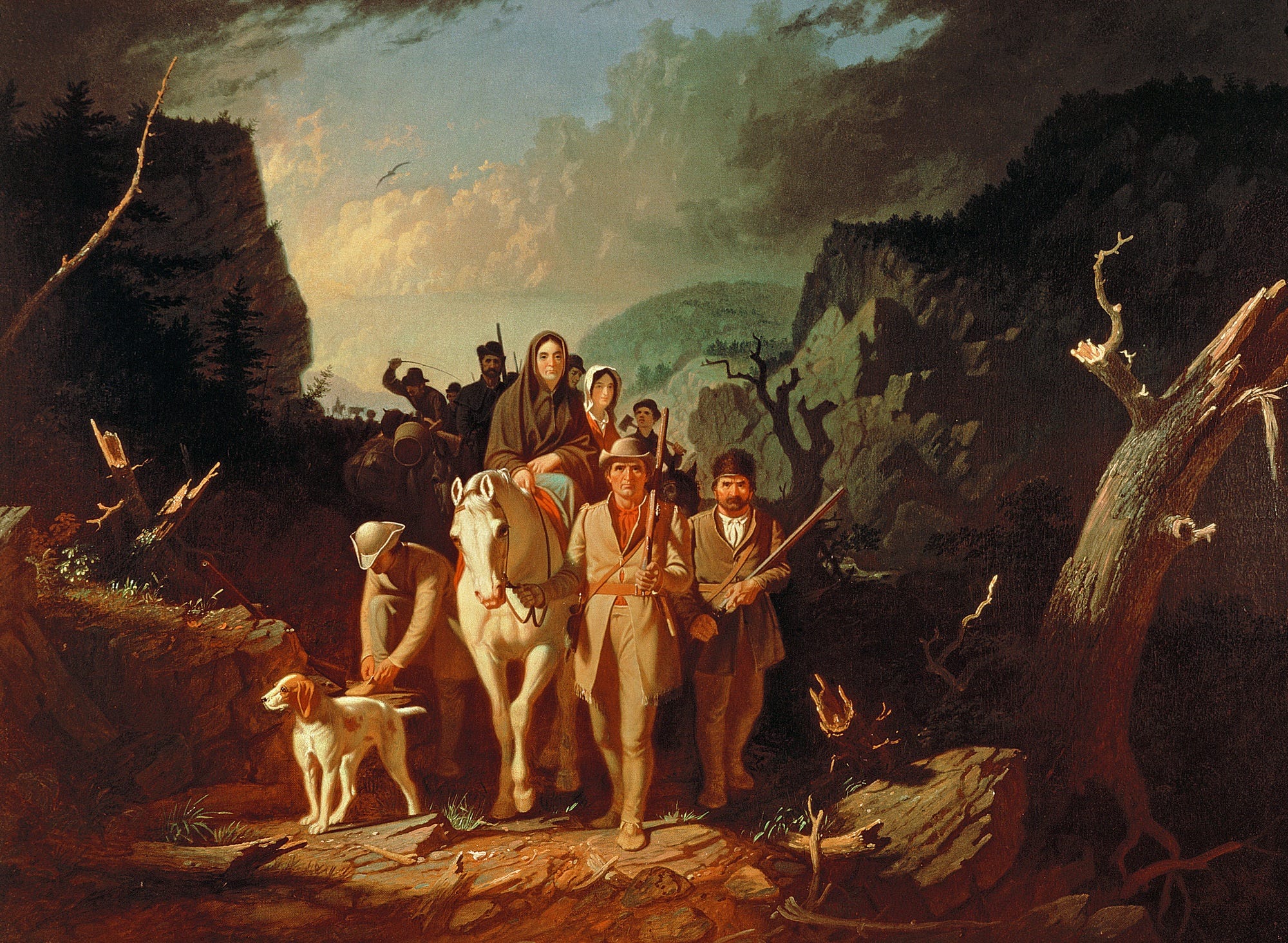
Think of George Caleb Bingham's 1852 painting of Daniel Boone leading "white settlers" through the Cumberland Gap - a painting made over 80 years after the events it sought to portray.
Yet even before Daniel Boone had crossed the mountains into "Ken-te-ke", people of mixed ethnicity from the Virginia and Carolina backcountry had been hunting, trading, and intermarrying among the Indians in both Kentucky and Tennessee for decades.
Later generations would refer to this mixed crew as "Melungeons", and begin to construct a dubious mythology around them, as if the existence of free "brown people" were a mysterious affront to the natural order.
Yet there was little mystery to it. Since the time of first European contact, the underclasses in North America had been intermixing with one another.
Spaniards, Portuguese, Portuguese Jews, Romani, Irish, Scots, Welshmen, Finns, Germans, Poles, Swedes, Dutchmen and Frenchmen.
Intermixing with Malagasy, Africans, Caribbeans, South Asians, Arabs or "Moors", Yuchi, Catawba, Lenape, Pamunkey, Cherokee, Shawnee - you name it, they were all there in the first melting pot.
Yet we see none of these mixed or "brown" families represented in the story of the "American frontier", and they are almost never represented in art.
This is where it gets a little ticklish and complex, because there ARE early American drawings of "non-white" people in scenes such as slave markets and slave auctions, or Indigenous peoples shown in obsequious postures of "the vanquished", or in romanticized portrayals of "noble savages".
Yet the presence of these people in contemporary art was almost incidental, with the Indigenous and enslaved treated more like props than human subjects, with their own narratives and regular attempts to assert their personal and collective agency.
This is because America was happy to portray "The Three Americas" which underpinned the racial caste system - Black, White, Indian - but only if the use of "non-white props" served a “white”, Euro-supremacist narrative.
Anyone who was not "Black" (and thus unfree), anyone who was not "Red" (and thus savage), became by default and by design, "White" - and thus free.
White, Savage, or Slave.
With very few exceptions, when speaking of freeborn citizens, "Brown" was simply not an option.
*****
As we've already suggested, most artists in 16th and 17th century class-conscious colonial America painted what they deemed to be "worthy" subjects - or at least subjects who could afford to pay them.
In other words, the "white" merchant classes, religious leaders and elites.
So decades and centuries of art mostly portrayed only three groups of people at best - well-to-do "whites", enslaved "Blacks", or "Indians".
For their own futures and safety, the free mixed-ethnic brown underclasses were usually pressing ever westward, or keeping to the hills and hollers, swamps and backwoods...
Needless to say, the brown and impoverished underclasses of the rural hinterland and frontier rarely sat for painters - men who worked mostly in large coastal towns and cities with their more developed economies.
In the post-Revolutionary years (as many American artists began to turn their faces away from "elite" subjects and to the historical men and women who were now deemed worthy of remembrance as “nation builders”), painters from “back east” probably found it hard to conceive that the American frontier was actually settled in large part by "brown people".
Yet it was.
Photography would only begin to become widespread and more affordable in the mid- to late 1880s, just in time to capture some of the elderly faces of those who first settled the Appalachian region.
Yet we can push the time frame slightly farther back in time by examining early camera lucida drawings.
Historians and genealogists digging through 19th century documents and family records will often stumble across images of people rendered in a curious style.
These portraits are neither freehand drawings, nor are they early photographs.
These pictures were made using an old optical drawing aid called a “camera lucida”, patented in the early 1800s, but clearly a development of the much older “camera obscura” of the 1500s.
This apparatus essentially involved using a lens to project an image of the sitter directly onto a flat surface where paper or canvas was placed, allowing the artist to trace and shade the subject with no need to be constantly looking up.
This of course allowed the artist to produce quite accurate images at greater speed than conventional drawing or painting.
Because the camera lucida was also quite portable, artists were not bound to work by appointment in a workshop or studio.
Itinerant artists were thus able to offer relatively true-to-life portraits for a price well below that of oil or watercolor paintings, in the comfort and privacy of the customer’s home.
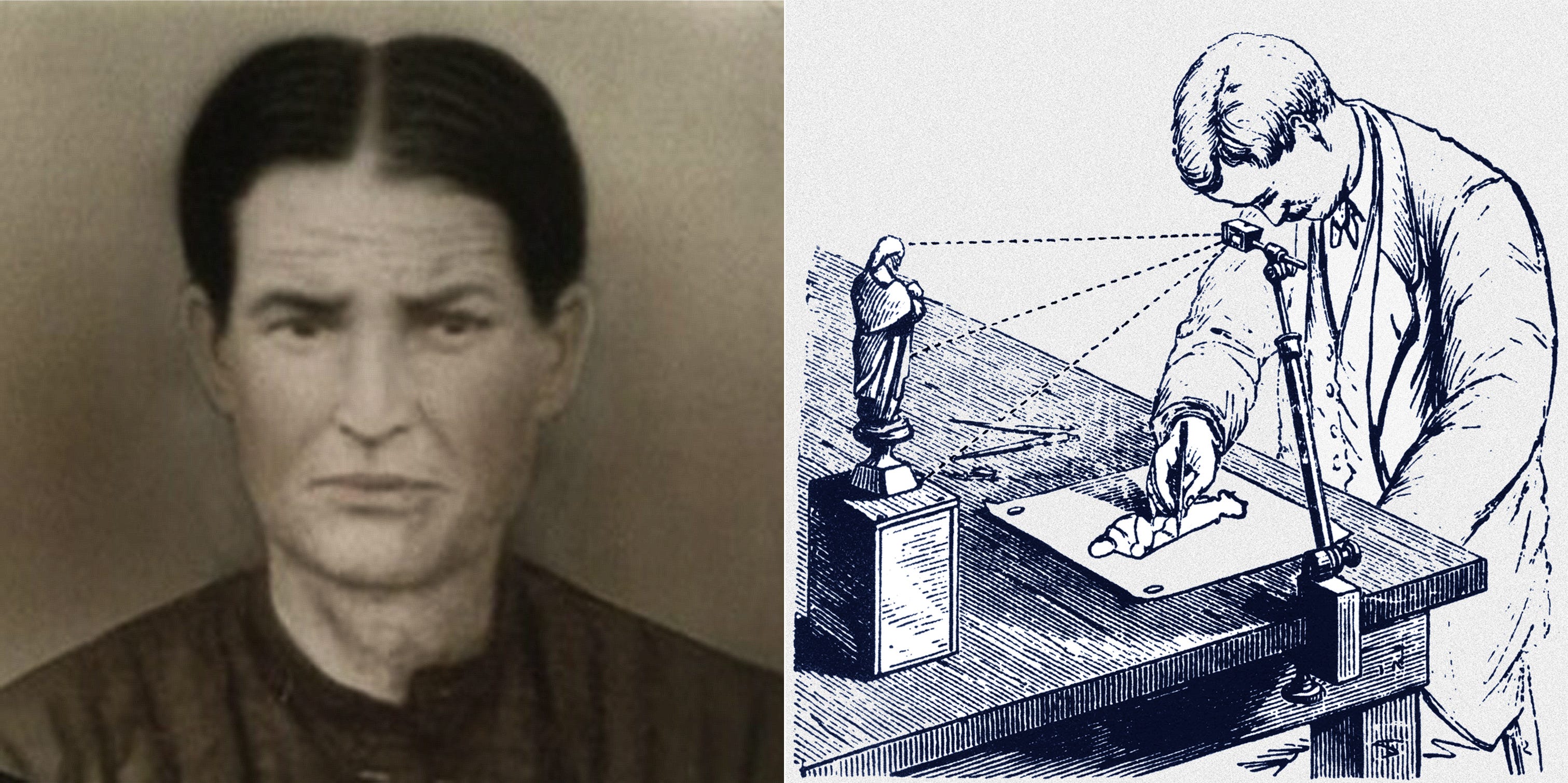
Through a combination of camera lucida images, the earliest photographs, court and census documents, and cross-referencing folklore and DNA, we can begin to build a picture of the lost “brown people” who have been mostly written-out of American history.
*****
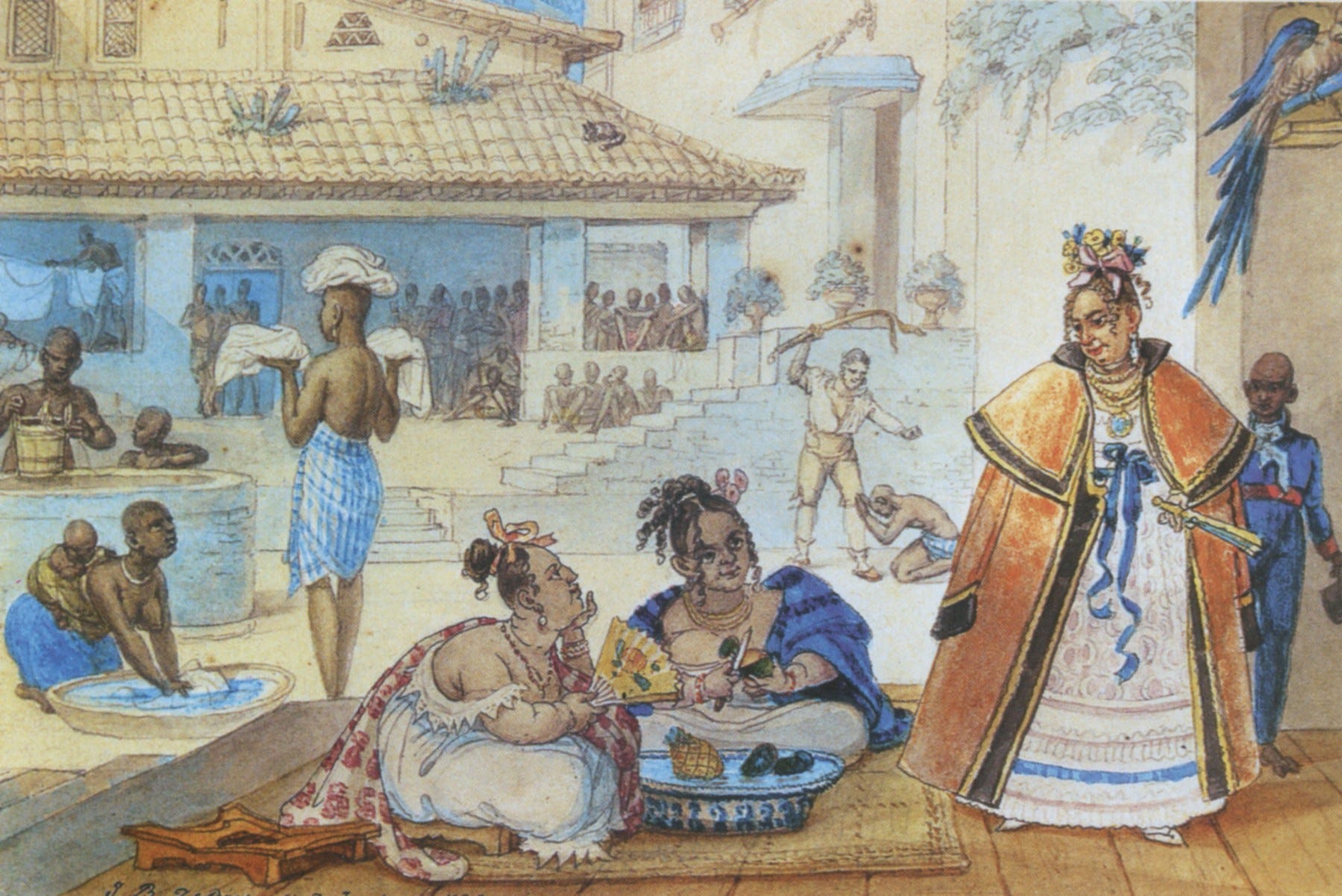
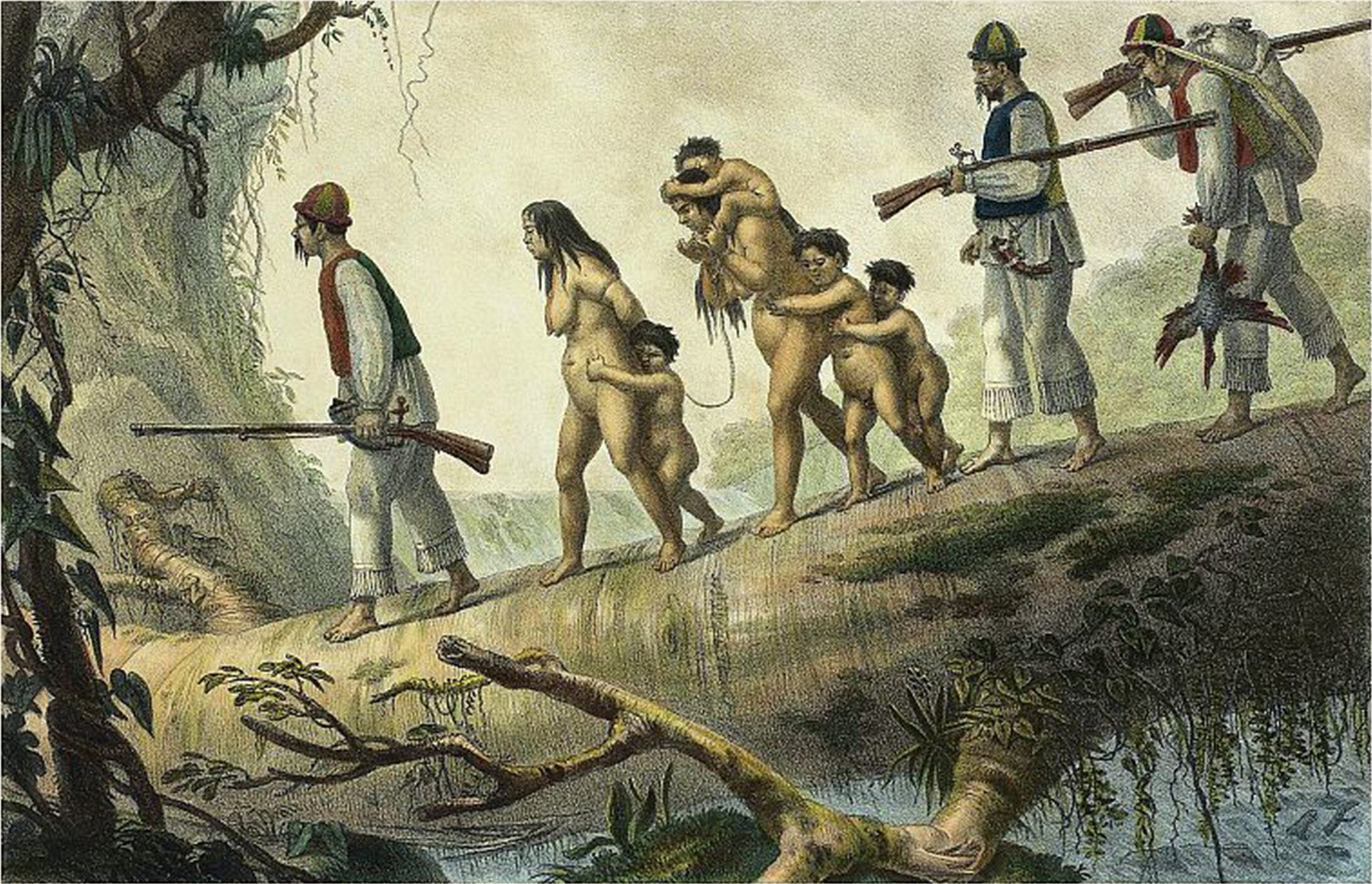
The paintings shared at the top of this piece and just below were made by a French gentleman in early 1800s Brazil, a man named Debret.
Debret was an unusual man with an early, almost anthropological fascination with the "non-white" peoples of Brazil.
The one above shows the house of Portuguese Cigano "Gypsy" slave traders in Rio de Janeiro. The other here below shows what are probably "Genizaro" or mixed-ethnic slave traders marching Guarani captives to market.
What does this have to do with Anglo-American history?
SIMILAR SCENES WERE OCCURRING FROM MAINE TO SOUTH CAROLINA TO LOUISIANA TO TEXAS TO CALIFORNIA, even if we are not lucky enough to have had a painter like Debret working in such places.
Catholic Spanish and Portuguese America saw people of mixed ethnicity as existing on a spectrum of "casto".
Protestant Anglo-America, perhaps due to its literalist and more simplistic Manichean view of things, tried desperately to reduce much of the world into binaries.
Good/evil.
Black/white.
Artificial binaries were good for defining real humans versus "property".
Free versus unfree.
But, humans being human, they often refuse to slot into ridiculous and arbitrary categories.
American "folk heroes" like Jim Bowie were trading with mixed-ethnic pirates for slaves among the mixed-ethnic communities of the Gulf Coast long before Texan "independence" from Mexico.
"Gulf of America”, indeed...
Jewish slave merchants operated out of Maryland, Rhode Island, and Charleston, with households often comprised of "free people of color".
Many Indigenous American tribes had become drawn deeply into this sordid trade, and many people of African origin became absorbed into tribal communities like the Seminole, Cherokee, and Choctaw.
Métis communities and mixed-ethnic "prairie bandits" lived for decades on the lands which would only later become the Louisiana Purchase.
And all of these people (who were often brown to begin with) "co-mingled" endlessly, thus creating an even larger brown American underclass - an unsung and largely forgotten part of American history - some of whom would spend decades, centuries, attempting to cross the color bar into "whiteness".
Comments
Nothing yet. Say the first thing.
Sign in to join the conversation.