
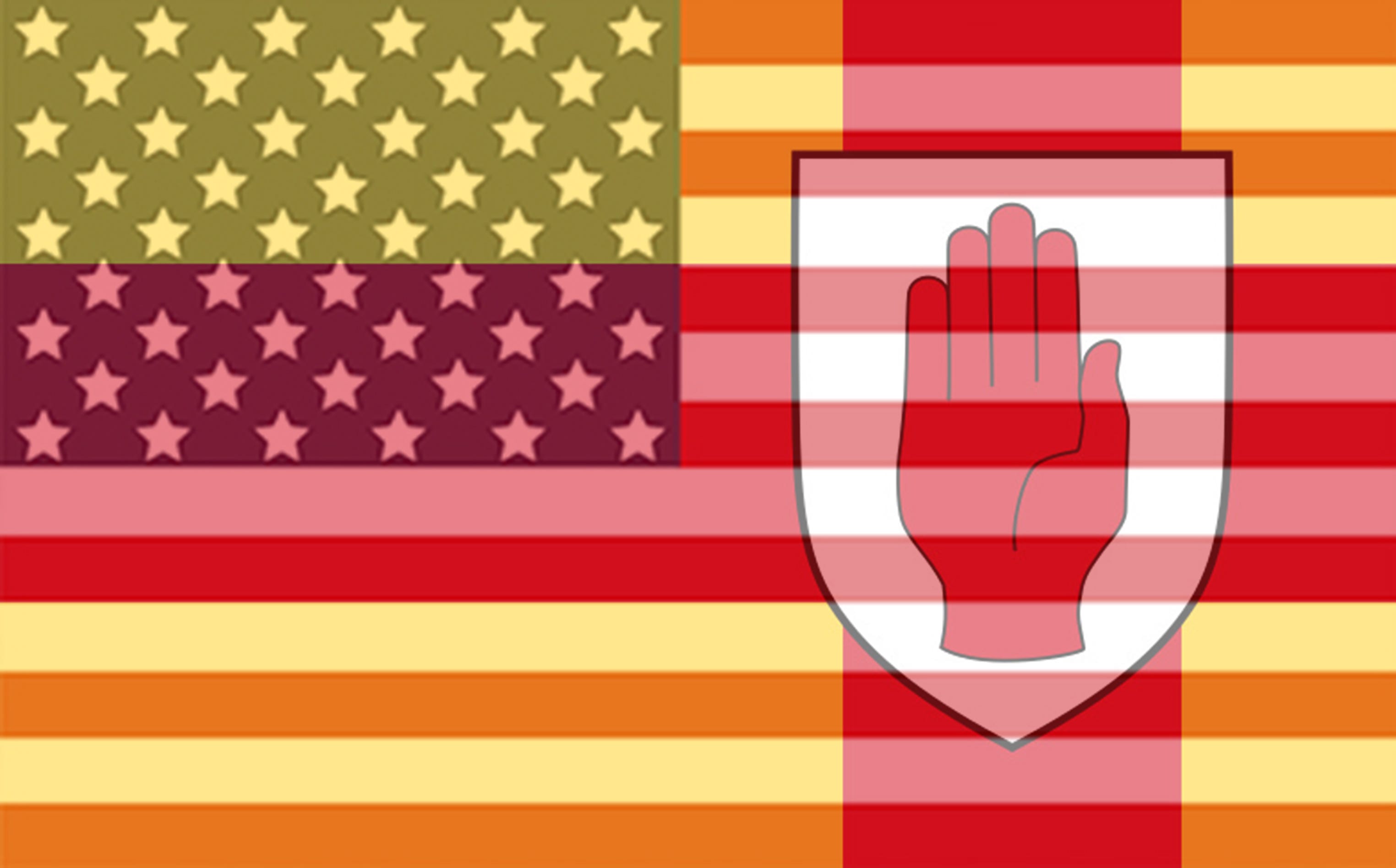
Within 48 hours of Mark Zuckerberg's pathetic, cringe-inducing curtsy before the gold-plated iron throne of MAGA authoritarianism back in January of 2025, my feed on Facebook underwent a metamorphosis.
Before We Were White is a reader-supported publication. To receive new posts and support my work, consider becoming a free or paid subscriber.
After years of curating my social media experience with third party ad-blockers, aggressive privacy settings, and regularly clicking "hide all posts from this page", Zuckerberg seems to have instructed the people who code the Facebook algorithm to go for "maximum MAGA brown nose", and find a way to force-feed right wing culture war talking points to those of us with no appetite.
I suddenly found myself being treated to an endless parade of creepy memes and "content" from various corners of the GOP, MAGA, and Christo-nationalist freakoverse.
I recall a page with around 700,000+ plus "followers" called "The Patriot Post" was particularly persistent during the first weeks of Trump’s second term in trying to shove its garbage into my beleaguered feed.
It took me a few hours of digging to get to the source of that particular spooky and weird manifestation of MAGA worship.
You are welcome to make yourself feel utterly soiled by doing your own investigations, but my own advice is don’t bother looking - unless you enjoy having unremitting ignorance and extremely limited concepts of “liberty” taking-up valuable space in your brain.
I can spare you the unpleasantness if you like.
The page/publication in question was written by people using pseudonyms ("We put the writing ahead of the writer"), whose sources of funding were as opaque as lead roof sheeting.
The main player appeared to be a man named Mark Caldwell, of Hamilton County, Tennessee. More anon.
Most urban-dwelling US citizens will be familiar with certain tropes which inform the self-identity of many heartland Americans.
Gun culture. Evangelical Protestant religion. Mistrust of authority.
What many people outside this culture do not understand, is how heartland America has spent centuries carefully redefining and reimagining its own roots, history, and origin story, to move it farther and farther away from various unpleasant truths.
For example, many of the people who first colonized the various frontiers in North America were often drawn from the very least empowered mixed-ethnic underclasses.
They acted almost as shock troops for a cash-strapped post-independence government which would only follow on their heels after much of the dirty work of ethnic-cleansing had been done.
In other words, they were useful to the new US government (with its so-called “federal lands”) and the speculator and industrialist elites (with their vast land companies).
Vast tracts of land only have a value to capitalists if resources can be converted into gold, silver, or cash.
It takes settlers to kill Indians, lay trackways and roads, log timber, set up mills, and mine lead, so the underclasses were given “title” to Indian lands through government grants, or they purchased Indian lands at a knock-down price from land speculators.
In an environment far distant from higher education or Enlightenment thought, in a place and time defined by violence, many of these colonizers would have been regarded by many people “back east” as an irretrievably debased and vulgar people - the very ancestors of the folks infamously described as “deplorables” by a certain politician.
As long as this rural underclass and urban working class remained useful (as cannon fodder for wars, for example), it was necessary for the speculator and industrialist elites to pay regular lip service to them, and to collaborate in the eventual redefining and reimagining of the underclass American identity.
The guns and violence which achieved ethnic cleansing were funnelled into a new mythos of self-reliance and “respect for the military”.
The characterization of American Indians as “savages” meant that being Christian became code for being “civilized”.
Because racialist thinking was core to both ethnic cleansing and slavery, the mixed-ethnic underclasses had to be allowed inside the “white” tent of self-identity.
Reduced to the simplest possible terms, the modern MAGA movement are the people who have chosen to accept the mythological version of their past, because the truth is far less palatable.
Back to the slop being served on social media…
Like so many other Americans from his background, Mark Caldwell of "The Patriot Post" goes big on claiming that the USA is "a Christian nation".
Like many evangelical and fundamentalist Christians who believe that if a text is old, then it must be "sacred", he treats the US Constitution as immutable Scripture.
Even though every amendment represents a decision to alter “scripture”.
Like many evangelical and fundamentalist Christians, Caldwell fetishizes military service as the ultimate expression of loyalty and devotion to the concept of "liberty".
Finally, he describes himself as being of mostly "Scots-Irish" ancestry, which is the self-identity of choice for many people of his background.
This choice of self-identity among much of conservative America is almost always based on only a tiny, selected percentage of their ancestry.
Allow me to explain why so many "Heartland Americans" perpetuate this highly-abridged (and often downright false) history of their origins...
*****
America's first inner identity, its first distinctly "American" culture, is "Southern Appalachian".
Before Appalachian culture came into being, America was largely a land of immigrant administrators, speculators, members of religious sects, colonists, convicts, servants, and slaves of many different cultures and ethnicities.
English, Africans (including the Gullah and so many others), Scottish, Irish, Welsh, German, French, Dutch, Swedish, Spanish, Portuguese, Jewish, Romani, Greek, Minorcan, Malagasy, et al.
Were these people changed by being in America? Sure. But in the earliest days, they tended to live, marry, work and migrate as ethnic enclaves, religious groups, or extended family groups.
There were Scottish communities around Cape Fear and in the Carolina backcountry. Quakers tended to settle near one another in Pennsylvania, North Carolina, Tennessee and elsewhere. German-speaking Mennonites did the same. French communities existed in places such as Manakin Town. Minorcans in Florida. Welsh towns in Pennsylvania. Jewish communities in Georgia. Displaced indigenous groups such as the Lenape and Catawba in various locales.
Unlike the people just mentioned, folks arriving in America from Ulster in Ireland were not a single, cohesive ethnic group. Some were Anglican. Some were Presbyterian. Some were Catholic. Many were Quakers. Some were English, some were Irish, some were Scottish, and a good few were Welsh. Many were French, German, or Flemish.
Some of these individual groups from Ulster stuck together in America, for a while - especially in places like Pennsylvania.
But for those who followed the spine of Appalachia southwards during the 1700s, into Virginia and the Carolina backcountry, any “Scots-Irishness” was soon subsumed into a potent, mixed-ethnic cocktail.
Southern Appalachia was not Pennsylvania (a multi-ethnic place itself).
Southern Appalachia was multi-ethnic on an entirely new level, with its mountain gaps and passes acting as funnels west for settlers from the entire eastern seaboard of North America.
In fact, "Southern Appalachian" equals "multi-ethnic".
Period.
There is no sustainable argument for a majority "Scots-Irish" culture in Appalachia. In terms of sheer numbers, people of English and German ancestry are far more prevalent.
The music said to be "Scots-Irish" is the same music which was played throughout the British Isles by English, Welsh, Irish, and Scots during the age of fiddle tunes and broadside ballads.
Feuding and fighting are not specific remnants of "Scots-Irish" culture. Feuding is a feature of remote rural insular communities everywhere; in fact, almost none of the mountain feuds of Virginia, North Carolina, Tennessee, or Kentucky were fought by people with roots in Ulster.
The cultural sideline most embraced as being a "Scots-Irish thing" - distilling liquor - was also practiced by mountain folks with German and French roots. We can know this by reading contemporary letters and wills leaving stills to relatives and children. Most everyone made booze of one kind or another from whatever was at hand.
Barley. Corn. Potatoes. Apples. Peaches.
In an age before painkillers and anesthetics, before colonizers had acquired herbal knowledge of their new surroundings, alcohol was a treasured blessing (and often a social curse).
The multi-ethnic character of Appalachia is there for all to see in other historical records, for those who care to read them.
Revolutionary War Rolls. Land bounties and land warrants. Wills. Census records. Marriages. Entries in family Bibles. Court proceedings. Newspaper accounts. Contracts of land and personal indenture.
In no county of the Southern Appalachian heartland - the hill and holler country of Eastern Kentucky, East Tennessee, western parts of Virginia and North Carolina, and southern West Virginia - in no county there, none, can the MAJORITY of people be demonstrated to be descended from Ulster folk.
Whatever Google tells you, whatever the new-fangled AI claims to "know", those search engines and large language models will only regurgitate what has been said the most times by the most people.
The majority of people in the 1970s and 1980s thought that eggs and butter were unhealthy, and that margarine was "good". We now know that everyone, from "experts" down to the man in the street, was simply repeating "received wisdom".
Received wisdom is often wrong.
*****
Someone recently asked "Why would people say they were Scots-Irish if they weren't? What could they hope to gain through this deception?"
Perhaps the most important thing to point-out when answering this question is that most old Southern Appalachian families have people of color in their family tree somewhere.
And this is surely why <some> Americans have been so determined to insist that "Southern Appalachian culture" equals "Scots-Irish culture".
If America's first non-indigenous core identity and culture could in fact be shown to be fundamentally multi-ethnic instead of "Scots-Irish" - and this CAN be shown - then one of America's earliest, largest and richest cultural identities - "Appalachian" - can no longer be considered the sole province of "Protestant white folks".
This would force us to change our image of the families travelling in covered wagons. It changes our mental picture of the people in the forts and blockhouses of frontier Kentucky. It changes the color of many women sitting at spinning wheels and looms in log cabins.
It makes us question everyone.
Tavern keepers.
Keelboatmen.
Loggers.
Mill workers.
Soldiers.
Longhunters.
And when we begin to question everyone, and we begin to see the many different ethnic groups intermixing, we begin to see a brown people.
And if you are the sort of person who believes that your culture, your "American-ness", your "specialness" resides in your "whiteness", this is a big problem for your entire sense of self.
*****
Always, always remember that America, perhaps more than any English-speaking nation, is full of people carrying surnames which bear no relation to their ancestry.
African-Americans carry Irish and Scottish surnames.
American Indians carry Irish and Scottish surnames.
As do people of Jewish and Romani ancestry.
During the late 1700s and early 1800s, America's binary racial caste system forced such multi-ethnic "brown people" of Appalachia to declare themselves "white".
This was not some personal proto-identity politics, about just wanting to identify with the "ascendant race".
This was a matter of deadly, legal seriousness.
Being declared a "mulatto" or "colored" could see any number of rights withheld.
Voting rights. The right to attend local schools. The right to own a gun.
Picking and going by a "white" name - often a name borrowed from a neighbor with Irish or Scottish roots - was the absolute basic first step in disguising one's true ethnicity.
Not every family claiming a spurious "Scots-Irish" background did this for consciously racialist reasons.
Many supporters of the Royalist or "Tory" cause found their lives and farms and personal property under threat by "Patriots" during the 1770s and 1780s. Many chose to pack-up and head for the mountains.
All things English became hugely unfashionable and undesirable in the immediate aftermath of the Revolution - a war which might arguably be better described as America's First Civil War.
People from Ulster - especially Presbyterians already hostile to Anglican English interests - were early and avid supporters of the "Patriot" cause.
It seems pretty obvious that former Tory/Loyalist families in Southern Appalachia would not have been keen to advertise their past affiliations, nor their roots, among such neighbors.
Especially if these erstwhile Tories appeared "racially dubious".
Given a choice between English-speaking "white" identities, many opted for "Irish" over "English".
Remember that the term "Scots-Irish" wasn't yet in wide usage, and certainly not among the descendants of Ulster folk. They simply called themselves Irish or Scots.
My own great-great-grandfather Hogan - a nut-brown Melungeon - claimed to have been born in Ireland on his military service records. He was not born in Ireland. Nor was his father. Nor his grandfather. But his claimed birth in Ireland helped to deflect uncomfortable questions in a deeply, deeply racist country.
Another British and American invented ethnicity - "Anglo-Saxon" - makes no room for brown people. But Anglo-Saxon racism always did allow for the idea of brown Irish people. Hell, the English were positively determined to prove the "racial inferiority" of Irish people ever since they first decided to steal the land of the Gaels.
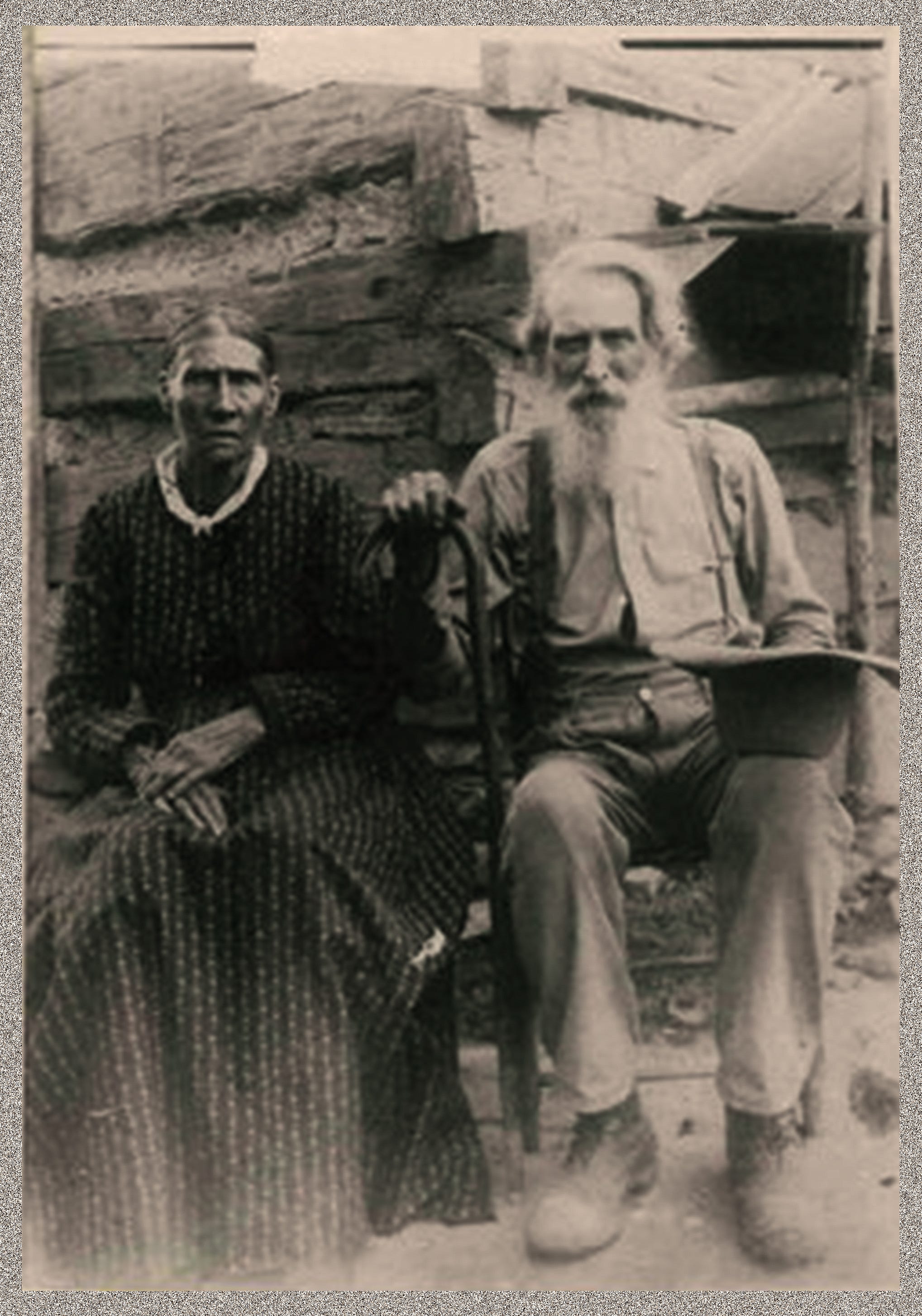
[Photo: Alfred Bailey and wife Sarilda Perkins]
In other words, my brown ancestors could have never gotten away with saying they were "Anglo-Saxon", and certainly did not want to admit to being part Indian or African.
Somewhere along the line, one side of my family became "Hogans", and in doing so, they also became Irish, and over time, "white".
Similar stories unfolded all over Appalachia.
There are some family lines of people named Vance, Myers and McInturff who call themselves "Scots-Irish", when they are in fact of German descent from people surnamed "Wentz", "Mayer" and "Meckendorf".
For multi-ethnic Appalachians, to be "Irish" was a simple form of shorthand.
Being "Irish" was to be aligned with "whiteness".
Being "Irish" was to be aligned with American, as opposed to English interests.
The history of Southern Appalachia during the 1700s and 1800s is one of the most richly fascinating stories imaginable.
We are doing this story a grave disservice by hiding it under a reductionist blanket of "Scots-Irishness".
Before We Were White is a reader-supported publication. To receive new posts and support my work, consider becoming a free or paid subscriber.
Comments
Nothing yet. Say the first thing.
Sign in to join the conversation.