
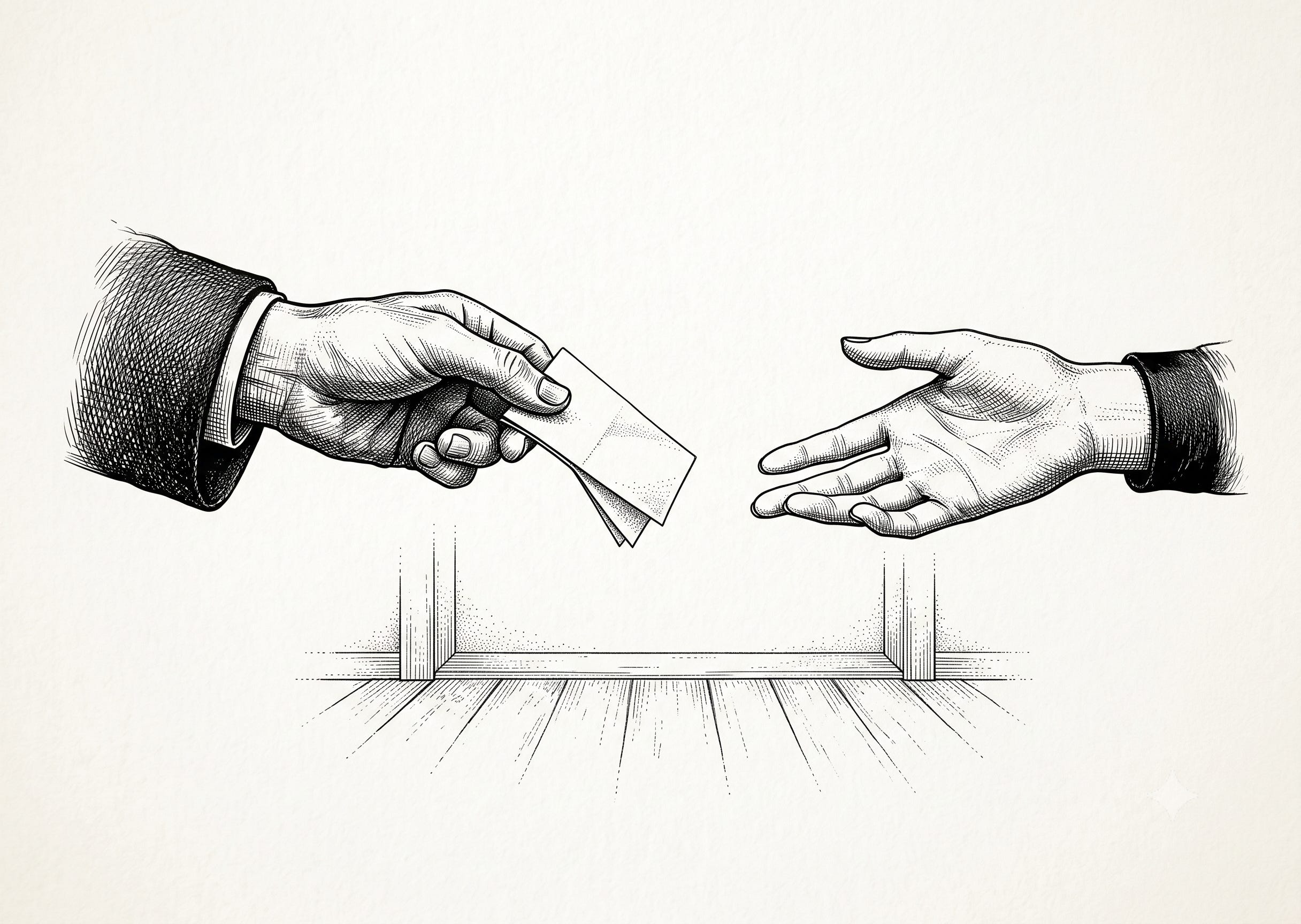
Julia Minson has spent years studying a question most of us assume we already understand: what happens when two people disagree. Her book, “How to Disagree Better,” distills that research into a quality called receptiveness. The people who handle disagreement well — the ones others find worth talking to again — are not the ones making the sharpest arguments. They are the ones who visibly engage with their counterparty’s perspective rather than bracing against it.1
In her academic work, Minson defines receptiveness as the willingness to access, consider, and evaluate contradictory opinions in a relatively impartial manner. In her experiments, people trained to write with conversational receptiveness are seen as more reasonable and more trustworthy, and their counterparts come away evaluating them more favorably and are more willing to keep talking. Furthermore, the effect is reciprocated. That is, if one person uses receptive language, their counterpart will tend to do so, as well.
What receptiveness does not do reliably is change anyone’s mind. In one study, receptive writers were about as persuasive as writers who were explicitly told to be as persuasive as possible. You don’t sacrifice persuasiveness by being receptive, but you don’t enhance it, either. Minson argues that the right thing to measure in a difficult conversation is its quality and its aftermath, not whether someone capitulated.
She proposes a different yardstick altogether. The measure isn’t agreement, consensus, or compromise; it’s whether both parties come away wanting to talk again. Receptiveness lowers the relational cost of disagreement and keeps the door open. It doesn’t settle who was right.
Minson’s work illuminates the threshold between the pre-meeting reflection I focus on and the facilitated engagement in the meeting itself. It also helps to highlight a bias in my thinking.
Minson starts by naming the trap underlying most bad disagreements: naïve realism. Naïve realism is our quietly confident assumption that our own view of the world is accurate, and that anyone who sees things differently must be misinformed, biased, or acting in bad faith. When someone disagrees with us, we don’t pause to wonder what we’re missing; we reflexively wonder what’s wrong with them. From there, the goal of the conversation becomes winning, and that reliably ends learning.
She advocates shifting from “How do I win this argument?” to “How do I understand my counterpart’s position?” Crucially, receptiveness isn’t only an attitude; it has to be reflected in the words we use. Because we are reliably bad at reading each other’s intentions, we must depend on our language.
We demonstrate our receptiveness by asking questions that signal our sincere interest in learning about and understanding our counterpart, listening to their whole answer before interjecting, and restating our counterpart’s views until they have verbally confirmed our understanding. When it’s our turn to talk, Minson offers a compact formula she calls H.E.A.R.: hedge your claims rather than universalize them, emphasize where you actually agree, acknowledge the other person’s views before you counter them, and reframe to the positive.
None of this asks you to abandon your position. It asks you to show that you’ve left room in your head for theirs.
Minson is precise about the words that shut down constructive disagreement. These include negations (“don’t,” “can’t,” “never,” “hate,” “terrible”), the lecturing and condescending reasoning words (“because,” “therefore,” “the fact is”), and the adverb limiters (“merely,” “just,” “simply,” “only”) that diminish the other person’s point of view.
In addition, she argues that much of the perceived distance separating us stems from false polarization. We systematically overestimate how far apart we are, then avoid the conversation that would correct the caricature. That, of course, ensures the caricature persists.
It’s a good book, built on real evidence. I think its central claims are true.
Almost everything Minson prescribes happens in the room. Be receptive while the stakes are live and emotions run hot. Hedge while your status is exposed. Acknowledge the other’s view at precisely the moment your adrenaline is arguing to belittle it.
I’ve argued that this is exactly the wrong place to locate the fix. Courage is a tax on honesty, I wrote; good design is a subsidy.2 The entire premise of the methodology I’ve been helping to develop — asynchronous, anonymous reflection that surfaces divergence before the meeting — is that you should not have to be brave or skillful in the moment to get the right things on the table. Instead, you should be able to subtract social pressure rather than ask people to overcome it.
So, on first read, Minson sounds like she’s standing on the wrong side of my line. She’s handing people a behavioral discipline and asking them to perform it precisely when performance is hardest. She admits as much, writing “engaging with opposing views in order to learn about other people, improve your mastery over your own emotions, and improve your relationships does take courage.”
The thing is, the line I just drew isn’t a boundary; it’s a threshold. My work on pre-meeting intelligence walks up to that threshold and stops.
The anonymous reflection, the AI-assisted synthesis, and the Field Report lay out the tensions a group would probably otherwise bury; all of the Reflect & Engage machinery is designed to get the hard thing said. It does little to ensure the hard thing is heard. I made this point recently: bias doesn’t silence the message, it disqualifies the messenger. A view can be stated perfectly clearly and still be waved off. Separating the speaker from the perspective gets the sentence into the room. It doesn’t make the room receptive to hearing and understanding it.3
I’ve not pretended otherwise. The Field Report’s job is to hand a map of tensions, unexamined assumptions, and minority perspectives to a facilitator. In other words, the structural half of the process ends by naming the facilitator as responsible for the behavioral half. But equipping the facilitator with better situational awareness is not the same as facilitating.
Minson’s insights don’t compete with structural design. She describes the skills the facilitator and the group need in the room. Conversational receptiveness is what someone on the receiving end of a divergent view either extends or withholds.
I have written about the relevance of behavioral methods, including Humble Inquiry, listening as a discipline, and psychological safety.4 To be honest, though, I’ve implicitly ranked them as second in importance to structural design. Underpinning my writing has been an assumption that behavioral methods are something of a fallback, the thing you lean on when the structural work is incomplete. That was a mistake.
Structural design and behavioral methods aren’t competitors; they’re elements of a relay. Structure gets the baton to the threshold of the meeting. The next leg requires the application of behavioral methods.
It would be tidy (and gratifying) if I were able to close with “structural design allows dissenting perspective to be voiced, and then conversational receptiveness during the conversation allows dissent to be heard.” But answers tend to reveal new questions.
My first concern relates to the difference between experimental conditions and real disagreement when the stakes are high. Minson knows these are hard cases, and her research examines disagreements around hot-button issues. She believes, with good reason, that training in conversational receptiveness will trigger reciprocity, which will tend to make hard conversations better. Nevertheless, I’m not sure how her methods survive contact with a live, high-stakes room where status and livelihood are exposed. Surfacing dissent in such instances can be a tricky business.
Minson is careful to frame the boundaries of her research findings. Receptiveness helps people feel more reasonable toward each other, trust each other more, and stay willing to keep talking. Those are relational goods worth pursuing. They are not the same as the group deciding better as a result. A room can hear a dissenting view and still talk itself into the wrong decision. Receptiveness keeps the conversation alive and humane, but it doesn’t guarantee an outcome. That’s not a failure of Minson’s techniques; it may be a limit.
My project focuses on the centrality of orientation, but the quality of orientation must manifest in sound decisions and, ultimately, effective action.5 Structure gets the buried thing said without anyone having to be brave. Receptiveness gets it heard without fracturing the relationship. Neither tells the group whether the buried thing was right. That’s a separate problem, and I’ve acknowledged before that revealing a tension isn’t the same thing as resolving it.6
Finally, I perceive one last complication. If a disagreement is constructive when it leaves people wanting to talk again, then the success condition is not closure; it’s return. A material disagreement, the kind worth surfacing in the first place, may need several conversations before a group can act on it. But almost no one convenes a meeting wanting to schedule three more. The sponsor wants congeniality, alignment, and a decision they can act on. The group wants the relief of having reached a conclusion.
I pitch the structural front-end as a way to improve the meeting. The most honest thing receptiveness might produce is recognition that this particular disagreement isn’t resolved, and the right next step is to come back to it tomorrow. By Minson’s definition, that’s a success, and I don’t disagree. Even so, by the calendar's measure, it may appear that the process failed to deliver what it was hired to do.
I can help design the conversation up to the meeting threshold. I can help prepare the facilitator for what’s coming next. I can’t build the receptiveness the moment requires, and even where that receptiveness exists, it buys a better conversation, not automatically a better answer, and not always a finished one.
Julia Minson, How to Disagree Better (2026). Minson is a decision scientist and professor of public policy at the Harvard Kennedy School and founder of the Constructive Disagreement Lab. Her book synthesizes her peer-reviewed research on receptiveness.
In “Trustworthy by Design,” I argue that honest input is best produced by structural safe harbors rather than by asking people to be brave. I concede in “No Villain in the Room” that conversational design can make courage less necessary, but it can’t do everything.
In “Said Is Not Heard,” I examine the categorization-elaboration model and conclude, “Whether what is said is heard is answered in real time, by the people in the room, with anonymity stripped away.”
No posts
Comments
Nothing yet. Say the first thing.
Sign in to join the conversation.