
PIE organizes and facilitates executive peer exchanges for professional service firms. Last year, over 5,000 executives in more than 100 peer groups were guided by PIE’s facilitators in more than 400 conversations.
They know what they’re doing.
To ensure that each exchange is relevant and timely, PIE interviews each participant in advance of the meeting. Over the years, PIE has conducted tens of thousands of such one-on-one interviews because it has found them effective. They are also logistically complex, time-consuming, and expensive. Furthermore, while PIE has developed sophisticated hiring parameters and training protocols, facilitators’ interviewing skills vary.
I have often wondered how groups might benefit from PIE-style pre-meeting intelligence without the high cost and extended timelines. But the more time my colleague, Laura Black, and I have spent designing an alternative, the more I’ve come to respect what PIE’s approach does that ours cannot. The interesting question isn’t which mode of interviewing is better. It’s what you lose when you choose one over the other, and whether you can live with the loss.
It’s tempting to describe a good interview as a sequence of probes. The follow-up questions, the “say more about that,” the willingness to sit in a pause until the interviewee fills it, are all part of it. But I don’t think it’s the core.
The core is witnessing. A skilled interviewer takes someone seriously in real time, and the effect on what the person can say is immediate and non-trivial. Inquiry is not just a technique for extracting information. It’s a way of being present that changes what the other person hears themselves thinking.
Edgar Schein, whose work on Humble Inquiry has shaped my own, argued that the deepest function of genuine questioning is not to extract a better answer but to build a relationship in which better answers become possible.1 The interviewer’s attention is not passive. It creates a space, a relational container of sorts, in which the interviewee can risk saying something they haven’t fully formed yet. Thoughts that would dissolve if spoken into a void can survive in the presence of someone who is visibly receiving them.
People will cross into territory in the presence of a patient, curious, non-judgmental human being that they will not cross alone at a keyboard or a microphone. I’ve experienced this myself on both sides of the table.
That’s not a minor benefit.
And yet.
The interviewer constitutes an audience, and we perform for the audience to a degree. The interviewer’s demeanor, status, and relationship with others influence what we say and how we say it.
The psychologist James Pennebaker has spent decades studying the difference between processing experiences privately and disclosing them to another person. His findings are relevant here. Pennebaker’s research on expressive writing demonstrates that people can benefit cognitively and emotionally through solitary, anonymous reflection, without a witness present.2 The mechanism he identifies isn’t relational. It’s the act of translating experience into language, which forces a coherence that unstructured thinking doesn’t require.
The implication is uncomfortable for anyone, including me, who values the craft of live interviewing: some of the depth we attribute to the interviewer’s skill may actually arise from the structured act of reflection itself. The witness helps. But the witnessing isn’t always what’s doing the work.
And in certain contexts, the witness actively gets in the way.
The most visible version of this problem occurs in group settings. Some meeting participants will not speak the full truth when their boss or someone who reports to their boss is in the room. Or when they are the only person who holds a particular identity, disagrees with the prevailing view, or has watched the last three people who spoke up get quietly classified as “not a team player.” Power dynamics, perception bias, and conversational pace distort what surfaces. Extroverts are more likely to be perceived as confident and credible; quieter voices are undervalued, not because their thinking is weaker but because their delivery doesn’t match the room’s tempo.3
But a one-on-one interview with a skilled facilitator isn’t the same as a room full of people. The boss isn’t present. The loudest peers aren’t setting the tempo. The interviewer’s full attention is on the interviewee, and the best interviewers know how to make the conversation feel safe. So does the problem disappear?
I don’t think it does, because the interviewer is never entirely separable from the larger room they represent. The interviewee knows, even if it’s never stated, that the interviewer will synthesize what they hear and carry it forward into a report, a briefing, or a group conversation. The facilitator is, in this sense, a proxy for the larger room. And the calculus of disclosure shifts accordingly. The question the interviewee is quietly answering is not “do I trust this person?” but “do I trust where this goes after it leaves this person?”
Amy Edmondson’s research on psychological safety has made this dynamic visible in organizational life. What her work shows is that candor is not a personality trait; it’s a function of the environment.4 People don’t withhold because they lack courage. They withhold because they’ve made a rational calculation about the cost of disclosure. That calculation doesn’t require the boss to be physically present. It only requires the interviewee to believe that what they say might reach the boss with their name still attached.
The result is a paradox. The witness who creates the relational container for depth is also, in some contexts, a vector for attribution. The same presence that helps someone think out loud can be the reason they choose not to.
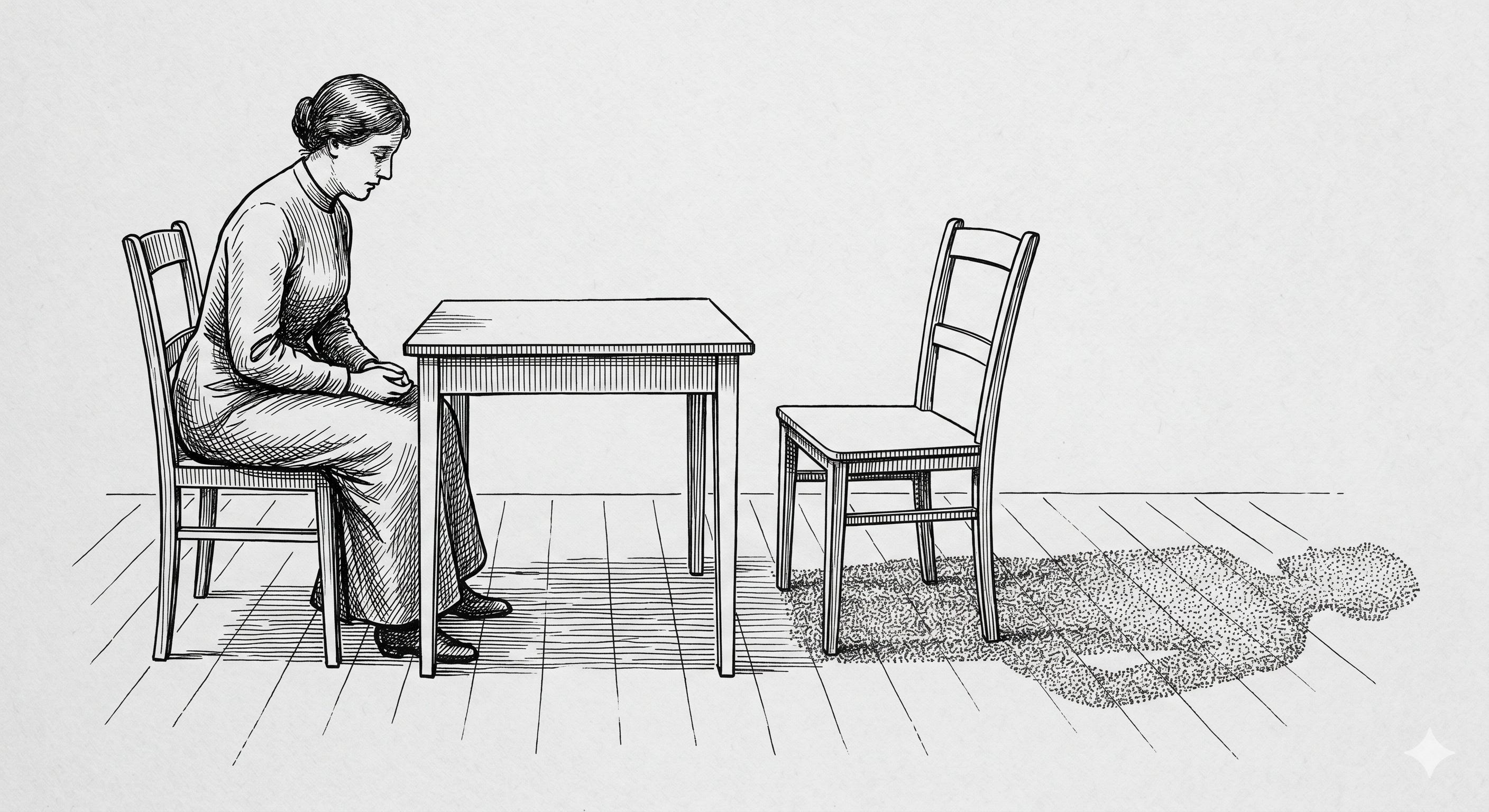
This is the design problem at the center of Reflect & Engage. Not “how do we interview people more efficiently?” but “what happens if we deliberately remove the witness from the room?”
R&E uses asynchronous, anonymous virtual interviews composed of a prepared set of reflection prompts that participants respond to at their convenience without an interviewer present. The design logic is one of subtraction: remove the audience, and the fear of attribution is lessened or eliminated. Remove the time pressure of live conversation, and the advantage of thinking quickly on your feet is neutralized. Remove the identifiable voice, and responses to identical prompts can be compared across a group to surface divergent thinking that would never have emerged in a shared room. It’s an attempt to make courage less necessary by removing the conditions that demand it.
But subtraction can have a cost.
When you remove the interviewer, you remove the relational container. No one is visibly receiving the interviewee’s half-formed thought. No one is sitting in the pause. No one is asking the follow-up question that says, in effect, that thing you just said matters.
Schein’s point about Humble Inquiry is precisely that the relationship is the mechanism for depth. If he’s right, then removing the witness doesn’t just change the logistics of data collection. It changes the kind of thinking that’s even possible.
It’s difficult to convey warmth, empathy, and understanding through a screen. Speaking into a microphone, for many people, imposes its own performance pressure. The reflection prompts must be carefully constructed because there’s no opportunity to read a look of confusion or irritation and offer clarification. Even with the capabilities of conversational AI, the ability to ask effective follow-up questions is constrained compared with a skilled human interviewer.
In addition, anonymity, while structurally powerful, is not foolproof. In small-group settings, attribution by inference is a real possibility. The structural guarantee of safety is always weaker than it appears.5
So the trade is real. What’s gained in candor may be lost in depth. What’s gained in equity of voice may be lost in the kind of relational thinking that only happens when someone is present and paying attention.
I’ve been building Reflect & Engage for long enough now to know that the trade-off between witnessing and candor isn’t a problem to be solved. It’s a tension to be managed, and the right answer depends on the context.
In PIE’s world of executive peer groups, the trade-off barely exists. Neither the facilitator nor the interviewee’s peers are threatening. The interviewee’s self-interested disclosure helps set the agenda for a group conversation among relative equals. In this context, the witnessing enabled by live interviewing is an unambiguous virtue.
But PIE’s context is not the only context. When a leadership team is facing a decision that will affect people with unequal power in the room, and when candid perspectives may only surface if the cost of disclosure is reduced, the absence of a witness may be precisely what’s needed.
R&E is designed to provide a facilitator with pre-meeting intelligence for a subsequent live conversation. The output from the anonymous reflections enhances the facilitator’s ability to interrogate the group, so that minority perspectives, unexplored assumptions, and tensions aren’t overlooked. In that sense, the two modes aren’t competing; they’re sequential. The anonymous reflection feeds the witnessed conversation.
Nevertheless, I’m not fully satisfied with that framing, because it makes the design sound cleaner than it is. Some of what a skilled interviewer would have drawn out in a live conversation will never surface in an anonymous prompt response. The relational container does something that structural anonymity cannot replicate. The question of whether what’s gained justifies what’s lost is one that is only answered provisionally, case by case.
I keep thinking about Pennebaker’s finding that structured private reflection can produce meaningful insights without a witness. It’s reassuring, and I believe it. But I also know, from my own experience on both sides of the table, that there’s a quality of thinking that happens in the presence of someone who is genuinely curious about what you’re about to say. I don’t know how to design for that without reintroducing the conditions that suppress candor.
Edgar Schein, Humble Inquiry: The Gentle Art of Asking Instead of Telling (2013). Schein’s argument is that the Western cultural bias toward telling over asking undermines the relationships on which effective organizations depend.
James Pennebaker’s research on expressive writing, spanning several decades, consistently finds that structured written reflection produces measurable cognitive and health benefits. See Opening Up by Writing It Down (2016) for a comprehensive treatment. Although Pennebaker has focused on reflective writing, in an APA podcast, he acknowledged no meaningful difference between reflective writing and “talking to a speech to text program.”
The research on perception bias in conversational settings is extensive. I’m drawing broadly here from work on thin-slice judgments and the halo effect associated with confident verbal delivery, but I should note I haven’t found a single study that cleanly isolates this dynamic in interview-specific contexts. The claim is plausible and widely supported in adjacent literatures, but it’s not as empirically tight as I’d like.
Amy Edmondson, The Fearless Organization: Creating Psychological Safety in the Workplace for Learning, Innovation, and Growth (2018).
No posts
Comments
Nothing yet. Say the first thing.
Sign in to join the conversation.