
A friend of mine suggested that what we’re trying to do with Reflect & Engage reminded him of “clearing landmines.” It’s an interesting analogy that I’d like to explore1.
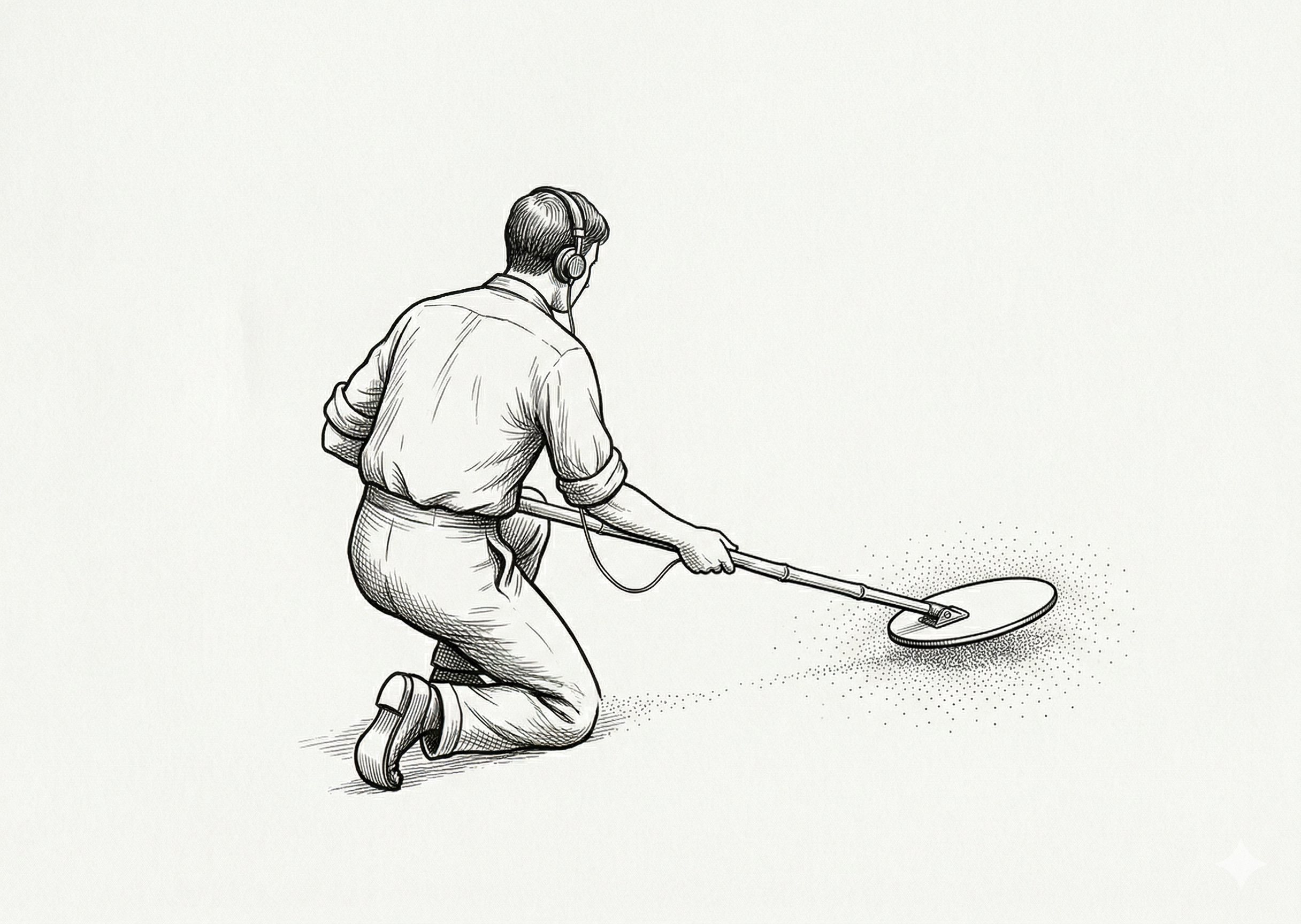
Picture a scene from the Second World War: a British soldier on his hands and knees in the North African sand, pushing a pointed stick into the earth, hoping to feel the outline of a buried mine before it feels the weight of his body. Before 1941, this was the state of the art. The method for finding hidden explosives was, essentially, to poke around and hope for the best. It was a process nearly as dangerous as walking blindfolded through the minefield2.
Most leadership teams making high-stakes decisions operate under analogous conditions, though the stakes are measured in capital, strategy, and institutional trust rather than life and limb. The “buried mines” are unexamined assumptions, suppressed minority perspectives, and premature consensus, which distort a group’s perception of reality. The traditional method of finding such landmines is equivalent to prodding with a bayonet: convene a meeting, ask “does anyone disagree?”, and hope that someone is brave enough to speak up before the group steps on something it doesn’t see. With Reflect & Engage, my colleagues and I are proposing a different instrument for the job, one whose logic mirrors the portable mine detector invented by Jozef Stanislaw Kosacki in 1941.
Kosacki’s great contribution was not that he found a way to destroy mines. It was that he found a way to reveal them without triggering them. His detection device consisted of a bamboo pole with an oval panel holding two electromagnetic coils, connected to headphones via an amplifier. It disturbed no earth and applied no pressure. It simply passed over the ground and listened. When the induction balance between the transmitting and receiving coils was disturbed by a metallic object beneath the surface, an audio signal indicated to the soldier, “Something is here.” The information arrived before the consequence.
Reflect & Engage operates on a similar principle. The process is designed to surface tensions and divergent assumptions before they detonate in a boardroom, or worse, silently warp the decision without anyone noticing. It asks each person to reflect individually and privately before the group convenes, which might be considered to be the methodological equivalent of Kosacki’s coils passing over the ground: it scans the terrain of a group’s thinking without applying the social pressure that causes people to suppress what they actually believe. What emerges is a map of hidden assumptions and minority perspectives that reveals what might have otherwise remained buried.
Kosacki gave soldiers a way to read the electromagnetic signature of buried metal. The value of his device was in what it prevented: the catastrophic encounter between a human being and an invisible danger. Reflect & Engage aims to give decision-makers a way to read the cognitive and social signature of buried disagreement.
Both technologies are lightweight, portable, and designed to be used before the consequential act. Both assume that the danger is not the absence of skill or courage but the absence of perception. Both demonstrate a profound truth: the most powerful tools are often not those that help us do more, but those that help us see what is already there.
But the analogy has limits, and I'm not sure I've found all of them yet. A mine is binary. It's either buried there, or it isn't, and Kosacki's detector gives you a clean signal. The things Reflect & Engage is scanning for aren't like that. An unexamined assumption doesn't sit in one spot waiting to be flagged. It's more like a root system: distributed and entangled with the things the group actually needs to keep. A detector tells you where not to step, which is clear, actionable guidance. I'm less certain that surfacing a buried disagreement tells a group what to do next. It might just make the ground feel less stable. That could be exactly what's needed, or could be paralyzing, depending on the group and the moment. The analogy feels right. However, I want to be careful about what I'm borrowing and what I'm glossing over.
The parallels are appealing. They might even be appropriate.
Thanks to my friend, Jeff Linkenbach, a highly skilled and experienced facilitator, for making the conceptual link between Reflect & Engage and “clearing landmines.”
No posts
Comments
Nothing yet. Say the first thing.
Sign in to join the conversation.