
Your “relaxing” is keeping you stressed. Scrolling isn’t rest.
Netflix-while-texting isn’t rest. Your nervous system reads constant input as “stay alert.” The cortisol stays up. And nothing feels calming — no matter how tired you are.
Most stress advice treats your evening as the problem to fix. Wind down more. Breathe more. Try harder to relax.
But here’s what nobody tells you.
Cortisol is your main stress hormone. It’s meant to rise in the morning and fall by night.
When you’re “on” all day — texts, news, decisions — it can stay elevated into the evening. Stress hormones stuck in the on position.
So you lie there wired-but-exhausted. Your body never got the all-clear.
That’s not a willpower gap. It’s a timing problem — and timing is fixable.
You’re not bad at relaxing. You’ve just never given your nervous system a moment with no input.
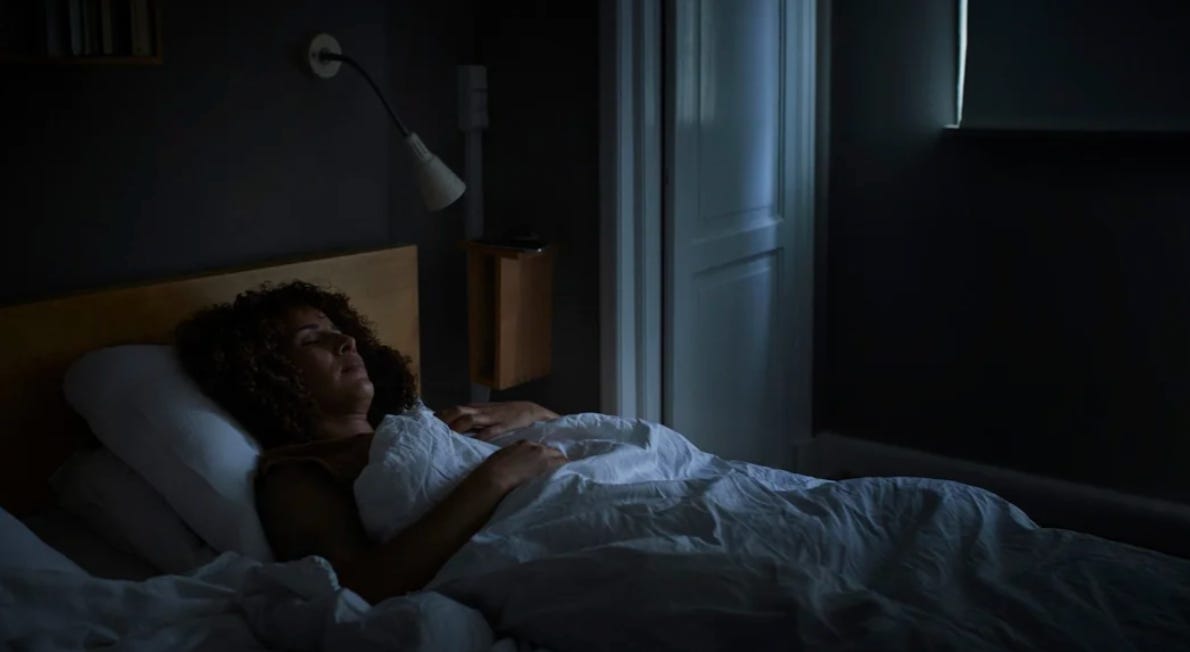
→ Why “wired but tired” is a cortisol-timing problem, not a discipline one
→ A 90-second reset that, in a Stanford study, beat meditation
→ The full daily order — built around kids, not a quiet house
→ Read time: ~6 min
if you only do one thing from this post, do the physiological sigh. 90 seconds, in the pickup line. That alone moves the needle.
Joe Rogan spent 3 hours with James Nestor learning that most people breathe wrong every minute of every day.
Two short inhales through the nose. One long, slow exhale through the mouth. Repeat for 60–90 seconds.
The long exhale signals your nervous system to shift out of “alert” — your heart rate drops and the edge comes off.
In a 2023 Stanford study, five minutes of this a day reduced anxiety and physiological arousal more than meditation did.
Do it at the next red light. No app, no setup.
Scrolling is input. Netflix-while-texting is input. A podcast during chores is input.
Constant input keeps your nervous system in “stay alert” — so cortisol never gets the signal to drop.
Real rest has almost no input. Even two minutes of sitting with nothing counts.
This is the one most parents have never actually tried. Two minutes, no screen. That’s the whole experiment.
Most stress advice was built for someone with a quiet house and two free hours. That’s not your life — so let’s build for the one you’ve got.
Before the full sequence — one question I actually want you to answer.
What time of day does the stress hit you hardest: the morning, the 3pm wall, or 10pm?
Reply with one word. I read every reply personally not a generic response. It tells me what to write next, and it helps me help you.
Here’s the exact order to run all seven across one ordinary day — including the morning move that sets your cortisol rhythm before the chaos starts, and the one most parents skip entirely.
Comments
Nothing yet. Say the first thing.
Sign in to join the conversation.