
A Stanford neuroscientist said this directly:
High cortisol doesn’t just make you anxious.
It physically enlarges your amygdala —
your brain’s fear centre —
making it hypersensitive to threats
that aren’t actually there.
It wrecks memory formation
by flooding the hippocampus
with cortisol receptors
that block the encoding of new information.
And it creates the specific sensation
most parents describe as their brain “feeling broken.”
The fix is not psychological.
It’s not meditation or journaling or gratitude.
It’s physical.
Body-based.
And most of it takes under 5 minutes.
Here’s what chronic cortisol is actually doing to your brain.
Not metaphorically. Physically.
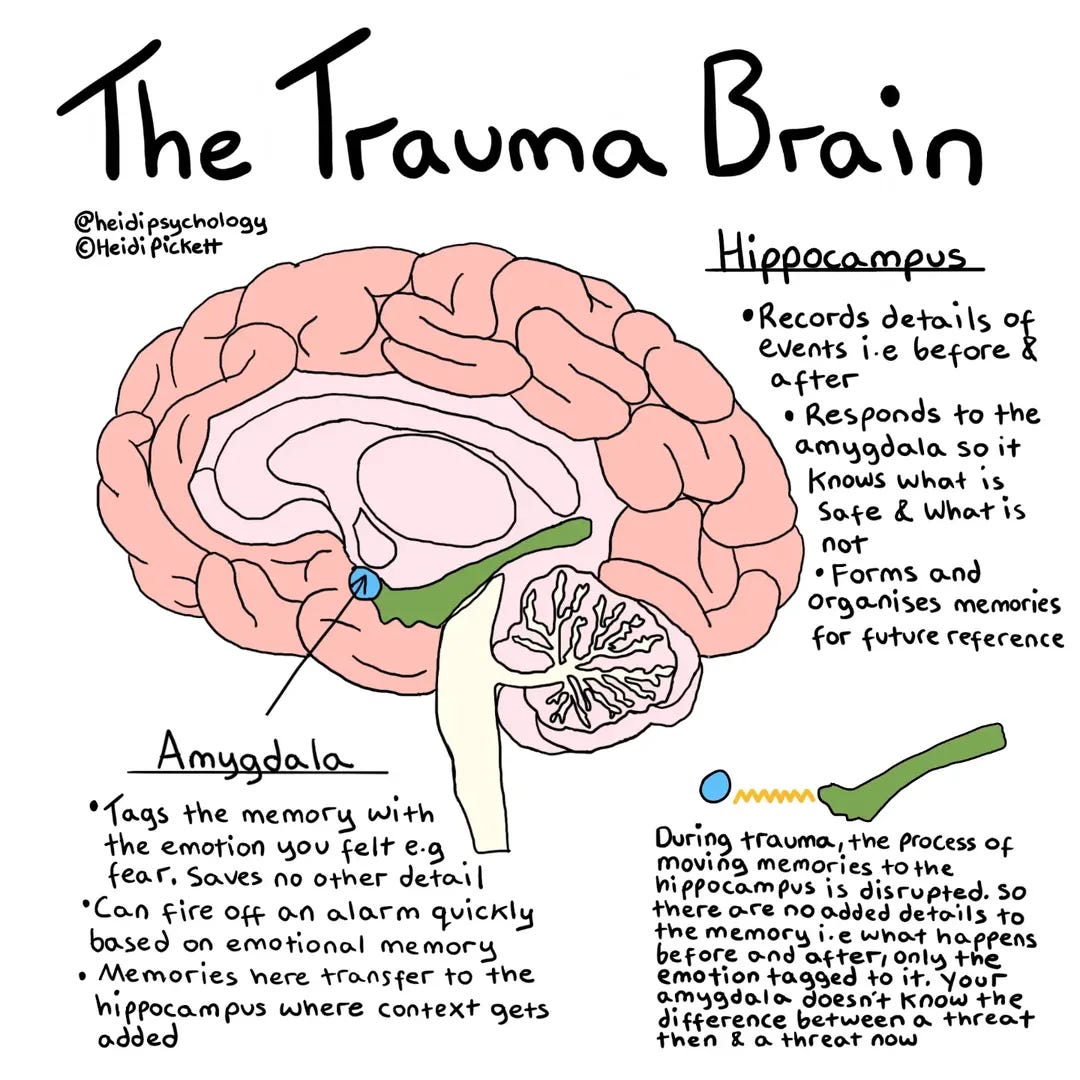
Your amygdala is your brain’s threat detection centre.
When cortisol stays chronically elevated —
the amygdala physically grows larger
and becomes hypersensitive to perceived threats.
This is why everything feels urgent.
Why small things feel catastrophic.
Why you snap at the kids over something minor
and can’t understand your own reaction afterward.
Your threat detector has been rewired
by a hormone that’s been running
since the alarm went off this morning.
The hippocampus — your brain’s memory formation centre —
is packed with cortisol receptors.
When cortisol floods the hippocampus chronically,
those receptors block the encoding of new information.
The email you’ve read four times.
The name you should know.
The word that was there a second ago.
That’s not age.
That’s cortisol.
Not because anything is fundamentally wrong with you.
Because a stress hormone designed for short-term emergencies
has been running continuously
in a body built for a world
where emergencies ended.
The fix your brain needs
is not a better mindset.
It’s a body-based signal
that the emergency is finally over.
→ 8 body-based habits that lower chronic cortisol — reordered by mechanism and surprise
→ Why your feet, your eyes, your breath, and your voice are four direct cortisol pathways most people never use
→ The exact daily sequence and the order that makes each habit compound (paid section)
→ Read time: 5 min
Pick the two that surprise you most.
Those are usually the ones
your nervous system has never received before.
New signals produce the fastest shifts.
Reordered by surprise — starting with the ones most people never consider.
Threat states narrow your visual field. You get tunnel vision. Widening your gaze sends an immediate safety signal through your entire nervous system — in seconds, with no equipment.
When the threat response activates, the sympathetic nervous system narrows visual attention — a survival mechanism designed to focus on the specific threat. This narrowing — called “tunnel vision” — is controlled by the superior colliculus and connected directly to the amygdala’s threat assessment system. The relationship is bidirectional: the brain narrows vision when it detects threat, AND narrowed vision signals to the brain that a threat is present. When you deliberately widen your visual field — softening your focus, expanding peripheral awareness — you send a signal through the orienting system in reverse. The brain reads wide, soft vision as an absence of threat. Cortisol begins to drop. The freeze response loosens. Research on attentional bias in anxiety confirms that practices which broaden visual attention measurably reduce perceived threat intensity — because they interrupt the narrow-vision → threat-confirmed loop at the sensory level.
Narrowed tunnel vision → orienting system signals threat present → amygdala stays activated → cortisol continues → widened soft gaze → orienting system signals safety → amygdala activation reduces → cortisol begins to fall.
The moment you’re staring at the screen feeling the anxiety build. The eyes physically narrow. The jaw tightens. The cortisol climbs. All you have to do is let your eyes go soft — look at the whole room instead of the single email — and your nervous system receives a signal it was waiting for.
Let your eyes go soft and wide. Don’t focus on any single point. Take in the whole room with relaxed peripheral vision. Hold for 60 seconds. Repeat at any moment of rising anxiety throughout the day. No setup. No equipment. Available at 2pm in any meeting.
Humming stimulates the vagus nerve directly through laryngeal and pharyngeal vibration. It increases social safety signals in the brain and drops cortisol measurably within 2 minutes.
Vocalization — specifically low-frequency humming — engages the vagal pathways through a specific mechanism. The larynx and pharynx are innervated by branches of the vagus nerve. When these structures vibrate during humming, they send direct parasympathetic signals along the vagal pathway to the brainstem — triggering a shift from sympathetic activation toward parasympathetic rest. Simultaneously, vocalization activates what Stephen Porges’ polyvagal theory identifies as the social engagement system — the neural circuit that signals “I am safe, I am with others who are safe.” Tonal singing and chanting have been shown to increase social safety signals and reduce the amygdala’s threat response. On the physiological level, humming on long exhales compounds the vagal stimulation with the exhale-dominant breathing mechanism — producing the fastest combined parasympathetic response available in under 2 minutes.
Humming on exhale
→ laryngeal/pharyngeal vagal stimulation
→ parasympathetic signal to brainstem
→ social safety system activated
→ amygdala threat response reduces
→ cortisol begins to fall
→ heart rate drops
→ body relaxes.
The school pickup queue. The drive home. The 2 minutes before walking through the front door. Mouth closed. Low steady hum on every exhale. Your kids won’t notice. Your cortisol will.
Hum on long exhales for 1–2 minutes. Any pitch — whatever resonates most in your chest. Mouth closed. Combine with soft gaze for a compound effect. Best use: transitions between stressful contexts — the car, the lift, the bathroom before a difficult meeting.

Nature scenes reduce stress reactivity, improve mood, and lower rumination. But only if you let your nervous system receive it — which requires no input competing for the same attentional bandwidth.
Exposure to natural environments reduces activity in the subgenual prefrontal cortex — the brain region associated with rumination and repetitive negative thinking. Research from Stanford demonstrates that 90 minutes of nature walking significantly reduces rumination and subgenual prefrontal cortex activity compared to urban walking. The mechanism: natural environments activate the salience network differently from urban environments — providing restorative attention that doesn’t deplete cognitive resources. The key variable that most people eliminate: the phone. Podcasts, music, and social media consume the same attentional channels that nature is trying to restore. The nervous system needs input bandwidth to receive the regulating effects of natural stimuli. Competing digital input blocks the mechanism entirely.
Natural environment exposure
→ reduced subgenual prefrontal cortex activity
→ rumination decreases
→ salience network recalibrates
→ stress reactivity reduces
→ cortisol baseline lowers
→ mood improves
→ cognitive resources restore.
The park run that’s done with earphones and a podcast — technically “nature exposure” but neurologically just a run with a screen attached. Thirty minutes outside with nothing competing for your attention is qualitatively different from the same walk with content. Your nervous system needs the bandwidth. Give it twenty minutes of quiet.
20+ minutes outside. Green space if possible. No podcast. No music. No scrolling. Let your eyes go soft (habit 1). Let your attention wander where it wants. Best use: lunchtime, school pickup on foot, evening walk after dinner. The absence of digital input is as important as the presence of nature.
When you put feelings on paper — even badly, even randomly — you reduce cognitive load, drop limbic reactivity, and measurably reduce amygdala activation. Research confirms it. Your nervous system doesn’t care if it looks good.
Drawing and doodling engage the visuomotor networks and sensory-motor integration pathways — activating regions of the brain that process external stimuli rather than internal rumination. When we externalize emotional content by representing it visually, we shift it from the limbic system (where it generates cortisol) to the prefrontal cortex (where it can be processed and contained). Research demonstrates that drawing reduces amygdala activation — the primary driver of cortisol production in emotional stress states. The mechanism involves two parallel pathways: naming and representing the feeling reduces its perceived intensity through the labelling effect (naming activates the prefrontal cortex and damps amygdala response), while the physical act of drawing anchors attention in sensory-motor experience rather than ruminative thought. You do not need to be able to draw. The medium is irrelevant. The mechanism is the externalization.
Drawing emotional content
→ visuomotor network activation
→ attention shifts from limbic to sensory-motor processing
→ amygdala activation reduces
→ cortisol drops
→ cognitive load decreases
→ emotional tolerance increases.
The 9pm brain that’s still running the Tuesday meeting. The anxiety that has no single clear object. Pick up anything that makes a mark and put it on paper — not to create something, not to process anything consciously, but to give your limbic system somewhere to put what it’s been holding. Three minutes. Any surface. Any tool.
Draw, doodle, or scribble whatever appears — shapes, patterns, the feeling as a colour or form. No agenda. No artistic standard. Best use: evening wind-down, the 10 minutes after the kids are in bed, any moment when the brain feels full and won’t slow down.
→ Before habits 5–8 — one honest question
You’ve just read the four most counterintuitive cortisol interventions on this list.
But here’s what I’ve noticed working through this individually with people:
Chronic cortisol always has a primary driver.
For some parents it’s the sleep — cortisol never drops low enough at night to allow recovery.
For others it’s the body composition — the belly fat that cortisol is actively directing to stay there.
For others it’s the cognitive — the memory, the focus, the brain that feels like it’s running at 60%.
Which one is affecting you most right now?
Reply with your honest answer.
One sentence is enough.
I read every reply personally —
and I’ll respond with the specific thing that applies to your situation.
Not generic advice.
Something that fits where your cortisol pattern actually lives.
Reply now. I’m reading.
Habits 5–8 are where the sequence comes together.
Especially habit 6 — the breathing technique that Stanford confirmed lowers cortisol faster than any other tested method — and exactly how to use it during a parent’s actual day.
And the full daily sequence: the specific order from morning to evening that makes each habit compound the one before it.
The order is the protocol.
Doing them randomly produces half the result.
Comments
Nothing yet. Say the first thing.
Sign in to join the conversation.