
Your brain produces toxic waste every day.
Amyloid proteins. Tau tangles.
Cortisol metabolites from the school run
and the Tuesday back-to-back meetings.
Every night — if the conditions are right —
your brain runs a cleaning cycle that flushes all of it out.
When it works: you wake up clear, lean, and recovered.
When it doesn’t: the waste accumulates.
The cortisol stays elevated.
The belly fat stays exactly where it is.
And nothing you do to the diet
touches what’s happening at the hormonal level overnight.

Most health advice treats these as separate problems.
The fatigue: fix your sleep.
The belly fat: fix your diet.
The brain fog: fix your stress.
Different problems. Different solutions. Different products.
But a growing body of research — including a landmark 2025 study — points to one system connecting all three.
The glymphatic system.
Your brain’s built-in waste-clearance mechanism.
And the primary reason it fails in most parents
is a single variable:
Chronic cortisol.
The same cortisol your body produces
from the inbox, the school run, the 9pm stress eating,
and the sleep that never fully restores —
is the same cortisol suppressing the brain’s cleaning cycle
every single night.
The fog accumulates.
The inflammation builds.
The cortisol redistributes fat to your abdomen.
And the standard advice — eat less, move more, sleep better —
addresses the symptoms
while the root cause keeps running underneath.
→ Why Alzheimer’s research is pointing directly at the glymphatic system — and what this means for parents in their 40s right now
→ The 4-stage cascade that connects glymphatic failure to chronic fatigue
→ Why cortisol is both the primary blocker and the belly fat driver
→ The exact nightly activation sequence that addresses all three (paid section)
→ Read time: 5 min
Everything in this post is connected.
You don’t need to fix all of it.
Fix the cortisol.
The cleaning cycle runs.
The fat follows.
Reordered by stakes — starting with what Alzheimer’s research just confirmed.
The amyloid plaques that define Alzheimer’s brains are exactly the waste the glymphatic system is designed to clear nightly. When it fails to clear them — they accumulate. Decade by decade. Starting now.
A randomised pilot study published in Neurology assessed low-flow CSF drainage as a direct treatment for probable Alzheimer’s disease (Silverberg et al., 2002, Neurology 59:1139–1145). Patients in the treatment group showed improved cognitive scores while control group patients declined. Ventricular CSF concentrations of Alzheimer’s biomarkers — MAP-tau and amyloid-beta — decreased measurably in the treatment group. Multiple preceding animal studies confirmed that improving glymphatic drainage reduces amyloid accumulation. The implication for a parent in their 40s: if mechanically draining CSF improves Alzheimer’s outcomes, then the conditions that allow natural glymphatic clearance every night — sleep depth, cortisol reduction, body position — are the accessible, daily version of the same mechanism. What you do between 9pm and midnight is part of a compounding pattern that determines your brain health 30 years from now.
Daily brain activity → amyloid and tau accumulation → glymphatic clearance required nightly → without adequate clearance, proteins accumulate → cognitive decline risk builds silently → 20–30 years before first symptom appears.
You are not too young for this to matter. Research using PET imaging has detected amyloid accumulation in cognitively normal adults in their late 30s and 40s. The damage doesn’t announce itself. It builds in the background — across every night the cleaning cycle didn’t complete — while everything feels fine.
→ Study: Silverberg et al., Neurology 2002;59:1139–1145

The brain fog, the fatigue that rest doesn’t fix, and the low mood with no obvious cause are not random. They are four connected stages of one failure cascade.
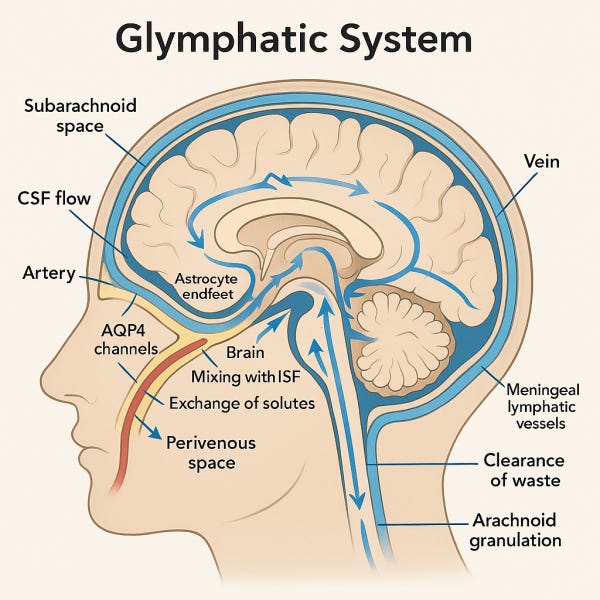
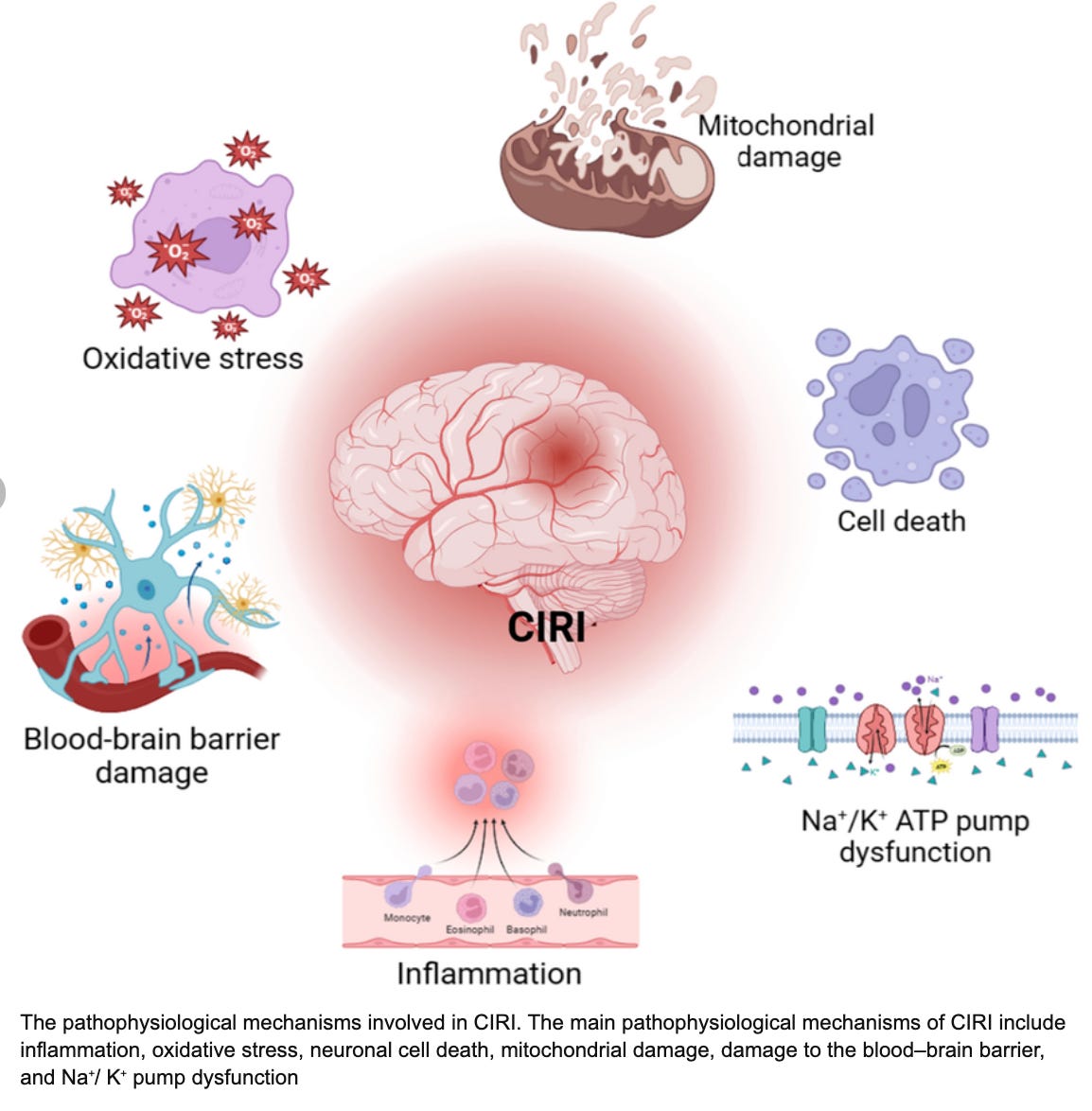
When glymphatic waste clearance is incomplete, the following sequence occurs without exception. Stage one: oxidative stress builds in the astrocyte cells lining the brain’s blood vessels — the same cells that house the AQP4 water channels through which CSF flows. Stage two: mitochondria in those cells become dysfunctional, reducing ATP production — the energy currency every neuron requires to fire. Stage three: the blood-brain barrier becomes compromised, allowing inflammatory compounds from the bloodstream to enter brain tissue. Stage four: the brain becomes chronically inflamed — producing the specific cognitive, energetic, and emotional pattern most parents have lived with for years without a name for it. Research confirming this cascade in chronic fatigue has been published in peer-reviewed literature linking glymphatic dysfunction to ME/CFS pathology through precisely this four-stage mechanism.
Incomplete glymphatic clearance → oxidative stress → mitochondrial dysfunction → ATP depletion → blood-brain barrier compromise → neuroinflammation → the exhaustion that sleep doesn’t fix + the fog that coffee can’t clear + the flat mood with no cause.
The 3pm cognitive collapse that makes simple decisions feel impossible. The morning heaviness before the day has started. The brain that feels like it’s running through fog by Tuesday. These are not character traits. They are stages 3 and 4 of a cascade that started when the cleaning cycle didn’t complete two nights ago.
The body’s lymphatic system clears waste from tissues through lymph nodes. The brain’s glymphatic system does the same. Neither has a dedicated pump. Both stagnate without specific inputs.
Your body’s lymphatic system collects metabolic waste — toxins, microbes, cellular byproducts — from tissues via lymphatic vessels and routes it to lymph nodes where immune cells neutralise it. The lymphatic system has no heart equivalent to pump it continuously. It relies on muscle movement, breathing patterns, and body position to keep fluid circulating. Leave it stagnant and waste backs up. Your brain faces the identical mechanical challenge. The glymphatic system — operating through channels surrounding brain blood vessels — uses cerebrospinal fluid (CSF) to collect waste and route it through the meninges to the lymph nodes in the neck. CSF is produced continuously from blood. Your neurons depend on it to fire properly. It also physically protects your brain from damage. But its most critical function — glymphatic clearance — requires specific physiological conditions to complete. Without them, the fluid stagnates. The waste stays. The cascade begins.
FOOD→BRAIN LINK: Stagnant CSF flow → waste remains in brain tissue → astrocyte dysfunction begins → four-stage cascade initiates → cortisol rises in response to neuroinflammation → belly fat redistribution accelerates.
The body’s lymphatic system stagnates when you’re sedentary — which is why a walk after dinner moves more than glucose. The brain’s glymphatic system stagnates when cortisol stays too high, when sleep is fragmented, and when you sleep in the position that minimises CSF flow. All three are fixable. All three are in the paid section.
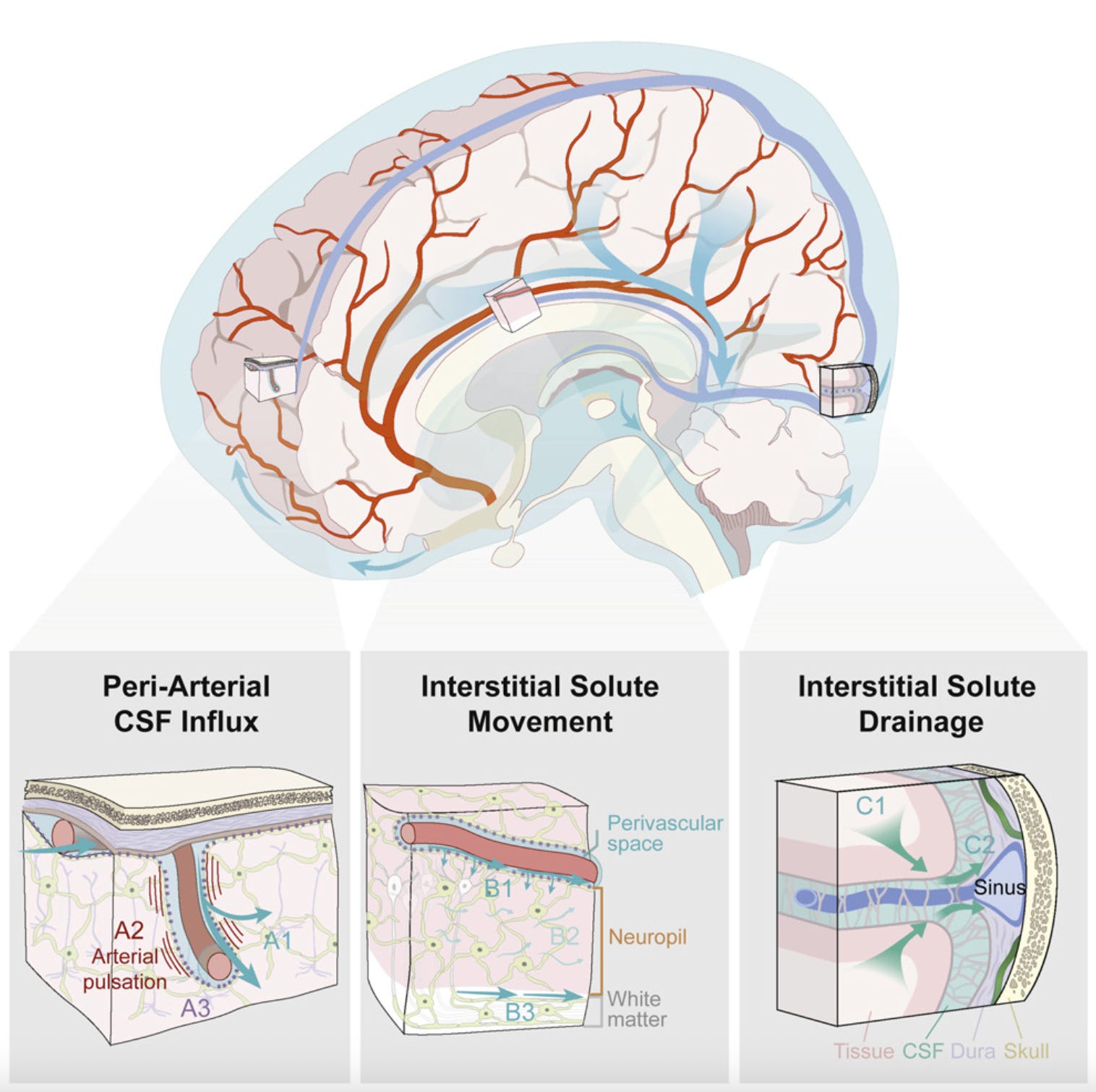
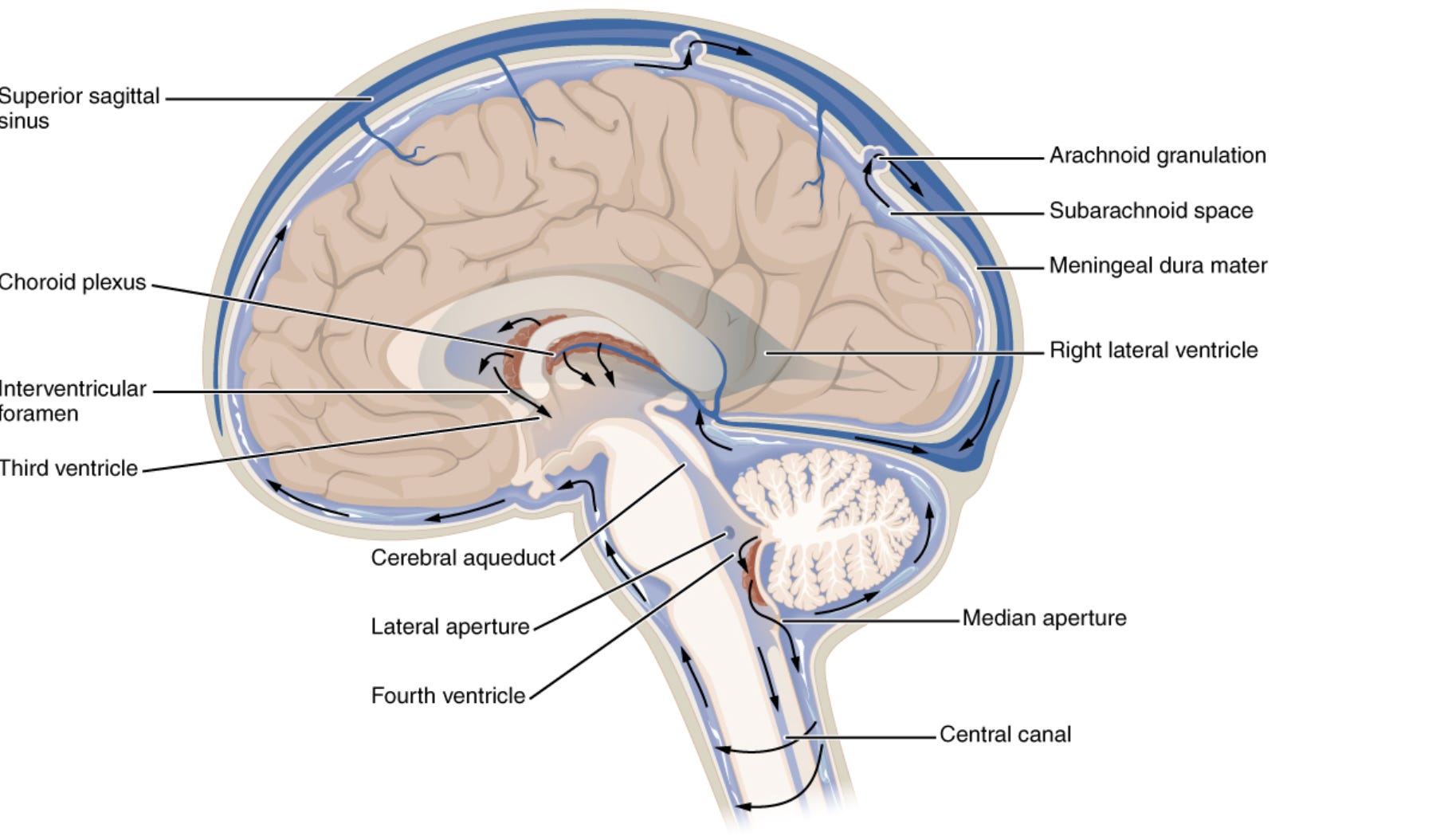
Cerebrospinal fluid is produced from blood, flows into brain tissue, collects waste, routes through the meninges, and drains into the lymph nodes of the neck. It has a long journey. And no pump to drive it.
CSF is produced by the choroid plexus from blood at a rate of approximately 500ml per day. It circulates through the ventricles of the brain — physically protecting neural tissue and providing nutrients — before entering the perivascular spaces surrounding cerebral blood vessels. In these spaces, it exchanges into brain tissue through AQP4 water channels in astrocyte endfeet, collecting amyloid proteins, tau, and metabolic byproducts as it flows. This waste-laden CSF then enters the venous region, gets cleared into the subarachnoid space, routes through the meninges (the outer lining of the brain), and ultimately drains into the cervical lymph nodes in the neck. The total journey requires consistent flow pressure, adequate AQP4 channel function, and the right sleeping position to complete efficiently. Any disruption — elevated cortisol, fragmented sleep, supine sleeping position, magnesium deficiency — reduces flow and leaves waste in brain tissue overnight.
CSF produced from blood → flows through brain tissue via AQP4 channels → collects amyloid and metabolic waste → routes to meninges → drains to cervical lymph nodes → specific conditions required for full cycle completion nightly.
The system is already running. Your brain is already producing CSF continuously. The question isn’t whether the mechanism exists — it’s whether the conditions are right for it to complete its full route every night. Most parents’ conditions aren’t. That’s what the protocol addresses.
A 2025 peer-reviewed study confirmed that elevated cortisol is directly linked to impaired glymphatic clearance in people with depression. This is the mechanism behind the low mood that has no obvious cause.
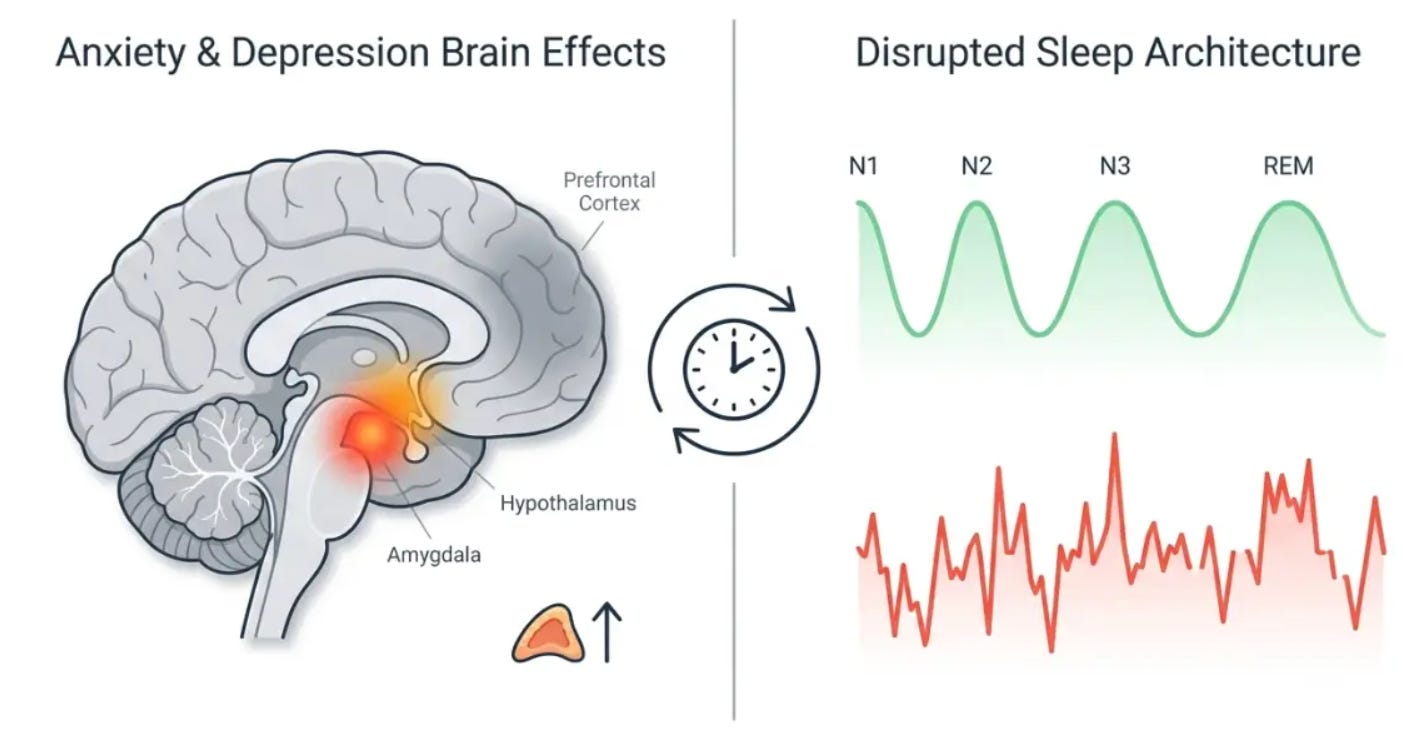
A study published in Translational Psychiatry (Chen et al., 2025) assessed 210 participants — 164 with major depressive disorder and 46 healthy controls — using MRI-based evaluation of glymphatic circulation. Depressed patients showed significantly poorer glymphatic clearance than healthy controls. Critically — elevated plasma cortisol levels correlated directly with the degree of glymphatic impairment. The mechanism is precise: cortisol suppresses slow-wave deep sleep architecture — the specific sleep phase during which glymphatic activity peaks. Suppressed slow-wave sleep means incomplete waste clearance. Accumulated waste disrupts the neurochemical environment regulating serotonin and dopamine. Mood degrades. Cortisol rises further in response. The loop compounds nightly.
Elevated cortisol → slow-wave sleep suppressed → glymphatic clearance incomplete → neuroinflammation accumulates → serotonin and dopamine environment disrupted → depression worsens → cortisol rises further → cleaning window shortens further.
The low mood that arrived gradually over months with no single identifiable cause. The emotional flatness that’s there before the day starts. The anxiety that’s worse after sleep than before it. If cortisol has been chronically elevated and sleep has been fragmented — this study names what’s happening and why standard interventions haven’t fully worked.
→ Source: Chen et al., 2025 — Translational Psychiatry
“Glymphatic dysfunction associated with cortisol dysregulation in major depressive disorder”
https://doi.org/10.1038/s41398-025-03486-1
Everything above points to the same root cause.
Cortisol staying too high.
The cleaning cycle failing to complete.
The waste accumulating.
The belly fat staying exactly where it is.
Here’s what I’ve noticed working through this with people individually:
The belly fat that won’t shift despite eating reasonably
is almost always the most visible sign
that cortisol has been chronically elevated
for longer than the person realises.
It’s not a diet failure.
It’s a hormonal signal that’s been running
while the standard advice was addressing the wrong variable.
So tell me honestly:
How long has the belly fat been there — and what have you already tried to shift it?
Reply to this post with your honest answer.
One sentence.
Here’s the exact nightly sequence.
The specific order of habits — food timing, magnesium, sleep position, breathing, and the one cortisol driver most parents have in their bedroom that closes the cleaning window before it opens —
that gives the glymphatic system the five conditions it needs to run a complete cycle tonight.
And after the protocol:
why fixing the glymphatic system is the missing variable
in every fat loss attempt that’s stalled — and what changes when cortisol finally drops low enough for the cleaning cycle to complete.
Before the protocol — the connection most people are never shown.
Cortisol drives glymphatic failure.
But cortisol also does something else simultaneously:
It redistributes fat — specifically to the abdomen.
Through the glucocorticoid receptor pathway in visceral fat cells,
elevated cortisol directly increases abdominal fat storage
independent of caloric intake.
This is why you can eat in a deficit and the belly fat doesn’t move.
This is why you can exercise consistently and the waist measurement stays the same.
The cortisol is overriding the diet and the exercise.
And the same cortisol is blocking the cleaning cycle overnight.
Fix the cortisol — the cleaning cycle completes.
Fix the cortisol — visceral fat storage begins to reverse.
These are not two separate interventions.
They are one cortisol intervention
producing two simultaneous outcomes.
Comments
Nothing yet. Say the first thing.
Sign in to join the conversation.