
A Harvard neuroscientist said this directly:
Chronic cortisol isn’t just making you tired.
It’s murdering your sleep —
by collapsing deep sleep architecture
before the first hour is complete.
It’s rewiring your fear centre —
making your amygdala permanently oversensitive
to threats that aren’t there.
And it’s trapping you in survival mode —
where digestion shuts down,
libido disappears,
and your body redirects every resource
toward a danger that never actually arrives.
The fix — he said — is shockingly physical.
Not psychological.
Physicals
Here’s what’s actually happening inside your nervous system right now.

Your nervous system is a network of 86 billion neurons
running from your brain to every organ in your body.
It regulates stress through two competing systems:
The sympathetic system — fight or flight.
Designed for predators, emergencies, physical danger.
The parasympathetic system — rest and digest.
Designed for recovery, repair, sleep.
Every cortisol spike starts in the sympathetic system.
And here’s the problem for a parent in 2026:
The sympathetic system was designed for threats that end.
A predator arrives. You run. It leaves. Cortisol drops.
But the modern parent’s stressors never leave.
The inbox is always full.
The school run happens every day.
The financial worry doesn’t resolve overnight.
The 9pm doom-scroll brings new threats every minute.
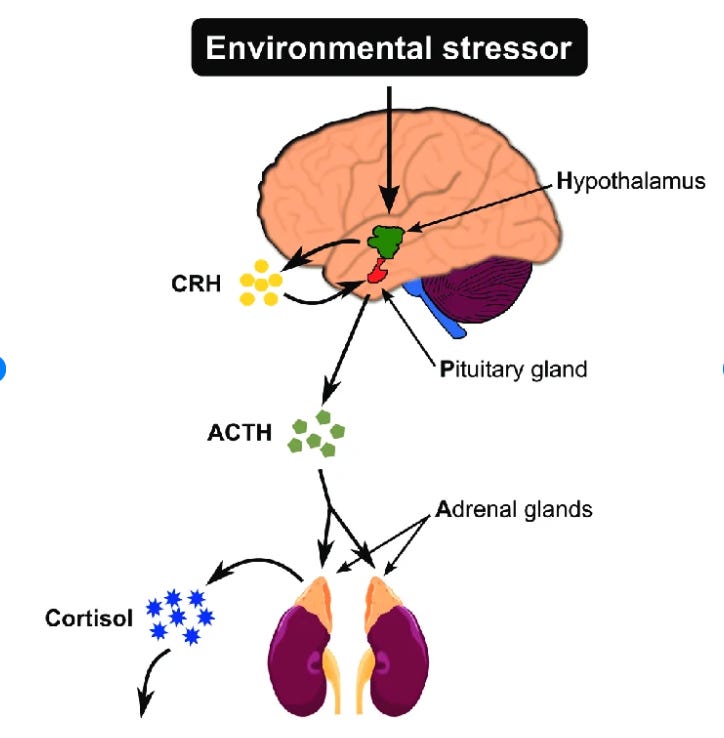
So the HPA axis — the hypothalamus-pituitary-adrenal system
that controls your cortisol response — keeps firing.
Cortisol stays high.
Deep sleep collapses.
Digestion and libido shut down.
And your body stays in survival mode —
diverting energy away from recovery
and toward a danger that never fully arrives.
The Harvard neuroscientist’s point:
the fastest fixes are not psychological.
They are physical interventions
that send your body a signal the mind can’t override.
→ 8 physical habits that lower chronic cortisol — reordered by speed of effect
→ Why the sequence matters as much as the individual habits
→ The exact morning-to-evening cortisol protocol (paid section)
→ The 9pm habit that undoes all of it — and what to replace it with
→ Read time: 5 min
You don’t need all 8.
Find the two you can implement before this Friday.
Those two alone will shift the baseline within days.
Reordered by speed — starting with what works in under 3 minutes.
Two short inhales through the nose. One long exhale through the mouth. Stanford’s Andrew Huberman confirmed this lowers cortisol faster than any other technique tested.
The physiological sigh works through a specific mechanism — the double inhale re-inflates collapsed air sacs in the lungs, maximising the surface area available for gas exchange. The extended exhale activates the parasympathetic nervous system through the vagus nerve — triggering a rapid drop in heart rate and a measurable reduction in cortisol within 60–90 seconds. The exhale-dominant breathing pattern signals to your brain that the emergency has passed. It is the fastest voluntary cortisol intervention available — requiring no equipment, no preparation, and no time commitment beyond 90 seconds.
Double inhale → lung inflation → extended exhale → vagus nerve activation → parasympathetic shift → heart rate drops → cortisol begins to fall → brain receives safety signal → HPA axis firing rate reduces.
The moment after the kids have finally gone to bed. The 30 seconds in the car after school pickup before you walk through the front door. The gap between meetings. All of them physiological sigh opportunities. 90 seconds. No equipment. Cortisol drop your body can feel.
Breathe in through the nose. Then a second short inhale through the nose immediately after. Long slow exhale through the mouth. Repeat 5 times. That’s it.
This One Breathing Technique Increases Brain Blood Flow by 500%
30 seconds of cold water on your face triggers one of the most powerful parasympathetic responses in the human body. Heart rate drops. Vagal tone spikes. Cortisol crashes.
The mammalian dive reflex — triggered by cold water contact with the face, specifically around the eyes and nose — produces an immediate bradycardic response. Heart rate drops measurably within seconds. The trigeminal nerve sends a rapid parasympathetic signal that overrides the sympathetic activation driving cortisol elevation. This is not a gradual relaxation response. It is an ancient physiological override — the same mechanism that allows mammals to survive underwater — repurposed as an immediate cortisol intervention available at any bathroom sink.
Cold water on face → trigeminal nerve activation → mammalian dive reflex → immediate heart rate reduction → vagal tone spike → cortisol crash → sympathetic system temporarily overridden → 10–20 minutes of measurably lower baseline cortisol.
The bathroom sink. The kitchen tap. Right now. 30 seconds of cold water cupped over the face — eyes, nose, forehead. Your heart rate will drop before you reach for the towel. The afternoon stress that’s been running since 2pm will have somewhere to go.
Fill the sink with cold water. Submerge your face for 30 seconds — or splash cold water on your face, eyes, and nose repeatedly. Do this once in the afternoon and once before bed. Total time: 60 seconds daily.

Monks and singers hum at 40–60 Hz. It vibrates the vagus nerve directly, raises nitric oxide by up to 15x, and drops heart rate in seconds. Ancient practice. Modern neuroscience now explains exactly why it works.
Humming generates vibration in the pharynx — the throat region directly adjacent to the vagus nerve. This vibration mechanically stimulates vagal afferent fibres, producing a parasympathetic response that drops heart rate and reduces cortisol. Simultaneously, humming increases nasal nitric oxide production by up to 15 times compared to normal breathing. Nitric oxide dilates blood vessels, improves oxygen delivery to the brain, and has a direct anti-inflammatory effect on neural tissue. The combination — vagal stimulation plus nitric oxide production — makes humming one of the most efficient cortisol interventions available with no equipment, no training, and no time beyond 2 minutes.
Low-frequency humming → vagal nerve vibration → parasympathetic activation → nitric oxide production increases → heart rate drops → cortisol begins to fall → brain inflammation reduces → calm without sedation.
Driving to school pickup. Washing the dishes after dinner. The 2 minutes before the morning meeting starts. Humming doesn’t require silence or space. It requires 2 minutes and a closed mouth. Your kids will think you’re odd. Your cortisol won’t care.
Low, steady hum — mouth closed — for 2 minutes. The pitch that feels most resonant in your chest. No particular note required. The physical vibration is the mechanism — not the melody.
Indigenous cultures did this daily. Modern shoes block the mechanism entirely. 5–7 minutes of direct skin contact with the earth lowers cortisol within 20 minutes and resets vagal tone.
Earthing — direct skin contact with the earth’s surface — transfers free electrons from the ground into the body through a process of electrical conduction. These electrons act as antioxidants, neutralising inflammatory free radicals in tissue. Research has demonstrated measurable reductions in inflammatory markers and cortisol following grounding sessions as short as 5 minutes. The secondary mechanism involves barefoot walking’s proprioceptive activation — stimulating specific nerve endings in the feet that send calming signals through the peripheral nervous system to the HPA axis. Modern rubber-soled shoes block both mechanisms completely.
Barefoot on earth → electron transfer → free radical neutralisation → inflammatory markers reduce → cortisol drops → vagal tone resets → HPA axis firing rate reduces → 20-minute cortisol window created.
The garden after school pickup. The park on the weekend. The grass outside the office at lunch. 5 minutes. Shoes off. The cortisol that accumulated between 9am and 1pm has a physical pathway out of your body that your rubber soles have been blocking every day.
Shoes off. Grass, soil, or sand. 5–7 minutes of walking or standing. Morning is optimal — compounds with the morning sunlight protocol. But any time works.

You’ve just read the four fastest physical cortisol interventions available.
But here’s what I know from working through this individually:
Chronic cortisol looks different in every parent.
For some it’s the sleep — wired at midnight, foggy by 7am.
For others it’s the body — belly fat that won’t shift regardless of diet.
For others it’s the mood — low-grade anxiety with no identifiable cause.
Which one is showing up most for you right now?
Reply to this post with your honest answer.
One sentence is enough.
I read every reply personally —
and I’ll respond with the specific thing
that applies to your situation.
Habits 5–8 are where the sequence comes together.
Especially habit 5 — because it’s the one that sets the hormonal tone for every other habit on this list. Get it wrong and the afternoon cortisol interventions are fighting uphill from the first hour of the day.
And habit 8 — the 9pm habit that undoes everything before it — is the one most parents are doing right now without knowing what it’s costing them overnight.
Comments
Nothing yet. Say the first thing.
Sign in to join the conversation.