
Everyone’s quoting a study this week to prove coffee is medicine.
The people who sell coffee paid for it.
That doesn’t make it fake. It makes it a study you read with your eyes open.
Underneath the hype sits something useful for a tired parent. Alongside it sits a viral claim built on a word no honest scientist would use.
Two things went round this week. One: you’re not drinking coffee for the caffeine, you’re drinking it for the gut bugs that run your brain. Two: a sleep doctor’s “nappa latte” that leaves you “good for four hours, guaranteed.”
I read both papers. Here’s what’s in them.
The gut-brain coffee study
The research is new. Scientists at APC Microbiome Ireland ran it, published in Nature Communications (Boscaini, 2026: https://www.nature.com/articles/s41467-026-71264-8).
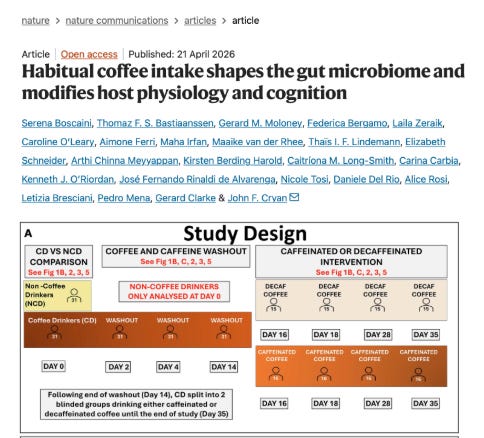
What they did: 62 healthy adults, aged 30 to 50. Half never drank coffee. Half drank three to five cups a day.
First they compared the two groups. Then the coffee drinkers gave it up for two weeks and were split at random, blinded: some got caffeinated instant coffee for three weeks, some got decaf.
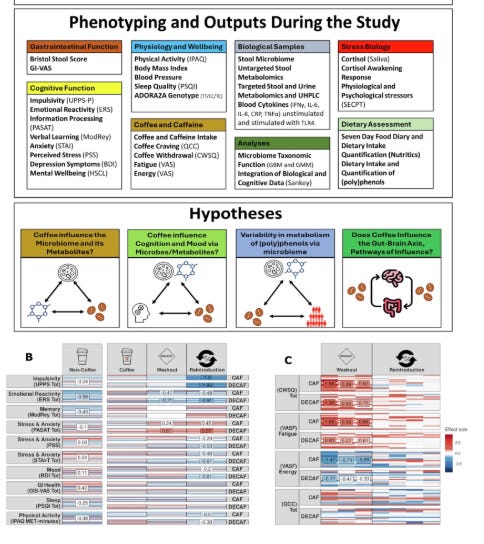
Blood, saliva, stool, urine, memory tests, mood questionnaires, a cold-water stress test. A serious amount of measurement.
What they found:
Coffee changed the gut microbiome. Both kinds. Regular drinkers carried a different microbial fingerprint from non-drinkers, distinct enough that the researchers could half-guess your coffee habit from your stool sample.
The two coffees did different jobs. Caffeinated lowered anxiety and sharpened attention. It also lowered cortisol. The thread said that number stayed flat.
Decaf improved memory and learning, sleep quality, and physical activity. Both lowered stress and depression scores.
The memory finding is the interesting one. It showed up only in the decaf group.
If caffeine were doing that work, the caffeinated group would have got it too. They didn’t. So something else in the bean looks responsible: the polyphenols, the plant compounds that survive decaffeination.
Here’s the food-brain bridge, in plain terms. Coffee carries polyphenols → polyphenols feed certain gut microbes → those microbes make chemical messengers that travel to the brain → the brain responds, in mood, memory and stress.
That pathway is plausible and partly measured here.
One line in the paper changes how you hold all of it.
Read the funding line
This study was funded by the Institute for Scientific Information on Coffee. ISIC is funded by major coffee companies.
That is disclosed in the paper. It doesn’t mean the findings are false. The researchers are respected and the methods are strong.
It means the study exists because an industry wanted questions about its product answered. Industry-funded nutrition research tends to land better for the product than independent work does.
You hold it a little further from your face. You wait for someone with no coffee to sell to repeat it.
The size is the other thing the viral version hides.
Sixty-two people sounds solid. But only the 31 coffee drinkers went into the experiment, and they were split into two arms of 16 and 15 people.
Every headline claim about caffeinated versus decaf rests on fifteen or sixteen people, drinking instant coffee, for three weeks. That’s a first look.
And the person who posted the big thread walked back two of his own points in the replies.
The claim that caffeine “blocks” gut benefits by rushing food through your system: his interpretation. The paper doesn’t say it.
The tidy inflammation story he corrected himself, to “split, not uniformly down.”
When the messenger edits his own claims within a day, the loud version was louder than the evidence.
I’ll say the quiet part. I can’t tell you coffee will lift your mood or sharpen your memory.
The best new study is small, industry-funded, three weeks long, in healthy adults who aren’t running on your kind of sleep. Be curious. Don’t believe the headline.
“A study can be real, useful, and paid for by the seller, all on the same page. Most people only read one of those three.”
What it’s fair to do
Nothing here is a protocol you have to earn. It’s small and it costs nothing to try.
The study points one place you can use. The two coffees have different strengths, so put them at different ends of the day.
Caffeinated in the morning. That’s where the attention, the alertness and the lower anxiety showed up. It’s also where the caffeine won’t reach into your night.
Decaf later, if you want the evening cup. That’s where the memory, gut and sleep signals sat, without the caffeine that wrecks your 3am.
You keep the ritual: the warm mug, the ten minutes that are yours. You lose the part that keeps you wired at midnight.
And the timing rule that survives every coffee study ever run: caffeine has a long tail. One cup six hours before bed still behaves in your blood like half a cup at bedtime (Drake, 2013: https://pmc.ncbi.nlm.nih.gov/articles/PMC3805807/).
If your nights are broken, the afternoon cup is a suspect, whatever it’s doing for your gut.
The “nappa latte,” and the word that gives it away
The second claim: drink a black coffee fast, take a 25-minute nap, and the caffeine slots into your brain as the nap clears the sleepiness. Wake up “good for four hours, guaranteed.”
The mechanism is real. Adenosine is the molecule that builds up all day and makes you sleepy. Caffeine is shaped enough like adenosine to sit in the same receptor and block it.
Comments
Nothing yet. Say the first thing.
Sign in to join the conversation.