
I nearly didn’t get this article published today.
My car is currently having a dent and scrape repaired and, thanks to a lack of WiFi, there was a brief period where I thought I might miss my usual publishing day. It wasn’t a disaster. Nobody was going to be harmed. The world would have continued turning exactly as it always does. Yet I found myself feeling strangely uncomfortable about it. As I sat with that feeling, I recognised something familiar. The subtle pressure to keep things moving. The slight discomfort that appears whenever I imagine disappointing people, even in relatively small ways. Honestly, it would have been fine for me to miss publishing today but I’ve making a promise to myself regarding consistency and *trying* to remain consistent to post every week alternating between blogs (the other substack is for therapists ‘the good therapist’)
I did something that would probably have felt quite unfamiliar to an earlier version of me I took myself to a nearby pub, bought myself some lunch and settled in to write.
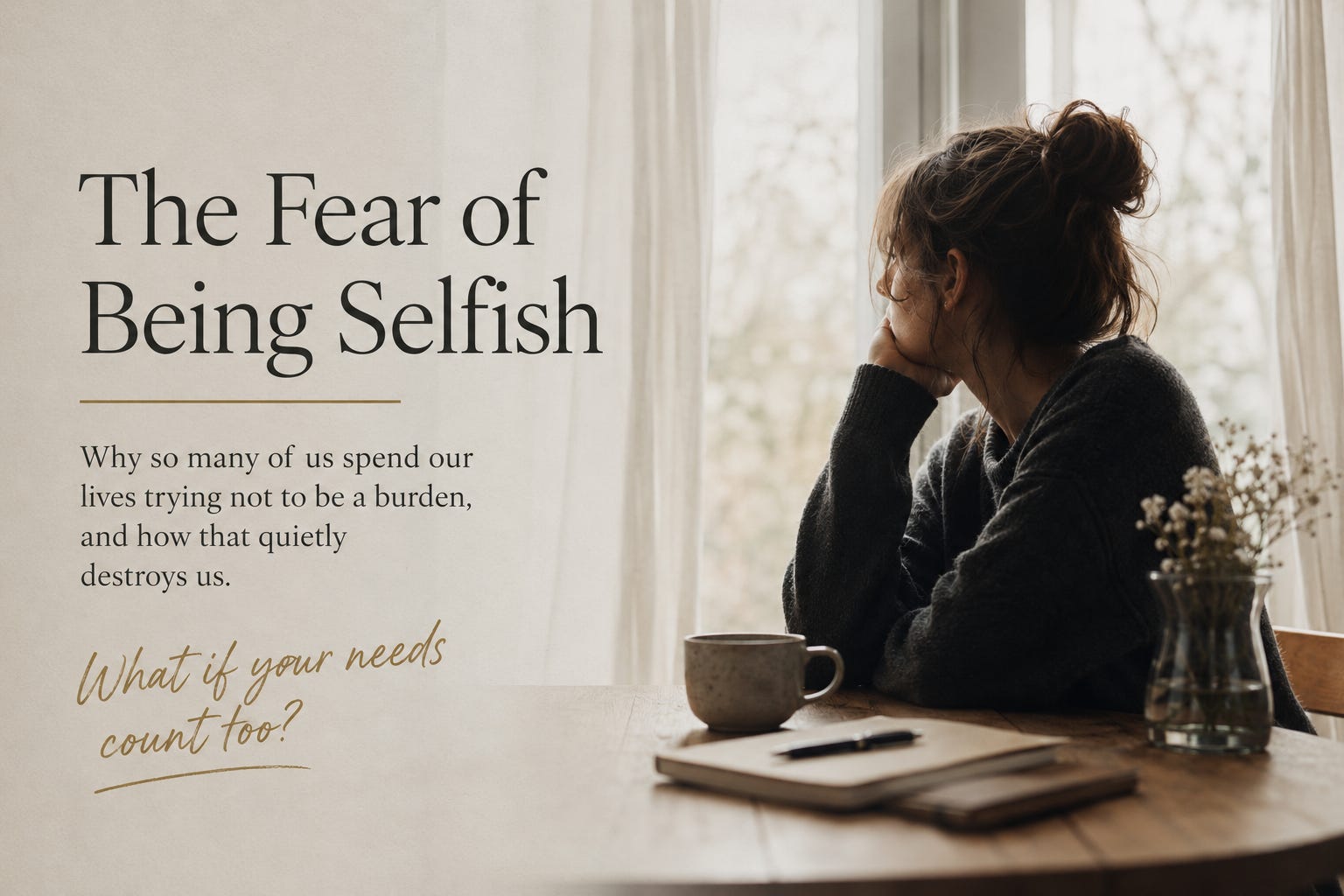
For several weeks now, I’ve been thinking about the fear of being selfish. The more I sit with The Good Person Trap™, the more I suspect that underneath many of the behaviours we talk about so often - people pleasing, perfectionism, burnout, over-functioning and self-sacrifice - there is sometimes a much simpler fear quietly organising the whole system.
Not the fear of being bad exactly.
The fear of being selfish.
I don’t mean selfish in the obvious sense of exploiting people or behaving without consideration for others. I mean the way some people seem to move through the world carrying an almost constant awareness of the impact they are having on everybody around them. The person who apologises before asking a question. The person who feels guilty taking up somebody’s time. The person who finds it easier to support other people than ask for support themselves. The person who struggles to rest. The person who says yes when they want to say no. The person who is exhausted but keeps going anyway.
I’ve become increasingly interested in these people, partly because I work with so many of them, but mostly because I have spent much of my own life being one of them.
A few years ago, whilst working in university mental health and wellbeing, I found myself talking to a colleague about how exhausted I felt. I was carrying too much emotionally and, although I could recognise that intellectually, I seemed unable to do anything meaningful about it. At some point in the conversation they suggested that perhaps I needed to put myself first for a while.
I remember feeling immediate resistance.
Not because I thought they were wrong. In fact, part of me knew they were right.
The resistance came from somewhere deeper.
Almost instantly my mind began producing reasons why it wasn’t possible. Students were relying on me. There was too much work to do. Other people needed support. There were responsibilities, expectations and consequences. Looking back now, what strikes me isn’t that those concerns existed. Many of them were perfectly reasonable. What strikes me is how quickly my attention moved towards everybody else’s needs and how little space there seemed to be for my own.
The conversation stayed with me because it wasn’t really about work. Work was simply where the pattern happened to be showing up at the time.
I’d seen versions of it before.
During my nursing training, my Dad died. I took a couple of weeks off before returning to the course. Looking back, there were practical reasons for that decision. Nursing degrees are highly structured and taking additional time away could have meant dropping back a cohort, delaying qualification and disrupting everything I had worked towards. Those concerns were real and they mattered.
What I notice now, however, is how little curiosity I had about what I actually needed.
My attention moved almost immediately towards the consequences of needing support rather than the fact that I was grieving. Even in the middle of one of the most significant losses of my life, my focus seemed to be on how to minimise disruption and keep moving forwards.
The same thing appeared later whilst working in secondary education. Then again in university wellbeing. Then again in mental health services. Different jobs. Different circumstances. Similar pattern. Again and again, I seemed able to recognise suffering in other people long before I recognised it in myself.
For a long time, I interpreted this as evidence that I was caring. I thought it reflected commitment, responsibility and compassion. Increasingly, I wonder whether something more complicated was happening underneath.
The more I reflect on my own life, the more I think the conversation may be about safety as much as morality.
Growing up, life often felt financially stretched and somewhat disorganised. There wasn’t a strong sense of abundance. There wasn’t much spare capacity. Things felt uncertain more often than they felt secure. Looking back now, I can see how much of my attention seemed to orient towards competence, achievement and responsibility. At the time, I simply thought this was my personality. I was driven. Conscientious. Somebody who worked hard and got things done.
Now I’m not entirely sure those qualities appeared in isolation.
I sometimes wonder whether they were solving problems for me.
Not practical problems necessarily, but emotional ones.
If life feels unpredictable, responsibility can feel reassuring. If things feel uncertain, achievement can create a sense of stability. If money feels stretched, competence can start to feel protective. Children don’t consciously decide these things. They don’t sit down and think, “I will become responsible because it feels safer.” They simply discover ways of navigating the environment they find themselves in.
The more I think about it, the more I wonder whether this is where goodness starts becoming complicated.
Because eventually the qualities that once helped us feel safe can become fused with identity. We stop experiencing them as strategies and start experiencing them as who we are.
I’m just responsible.
I’m just hard-working.
I’m just independent.
I’m just somebody who gets on with things.
Yet underneath those descriptions there can sometimes be a quiet fear. A fear of what might happen if we stop being those things. What happens if I need help? What happens if I can’t cope? What happens if I disappoint somebody? What happens if I become the person creating the problem rather than solving it?
I suspect many people spend years trying to avoid finding out.
When I look back at periods of exhaustion in my own life, what stands out isn’t simply how much I was doing. It’s how difficult it felt to justify doing less. There always seemed to be a reason to keep going. Somebody needed something. There was another responsibility to fulfil. Another practical consideration. Another reason why now wasn’t the right time.
What I rarely stopped to ask was whether my needs counted in the equation.
Not whether they existed.
Whether they counted.
That’s a slightly different question.
I think most people who end up trapped in these patterns know they are tired. They know they are overwhelmed. They know they need support. The difficulty is that their needs often seem less important than everything else that is happening around them.
The consequence is that life gradually becomes organised around avoiding becoming a burden. Avoiding inconvenience. Avoiding disappointment. Avoiding selfishness.
And because these behaviours are often rewarded by the world around us, they can continue for years before anybody notices the cost.
Schools reward the child who achieves highly and causes no disruption. Families often rely on the person who appears the most capable. Workplaces reward the employee who goes above and beyond. Relationships can become organised around the person who always says yes.
From the outside, it can look admirable. From the inside, it can feel like slowly disappearing.
The more I explore The Good Person Trap™, the less convinced I am that many people are exhausted simply because they are doing too much. I think many people are exhausted because they have spent years trying not to become somebody.
The selfish person.
The difficult person.
The demanding person.
The burden.
The problem.
The irony, of course, is that the people most frightened of becoming selfish are often some of the most thoughtful people you could meet. They think endlessly about the impact they have on others. They monitor themselves carefully. They carry responsibility that was never really theirs to carry. They worry about things other people barely notice.
Yet despite all of that, many still walk around feeling as though they are somehow getting it wrong.
The more I sit with this work, the more I wonder whether one of the hidden costs of The Good Person Trap™ is that people become so focused on proving they are not selfish that they gradually lose permission to be human - to have needs, make mistakes, have limits, disappoint people occasionally. And to take up space and matter.
Perhaps healing begins when we start questioning the assumptions underneath the fear.
Not “Am I selfish?”
But “Why am I so frightened of being seen that way?”
And perhaps, somewhere along the way, we discover that having needs was never selfish in the first place.
Becky
If this essay resonated with you, subscribe for future writing exploring The Good Person Trap™, morality, burnout, perfectionism, eating disorders, neurodivergence, identity and modern life.
Thanks for reading The Good Person Trap™️by Becky Grace! Subscribe for free to receive new posts and support my work.
Becky Grace is a therapist, writer and creator of The Good Person Trap™ - an evolving body of work exploring what happens when goodness becomes a survival strategy.
Comments
Nothing yet. Say the first thing.
Sign in to join the conversation.