
I have been thinking about this for a long, long time as someone who is a deep thinker, systems thinker and observes people for a living. It didn’t arrive all at once. There wasn’t one conversation that suddenly changed my thinking, or one news story that made everything fall into place. Instead, it has emerged gradually through hundreds of ordinary moments that, taken individually, don’t seem especially remarkable. A client who spends half a therapy session apologising because they cried. A healthcare professional describing the fear of making one mistake that could define an entire career. Someone replaying a conversation from weeks ago because they’re convinced they came across as selfish. A headline that reduces a complicated human life to a single decision, one sentence or a clip lasting less than a minute.
On their own, none of these moments tell us very much. Together, though, they have left me with a growing sense that something has shifted in the way we relate to one another. I keep coming back to the same question.
When did making a mistake stop meaning, I’m human, and start meaning, I’m a bad person?
I’m not asking that rhetorically. I genuinely don’t know the answer.
Part of me wonders whether I’m simply becoming more aware of something that has always existed. Human beings have always judged one another. Reputation has always mattered. We’ve always wanted to belong because, for most of our history, belonging wasn’t simply comforting; it was essential for survival. It would be surprising if our brains didn’t care what other people thought of us. Evolution almost guaranteed that they would. Yet another part of me isn’t convinced that’s the whole story.
It feels as though we’ve become less tolerant of ordinary human imperfection.
That feels like an important distinction because it isn’t the same as becoming less tolerant of harm.
I don’t want to live in a world where people aren’t accountable for the impact they have on others. Accountability matters. So do honesty, repair and taking responsibility when we’ve caused harm. Over the last few decades we’ve rightly become more aware of safeguarding, inequality, abuse of power and the importance of listening to voices that have historically been ignored. Many of those changes represent genuine progress, and I wouldn’t want to lose them. But somewhere within those important developments, I wonder whether something else has quietly happened alongside them. There is a profound difference between believing that people should take responsibility for their mistakes and believing that people shouldn’t make mistakes at all. One assumes that human beings are imperfect and asks how we respond when things go wrong. The other quietly imagines that imperfection itself is the problem. The question that keeps returning to me isn’t whether people should be accountable. It’s whether we’ve become less able to imagine that someone can make a mistake and still remain a fundamentally decent human being.
Perhaps this question has stayed with me because it isn’t only something I’ve observed in the therapy room or noticed in the wider culture.
I’ve felt it in my own life too.
Over the past few years, I’ve found myself reflecting on how quickly relationships can change when people hold different opinions or interpret a situation without knowing the wider context. I’ve experienced friendships becoming strained, or ending altogether, not because of a dramatic betrayal, but because it sometimes felt as though there was very little room left for curiosity. Once an opinion had been formed, there seemed to be less interest in asking another question, hearing the rest of the story or allowing complexity to exist.
I don’t share that because I think my experience is unusual.
If anything, the opposite is true.
The more I speak to clients, colleagues and friends, the more I hear different versions of the same story. Different circumstances. Different relationships. Different professions. Yet beneath them all seems to sit a remarkably similar fear.
The fear that one mistake, one opinion, one misunderstanding or one difficult moment might become the thing that defines you.
Those experiences have been painful at times, but more than anything they have made me curious. Curious about what seems to happen psychologically when we stop asking questions about one another.
Human beings have always disagreed. Families disagree. Friends disagree. Colleagues disagree. Difference of opinion has always been part of living alongside one another. What feels different to me is how quickly disagreement can become a judgement about character.
It’s one thing to think, I don’t agree with you.
It’s another to conclude, That tells me everything I need to know about the kind of person you are.
Perhaps that’s the shift I’ve been trying to understand. Not because I think people should avoid difficult conversations or stop holding one another accountable. If anything, healthy relationships depend on both. But they also depend on something else that feels increasingly precious.
The willingness to stay curious.
The willingness to imagine that there might be more to another person’s story than the small part we’ve seen.
The willingness to believe that someone can make a mistake, hold a different opinion, apologise, change their mind or grow without that becoming the defining feature of who they are.
I wonder whether that’s what we’ve slowly begun to lose. The more I’ve reflected on all of this, the more I’ve found myself becoming interested in a different kind of question.
As a therapist, I am trained to think about context. We ask about childhood, family, relationships and the experiences that shaped someone’s beliefs about themselves. We understand that people adapt to the worlds they grow up in because human beings don’t develop in isolation. Recently, I’ve found myself wondering about another kind of context.
Not the environment that shaped us as children.
The environment we’re all living in now.
Because it seems to me that the world has changed in ways that are easy to overlook precisely because they’ve happened so gradually. None of these changes, on their own, feel especially dramatic. Yet together they may have altered something fundamental about what it feels like to be human. That thought has stayed with me because it shifts the question completely.
Instead of asking, What’s wrong with people?
I find myself wondering...
What kind of world are people adapting to?
The more I’ve sat with that question, the less convinced I am that what I’ve been noticing can be explained by individual psychology alone.
At first, I thought I was simply seeing more perfectionism, more burnout, more anxiety and more people carrying an almost unbearable fear of getting things wrong. Those observations weren’t particularly unusual. Most therapists would probably recognise them. But the longer I’ve lived with the question, the more they’ve begun to feel less like separate difficulties and more like different expressions of something shared.
I don’t mean that every psychological struggle has the same cause. Human beings have always experienced anxiety, shame, grief and conflict. Trauma has always existed. Childhood experiences matter. Relationships matter. Biology matters. The way our brains process the world matters. None of that disappears because society changes.
Yet I keep coming back to a thought that feels almost too obvious to ignore. If human beings adapt to the environments they grow up in, why wouldn’t they continue adapting to the environments they live in?
It’s an idea that feels almost commonplace in every other field. We understand that biology adapts to changing environments. Organisations change in response to external pressures. Families develop ways of relating that make sense within their own circumstances. We readily accept that context shapes behaviour. Somehow, though, when it comes to psychology, we often stop at the individual.
We ask why this person has become anxious.
Why this person struggles with perfectionism.
Why this person finds it so difficult to rest.
Those are important questions.
But I’ve found myself wondering whether there is another question sitting quietly alongside them.
What kind of environment makes those adaptations more likely?
The more I’ve looked around, the more one phrase has stayed with me.
A culture of continuous evaluation.
It feels as though we’ve quietly entered a world where almost every part of life can be measured, reviewed, compared or judged. Our work is evaluated through appraisals and performance targets. Our businesses are reviewed by strangers we’ll never meet. Our appearance is compared against carefully curated images. Our opinions can travel far beyond the audience they were ever intended for. Even our sleep, our productivity and the number of steps we’ve taken today can be measured against an invisible standard.
None of those developments are inherently problematic. Many have improved healthcare, education, business and public life. Feedback matters. Data can help us make better decisions. The issue isn’t evaluation itself.
It’s what happens when evaluation quietly begins to replace belonging.
I’ve found myself returning to that distinction again and again because those two experiences ask very different things of us.
Belonging says, I know you.
We no longer live in communities that know us. We increasingly live in audiences that judge us. That’s different. Communities remember history. Audiences remember moments. Communities allow repair. Audiences often demand performance. Communities see complexity. Audiences flatten people into snapshots
It makes room for history, context and contradiction. It allows someone to be generous one day and impatient the next without assuming either moment tells the whole story. It recognises that relationships inevitably contain misunderstandings because relationships are built between imperfect people.
Evaluation asks a different question.
How did you perform?
The more I think about it, the more those two questions seem to shape entirely different ways of living.
When we feel that we belong, mistakes still matter, but they don’t necessarily threaten our place within the relationship. They become something that can be acknowledged, repaired and learned from. When we feel that we’re being evaluated, the psychological stakes become much higher. A mistake no longer feels like something that happened. It begins to feel like evidence. Evidence that we’re competent enough. Kind enough. Professional enough. Successful enough. Good enough.
I wonder whether that’s one reason so many people seem exhausted. Not simply because they’re doing too much, although many undoubtedly are. They are carrying the quiet feeling that they are always being assessed.
Sometimes that assessment is real. Often it exists only in anticipation. Yet our nervous systems don’t always make a neat distinction between the two.
If we come to expect judgement, we gradually begin organising ourselves around avoiding it. We edit what we say before anyone has criticised us. We rehearse conversations that haven’t happened yet. We hesitate before expressing uncertainty because certainty feels safer. We over-explain in case we’ve been misunderstood. We apologise before we’ve even established that an apology is needed.
The external culture slowly becomes an internal psychology. That thought has stayed with me because it changes the way I look at many of the people who sit opposite me in the therapy room.
What if perfectionism isn’t simply about having impossibly high standards?
What if it’s an attempt to reduce the possibility of rejection?
What if people-pleasing isn’t only about avoiding conflict?
What if it’s an attempt to preserve belonging in a world where relationships can sometimes feel surprisingly fragile?
What if overthinking isn’t simply indecision?
What if it’s an attempt to anticipate criticism before it arrives?
Even burnout begins to look slightly different through this lens.
We often talk about burnout as the inevitable consequence of working too hard for too long, and that is certainly part of the story. But I sometimes wonder whether another burden sits quietly underneath it. Not simply the pressure to perform. The pressure to prove. To prove that you’re competent enough. Responsible enough. Emotionally regulated enough. Productive enough.
A good enough parent.
A good enough partner.
A good enough therapist.
A good enough human being.
There is no finish line for that kind of work.
No amount of achievement can permanently answer a question about worth. Tomorrow simply asks for more evidence. I’ve found myself thinking about this in relation to moral scrupulosity too. On the surface, it can look like an overwhelming fear of making the wrong decision or causing harm. Yet I often wonder whether another question sits quietly beneath it.
What if this mistake says something unforgivable about who I am?
That feels like a very different fear.
One is about behaviour. The other is about identity. Perhaps that’s the thread I’ve been trying to follow throughout this essay. Somewhere along the way, many of us seem to have become less able to separate the two.
We don’t simply think, I made a mistake.
We begin wondering, Perhaps the mistake revealed who I really am.
The more I’ve reflected on that possibility, the more I’ve found myself returning to an idea I’ve been exploring in my own work.
The Good Person Trap™️
When I first started writing about it, I thought I was describing a pattern that affected particular people. The tendency to over-function. To people-please. To place everyone else’s needs before your own. To feel responsible for everyone else’s emotions while quietly neglecting your own. Now I’m beginning to wonder whether it’s something much bigger than that.
The Good Person Trap is what happens when goodness becomes an identity that requires constant evidence rather than a value we attempt to live by.
If that’s true, then perhaps many of the struggles we often think of as separate begin to make a little more sense. Not because they’re identical, but because they may all represent different attempts to solve the same problem. Not the problem of being imperfect. The fear of imperfection might cost us our place with other people.
I don’t know whether that’s the answer. I’m still thinking it through. But I keep returning to the same question. We’ve spent years asking people how to become less anxious, less perfectionistic and more resilient.
What if we also need to ask what kind of world has made those adaptations feel necessary in the first place?
There is one more thought that keeps returning to me, and perhaps it’s the one I’ve found hardest to put into words.
Perhaps we now inhabit a world that rewards visibility over relationship, certainty over curiosity, speed over reflection and performance over presence. None of those changes were designed to undermine our psychological wellbeing. Yet together they may create conditions in which being seen increasingly feels like being evaluated, and being evaluated begins to feel like being loved conditionally.
I wonder whether we’ve become less practised at repair.
People haven’t stopped caring about one another, however, the environments we inhabit no longer require us to repair relationships in quite the same way they once did. For most of human history, people didn’t have endless opportunities to begin again somewhere else. Families argued and remained families. Neighbours disagreed and still lived next door. Colleagues had to find ways of working together after difficult conversations because they would be seeing one another again tomorrow morning. Communities survived because people learned, however imperfectly, how to live with disappointment, misunderstanding and difference. Repair wasn’t remarkable. It was simply part of being human.
That doesn’t mean the past was somehow kinder. It wasn’t. There were countless relationships that people couldn’t leave despite being unsafe, unequal or deeply harmful, and I have no desire to romanticise that. Many people today have choices they simply didn’t have in previous generations, and that’s something worth protecting. Yet I still wonder whether, alongside those gains, we’ve quietly lost confidence in something else. We’ve become very good at recognising rupture, but perhaps less practised at imagining what comes afterwards.
Sometimes ending a relationship is absolutely the healthiest thing we can do. Sometimes it is an act of safety, dignity or self-respect. But not every difficult conversation is abuse. Not every disappointment is betrayal. Not every misunderstanding is evidence that somebody has revealed their true character. Every meaningful relationship will eventually include moments where someone gets it wrong. Someone will misunderstand. Someone will become defensive. Someone will say something they later wish they hadn’t. None of that has ever been evidence that a relationship is failing. It has always been evidence that two imperfect human beings are trying to live alongside one another.
The quality of a relationship has never depended on the absence of rupture. It has depended on the capacity for repair.
Perhaps that’s another consequence of living in a culture where mistakes increasingly feel permanent. If every misunderstanding begins to look like evidence of somebody’s true character, why would we stay curious? Why would we ask another question? Why would we believe repair is possible? It becomes much easier to conclude that we’ve already seen enough. I sometimes wonder whether that reaches far beyond our individual relationships. If we stop believing that people can change, what are we left with? If somebody’s worst moment permanently defines them, what role is left for growth? If every mistake becomes a verdict, what happens to forgiveness? And if curiosity quietly disappears, what happens to dialogue itself?
These questions matter to me because, beneath all of the psychological language, I think this is ultimately an essay about hope. Hope that people can learn. Hope that relationships can recover. Hope that accountability and compassion don’t have to exist at opposite ends of a spectrum. Increasingly, I find myself wondering whether we’ve created a false choice, as though we must either excuse everything or condemn everything, either avoid accountability or abandon compassion. Real life has never felt that simple to me.
The healthiest people I’ve met, both personally and professionally, seem capable of holding two truths at the same time. They can say, “What you did had an impact,” while also believing, “You are more than the worst thing you’ve ever done.” Those two statements don’t weaken one another. If anything, they make genuine accountability possible. Accountability only makes sense if we believe people are capable of responding to it. Otherwise it risks becoming something much closer to punishment than growth.
As I finish writing this, I’m aware that I haven’t arrived at a neat conclusion, and perhaps that’s because I don’t think there is one. These ideas are still forming. They’ll probably continue to change as I keep thinking, reading, talking and listening. But one question has remained remarkably consistent throughout all of this.
What kind of world do we want to create?
One where people become frightened of making mistakes, or one where people are willing to acknowledge them because they believe repair is still possible? Those worlds produce very different human beings. The first encourages performance. The second encourages growth. The first teaches us to hide. The second invites us to stay in relationship, even when things become uncomfortable.
The more I think about it, the less convinced I am that we’ve simply become a more anxious society. I wonder whether we’ve become a more evaluative one. We’ve become increasingly skilled at teaching people how to regulate emotions, challenge thoughts, optimise performance and build resilience. Those things matter, and I spend much of my working life helping people do exactly that. But perhaps there is another question worth asking alongside them.
What if some of our distress isn’t only asking to be regulated?
What if it’s asking to be understood?
What if it is pointing us towards something about the environments we’ve created, the expectations we’ve normalised and the ways we’ve slowly begun relating to one another?
I don’t believe the answer is to lower our standards or become less accountable. If anything, I think we need accountability more than ever. But I also think we need something that accountability was never intended to replace: grace. Not the kind of grace that excuses harm or asks people to tolerate behaviour that isn’t safe. The quieter kind. The kind that leaves room for context before certainty, curiosity before judgement, and the possibility that one conversation, one mistake, one opinion or one difficult season can never tell us everything there is to know about another human being. There is a certain irony that my therapy practice is Becky Grace Therapy. I offer people grace.
Perhaps that sounds idealistic. Perhaps it is. But I also think it’s deeply practical. If we continue believing that mistakes define people, sooner or later every one of us will find ourselves living under the weight of that belief. None of us are exempt from being human. None of us will make it through life without disappointing somebody, being misunderstood, changing our minds or getting something wrong.
The question isn’t whether that will happen. The question is what those moments will come to mean. For me, that’s the question that remains.
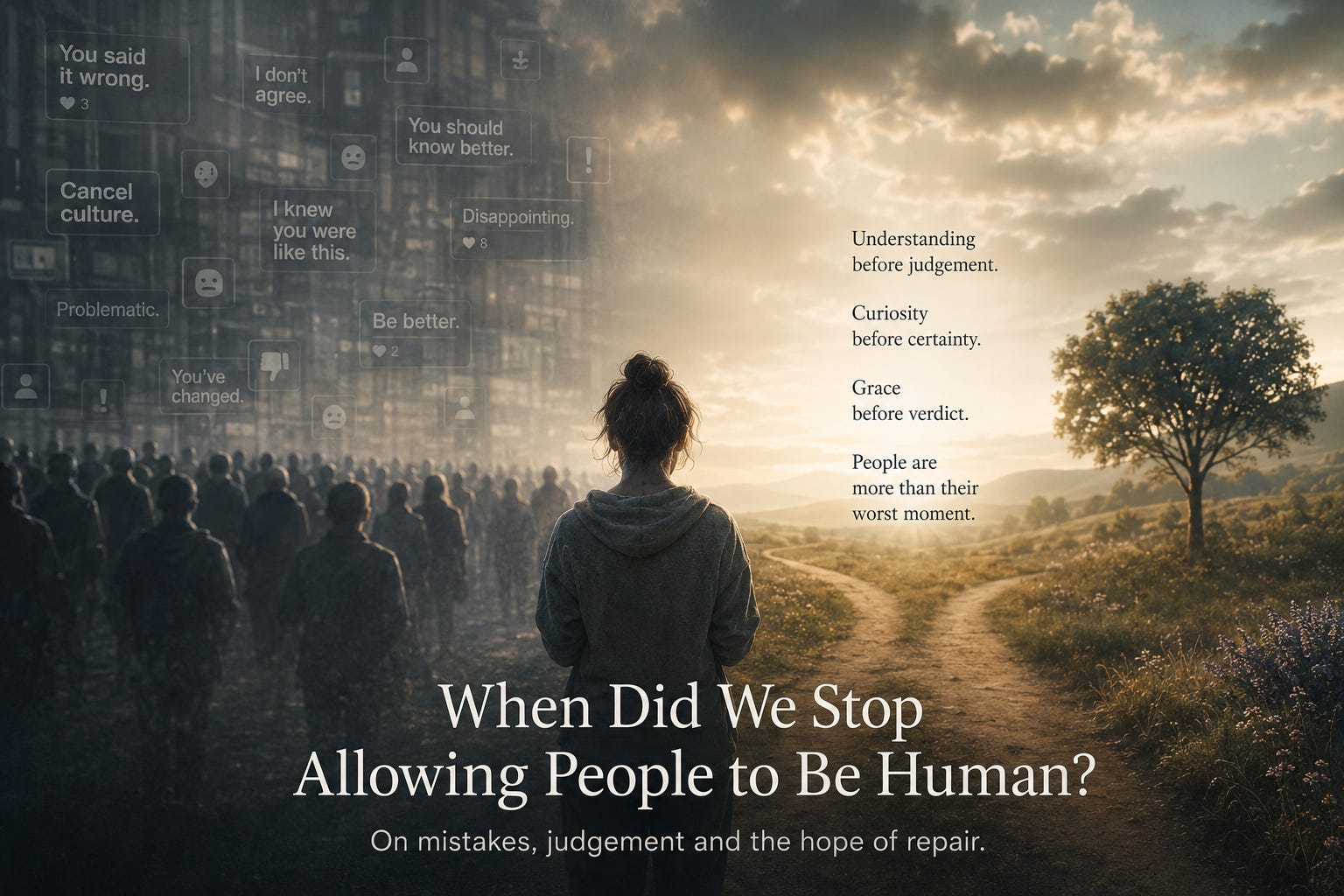
When did we stop allowing people to be human?
And perhaps an equally important one.
How do we begin allowing one another to be human again?
Perhaps becoming psychologically healthier isn't only about learning to tolerate our own imperfections. Perhaps it's also about creating relationships, workplaces and communities where imperfection no longer threatens belonging.
If this essay resonated with you, I'd love to hear your thoughts in the comments. I'm still thinking these ideas through, and I'd be interested to know what you've noticed too.
About the author
Becky Grace Irwing is a UK CBT psychotherapist, EMDR therapist, Registered Mental Health Nurse and writer exploring the intersection of psychology, culture and modern life. Her work examines why so many of today’s psychological struggles may be understandable adaptations to the environments we live in, and how we can move towards lives grounded in authenticity rather than constant evaluation.
If you enjoyed this essay, you can subscribe for future reflections on psychology, culture and The Good Person Trap.
Comments
Nothing yet. Say the first thing.
Sign in to join the conversation.