
In my last post, I introduced The Good Person Trap™ as a working framework exploring what happens when goodness becomes psychologically fused with safety, belonging and identity.
The more I sit with these ideas, the more I realise I’m not especially interested in “goodness” in a simplistic sense. I’m much more interested in the psychological function morality can begin to serve for certain people, particularly people who are thoughtful, conscientious, emotionally attuned or highly aware of other people.
One of the things I keep noticing is that morality itself is strangely absent from a lot of mental health conversations, despite the fact it quietly sits underneath so much human behaviour.
We talk about anxiety, trauma, perfectionism, burnout, attachment, OCD, eating disorders and people pleasing. But we often don’t talk directly about the fear many people carry of becoming bad.
Not bad in some extreme criminal sense necessarily. More the quieter, socially painful fears of being selfish, difficult, irresponsible, emotionally overwhelming, disappointing or somehow no longer acceptable to other people.
I think for some people, life gradually becomes organised around avoiding those possibilities at all costs.
Over the years, I kept noticing a similar emotional atmosphere across very different people with a familiar underlying tension. People who looked highly capable externally whilst privately feeling exhausted from constantly monitoring themselves. People who seemed to carry enormous pressure to remain emotionally safe for others.
I recognised parts of this in myself too.
I was always “the good girl” at school. The academically high-achieving one. The responsible one. The one who behaved properly, worked hard and achieved highly.
Of course there’s nothing inherently wrong with achievement or conscientiousness. But when you are repeatedly rewarded for being emotionally contained, capable, compliant and successful, those qualities can slowly start becoming psychologically fused with identity.
I began to experience goodness not simply as a value, but as something connected to approval, safety and belonging. Over time, it can become difficult to separate who I was from who I learned I needed to be in order to stay loved, praised or accepted.
I think many high-achieving people quietly carry this dynamic. The achievement itself often isn’t the problem. It’s the emotional meaning underneath it.
The feeling that mistakes are dangerous. That disappointing people carries enormous emotional weight. That rest must be earned. That being useful, easy and emotionally manageable is what keeps relationships stable.
I can also see this pattern very clearly when I look back at my own eating disorder and addiction history.
My eating disorder started around 15 or 16, which is a very typical age of onset. Looking back now, I think it developed inside the late 90s early 00s culture that heavily rewarded thinness as morally “good” and treated fatness as something shameful, lazy, disgusting or morally failed. Although we have somewhat returned to that place again in culture with Ozempic, GLPs and thinness at all costs.

It wasn’t only about appearance.
Thinness became psychologically associated with being disciplined, acceptable, admired, controlled and worthy. Underneath that sat the fear of becoming the opposite. Undesirable. Unacceptable. Out of control. Not good enough.
I think this is partly why morality feels so important within eating disorder conversations, even though we don’t often explicitly talk about it that way.
Food becomes moralised.
Bodies become moralised.
Self-control becomes moralised.
You start feeling as though your worth as a human being is constantly being assessed through appetite, body size, discipline and restraint.
At the same time, my codeine addiction started around 16 and continued until I was 26. Ten years. I think addiction complicated my relationship with morality even further, because addiction carries enormous shame culturally, particularly for people who strongly identify with being competent, responsible or “good.”
I think one of the most psychologically painful parts is often the split between external identity and internal experience.
Someone can appear highly functioning externally whilst privately struggling, suffering or relying on something to cope. That creates enormous shame because it disrupts the identity the person has built around themselves.
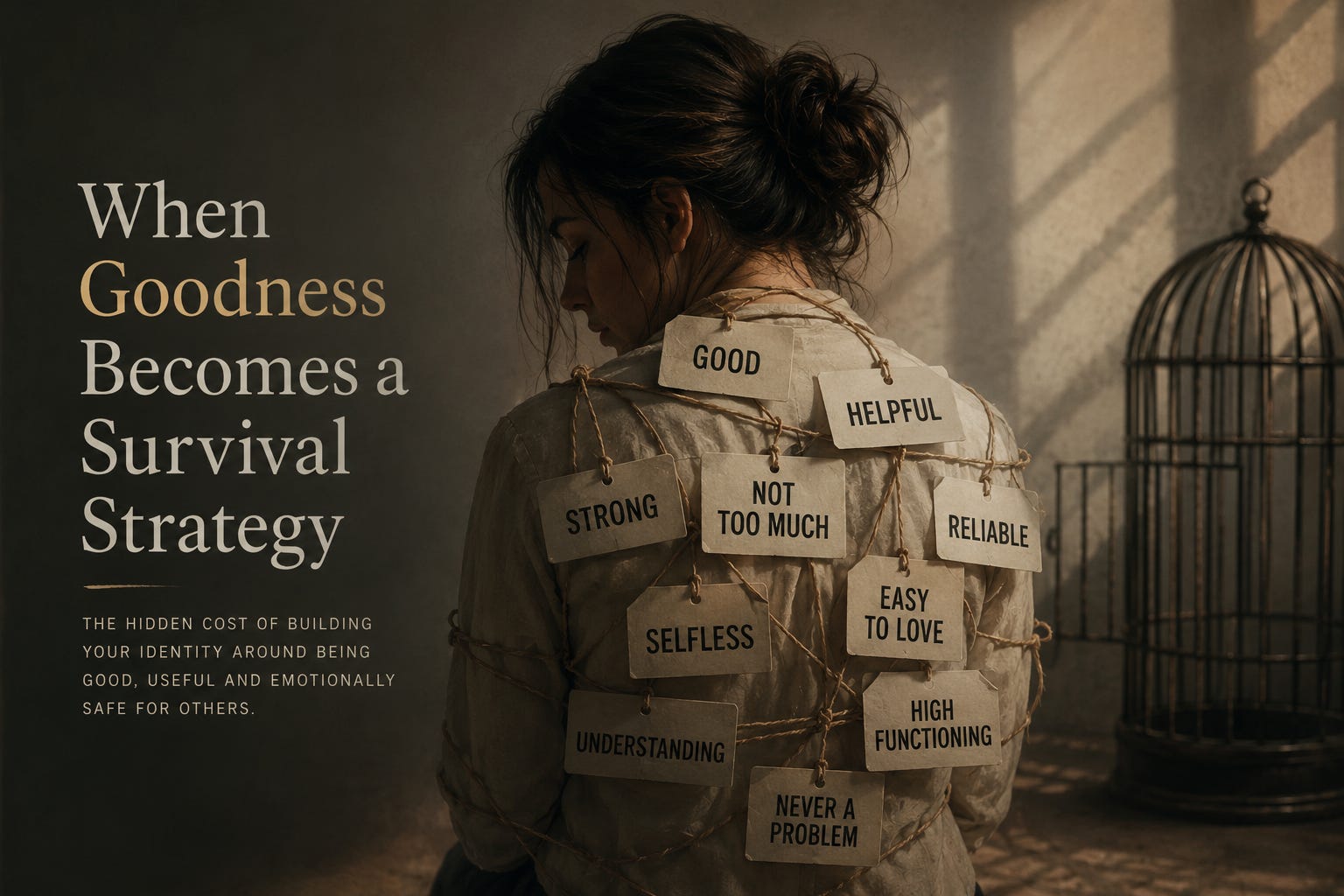
The good person.
The disciplined person.
The caring person.
The high-functioning person.
Both my eating disorder and addiction are now fully recovered, but I think those experiences fundamentally shaped the way I understand shame, survival and identity. Likely this is why I am able to write this now that the experience is integrated within me. The way human beings can become trapped inside versions of themselves that initially helped them survive, but eventually started costing them their freedom.
I think many people learn very early on that certain parts of themselves create risk.
Anger might threaten attachment. Neediness might risk rejection. Difference might invite humiliation. Failure might threaten approval or belonging. So adaptation begins quietly.
Someone becomes highly emotionally attuned because unpredictability once felt unsafe. Someone becomes exceptionally competent because usefulness becomes protective. Someone learns how to suppress emotion because visibility once carried consequences. Someone becomes agreeable because conflict feels dangerous to their nervous system.
Over time, these adaptations can become so integrated into identity that the person no longer experiences them as adaptations at all. They simply experience them as personality.
“I’m just a caring person.”
“I’m just driven.”
“I’m just sensitive.”
“I’m just hard on myself.”
But I’m not always sure that’s entirely true.
I think many people who describe themselves as perfectionists, people pleasers, chronic carers or “high functioning” have spent years building identities organised around maintaining psychological safety.
Not consciously, necessarily. More as an accumulation of small learnings over time about what protects belonging, reduces shame and keeps the self feeling acceptable. Society often rewards these patterns, many people never stop to question them.
Schools reward the child who causes no disruption and achieves highly. Workplaces reward over-functioning and emotional self-sacrifice. Healthcare systems often reward the people who push through exhaustion quietly. Families can become emotionally organised around the person who appears the most capable.
I think this comes up professionally far more than we openly acknowledge.
Mental health services often quietly reward the therapist, nurse or healthcare professional who keeps going no matter what. The person who absorbs emotional pressure without visibly collapsing. The person who is endlessly available, endlessly caring and endlessly self-sacrificing.
The fitness industry can reward relentless optimisation, discipline and self-control. Corporate environments often reward over-performance and emotional suppression whilst calling it resilience.
The people most praised are often the people best able to override themselves. As these adaptations are socially reinforced, many people never stop to question them. They simply become: who you are, how you relate, how you survive, how you stay acceptable.
I think this is partly why burnout can feel so psychologically destabilising for some people. It’s not simply exhaustion. It’s the collapse of an identity that has often been carrying safety, belonging and self-worth for years.
If someone has spent most of their life organising themselves around being dependable, emotionally contained and highly capable, what happens when the nervous system can no longer sustain that position?
For many people, exhaustion quickly becomes shame.
Not only because they can no longer function in the same way, but something much deeper underneath starts feeling unstable too. I do truly think the internet and social media have intensified these dynamics enormously.
We now live in a culture of near-constant visibility and moral observation. Everything can be seen, interpreted, screenshotted and publicly judged.
People are no longer simply trying to be good in a relational sense. Increasingly, people feel pressure to appear morally safe at all times.
To have the correct opinions.
The correct language.
The correct emotional reactions.
The correct politics.
The correct public identity.
I think this is psychologically exhausting for many people, particularly people already vulnerable to shame, hypervigilance and over-responsibility.
There is very little room left for contradiction, uncertainty or ordinary human imperfection. I also think AI is beginning to intensify some of these pressures in ways we don’t fully understand yet.
Partly because AI increasingly rewards optimisation, productivity and performance, but also because it risks deepening the sense many people already carry that they are constantly being evaluated.
Measured.
Observed.
Compared.
Assessed.
I think many people already move through the world carrying quiet internal questions like:
Am I good enough?
Careful enough?
Useful enough?
Safe enough?
Self-aware enough?
When someone’s nervous system is already organised around trying to avoid shame, rejection or moral failure, that kind of environment can quietly become unbearable.
The more I think about it, the more I suspect many people are not simply exhausted from doing too much. They are exhausted from maintaining identities that no longer leave enough room to be human.
The more I sit with this work, the more I think healing often involves recognising that survival strategies are not the same thing as identity.
A person can be caring without disappearing.
Competent without over-functioning.
Thoughtful without chronic self-surveillance.
Kind without organising their entire worth around never disappointing anybody.
But for many people, loosening those patterns initially feels frightening rather than freeing. If goodness has become psychologically linked with safety, then stepping outside those roles can feel genuinely dangerous to the nervous system.
I think that’s part of why these patterns can be so difficult to change, even when they are visibly exhausting somebody.
Because underneath the behaviour there is often a much deeper fear quietly organising the entire system:
Who am I if I stop being the person who keeps everything emotionally safe?
Becky
Becky Grace is a BABCP-accredited CBT therapist, EMDR therapist, Registered Mental Health Nurse, writer and educator specialising in trauma, eating disorders, OCD and neurodivergence.
She is the creator of The Good Person Trap™ framework - an evolving body of work exploring morality, burnout, perfectionism, masking and the psychological pressure to be “good” at all costs.
Alongside over 15 years working across NHS mental health services, higher education and private practice, Becky also brings lived experience of eating disorder recovery, addiction recovery, burnout and late-diagnosed neurodivergence into her work and writing.
Based in Norwich, UK, Becky works with adults through therapy, EMDR intensives, workshops and long-form writing.
Alongside her clinical work, Becky also speaks and consults on burnout, psychological safety, emotional labour, neurodivergence and the hidden costs of high-functioning workplace cultures. Organisations interested in workshops, consultancy or speaking can connect with her via LinkedIn.
If this essay resonated with you, you can subscribe below for future writing exploring The Good Person Trap™, burnout, eating disorders, OCD, trauma, neurodivergence, morality, identity and modern life.
You’re very welcome here.
Comments
Nothing yet. Say the first thing.
Sign in to join the conversation.