
It’s a hot June day, my phone says it’s 89 degrees. There’s a 9mph wind from the west, but where I am, nestled among the trees, it does little besides kick around the scent of pine and maple. I can hear the patter of water on concrete mingled with the laughter of kids playing on the splash pad. I’d passed them two minutes ago, parents in sunglasses and tank tops stood in the shady ring of trees, watching and gossiping. They’d all ignored me for their conversations and vigils, but I still smiled as I listened to the shrieking joy of kids at play.
I’d taken the slightly uphill path at a fork in the dirt trail I’d been following. The one to the right led to an open field that borders the pickleball and basketball courts. As I stand and stretch my hips and shoulders, I can hear the hollow tokk sound of pickleballs on concrete and cries of despair and jubilation from the competitors. There’s no basketball yet; the teenagers who regularly play pick-up games are probably still asleep, but if not, it’s probably too hot. Once the sun is lower, they’ll surely be out for shirts-and-skins.
I check my bag once more. I have my wallet and keys, a bottle of Gatorade for calories and hydration, and my epi-pen, incase I run afoul of any bees on the trail. Seeing the pen, I unconsciously adjust my emergency medical bracelet—a dorky precaution to be sure—but I like the tightness of the rubber straps: I can feel tiny flexions in my wrist I otherwise wouldn’t. It might be superstition, but it makes me feel more confident whenever I’m doing anything remotely athletic, and mindset is more than half the battle when it comes to sports (or anything, really).
The most important contents, though, are five plastic discs, the implements for the game I’m about to play. I’m playing disc golf, and today, you’re coming with me.
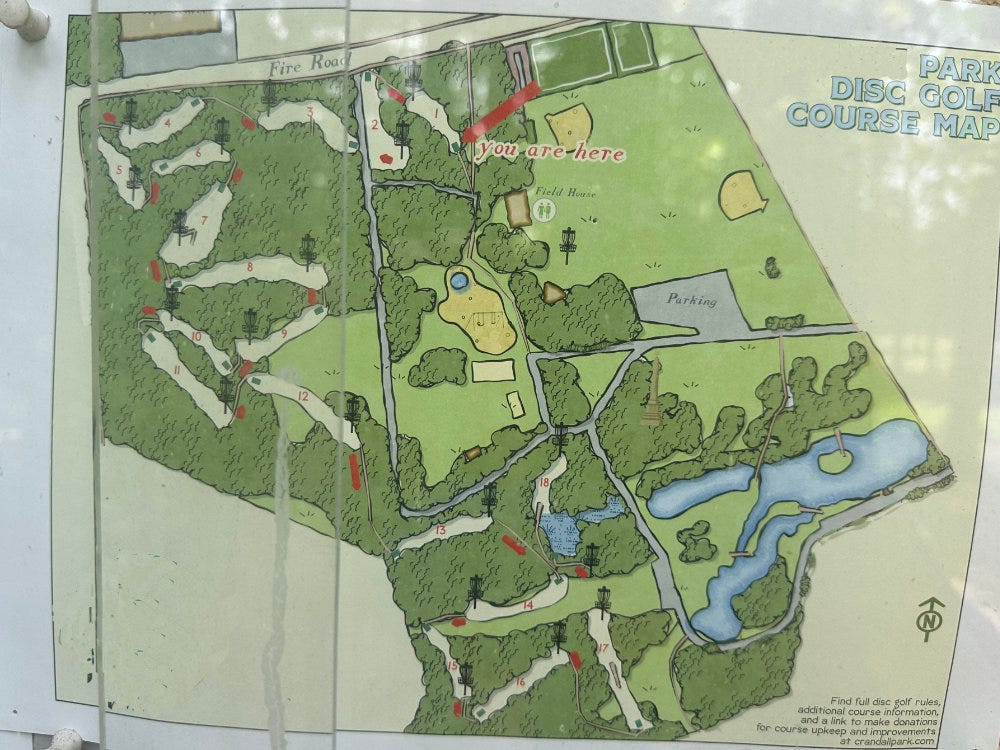
You’re probably familiar with the sport commonly known as golf, with little white dimpled balls and long metal clubs. The object is to get the tiny ball into a slightly larger cup in a target number of strokes called par; the object of the game is to play in the fewest number of strokes. Disc golf is fairly similar in concept, except instead of balls you use discs (sometimes called frisbees, but that’s technically a brand name and therefore frowned upon); instead of clubs you use your arms, and instead of cups you throw your discs into baskets with a sort of chained webbing in order to score.
I grew up playing ball golf with my dad, and enjoy the game, despite not being very good at it. But, it’s an expensive sport and does have questionable environmental impacts (golf takes up a lot of land and a LOT of water). But mostly my trouble with golf is the time it takes to play a round—about three and a half hours. Disc golf is unencumbered by these drawbacks and is so a game of choice for me…despite me not being very good at it.
Disc golf discs come in different varieties with different characteristics intended for specific kinds of throws, just like there are different kinds of golf clubs designed to give you more height (like a wedge) or more distance (like a driver). In fact, discs come in categories loosely similar: putter, midrange, fairway drivers, and distance drivers. These categories have different “flight numbers” that describe how they move through the air, but I’m not going to get into the physics here; it’s too technical and overwhelming for our casual round today.
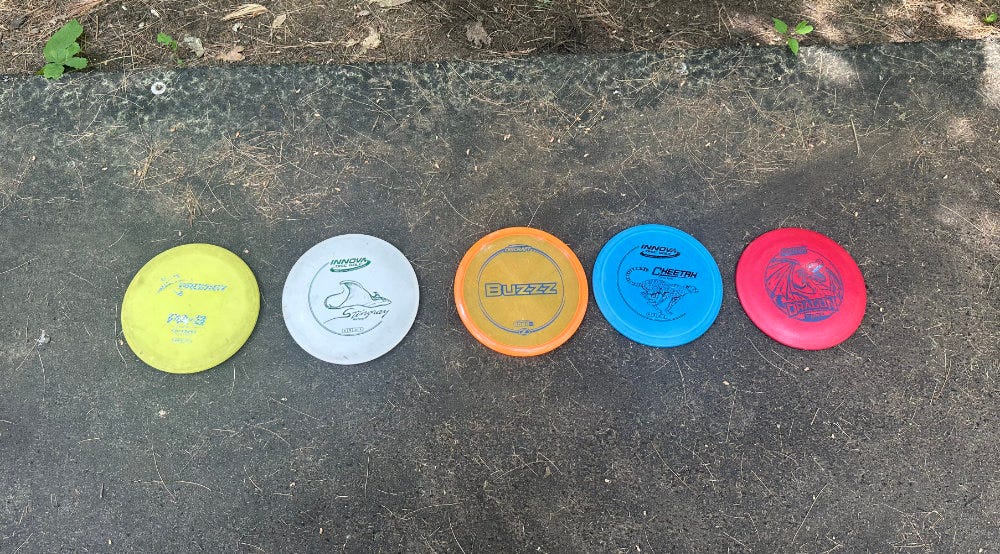
Instead, I’ll just say I brought 5 discs with me today: a Prodigy PA3 putter, an Innova Stingray midrange disc, a Disccraft Buzzz midrange (a heavier option that curves a little), an Innova Cheetah fairway driver, and an Innova Dragon fairway driver. My course is wooded and plays very short, so we need accuracy more than we need distance, and I’m comfortable with these 5 discs. Remember to write your phone number on the back of them; usually players will contact you to return a lost disc!
Alright! Stretch and take a sip. We’re ready for takeoff.
Quick note: I’ve put my round score next to the hole number so you can keep track of my overall progress. Many times I don’t keep score when I play because not worrying about it helps you feel like you play better, but I’m putting pressure on myself today for you, readers.
Hole one is a gentle introduction. There are a few thin trees in the way, but a lightly thrown disc can pass them before curving to the right. I actually feel pretty comfortable throwing a putter on this hole (you could play an entire game using only a putter if you wanted; labels like “putter” and “driver” are more general descriptions of flight capability than prescriptive use!). I like to attempt a couple practice throws if other players aren’t waiting, so my body can warm up and get used to a throwing motion. Sometimes I will throw two discs and then play from the best spot—I’m not very good and that’s a great way to practice and try out new techniques or discs. Today, I sling the Buzzz out using a “starting-the-lawnmower” type motion and watch it thok into the the tree on the right before pulling out my PA3 putter for an honest shot.
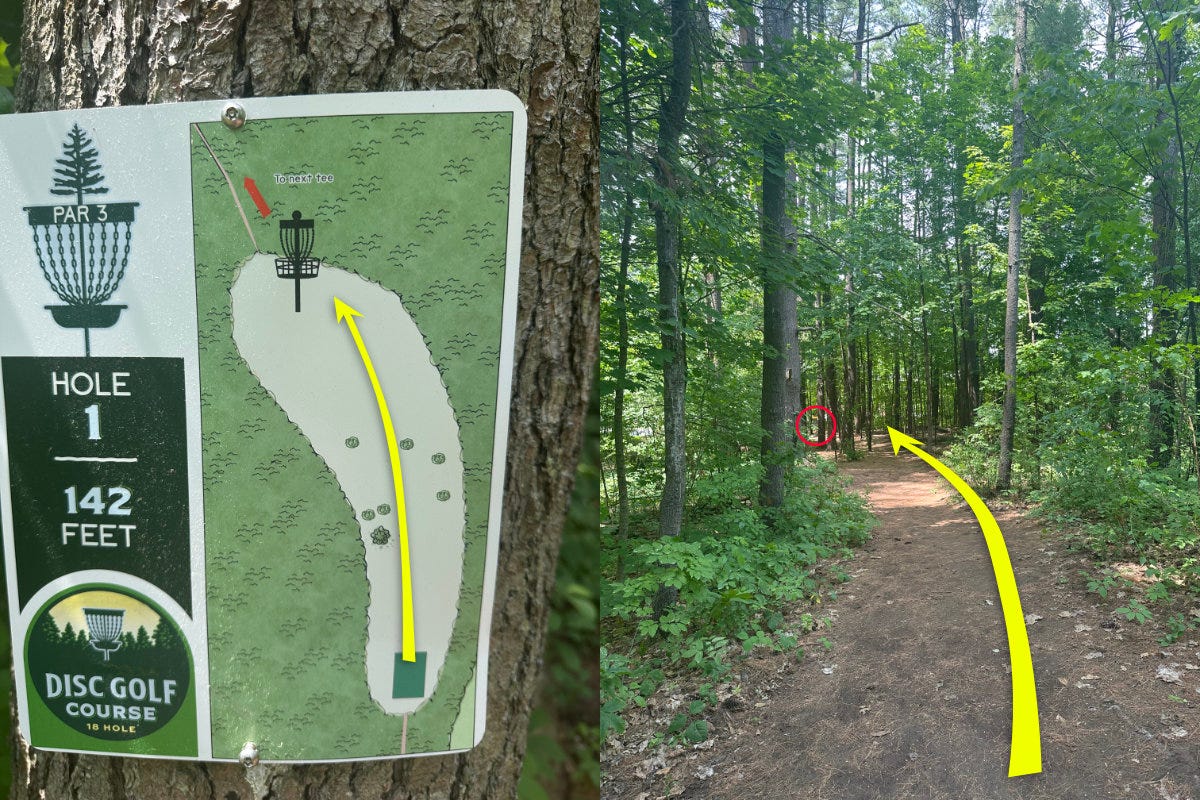
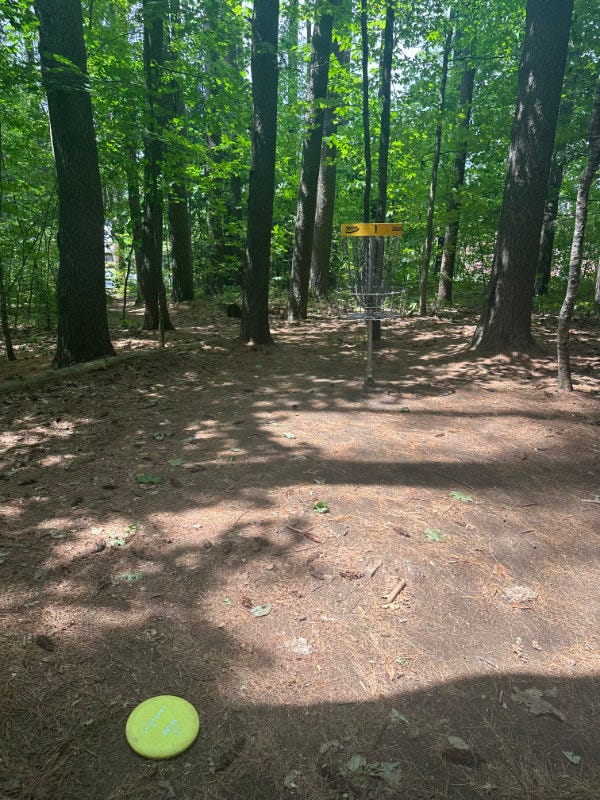
It’s a pretty good throw! Clears the thin tree on the right and arcs around the trio of trees on the left. It’s a little shot of the basket, but an easy 12 foot putt for a birdie. Starting the round off 1 under par is such a confidence boost!
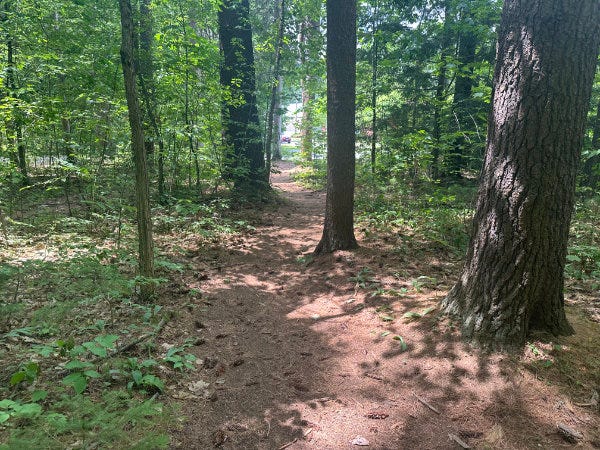
After the ease of the first hole, the second of the bunch brings you back to reality. You have a narrow tunnel of trees that feels like throwing down a hallway. To the left is a thicket of saplings, and on the right, there’s a road leading to the parking area. It’s not heavily trafficked, thankfully, but still, you don’t want a disc to land out there where it might be cracked by a passing car.
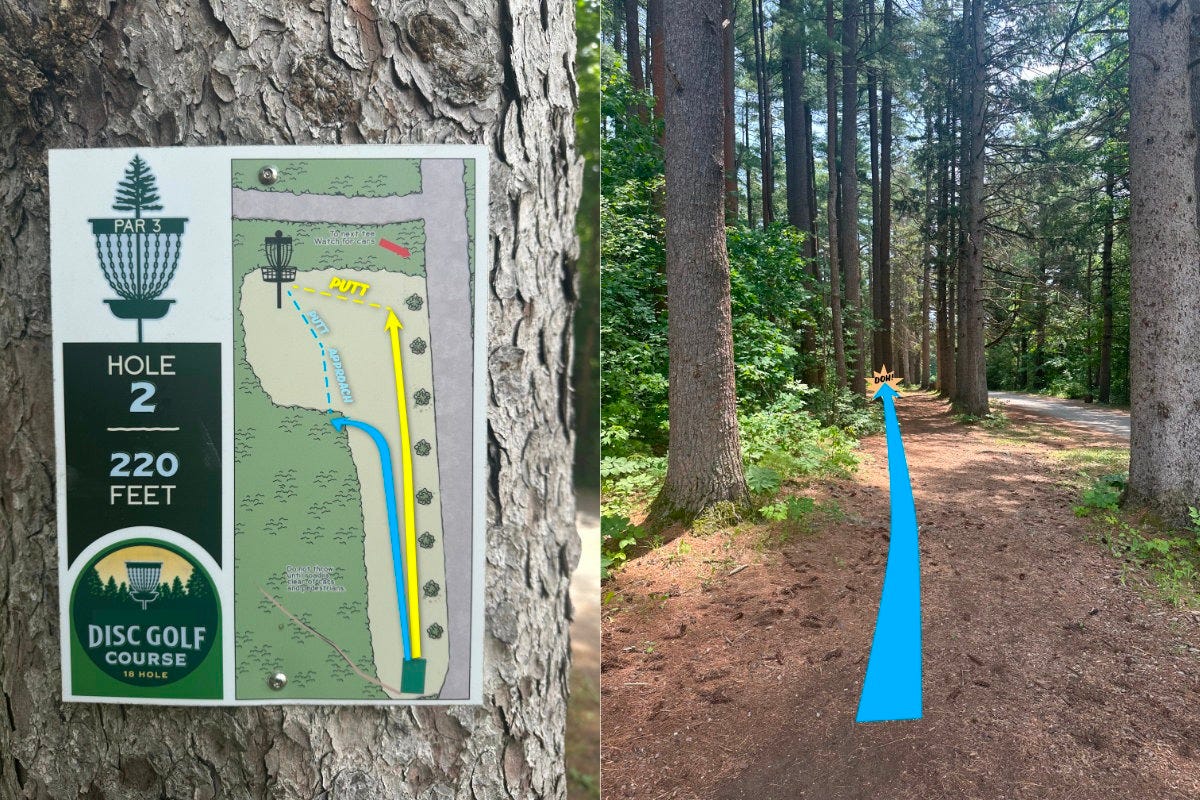
My usual plan is throw a straight shot out about 180 feet and set myself up for a medium putt. This plan has only worked once in a few dozen rounds, because as a relative beginner my disc moves slowly and is prone to arcing to the left. The map doesn’t show them, but you can see in the photo, there is a group of trees standing guard on the basket’s right side. I ended up in the thick vines there.
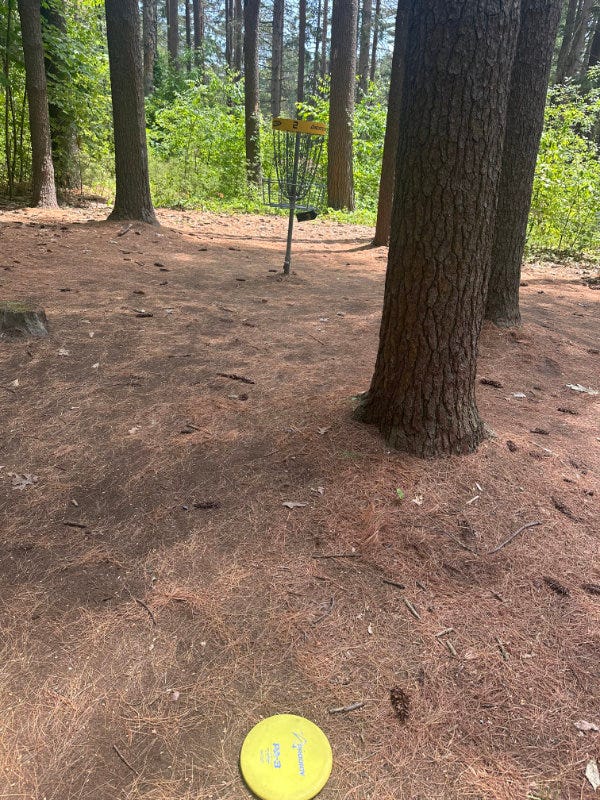
When stuck in situations like this, I make use of an overhand throw called a “tomahawk” —so named because of its hatchet-like throwing motion. It’s a good way to lob your discs up and over bushes and get it out into a clearing. I ended up near a tree, but it was a short 15 feet or so to save my par on the hole
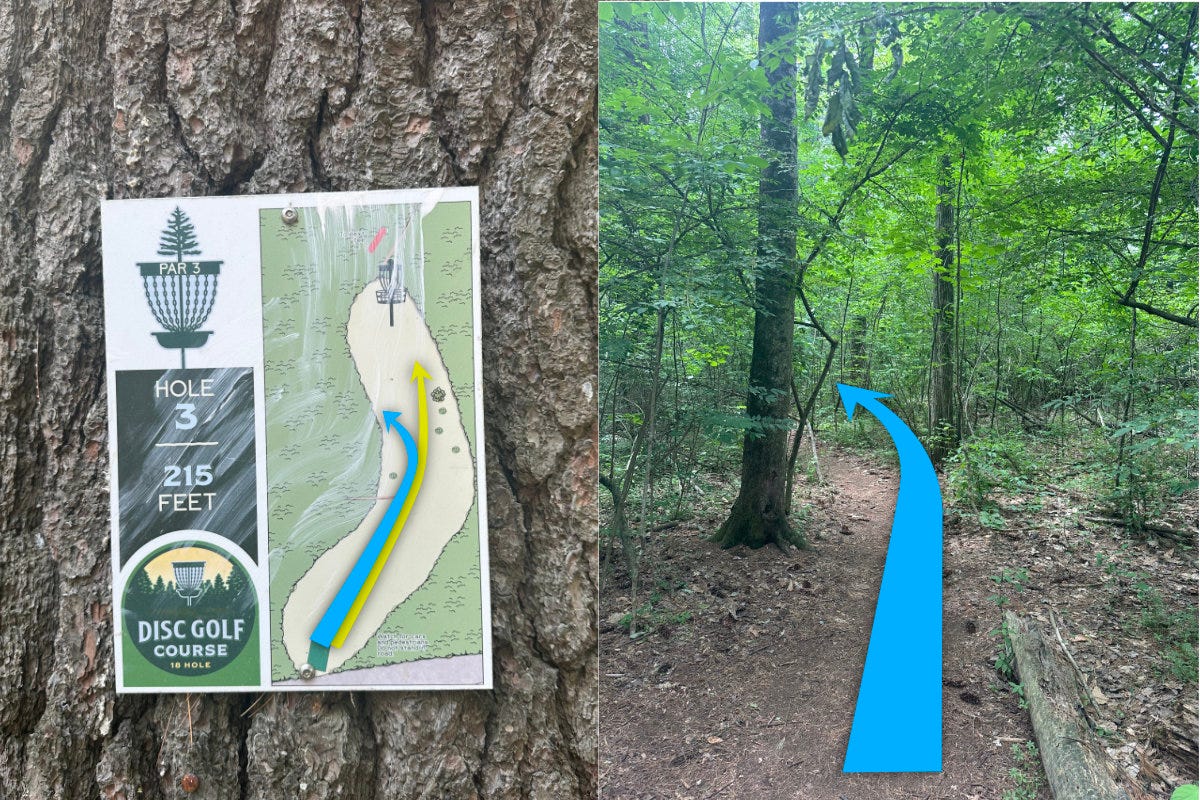
I think of hole three as a “boomerang” hole. From the teebox, it’s a pretty extreme leftward curve (in golf parlance, we call this a “dogleg”), but if you can bend your shot around the trees midway to the basket, you’ll be rewarded with a decent birdie attempt.
Unfortunately, I hugged a little to close to the left side with my tee shot, and clipped a tree. I left my shot in a small snag of saplings. No trouble to layup with another tomahawk. I should have thrown that a little harder, because I left myself with a long putt for par. It’s a shot that’s no sweat for more experienced players, but I lose confidence in my putting at about 25 feet—and this is about a 30 foot shot.
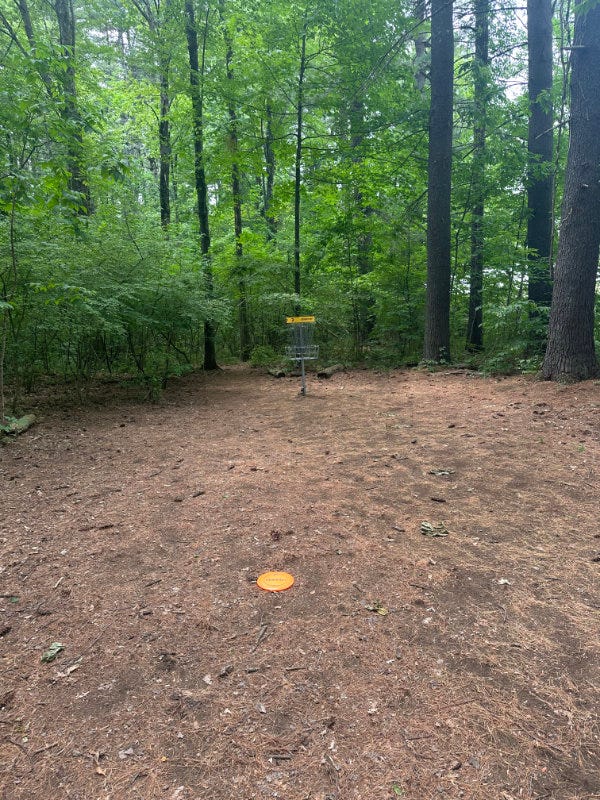
I held on for par though!
This is a dastardly hole. For an inexperienced righty like me, it’s hard to curve conventional backhand shots to the right, and hole four is set up to bend that way. I could try a forehand shot which will curve right, but it’s one of my least consistent shots, especially if I’m looking for distance, so I usually only keep it for approaches. My usual strategy is to thread the trees on the right like a needle so I can set up a long put or a short layup. Once, I threw a miracle shot through the thicket on the right and parked my tee shot about 6 feet from the pin for a birdie.
Attempts to replicate this shot have resulted in “hilarious” treks to the underbrush.
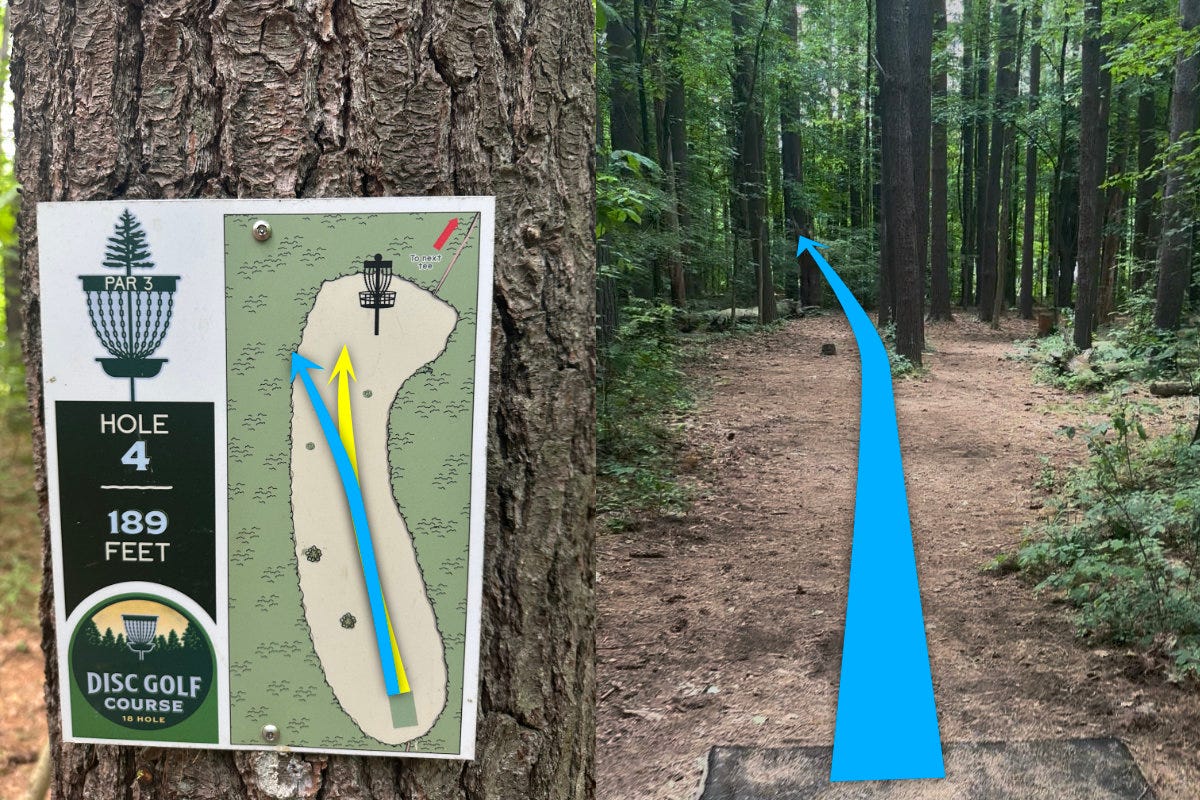
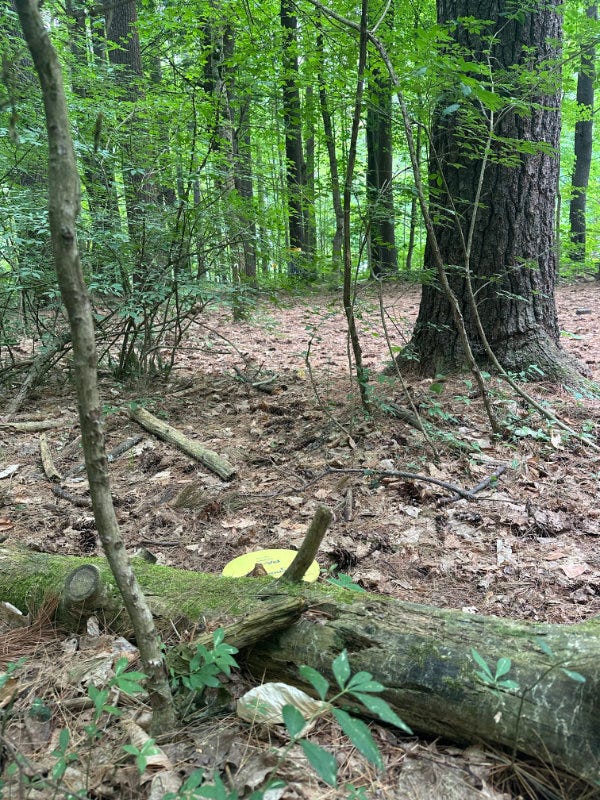
I got good distance on my drive, but ended up in the rough on the left. A lobbed tomahawk put me in good position for par save.
After the gauntlet of 4, five is a nice breather. There are a few trees to worry about here, but for the most part, it’s a forgiving fairway so you can let your discs rip. I feel pretty good using a fairway driver here and set up accordingly.
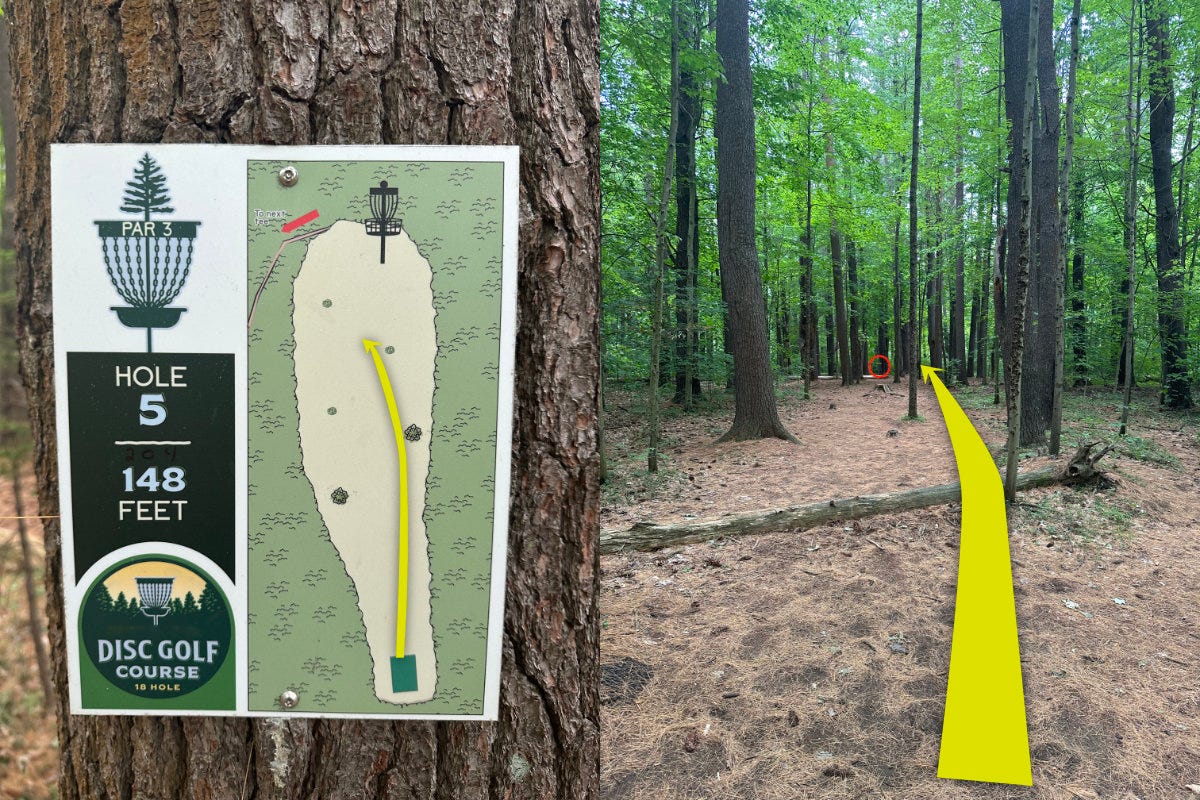
There’s a running path beyond the trees behind the teebox, and as I let my tee shot go, I heard someone yell “oh yeah, get it!” A jogger wearing a weighted vest flashed me a thumbs up. It was a pretty good throw—thanks Mr. Jogger! It was still about 30 feet short of the pin. Almost made a birdie, but had to settle for par
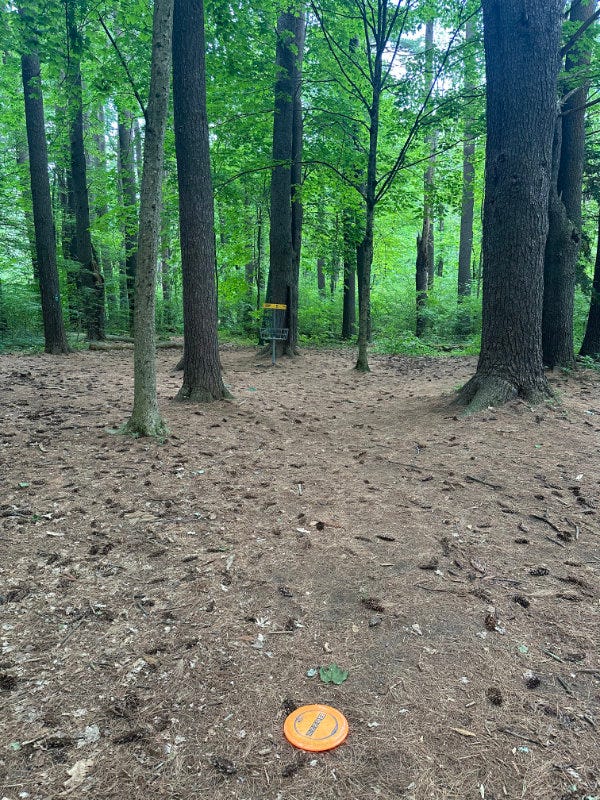
.
Like hole 4, this is another pin that’s set to the right of the teebox. I know I said I’m not good at shaping a rightward bend, but I like this hole for practicing one. There’s a technique called “anhyzer” where you tilt your wrist towards you a bit so the top of your disc points towards your chest. When thrown this way, the disc will want to bank to the right as it flies. Because of the way hole 6 is set up, though, if I fail to make this flight path work and my shot takes its normal left-breaking path, I’ll still be able to work my way back to the pin.
Like ball golf, disc golf is all about knowing your idiosyncrasies and managing risk based on them; once you realize this, the game becomes more of a meditation than a sport.
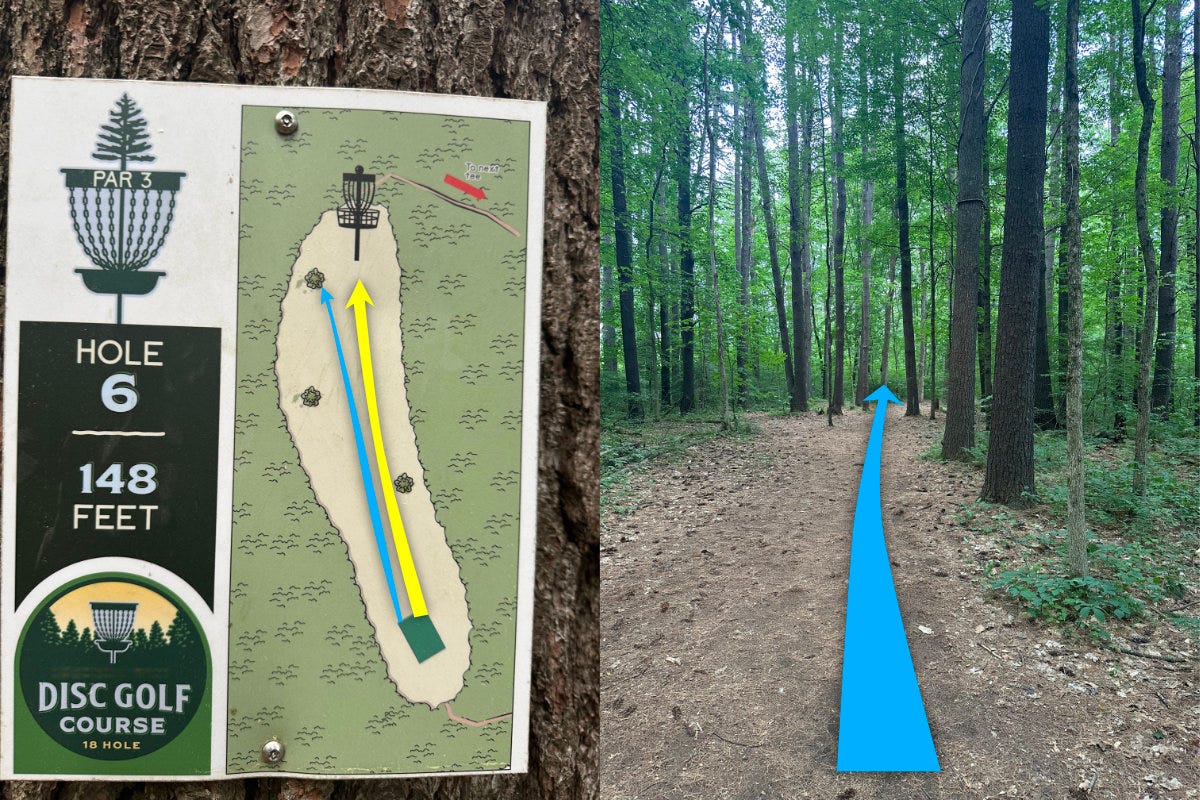
I had a pretty good tee shot, I released a little too far to the right of where I should’ve. My shot glanced off the tree we wanted to swerve around and kicked my disc to the left. It put my shot in line with the basket, but I had a sapling to contend with at my feet. This was a makeable putt for me, but I kept thinking about ticks as I took my shot, and so had to settle for another par.
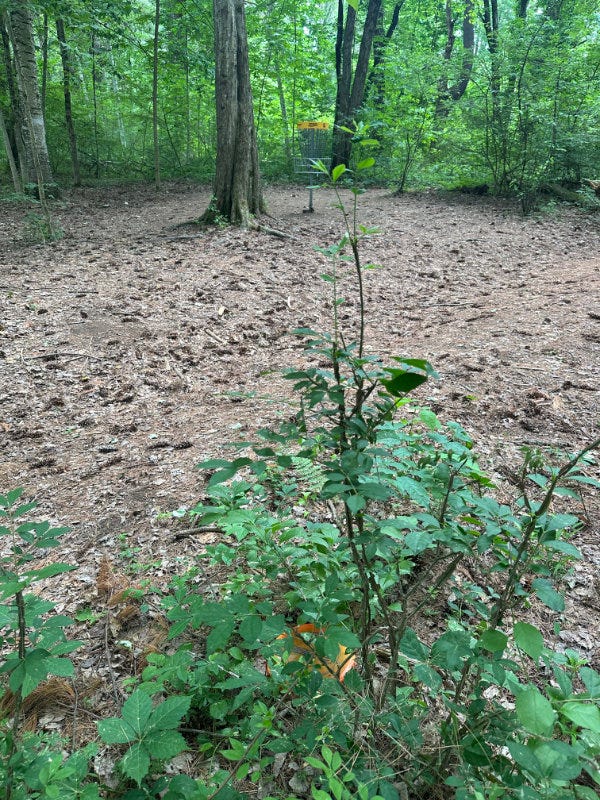
Hole 7 is an interesting one: it has two possible pin locations! As the course shares part of its path with the park’s trail system, sometimes the pin will move based on the parks service’s work. In the fall, I believe the back part of this hole is used to pile leaves and other detritus, so the pin is moved to the closer A position. Today, though, we’re playing for the longer B pin.
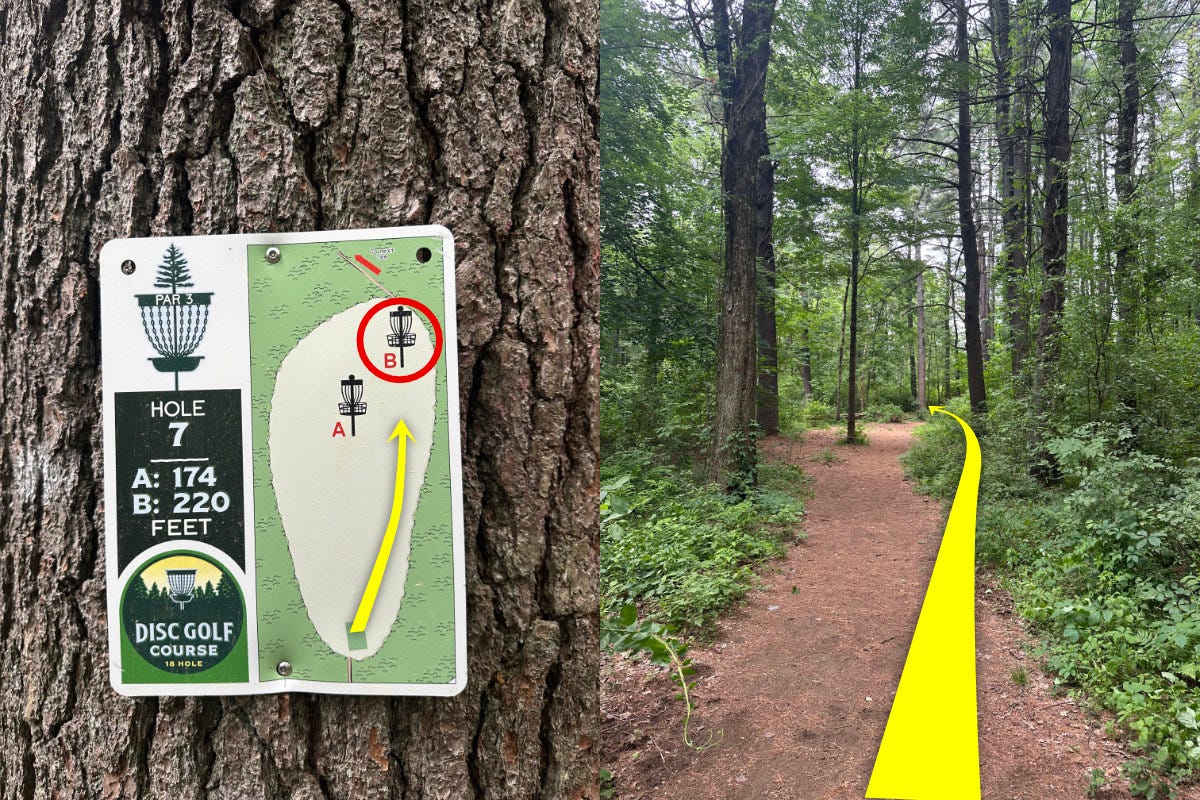
There are a couple of big trees in the middle of the fairway here to play around, as well as a fallen log about three-quarters of the way to our goal. I like to try to fly the fallen log and then work back to the pin on the right; the bushes to the left are incredibly thick and looking for discs in there is annoying. I thought about using a fairway driver here, but I prefer the confidence I have with my midranges, so I threw the Stingray on a line to the right. I think I threw it with its nose up a little because its flight stalled a little before my target log. Not a bad line, but I’m about 70 feet from the pin still.
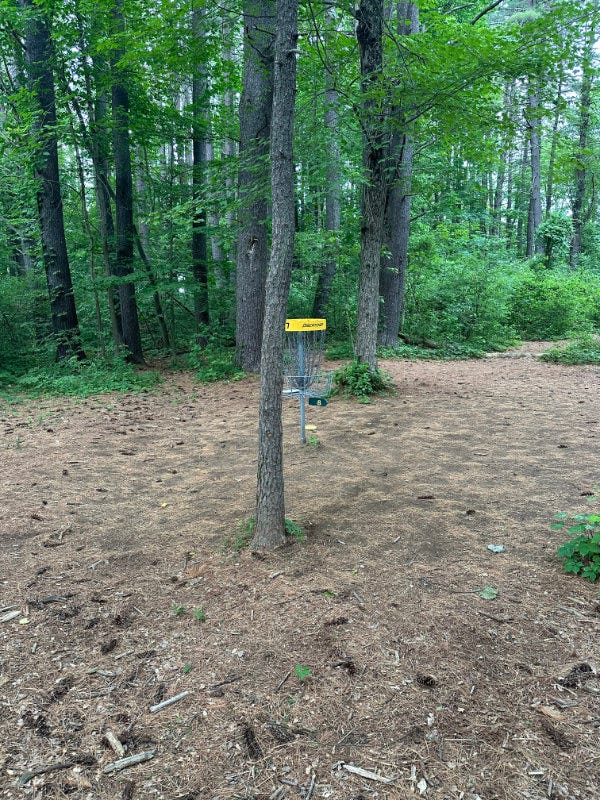
I put a little too much speed in my approach and sailed passed the pin by about 15 feet…but it was enough to keep par!
This hole is probably my least favorite on the front. It plays long, and the underbrush on the right eats discs—I have lost a few over there, never to be seen again. The brush on the left is annoying too, but I’d rather throw out of it than the other side. That said, because my fairway drivers tend to curve to the left, I launch towards 1 o’clock so I can take my second throw from the left of the clearing.
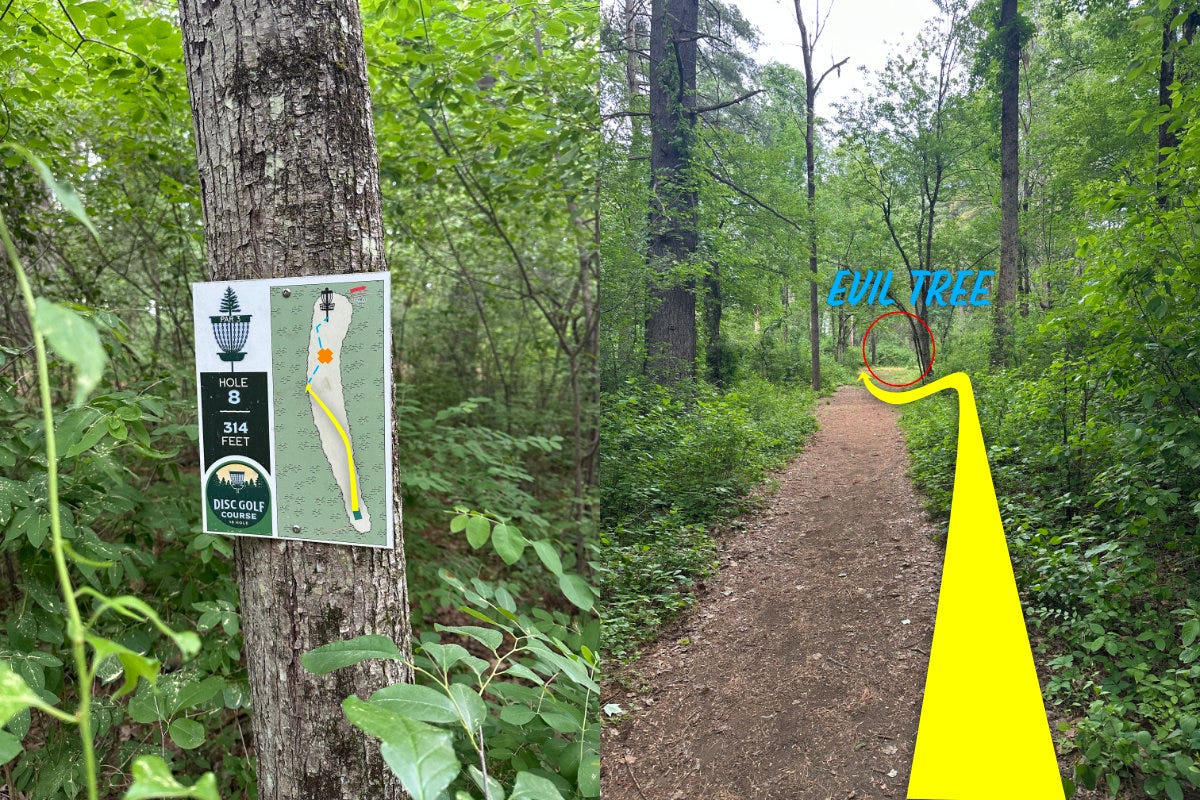
I had a good angle, but I think I gave my shot a little too much altitude; I left myself with a 130 foot approach or so. Honestly, not terrible, all I need to do is miss the 4-inch-wide bendy tree in the center of the path. Naturally…I hit the 4-inch-wide bendy tree in the center of the path.
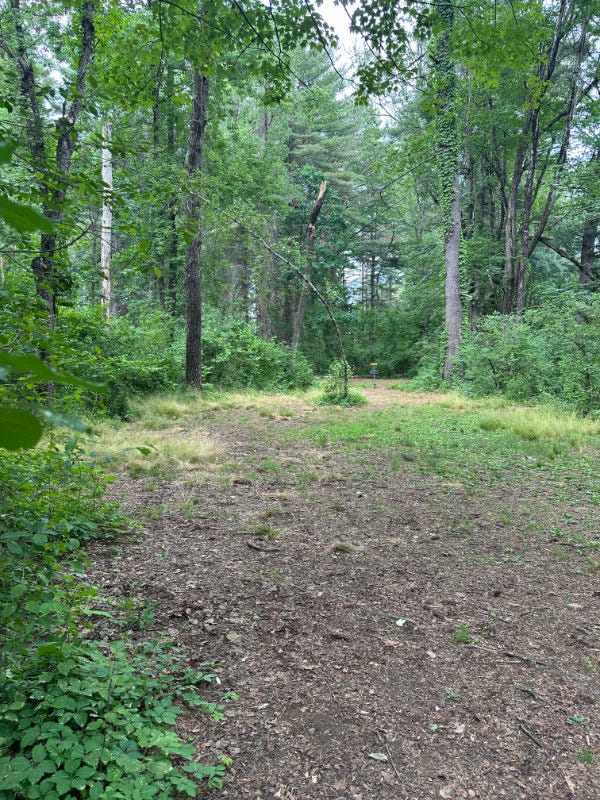
It was still about 80 feet or so from the pin, and I’ve only made one putt over 60 feet ever (ironically, on this very hole), but I would not today.
Bogey. Bummer.
This is a fun hole because most of the fairway is open field—aside from the trees to immediately to the left and right of the teebox, you have a lot of room to work with. Brush on the right is a pretty thick hazard, but aiming my shoulder at the bush just in front of the tee makes it a non-issue.
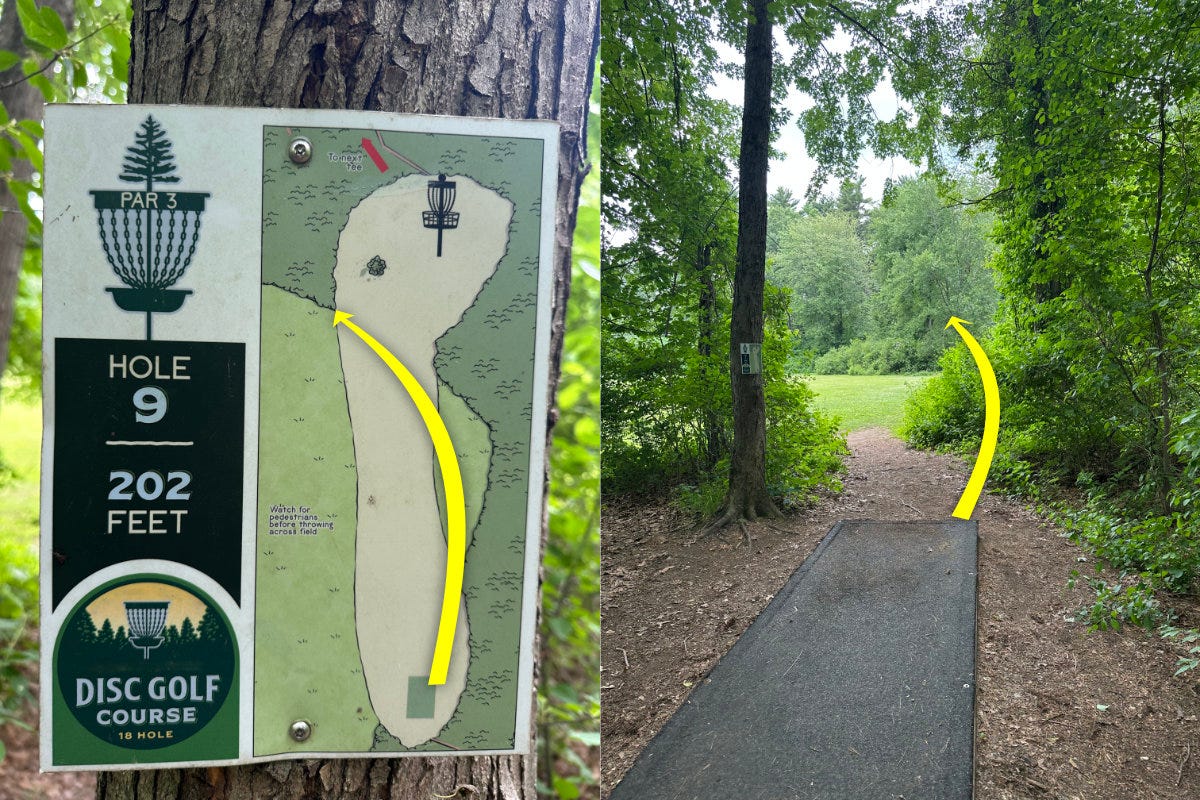
I threw a pretty good drive that put me on line with the pin! But there’s actually a 5-foot tall bush that obscures the pin. A trusty tomahawk throw sets up an easy par to finish the front nine.
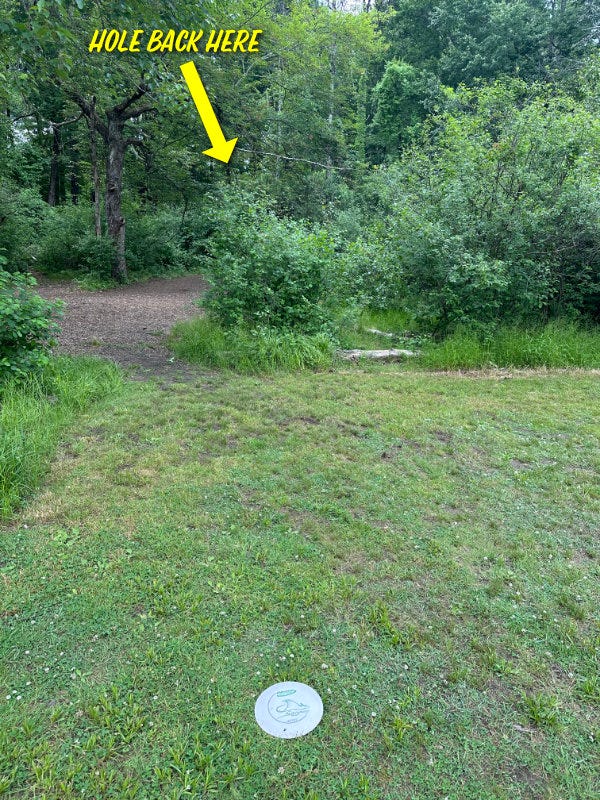
So we’re shooting par through nine! I’m a little rusty on top of not being that good to begin with, but I’m happy with my progress so far. We’ll take a break here (hydrate!) while I mark up my photos of the back nine—incidentally, my favorite half of the course. I’ll try to get it to you in the next day or two. Stay tuned!
No posts
Comments
Nothing yet. Say the first thing.
Sign in to join the conversation.